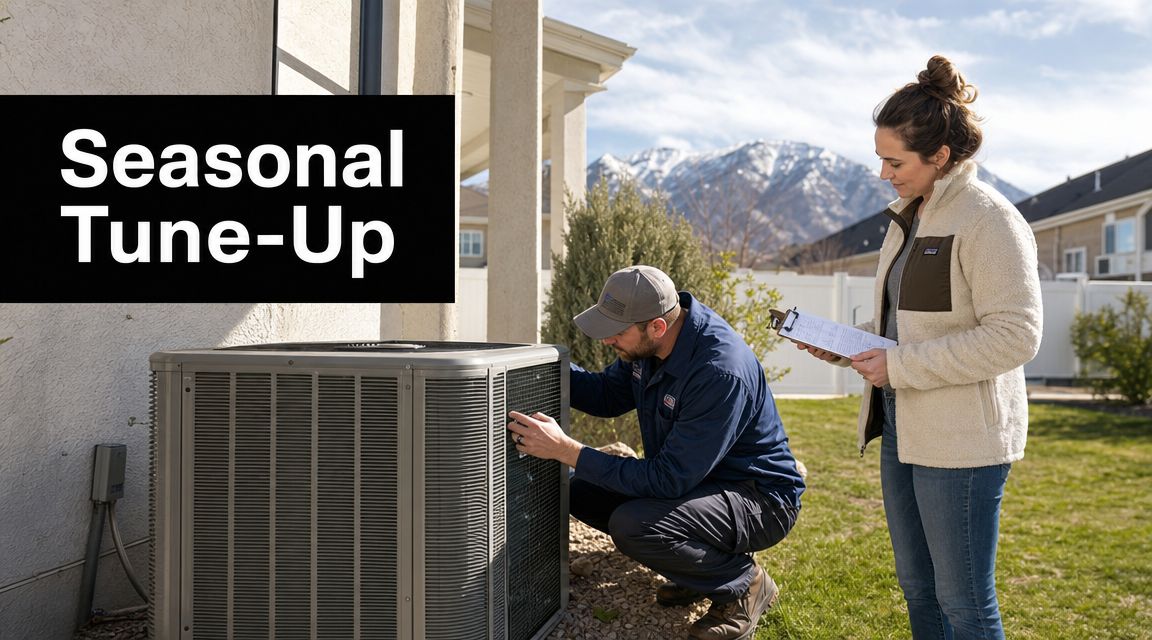
When the Wasatch Front flips from freezing mornings to hot afternoons, your HVAC system doesn't get much of a break. A proper Seasonal HVAC Tune-Up helps you catch the small problems before they turn into a no-heat night in January or a no-cool weekend in July.
Why Timing Your HVAC Tune-Up Matters in Utah
A lot of avoidable HVAC failures in Northern Utah start the same way. The first hard cold snap hits Ogden, Layton, or Salt Lake County, the furnace kicks on after sitting for months, and a weak electrical part finally gives out under load. In summer, the same thing happens when the AC tries to pull through the first real heat wave.

That is why timing matters.
Along the Wasatch Front, the best schedule is usually spring service for cooling and fall service for heating. April or May gives you time to catch AC issues before daily run time jumps. September or October makes sense for furnace service, before freezing mornings expose bad ignitors, failing draft components, loose low-voltage wiring, or breakers that have been running hot.
A standard HVAC visit often focuses on airflow, refrigerant performance, filter condition, and cleaning. Those items matter. But timing also matters because electrical problems tend to stay hidden until the system is asked to start hard and run longer. A capacitor can test weak but still limp along in mild weather. A loose lug, scorched contactor, brittle disconnect, or failing blower motor connection may not show up until the equipment sees real demand.
For most homes, this rhythm works well:
- Spring service for cooling: Schedule it before the hotter stretch, ideally in April or May.
- Fall service for heating: Schedule it before furnace season, usually September or October.
- Heat pumps and dual-purpose systems: Check them before both major operating seasons because they do not get much downtime.
- Older equipment or systems with symptoms: If you have breaker trips, delayed starts, buzzing, short cycling, or lights dimming when the unit starts, schedule service now instead of waiting for the calendar.
Industry guidance commonly recommends twice-yearly preventive maintenance, with one visit before cooling season and one before heating season, and a typical tune-up is often priced around $75 to $200 per visit according to Bryant's HVAC tune-up guidance.
Pre-season scheduling also gives you better odds of finding the right problem before it becomes an emergency call. Once the first extreme week arrives, service calendars fill fast. This pattern is common. The first stretch of real heat or real cold exposes weak capacitors, loose connections, dirty coils, restricted airflow, tired relays, and controls that were barely holding together.
That last part gets missed too often. A tune-up should not stop at cleaning and temperature checks. In Utah homes, I want the electrical side looked at carefully: disconnect condition, breaker behavior, wire terminations, contactors, motor amp draw, capacitor health, grounding, and any signs of heat damage at the equipment. That is the difference between a surface-level visit and a tune-up that reduces risk.
Utah adds its own wear factors. Dust, dry air, long shoulder seasons, and sudden weather swings all put stress on HVAC equipment. Outdoor units collect debris. Furnaces sit idle, then are expected to fire safely on the first cold morning. Evaporative coolers, AC units, and heat pumps all depend on sound electrical connections to start and run reliably.
If you want another practical read on seasonal heating prep, Bear Valley's furnace maintenance guide is a useful example of the same pre-season mindset. Different region, same basic truth. Maintenance works best before demand peaks.
In short, the best time to schedule service is before your system has to prove itself. In Utah, that is not just about comfort or efficiency. It is also about catching the electrical faults that basic HVAC checks can miss, especially in homes where safety and reliability matter more than getting one more season out of a questionable part.
The Homeowner's Pre-Tune-Up Checklist
A good tune-up starts before the technician knocks on the door. Not because you should do professional work yourself, but because a little prep helps uncover issues faster.
Start with the filter
The air filter is still the most commonly ignored item in residential HVAC. If it's clogged, the whole system has to fight for airflow.
According to Carrier's AC tune-up guidance, standard 1-inch filters should generally be inspected or replaced about every 90 days, while 4-inch filters may last 6 to 9 months. Homes with pets or allergies may need monthly checks.
Use that as a practical baseline, then adjust to your home.
- Check the filter size first: Don't guess. The size is printed on the frame.
- Look for visible loading: Gray buildup, pet hair, or collapsed media means it's time.
- Install it in the right direction: Follow the airflow arrow on the filter frame.
- Write the date on the edge: That keeps the next change from becoming a memory game.
A dirty filter doesn't just reduce comfort. It can hide bigger problems by making the whole system look weak.
Clear the path around the equipment
Outdoor condensers need breathing room. If cottonwood, leaves, weeds, or wind-blown debris are packed around the cabinet, airflow drops and service gets harder.
Before the appointment:
- Remove loose debris: Rake out leaves, sticks, and trash near the unit.
- Trim back overgrowth: Keep shrubs and plants from pressing against the coil area.
- Make access easy: Move bins, patio furniture, or stored items away from the equipment.
- Check the disconnect area: Make sure the service panel beside the condenser isn't blocked.
Inside the house, do the same around the furnace or air handler. Clear boxes, paint cans, and storage away from service panels and electrical access points.
Do a quick walk-through indoors
You don't need tools for this. Just pay attention.
- Open supply and return vents: Closed vents can affect airflow and make rooms feel uneven.
- Make note of problem rooms: One hot bedroom or one cold basement corner helps narrow the diagnosis.
- Test the thermostat mode change: Switch between heating, cooling, and fan if the season allows.
- Listen during startup: Buzzing, delayed starts, or rattling are worth mentioning.
What to have ready when service starts
A short list helps more than commonly realized:
| What to note | Why it helps |
|---|---|
| When the problem started | Helps separate long-term wear from recent changes |
| Any breaker trips | Points toward electrical stress or motor issues |
| Rooms with weak airflow | Helps identify duct, blower, or filter-related problems |
| Recent filter changes | Gives context for airflow and coil condition |
| Strange sounds or smells | Often points to a specific component or operating condition |
That prep won't replace a professional inspection. It just clears the clutter so the important diagnostics happen sooner.
Inside a Professional HVAC Tune-Up Checklist
A real tune-up should look like a diagnostic process, not a fast checklist. If someone changes a filter, sprays a little cleaner, and calls it done, that's not much protection for your home.

What a thorough visit should include
The best service usually follows a sequence. Power is isolated. The filter is inspected. Coils are checked and cleaned as needed. Airflow is verified. Refrigerant pressures are measured when outdoor conditions allow stable readings. Then the technician tests electrical components under load and confirms proper control operation.
That sequence matters because HVAC problems overlap. Poor airflow can imitate refrigerant issues. A weak capacitor can look like a hard-start mechanical problem. Dirty coils can push the system into inefficient operation even when the thermostat seems normal.
According to ENERGY STAR's maintenance checklist, a high-value tune-up should include tightening electrical connections, checking current and voltage on motors, cleaning coils, and inspecting condensate drains. ENERGY STAR also notes that airflow problems can reduce system efficiency by up to 15% in that same checklist.
The mechanical side people expect
Most homeowners think of tune-ups in terms of cleaning, and that part does matter.
Typical mechanical work includes:
- Filter inspection or replacement recommendation
- Evaporator and condenser coil inspection
- Blower assembly check
- Drain line and condensate pan inspection
- Thermostat calibration check
- Moving-part lubrication where applicable
These tasks support comfort and system operation. Dirty coils reduce heat transfer. Poor blower performance affects airflow. A clogged drain can lead to water damage or system shutdown.
The electrical side that gets missed
This is the part that deserves more attention, especially in older Utah homes and in systems that see heavy seasonal swings.
A proper tune-up should inspect and test:
- Capacitors: Weak capacitors often show up first during hard starts or hot weather demand.
- Contactors: Pitted or worn contacts can lead to unreliable startup.
- Electrical terminals and wire connections: Loose or heat-damaged connections can create arcing, intermittent faults, or nuisance shutdowns.
- Motor voltage and current draw: These readings help reveal motors that are overworking or nearing failure.
- Safety controls and control sequence: The system has to start, run, and shut down in the proper order.
The most valuable part of a tune-up isn't always what gets cleaned. It's what gets caught before a component fails under stress.
Let me explain why this matters. A condenser fan motor may still run, but draw poorly. A contactor may still pull in, but show wear that suggests unreliable operation later. A connection may still be intact, but show heat discoloration. Those are the findings that separate preventive service from reactive repair.
What a good technician is actually looking for
Not every issue is a failure today. Many are signs of developing trouble.
| Component | What gets checked | Why it matters |
|---|---|---|
| Capacitor | Condition and performance under load | Weak startup can strain motors and compressors |
| Contactor | Wear, pitting, and pull-in behavior | Startup reliability depends on clean switching |
| Motor circuit | Voltage and current behavior | Helps identify electrical stress before failure |
| Drain system | Flow and blockage | Prevents overflow and nuisance shutdowns |
| Coils | Dirt buildup and airflow restriction | Supports proper heat transfer and operating cost |
| Thermostat and controls | Accuracy and sequence | Prevents miscommunication between components |
A tune-up is preventive, not predictive. It can't promise that no part will fail later. What it can do is expose many of the common weaknesses before peak weather puts the system under its heaviest load.
DIY Maintenance vs Professional Service Costs and Risks
Homeowners should absolutely handle the safe, routine items. That's part of owning a house. But there's a line between maintenance and diagnostics, and crossing it without the right tools can create more expense than it saves.
What belongs on the homeowner side
You know what? Some of the highest-value HVAC tasks are simple.
- Replace or inspect filters on schedule
- Keep the outdoor unit clear of debris
- Make sure vents aren't blocked by furniture or rugs
- Test thermostat settings before the season changes
- Pay attention to startup sounds, cycling, and airflow changes
Those jobs are low-risk and worth doing. They help the system breathe, and they make professional service more productive.
What should stay on the professional side
Electrical testing, refrigerant verification, and loaded component checks are different. Those tasks require training, instruments, and judgment.
The primary value question isn't whether a homeowner can do anything. It's whether a professional tune-up includes the things a homeowner should not attempt. That's why the strongest case for paid service is safety and diagnostics, not just basic cleaning. That practical distinction is reflected in this discussion of whether a tune-up pays for itself, which points out that homeowner-led steps like filter changes matter, while professional service becomes most valuable when it includes electrical inspections and safety testing.
DIY vs Professional HVAC Tasks
| Task | Recommended For | Risk Level |
|---|---|---|
| Replace air filter | Homeowner | Low |
| Clear leaves and debris around outdoor unit | Homeowner | Low |
| Check for blocked supply and return vents | Homeowner | Low |
| Basic thermostat battery or setting check | Homeowner | Low |
| Open electrical compartment | Professional | High |
| Test capacitor or contactor | Professional | High |
| Measure motor voltage or current | Professional | High |
| Verify refrigerant pressures | Professional | High |
| Diagnose repeated breaker trips | Professional | High |
| Inspect heat-damaged wiring or terminals | Professional | High |
Honestly, the riskiest DIY HVAC mistakes usually start with good intentions.
A homeowner tries to wash a coil too aggressively and bends fins. Someone opens a panel and assumes power is off when it isn't. A breaker keeps tripping, and the guesswork starts. That's how a small maintenance issue turns into equipment damage or a safety problem.
Cost trade-offs that actually matter
Published consumer guidance places a typical tune-up in a moderate range, but cost alone doesn't answer the bigger question. The better test is this: does the visit include real inspection of electrical components, safety controls, startup behavior, and operating condition?
If you're comparing service pricing in other heating categories, what to expect for boiler service costs is a useful example of how inspection depth often matters more than the cheapest line item. The same logic applies here.
For homeowners weighing the decision, it helps to request a quote for HVAC-related electrical evaluation. Not because every system needs major work, but because the risky part of HVAC ownership usually isn't the dirty filter. It's the hidden electrical wear you can't safely assess from the outside.
Warning Signs Your System Needs More Than a Tune-Up
A tune-up is for a system that's basically healthy. If the equipment is already sending distress signals, maintenance alone may not fix it.

When the house starts talking back
A common Utah scenario goes like this. The upstairs gets stuffy every afternoon, but the thermostat says everything is fine. Then the system starts turning on and off more often. A week later, there's a new buzzing sound outside, and the utility bill suddenly looks wrong.
That's no longer a routine maintenance conversation.
The U.S. Department of Energy warns that neglected maintenance leads to declining performance and increased energy use in its air conditioner maintenance guidance. If your bill spikes without a clear reason, the system may be struggling with more than dirt and routine wear.
Red flags that deserve faster action
Watch for patterns like these:
- Short cycling: The system starts and stops too often instead of running steady.
- Uneven temperatures: One part of the house stays uncomfortable even when the rest feels normal.
- Grinding, squealing, or buzzing: Those sounds often point to motors, bearings, contactors, or other stressed components.
- Breaker trips: That can signal an electrical fault, motor issue, or overloaded component.
- Weak airflow from multiple vents: This can point to blower trouble, heavy restriction, or other system-level problems.
- Water where it shouldn't be: Drain issues can trigger shutdowns or cause damage around the unit.
Tune-up problem or repair problem
Some symptoms are easy to underestimate. Homeowners often hope for “just a tune-up” because that feels manageable. Sometimes that's right. Sometimes it delays the repair that's already needed.
A useful dividing line is this:
| Symptom | More likely tune-up related | More likely repair related |
|---|---|---|
| Dirty filter and light airflow drop | Yes | Sometimes |
| Outdoor debris buildup | Yes | Sometimes |
| Repeated breaker trips | No | Yes |
| Loud electrical buzzing | No | Yes |
| Persistent uneven cooling or heating | Sometimes | Yes |
| Sudden utility bill jump | Sometimes | Yes |
If the system is tripping breakers, failing to start, or making strong electrical noises, that moves beyond ordinary maintenance. In those cases, homeowners often need help from someone who can evaluate the electrical side safely. For such situations, a residential troubleshooting electrician can be the right next call, especially if the issue may involve wiring, controls, disconnects, or overloaded components.
Ensuring Year-Round Comfort and Safety in Your Home
The first cold snap along the Wasatch Front is when neglected systems show their age. A furnace that seemed fine in October can start pulling hard, expose a weak electrical connection, and shut down on a freezing night when your house needs it most.
Year-round comfort comes from catching those weak points before the weather does. Coil cleaning and airflow checks help, but reliable operation also depends on the electrical side being inspected carefully. I look for loose terminations, overheated wire, pitted contactors, weak capacitors, and disconnect or breaker issues that can shorten equipment life or create a real safety problem.
A good tune-up leaves you with more than a cleaner unit. It should confirm the system starts, runs, and shuts down the way it should under load, without stressing motors, controls, or branch wiring.
That wider safety check matters in the rest of the home too. If you are reviewing overall protection, keep your residential smoke and CO detector protection systems up to date along with the HVAC equipment. Heating and cooling problems, combustion issues, and electrical faults are often connected in ways homeowners do not see right away.
If you want a tune-up that looks beyond filters and coils, contact Black Rhino Electric. Call 385-396-7048 or request a free quote to schedule a seasonal HVAC evaluation focused on reliability, electrical safety, and year-round peace of mind.