
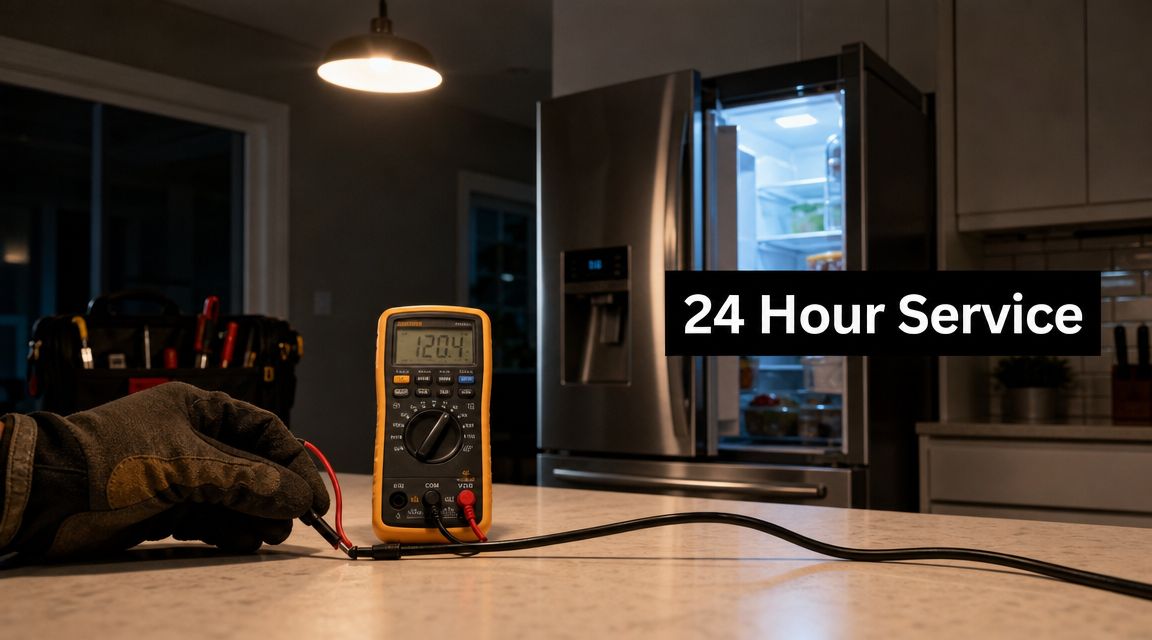
When a refrigerator quits in the middle of the night, the immediate reaction is often to focus on the box and forget the power feeding it. 24 Hour Refrigeration Service matters, but the fastest path to saving food often starts with figuring out whether the failure is electrical, mechanical, or both.
Your Fridge Just Died What to Do Right Now
It is 10:30 at night, the kitchen is quiet, and the refrigerator is warmer than it should be. The inside light may be off. The outlet may smell hot. In that moment, the goal is simple. Protect your food, avoid an electrical hazard, and figure out whether the problem starts with the appliance or the power feeding it.

A dead fridge turns into a food safety problem fast, especially during a summer outage in Ogden, Layton, or anywhere along the Wasatch Front where a warm garage or kitchen can speed up temperature loss. Homeowners often focus on the refrigerator first. I would check the electrical side just as quickly, because a bad receptacle, loose connection, failing breaker, or damaged branch circuit can shut the whole unit down without much warning.
Start with safety first
If you smell burning plastic, see scorch marks, hear crackling, or feel heat at the outlet, stop there. Do not touch the cord or keep resetting breakers to see if it comes back on.
Use this first 15-minute checklist:
- Check for visible electrical damage: Look for smoke, melting, discoloration, or sparking at the receptacle, plug, or cord.
- Keep the doors closed: Every opening dumps cold air and shortens the time you have to save food.
- See what else lost power: Check nearby counter outlets, lights, and any GFCI receptacles. If other devices are dead too, the issue may be in the circuit and not inside the fridge.
- Check the panel once: If the breaker tripped, you can note it. If it trips again right away, leave it off.
- Unplug the unit only if the area looks normal: If the plug or outlet shows heat damage, leave it in place for a licensed electrician.
- Move your highest-risk items first: Medications, baby formula, meat, dairy, and expensive refrigerated foods should get backup cooling before anything else.
If the refrigerator is completely dark, that is a strong clue.
Protect the food while you wait
A closed refrigerator usually holds temperature longer than people expect, but constant checking ruins that advantage. Group cold items together, load the most perishable food into a cooler if you have one, and leave the main door shut after that.
Write down what changed before the failure. Storm that rolled through Davis County. Flickering lights earlier in the evening. A breaker that has been touchy for months. Garage conversion work. New microwave on the same kitchen circuit. Those details help narrow the fault much faster than “it just quit.”
If you want a basic look at how an electrician confirms whether power is getting through a path, this guide on multimeter continuity troubleshooting gives helpful background.
The wrong first call often wastes time. If the outlet is dead, the breaker will not hold, or the receptacle looks burned, start with a licensed electrician who handles residential electrical troubleshooting for dead outlets and tripping circuits. A refrigeration tech may still be needed, but power problems have to be made safe first.
Is It an Electrical Problem or Something Else
A refrigerator can fail in two broad ways. It can lose its cooling function, or it can lose the electrical support needed to run at all.
A lot of people assume every fridge problem needs an appliance or refrigeration technician. That's not always true. Many refrigeration failures are electrical before they're mechanical because compressors, fans, and defrost systems all depend on stable power, as explained in this emergency refrigeration service overview.
Quick signs that point to electricity
If the interior light is off, the control panel is blank, or the breaker won't stay on, start with the electrical side. In Northern Utah homes, I'd also pay close attention after storms, remodel work, garage conversions, and older panel issues. Those are common moments when a fridge circuit starts showing weakness.
If you want a simple explanation of how a meter confirms whether a path is intact, this guide on multimeter continuity troubleshooting is useful background. It won't replace a licensed diagnosis, but it helps you understand what the electrician is testing.
For homeowners dealing with repeated trips, dead outlets, or intermittent power, professional electrical troubleshooting for residential systems is usually the right first move.
Electrical vs Mechanical Refrigeration Symptom Checklist
| Symptom | Likely Problem Type | Who to Call First |
|---|---|---|
| Fridge is completely dead, no lights, no display | Electrical | Electrician |
| Breaker trips as soon as fridge starts | Electrical | Electrician |
| Burning smell near plug or outlet | Electrical | Electrician |
| Outlet works intermittently | Electrical | Electrician |
| Lights are on, but unit isn't cooling well | Mechanical or airflow related | Refrigeration or appliance tech |
| Clicking repeatedly, but compressor won't start | Could be electrical or component-related | Electrician first if power issues are suspected |
| Frost buildup with fan/control odd behavior | Electrical controls or mechanical defrost issue | Electrician or refrigeration tech, depending on symptoms |
| Unit runs, but temperatures drift upward | Mechanical, sealed system, airflow, or control issue | Refrigeration or appliance tech |
If the appliance has power but won't maintain temperature, that often points toward the refrigeration side. If the appliance can't reliably get power, an electrician should usually be first on site.
When to call both
Some failures overlap. A control board may fail electrically inside the appliance while the rest of the branch circuit is fine. A compressor may struggle because of low voltage supply, then overheat and create a second problem.
That's why the best emergency calls start with symptom matching instead of guessing. You know what? The wrong first call often doesn't just waste money. It wastes the one thing you don't have during a refrigerator outage, and that's time.
Common Electrical Faults That Shut Down Refrigeration
Most electrical refrigerator failures come from a short list of trouble spots. The appliance may look like the problem, but the underlying failure can be at the breaker, the receptacle, the wiring path, or one of the start components that helps the motor come alive.

Overloaded or unstable circuits
A refrigerator wants consistent power. Put it on a circuit that's sharing space with garage tools, a microwave, or extra freezers, and nuisance trips become much more likely.
This shows up in real life as a fridge that “randomly” goes dead. It's not random. The load changes, the breaker reacts, and the fridge loses power.
If your home has recurring trip issues, aging equipment, or questionable load distribution, a licensed electrician should inspect the breakers and electrical panel system before another outage happens.
Worn outlets and loose connections
A loose connection behind the receptacle can starve the appliance even when the plug looks fine from the outside. That weak connection creates heat, voltage drop, and intermittent operation.
Common clues include:
- Warm outlet face: The receptacle shouldn't feel hot.
- Discolored cover plate: Browning or dark marks suggest heat damage.
- Power cuts in and out: The unit may restart when the cord is bumped.
- Buzzing at the wall: That's a stop-and-call symptom, not something to monitor for later.
Loose electrical connections don't heal themselves. They usually get hotter and more unstable with time.
Failed start components and controls
Inside the unit, some electrical parts do the hard work of getting the compressor and fans going. When a start relay, capacitor, thermostat, or control board fails, the refrigerator may click, hum, or sit silent without cooling.
Think of the capacitor as the push that helps a motor get moving. When that push is gone, the system can stall right at startup. The fridge may still look normal from the outside, but it won't perform.
Defrost and fan circuit issues
Some refrigerators fail because the fans or defrost controls stop doing their job. Air no longer moves correctly, frost accumulates where it shouldn't, and temperatures become erratic.
Those faults can feel mechanical because the symptom is poor cooling. But the root cause may be electrical control failure, not a sealed-system issue.
What to Expect When Our Electrician Arrives
Emergency service feels less stressful when you know the sequence. A good electrician doesn't guess, swap random parts, and hope for the best. The job starts with isolating the exact point where power is lost or compromised.

Reliable emergency guidance says a provider should give a firm arrival window, typically 2 to 4 hours, and that customers should note the unit's model, any error codes, and unusual sounds before calling, according to this emergency commercial refrigeration repair guide. Even in a residential setting, that same discipline helps the visit move faster.
What happens first at the house
The electrician starts with the supply side, not the appliance internals.
Expect a process like this:
Safety check at the outlet and cord
The first look is for heat damage, arcing signs, loose receptacles, or a compromised plug.Panel inspection
The breaker is checked for trip history, weak connection, and whether the circuit is showing overload behavior.Voltage testing
The electrician confirms whether the fridge is receiving proper power at the receptacle and, when appropriate, at accessible connection points.Circuit tracing if needed
If the outlet is dead or unstable, the next step is tracing upstream to find the interruption.
What you should have ready
You can help the diagnosis without touching anything unsafe.
- Model information: A photo of the appliance tag helps.
- Symptom notes: Was it clicking, silent, warming, or tripping the breaker?
- Timing details: Did it fail after a storm, after another appliance was used, or after recent electrical work?
- Access to the panel: Clear a path so testing can happen quickly.
The best service call is the one where the technician arrives with enough information to test the right things in the right order.
What a good diagnosis sounds like
You should hear a plain-English explanation. Not jargon, not pressure.
A solid electrician will tell you whether the problem is in the branch circuit, the receptacle, the breaker, the appliance feed, or whether the appliance itself now needs a refrigeration specialist after the electrical issue is ruled out. That separation matters because it keeps you from paying two trades to chase the same fault blindly.
Preventing the Next Emergency with Smart Maintenance
A refrigerator outage at 9 p.m. feels sudden. In a lot of homes along the Wasatch Front, the warning signs started weeks earlier. A breaker ran warmer than it should. The garage outlet got loose. The compressor struggled through low voltage on a crowded circuit every afternoon when the house load peaked.
Emergency repair gets food cold again. Smart maintenance lowers the chance of another midnight failure, and the electrical side is the part homeowners often miss.

Electrical prevention that actually helps
Good refrigeration maintenance is not just coil cleaning and door gaskets. Power quality matters too. If the appliance is working hard but the circuit feeding it is unstable, you can end up replacing parts without fixing the reason they failed.
For homeowners in Northern Utah, these checks prevent a lot of repeat calls:
- Put the refrigerator on the right circuit: A dedicated circuit reduces voltage drop, nuisance trips, and competition with microwaves, space heaters, garage tools, or freezer loads.
- Check receptacles that feel loose or warm: A worn outlet can interrupt power under load even if it still looks normal from the outside.
- Inspect breaker and panel connections: Weak breakers and loose terminations can cause intermittent shutoffs that look like appliance trouble.
- Add surge protection where it makes sense: Modern refrigerators rely on control boards that are more sensitive to outages, utility switching, and storm activity.
- Treat repeat trips as a fault, not an inconvenience: Resetting the breaker over and over just gives heat and arcing more time to damage the connection.
I see this a lot in older Ogden, Layton, and Salt Lake area homes where kitchens have been updated but the branch circuit serving the refrigerator never was.
Appliance-side habits still matter
The mechanical side still needs attention. Dirty coils, poor airflow, and bad door seals force longer run times, and longer run times expose weak electrical components faster.
A practical routine includes:
- Clean the coils on a regular schedule
- Watch for temperature swings or thawing
- Check door seals for gaps
- Listen for hard starts, repeated clicking, or delayed compressor operation
- Schedule service before summer heat puts the system under heavier demand
If you need help deciding whether the next step is electrical, refrigeration, or both, use our emergency electrical contact page before the problem turns into spoiled food and a rushed after-hours call.
Property owners with a second fridge in the garage, a basement freezer, or a rental unit should be more proactive. Those setups run longer, often sit in hotter or colder spaces, and are more likely to share circuits with other loads. That combination raises the chance of an electrical fault showing up as a cooling failure.
For a broader look at provider expectations and service planning, this guide on selecting the right refrigeration services is useful.
Your Local Emergency Electrical Partner in Northern Utah
In Weber, Davis, and Salt Lake counties, refrigerator outages often look like appliance failures when the actual cause is power loss, an overloaded circuit, a weak breaker, or a damaged receptacle. That's why local electrical support matters. You need somebody who understands emergency troubleshooting, code-safe repairs, and the realities of older and newer Northern Utah homes.
If you're comparing providers, this overview on selecting the right refrigeration services is a helpful way to think through response expectations, diagnostic ability, and whether a company is equipped for urgent work. For direct local communication, you can also use Black Rhino Electric's contact page to start the conversation about emergency troubleshooting or preventive electrical work.
When the fridge goes dark, the main question isn't just “Who can come out?” It's “Who can identify the failure safely and send me in the right direction without wasting hours?”
If you need fast help with a suspected electrical refrigeration failure in Northern Utah, contact Black Rhino Electric by calling 385-396-7048 or request a free quote.