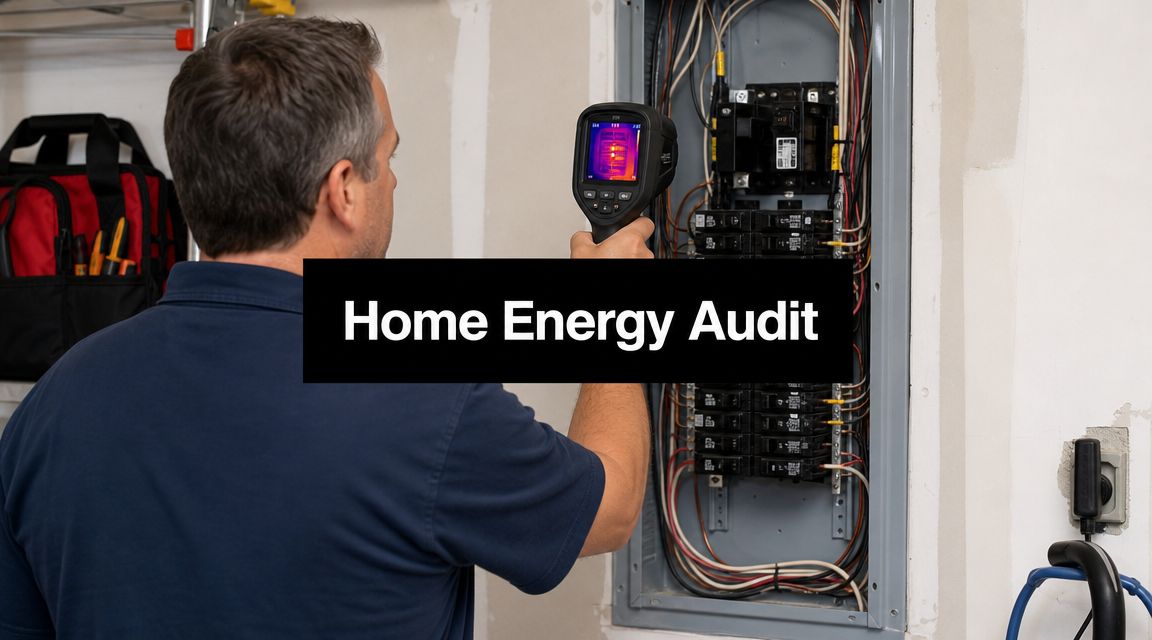
Wondering why your power bill feels high even after you've sealed a few obvious drafts? A lot of waste doesn't show up at the window trim. Home energy audit checklist work matters most when you look past the easy stuff and inspect the electrical side of the house too, because that's where efficiency problems and safety problems often overlap.
1. Electrical Panel and Service Entrance Inspection
Your panel tells a story fast. I've opened plenty of panels in Northern Utah homes and found a system that still works, but barely keeps up with how the house is used now. Space heaters, garage freezers, hot tubs, home offices, and EV plans all put pressure on old equipment.
Start with the basics. Look for rust, heat marks, double-tapped breakers, missing knockout fillers, loose labeling, and signs that past work was added in a hurry. If breakers trip often, or lights dip when large appliances start, the issue may be larger than one bad circuit.

What to check at the panel
- Service condition: Look at the meter base, service mast, conduit, and panel enclosure for corrosion, physical damage, or loose fittings.
- Breaker behavior: Pay attention to breakers that run warm, trip without a clear cause, or feel loose on the bus.
- Expansion room: Count spare spaces. If the panel is packed, future upgrades get expensive fast.
- Brand concerns: If you spot older problematic equipment, it deserves a closer look. Homeowners researching older brands often start with discussions like Solar Energy Management LLC on Zinsco issues.
A panel inspection isn't just about capacity. It's about whether the house can support improvements without creating a hidden hazard.
Practical rule: If the panel already looks crowded before you add an EV charger, heat pump, or basement finish, plan for an electrician to review the whole service, not just one new breaker.
If you need a closer look at panel condition, breaker problems, or upgrade options, breaker and panel service is usually the right next step.
2. Wiring and Branch Circuit Assessment
This is the part homeowners can't fully see, but it causes a lot of trouble. Wiring behind walls ages, gets altered, and sometimes gets patched by people who meant well but shouldn't have touched it.
Older homes often have circuits that were fine for lamps and a radio, not today's microwaves, gaming systems, bathroom hair tools, and garage equipment. That doesn't automatically mean the house is unsafe, but it does mean the wiring should match the actual load and the room's use.
Signs the branch circuits deserve attention
A quick walk-through can reveal a lot:
- Recurring nuisance trips: If one bedroom, bath, or kitchen circuit trips more than others, something is overloaded or poorly connected.
- Warm devices or cover plates: Heat at a switch or receptacle usually points to resistance, poor termination, or too much current on that branch.
- Mixed wiring methods: In remodels, I often see old cable tied into newer runs with questionable junction access.
- Extension-cord living: If a room depends on power strips and extension cords every day, the circuit layout likely no longer fits the space.
A real-world example is the finished basement that keeps adding devices over time. First it's a TV and mini fridge. Then a treadmill, game console, portable heater, and a second workstation. The wiring may still function, but it's no longer balanced for how the room is used.
The best audit notes don't just say “wiring appears old.” They identify where load is concentrated, where voltage drop may show up, and where dedicated circuits would make the house both safer and more efficient. Loose splices, buried junction boxes, and undersized branch circuits waste energy as heat and create exactly the kind of problem you don't want hidden inside drywall.
3. Outlet, Switch, and Device Safety Check
Outlets and switches seem minor until one fails under load. Then suddenly the “small issue” becomes a burnt receptacle, a dead circuit, or a call because half the kitchen went out.
A plug-in tester is useful for a homeowner, but it has limits. It can catch obvious wiring faults, missing grounds in some situations, and polarity issues. It can't tell you whether a connection is loose upstream or whether the device itself is worn out from years of heavy use.
Devices that deserve special attention
- Kitchen, bath, garage, and exterior outlets: These areas need proper protection because water changes the risk level immediately.
- Loose receptacles: If a plug falls out easily, the internal contacts may be worn.
- Dead-front or reset-style devices: Test them. Don't assume the button means it still functions.
- Cracked plates or humming switches: Those aren't cosmetic issues. They often point to damage or overheating.
The U.S. Department of Energy's DIY guidance also points homeowners toward common leakage points around outlets, switches, and pipe penetrations as part of a practical home assessment, because sealing and correcting those areas can reduce wasted heating and cooling energy according to the DOE's do-it-yourself home energy assessments guidance.
Bad outlets often announce themselves quietly first. A faint buzz, a warm faceplate, a reset button that won't hold, or a vacuum that only runs if the plug sits just right.
One common Utah scenario is a garage outlet that runs a freezer year-round. If the device is loose, ungrounded, or exposed to moisture, that's not just an efficiency problem. It's a reliability problem. You don't want to discover it after spoiled food or a tripped circuit in January.
4. Lighting System and Efficiency Evaluation
Lighting is one of the easiest wins in a home energy audit, but only if you do more than swap bulbs at random. The useful audit asks where lights stay on longest, which fixtures still run hot, and whether controls fit how the room is used.
The U.S. Department of Energy's home energy checklist says households should target the biggest energy users after gathering utility information and then decide which upgrades deserve priority in DOE's home energy checklist guidance. In many homes, lighting isn't the biggest line item, but it's often the easiest electrical upgrade to clean up quickly.

What actually works with lighting upgrades
- Replace high-use bulbs first: Kitchen cans, exterior coach lights, hallway fixtures, and living room lamps usually matter more than the guest room chandelier.
- Match the fixture and dimmer: LED upgrades fail early when people ignore compatibility.
- Use controls where behavior is predictable: Laundry rooms, closets, garages, and exterior paths do well with occupancy sensors or timers.
- Watch enclosed fixtures: Some LEDs aren't rated for heat buildup inside enclosed glass fixtures.
You know what? Good lighting work is part comfort, part efficiency, part maintenance reduction. A bad retrofit gives you flicker, poor color, and callbacks. A good one gives you lower heat at the fixture, steadier light, and fewer bulb changes.
If your home still has outdated fixtures, dimmer issues, or poorly planned room lighting, residential lighting electrician services can help sort out the fixture side and the wiring side together.
5. HVAC System Electrical Supply Check
Most homeowners think of HVAC as a furnace or AC problem. Sometimes it is. But I've seen systems run poorly because of electrical issues that never get checked first.
The disconnect, whip, breaker sizing, terminations, control wiring, and service receptacle all matter. If the power supply is unstable or the connections are heating up, even a mechanically sound unit won't perform the way it should.
Where electrical issues show up around HVAC
The obvious places are the condenser outside and the air handler or furnace inside. Check for damaged disconnects, weathered conduit, loose-seeming whips, scorched terminals, vibration wear, and signs that service access has been blocked by storage or landscaping.
The more subtle issues show up in operation. Short cycling, hard starts, nuisance trips, or blower problems can all have an electrical angle. That doesn't mean homeowners should open equipment and start poking around. It means the audit should note symptoms and visible conditions clearly.
The more rigorous home audit approach used in professional settings goes beyond a walk-through. It includes measuring air leakage, verifying insulation, checking combustion appliances for safety and efficiency, metering electrical loads, and screening for moisture and health concerns before findings are entered into software that ranks retrofit work through guidance summarized by NASCSP and DOE weatherization resources.
That matters because tightening a home or changing HVAC equipment without checking power supply, duct condition, and combustion safety is where people create new problems while trying to solve old ones.
6. Major Appliance Circuit and Connection Review
Large appliances don't forgive sloppy electrical work. Dryer, range, oven, dishwasher, disposal, microwave, water heater, and garage equipment each need the right circuit, right connection, and right protection.
When an appliance shares power it shouldn't, or the receptacle and cord don't match the equipment, you get nuisance trips, heat buildup, poor performance, or all three. In rental turns and older remodels, I often find the same pattern. The appliance was replaced, but nobody checked whether the branch circuit still made sense.
Common trouble spots
- Electric dryers: Loose terminations at the receptacle or cord cap can create heat fast.
- Ranges and wall ovens: These need solid dedicated supply and clean terminations.
- Dishwashers and disposals: Under-sink wiring is notorious for rough workmanship and moisture exposure.
- Garage refrigerators and freezers: Shared circuits with tools or outdoor loads can create reliability issues.
A practical example is the laundry room where the dryer works, but the lights dim every time it starts. That's not something to ignore. It may be a connection issue, a shared load problem, or a service concern.
An appliance review isn't glamorous, but it's one of the highest-value parts of an electrician's-eye home energy audit checklist. Heavy loads expose weak points quickly. If a connection is failing, the appliance often tells you before the panel does.
7. Phantom Load Identification
Not every waste problem is dramatic. Some of it is death by a thousand tiny draws. Chargers, cable boxes, gaming consoles, garage door accessories, smart speakers, printers, microwave displays, and spare fridges all sip power in the background.
That's why professional energy audits often include metering electrical loads instead of relying only on visual notes. If you don't measure what's always plugged in, you miss the stuff that adds up over time.

A better way to find standby waste
Walk the house with a notebook and look for clusters, not just single devices. The family room entertainment center is one cluster. The home office is another. Garage shelves and guest rooms can hide a surprising amount of always-on gear.
- Entertainment stack: TV, soundbar, streaming box, console, and subwoofer all pulling constantly.
- Office corner: Printer, monitors, docking station, router gear, and backup drives.
- Kitchen extras: Coffee station appliances, chargers, and secondary displays.
- Garage tech creep: Battery chargers, cameras, Wi-Fi extenders, and old appliances.
Let me explain. The goal isn't to unplug everything and live in the dark. The goal is to separate “needs continuous power” from “left plugged in out of habit.”
A simple real-world fix is using advanced power strips where several devices shut down together, or relocating chargers so they aren't permanently connected in low-use rooms. In homes planning for bigger electrical additions later, phantom load cleanup also gives you a clearer picture of the home's actual daily demand before you size future improvements.
8. Outdoor Electrical Systems and Safety
Utah weather is hard on exterior electrical gear. Sun cooks plastic. Snow and ice work into covers. Sprinklers soak the same spots over and over. Outdoor wiring that looked acceptable years ago can degrade faster than people think.
This part of the audit is half safety, half waste prevention. Damaged fixtures, wet boxes, and failed seals create faults, trips, corrosion, and lighting problems that people ignore because the issue is outside and “still kind of works.”
Exterior points worth inspecting
- Weatherproof covers: In-use covers should close correctly and protect the receptacle.
- Fixture mounting: Loose coach lights and floodlights let water enter boxes and wall penetrations.
- Outdoor and holiday power: Temporary cords often become semi-permanent.
- Outbuilding and patio feeds: Sheds, detached garages, pergolas, and hot tub areas need special attention.
One common scenario is a back patio receptacle that powers string lights, a grill igniter, and occasional tools. If the cover won't seal and the box shifts in the siding, moisture gets invited in every season.
Field note: Exterior electrical problems often show up first as nuisance trips after storms, not obvious failure at the outlet itself.
This is also where the broader home energy audit checklist comes back into play. Exterior penetrations around boxes, conduit, and fixtures should be sealed correctly, because leakage at these points wastes conditioned air and can let water into wall cavities too.
9. Smoke and Carbon Monoxide Detector Check
This one doesn't lower the utility bill directly. It still belongs in every serious audit.
If I'm already evaluating a home's electrical condition, I want to know whether the life-safety devices are present, powered, connected properly, and located where they'll do their job. A detector hanging loose, chirping for weeks, painted over, or missing where a remodel changed the room layout is a red flag.
What to verify
Start simple. Press the test button on each unit. Note battery-only models, hardwired models, and any detector that appears old, dirty, damaged, or disconnected. If units are interconnected, confirm that one test triggers the others as intended.
Then think about context. Bedrooms, hallways, basement areas, mechanical spaces, and any zone near combustion equipment deserve a close look. Homes that have been tightened up for efficiency deserve even more attention to ventilation and combustion safety.
That concern shows up in the audit guidance too. As homes are air sealed, ventilation matters more, and combustion appliances need proper attention because tightening a house can expose moisture, air quality, or combustion-safety issues that were previously hidden as discussed in the Portland State research summary on homeowner audit behavior and preparation.
A practical example is the finished basement with a utility room added years after the original construction. The space may feel comfortable, but if the detectors don't match the current layout and the house has been tightened without broader safety review, that's not a small oversight. That's a priority item.
10. EV Charger and Future-Proofing Assessment
A lot of homeowners wait until they buy the vehicle to think about charging. That's backwards. The smart time to assess EV readiness is during the audit, before the panel is full, before the garage is finished, and before trenching or drywall patching gets expensive.
An EV charger changes how the house uses power. It may be the largest regular electrical load you add. That doesn't mean every home needs a major overhaul, but it does mean every home should be evaluated thoroughly.
Questions that decide whether the home is ready
- Can the panel accept the load safely?
- Is there physical space for the breaker and wiring route?
- Is the charger location practical for daily use, not just technically possible?
- Will future plans add more load later, like a hot tub, workshop, or electric heating equipment?
Older homes especially need this looked at in context. Sometimes the answer is straightforward. Sometimes the best move is load management, panel changes, or planning the service upgrade now instead of paying for rework later.
Remote and assessment-based audit programs tend to work better when they give homeowners specific, actionable recommendations rather than just a score, and homeowners are often more interested in improvements for their own house than in a rating by itself. That practical takeaway appears in the Portland State work, which also notes customer acceptance of remote assessments reported by ACEEE in the same Portland State research summary.
For homeowners comparing charging approaches and planning options, broader reading on sustainable electric vehicle charging options can help frame the conversation. If you're ready to evaluate your own setup, EV charger installation services should start with panel capacity, circuit routing, and actual daily use, not just the charger model.
10-Point Electrical Home Energy Audit Comparison
| Inspection / Service | Implementation complexity | Resource requirements | Expected outcomes | Ideal use cases | Key advantages |
|---|---|---|---|---|---|
| 1. Electrical Panel and Service Entrance Inspection | Moderate to high (visual easy; upgrades complex) | Licensed electrician, safety gear, panel testing tools; possible parts for upgrade | Identify capacity, safety hazards, required upgrades (e.g., panel replacement) | Older homes, frequent trips, planning EV/hot tub, major remodels | Addresses major safety risks; enables higher loads and future upgrades |
| 2. Wiring and Branch Circuit Assessment | High (may require access behind walls) | Electrician, diagnostic tools, potential rewiring materials and time | Detect outdated/unsafe wiring, overloaded circuits, need for repairs or rewire | Homes built pre-1975, visible cloth/knob‑and‑tube wiring, before remodels | Prevents fire risk; ensures code compliance and long‑term safety |
| 3. Outlet, Switch, and Device Safety Check | Low to moderate (testing simple; fixes moderate) | Plug‑in tester, GFCI/AFCI devices, electrician for replacements | Verify grounding, correct polarity, GFCI/AFCI protection; replace unsafe devices | Two‑prong outlets, bathrooms/kitchens, loose or warm outlets | Reduces shock risk; protects electronics; relatively low cost fixes |
| 4. Lighting System and Efficiency Evaluation | Low to moderate (bulb swaps easy; system upgrades more work) | LEDs, compatible dimmers, smart controls, electrician for installations | Identify retrofit opportunities, compatibility issues, and energy savings | Homes with high lighting use, desire for LEDs or smart lighting | Large energy savings; quick ROI; improved lighting control |
| 5. HVAC System Electrical Supply Check | Moderate (breaker and thermostat wiring checks) | Multimeter, HVAC disconnect inspection, electrician for 'C' wire or breaker sizing | Confirm proper breaker sizing, thermostat compatibility, reduce HVAC failures | Installing smart thermostats, AC breaker tripping, HVAC reliability concerns | Improves efficiency and reliability; enables smart thermostat use |
| 6. Major Appliance Circuit & Connection Review | Moderate to high (240V circuit work possible) | Electrician, heavy‑duty receptacles, dedicated wiring and breakers | Ensure dedicated circuits, safe connections, and prevent overheating | Electric ranges, dryers, water heaters, appliance replacements | Reduces fire hazard; ensures appliance performance and code compliance |
| 7. Phantom Load Identification | Low (DIY friendly) | Plug‑in energy monitor, smart power strips | Identify standby draws and estimate savings; group control strategies | Households with many standby electronics and chargers | Low‑cost, easy energy savings; reduces bills 5–10% with minimal effort |
| 8. Outdoor Electrical Systems and Safety | Moderate (weatherproofing and proper burial depth) | GFCI outlets, weather‑resistant covers, conduit, electrician for installs | Safe outdoor power, sealed fixtures, correct conduit depth and GFCI protection | Hot tubs, outdoor outlets, landscape lighting, sheds | Protects against weather and shock hazards; required for code compliance |
| 9. Smoke and Carbon Monoxide Detector Check | Low (testing and battery changes) | Test button, replacement detectors, interconnect wiring for upgrades | Confirm working detectors, correct placement, and power source status | All homes; detectors >10 years old or battery‑only units | Critical life‑safety improvement; inexpensive relative to benefit |
| 10. EV Charger and Future‑Proofing Assessment | High (may require panel upgrade and new circuits) | Panel capacity assessment, conduit/wiring, dedicated breakers, licensed electrician | Site plan for charger, required circuit size, estimate of upgrade costs | Current or prospective EV owners; planning multiple high‑load additions | Future‑proofs home for EVs and other loads; avoids costly retrofits later |
Your Next Step: From Checklist to Action
A good audit changes how you look at your house. You stop seeing random annoyances and start seeing systems. The flicker in the bathroom, the warm outlet in the laundry room, the overloaded garage circuit, the patio receptacle that trips after snow melt. They're connected.
The biggest mistake I see is homeowners treating a home energy audit checklist like a one-day punch list. It isn't. It's a way to sort problems by urgency, cost, safety, and payoff. Some items are simple. Seal a penetration. Replace a failed device. Clean up lighting controls. Others need a licensed pro because the risk of guessing wrong is too high.
Use three buckets. First, handle obvious safety issues. Burnt outlets, damaged cords, unreliable breakers, missing detector coverage, wet exterior devices, and equipment that shows heat damage go at the top. Second, handle efficiency items that are easy to complete without creating side effects, like reducing phantom loads, correcting lighting choices, and noting obvious leakage around devices and penetrations. Third, plan the bigger projects in the right order, such as panel work before EV charging, or electrical corrections before a major remodel closes the walls back up.
That order matters. If you skip straight to upgrades without checking the electrical backbone, you can spend money twice. I've seen homeowners install new loads onto old circuits, finish a garage before running the charger feed they knew was coming, or tighten a home without thinking through ventilation and combustion safety. Those are expensive lessons.
The electrical side also helps you decide what's DIY-friendly and what isn't. Swapping lamps and organizing plug loads is one thing. Opening live equipment, replacing panel components, tracing hidden branch wiring, or correcting multi-issue outdoor circuits is another. Safety and code compliance aren't optional just because the fix looks simple on video.
In Weber, Davis, and Salt Lake counties, a local electrician offers real value to homeowners. A seasoned electrician can tell the difference between a nuisance issue and a system issue. More important, they can spot the upgrade chain reaction before it starts. Add an EV charger, then find the panel is full. Upgrade the panel, then uncover poor terminations and undersized branch circuits. It's better to learn that in the assessment stage.
If your audit uncovered flickering lights, an outdated panel, recurring breaker trips, outdoor safety concerns, or plans for an EV charger, it's time to get a professional set of eyes on it. Black Rhino Electric is one option for homeowners in Northern Utah who need licensed electrical inspection, repair, and upgrade work.
If you want help turning your findings into a safe repair plan, upgrade scope, or future-ready electrical layout, contact Black Rhino Electric. For a trusted, safety-first evaluation in the Weber, Davis, or Salt Lake County area, call 385-396-7048 or request a free quote.