
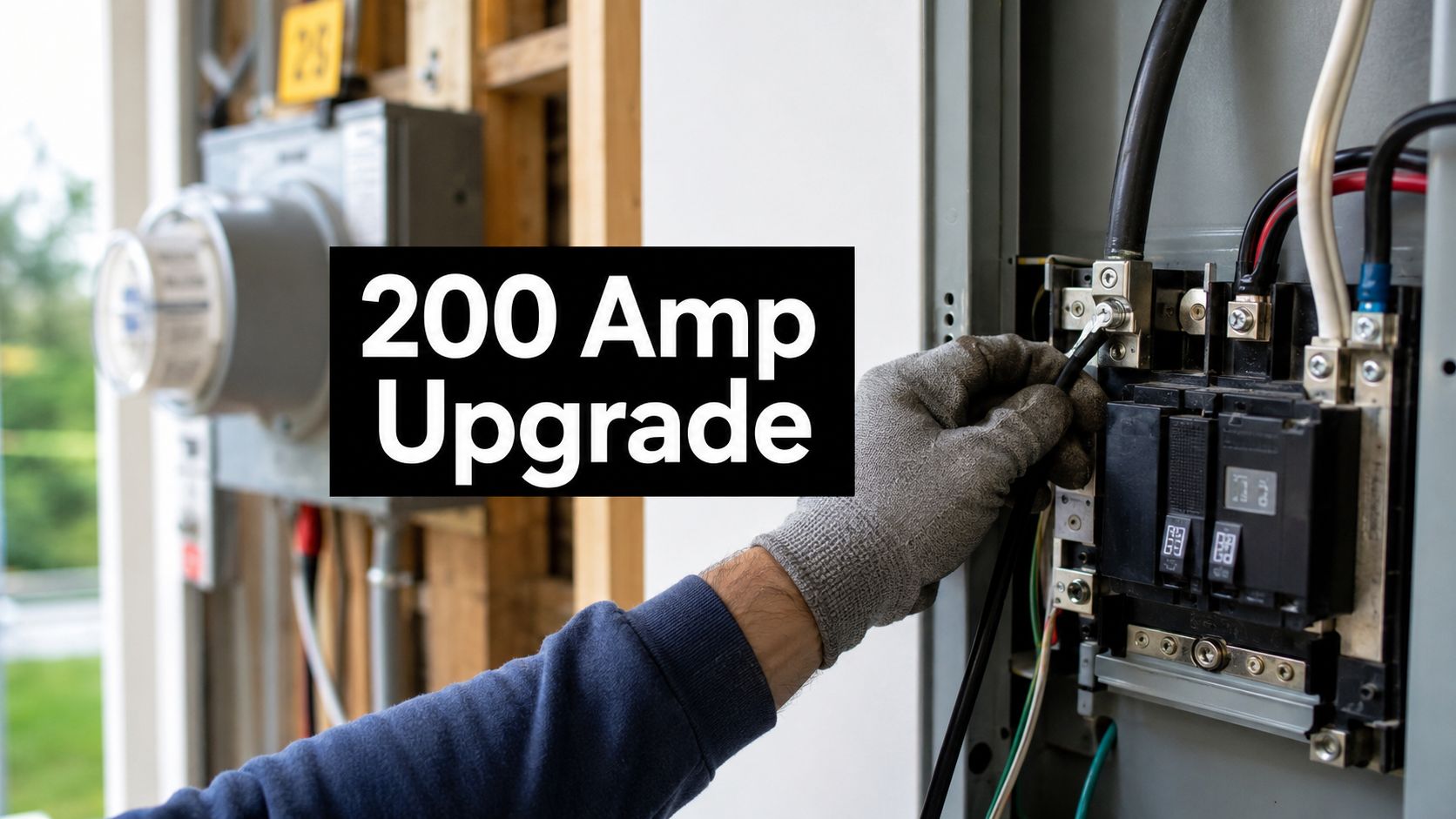
A lot of homeowners start thinking about a 100 amp to 200 amp upgrade when the house begins acting like it's short on power. Breakers trip, lights dip when a big appliance starts, and plans for an EV charger, hot tub, or basement finish suddenly run into the limits of an older service.
Signs Your 100 Amp Panel Is Overloaded
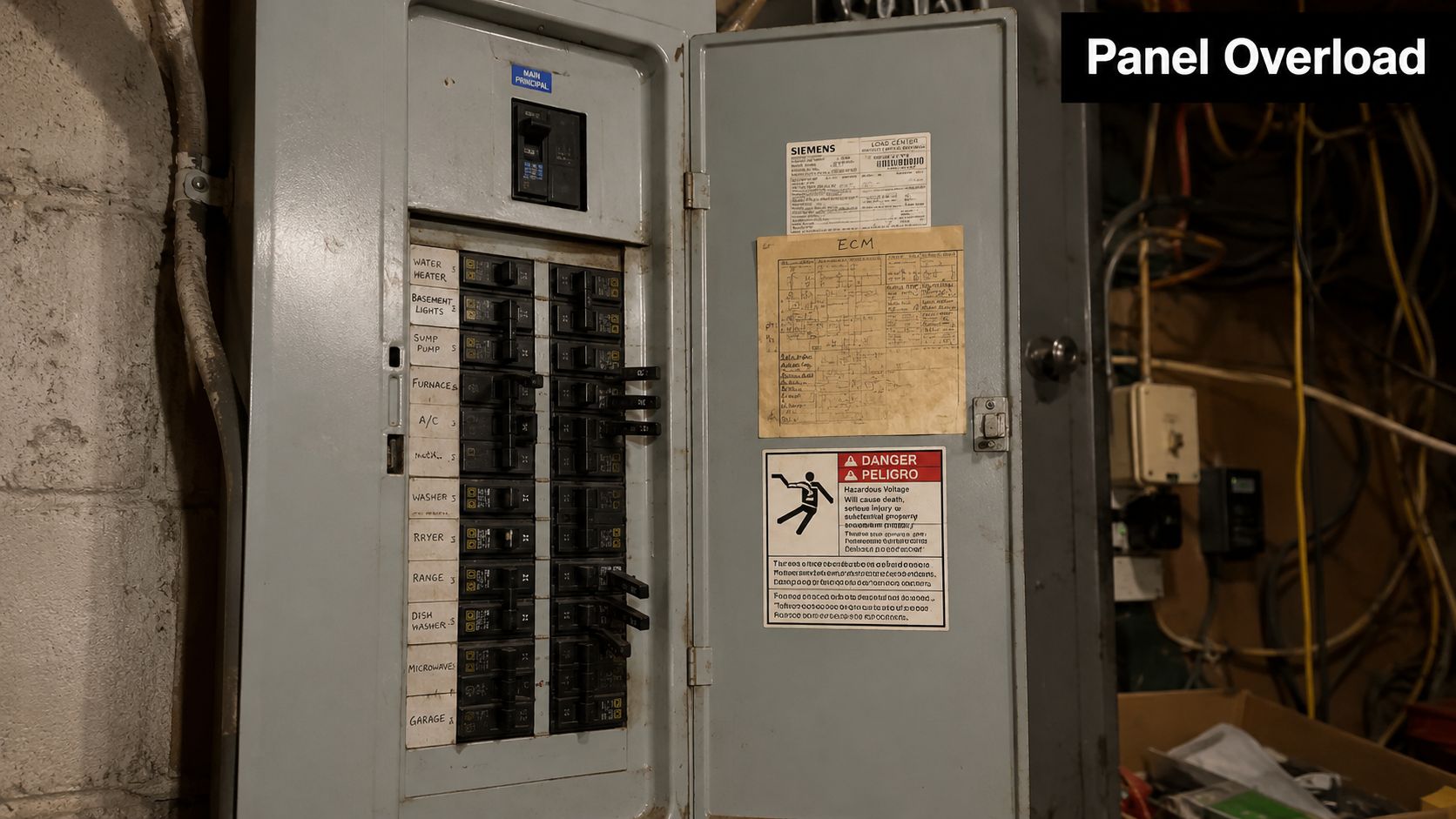
Older homes across Weber and Davis counties often weren't built around today's electrical loads. A house that once handled basic lighting, a range, and a few receptacle circuits may now be carrying home office equipment, added kitchen appliances, garage tools, freezers, and charging equipment.
What homeowners usually notice first
The first signs are usually practical, not technical:
- Breakers trip during normal use. If the microwave, hair dryer, space heater, or garage equipment pushes a circuit over the edge, the system may be running too close to its limit.
- Lights dim or flicker when larger loads start. That often shows up when air conditioning, a compressor, or another heavy appliance kicks on.
- The panel has little or no room left. Even if the house isn't tripping constantly, a packed panel makes future additions harder.
- The home relies on workarounds. Power strips, extension cords, and avoiding certain appliances at the same time are warning signs.
- Major upgrades are planned. EV charging, a hot tub, a kitchen remodel, electric heat, or a finished basement can push an older service past what makes sense.
Those symptoms don't always mean the answer is automatically a bigger service. Sometimes the issue is a bad breaker, an aging panel, poor circuit layout, or a load that should've had its own dedicated circuit. Homeowners who want a closer look at common warning signs can review identifying residential electrical panel issues.
Practical rule: Repeated tripping under ordinary household use isn't something to ignore or “just reset.” It's a sign the electrical system needs to be evaluated.
The panel label doesn't tell the whole story
One of the most important points homeowners miss is that the number printed on the panel doesn't always answer the actual question. According to NYSERDA's guidance on home electrical panels, some homes can already have enough service capacity even when the panel itself is only marked in the 100 to 150 amp range. The fundamental issue is actual service capacity, spare circuit space, and future load needs.
That matters in Northern Utah, where older homes are often remodeled in stages. A homeowner may think, “The house has 100 amps, so it definitely needs an upgrade,” when the smarter move is first verifying what's there and how the loads are being used.
A quick homeowner checklist
A licensed electrician will do the formal evaluation, but homeowners can safely observe a few things before making the call:
| What to look at | Why it matters |
|---|---|
| Breakers tripping more often | Suggests circuits or service may be strained |
| Empty breaker spaces | Shows whether there's room for added circuits |
| Planned additions | New loads often change the decision |
| Age of the home | Older service setups are more likely to need modernization |
| Meter and exterior equipment condition | Service upgrades often involve more than the panel itself |
If the house already feels maxed out before adding anything new, that's usually when a service upgrade moves from “nice to have” to a practical necessity.
Why Upgrade to a 200 Amp Service
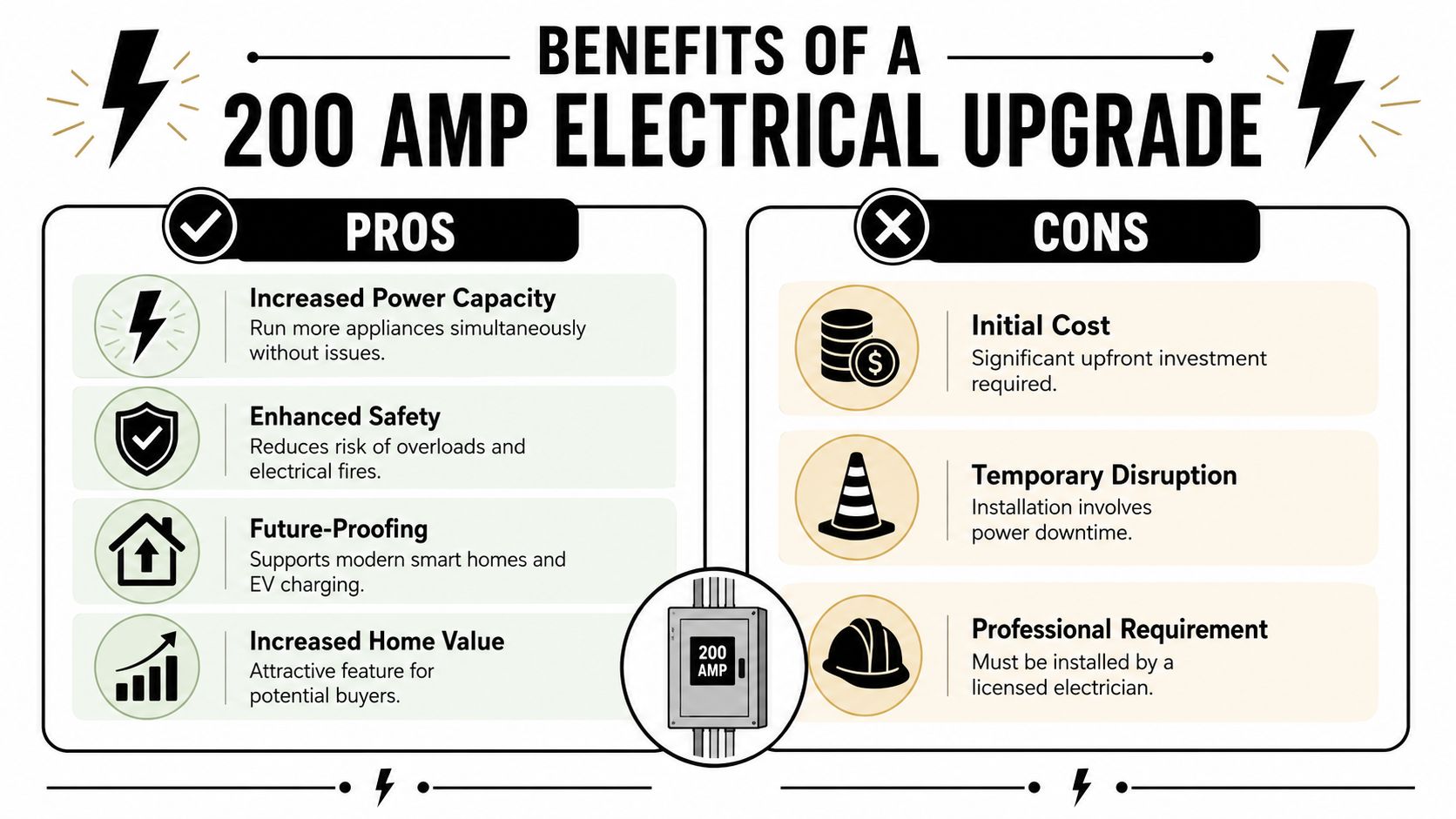
A 200 amp service gives a home more breathing room. It's less about “more power for the sake of it” and more about building an electrical system that matches how people live now.
Historically, 100-amp service has been treated as the minimum standard for many residential systems, while 200-amp service is widely recommended for larger homes, major renovations, and properties adding energy-intensive loads such as EV chargers, electric heating, or multiple high-demand appliances, as noted in this electrical service comparison.
Where a 200 amp service makes sense
Some houses can stay on 100 amps and operate fine. Others have clearly outgrown it. The homes that usually benefit most are the ones adding load in several places at once.
- EV charging at home. A Level 2 charger is one of the most common reasons homeowners start asking about panel capacity.
- Hot tubs and spas. These often require a substantial dedicated circuit, and they compete with the rest of the home's demand.
- Kitchen and basement remodels. Added circuits, larger cooking loads, under-cabinet lighting, and finished spaces all add up.
- All-electric planning. Homes adding electric heat, heat pump equipment, or more electric appliances usually need room to grow.
- Older homes being modernized. Many homes in Northern Utah neighborhoods were built for a different era of electrical use.
A homeowner planning vehicle charging should also understand how the charger and service size work together. This electrical service upgrade guide for Utah homeowners gives a useful side-by-side look at the difference between service sizes.
What changes in day-to-day use
The best upgrades are the ones homeowners stop thinking about after the work is done. A properly sized service helps with:
- Running multiple loads at once without juggling what can be turned on
- Adding dedicated circuits where they're needed instead of sharing overloaded ones
- Reducing strain on an aging system
- Supporting future electrical work without boxing the house into a corner
A service upgrade should solve a capacity problem and give the home room for the next project, not just the current one.
For homeowners adding vehicle charging, EV charger installation services often go hand in hand with a panel capacity review. That's especially true in Weber County and Davis County homes where the existing service was fine for the original house, but not for today's equipment.
When it may not be the right answer
A 200 amp service isn't automatically the right move just because the panel is older. If the house has enough capacity, enough circuit space, and realistic load management options, the better choice may be a targeted panel replacement or circuit rework instead of a full service upgrade.
That's why the best decision usually starts with the home's actual demand, not guesswork.
The 100 to 200 Amp Upgrade Process Step by Step
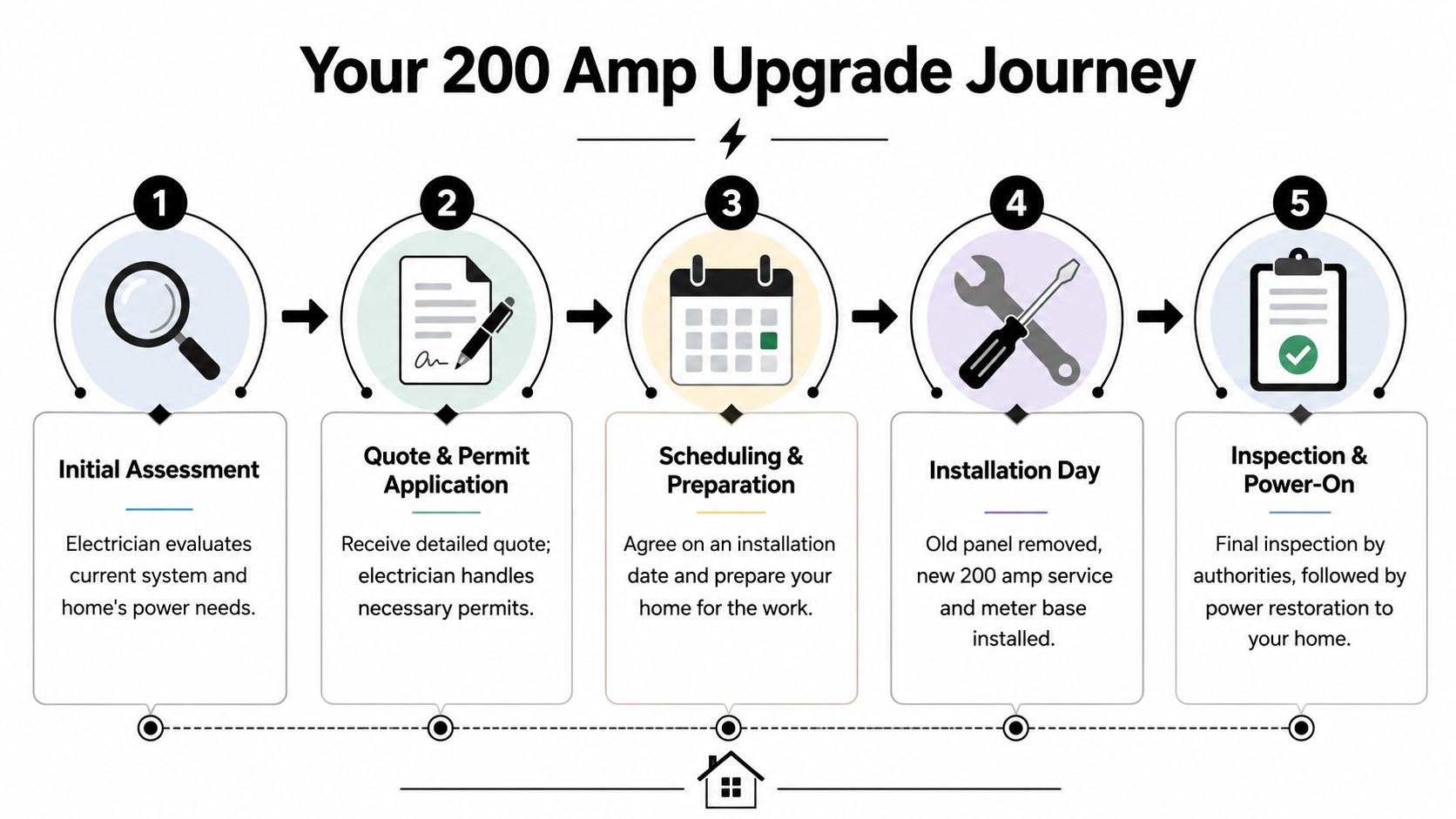
A real 100 to 200 amp upgrade is a service upgrade, not just swapping one breaker box for another. The electrical contractor has to evaluate the whole service path, from the utility connection down to the main disconnect and the branch circuits in the house.
Step one starts with the home, not the panel
The first visit is about scope. The electrician looks at the existing panel, meter location, service entrance equipment, grounding and bonding, available circuit space, and the loads the homeowner wants to add.
That's where remodel plans matter. A homeowner in Layton finishing a basement, or a homeowner in Ogden adding a hot tub and an EV charger, may need a different approach than someone only replacing a worn-out panel.
Typical questions include:
- What new electrical loads are planned
- Is the existing panel obsolete, damaged, or just undersized
- Does the current service equipment support the upgrade
- Will the utility require changes outside at the meter or service conductors
The upgrade usually reaches outside the house
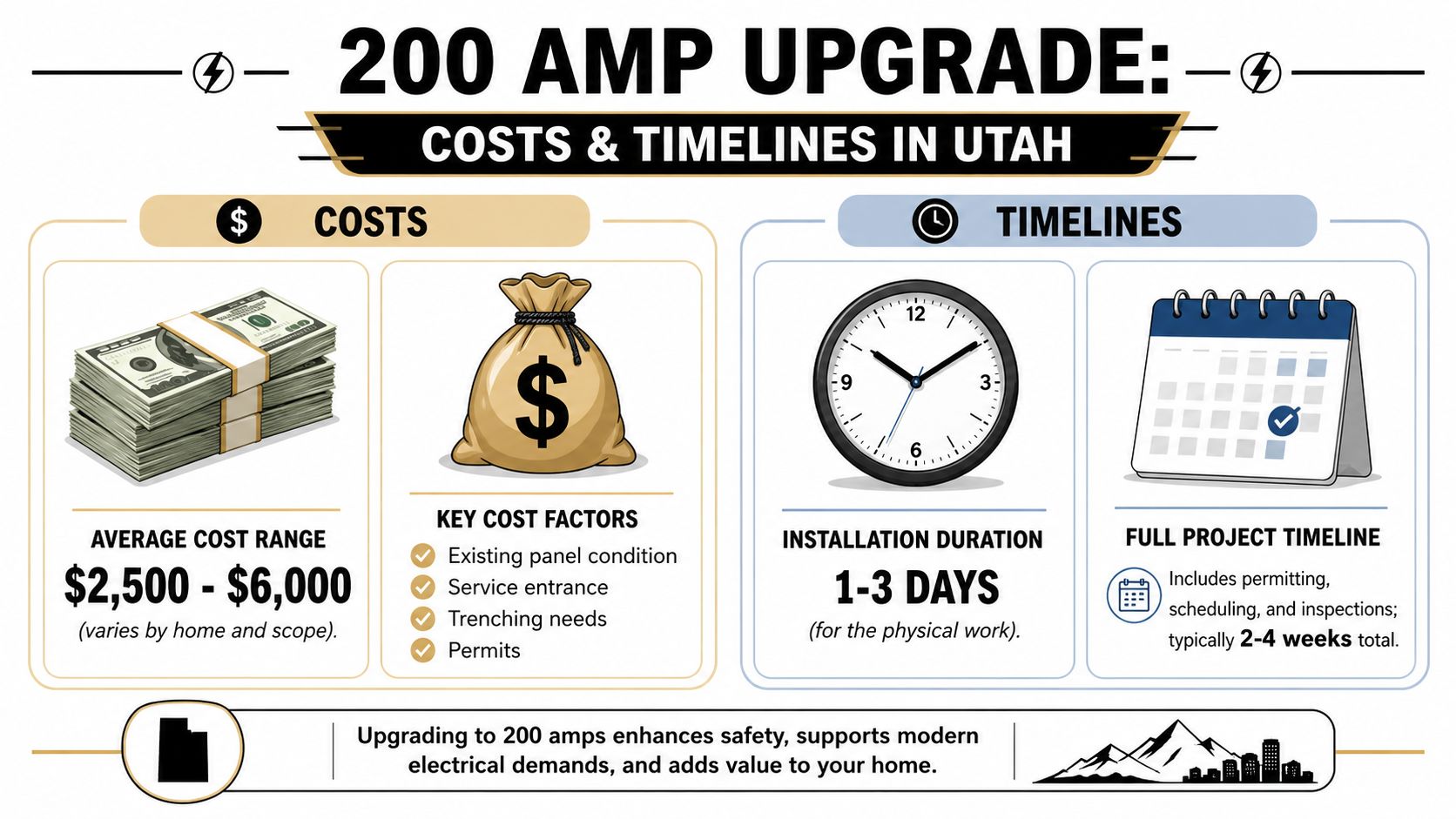
Many homeowners find it surprising that a 100 amp to 200 amp panel upgrade generally requires replacing the entire service entrance assembly, including the meter socket and the main service entrance cable. One industry reference notes that the main service entrance cable for 200 amps is typically 2/0 AWG aluminum or #2 AWG copper, and that physical installation often takes 1 to 4 days, while the full timeline can stretch to 4 to 6 weeks because of permits and utility coordination, according to this service upgrade timeline overview.
That same source also notes a direct jump in available continuous load capacity, from about 80 amps on a 100 amp panel to about 160 amps on a 200 amp panel under the common continuous load rule. In practical terms, that added capacity is what makes larger modern loads workable.
What happens before installation day
In Northern Utah, this part matters just as much as the day the work is done.
A proper upgrade usually involves:
- Load evaluation and project scope
- Permit application with the local jurisdiction
- Utility coordination for disconnect and reconnect
- Scheduling the outage and installation
- Inspection and approval before final energizing
For homes served by Rocky Mountain Power, utility coordination is a real part of the job, not an afterthought. Meter work and reconnect timing have to line up with the city or county inspection process.
Homeowners looking for the broader panel side of this work can review Black Rhino Electric for electrical panel services.
If a contractor talks about a “quick 200 amp swap” without discussing permits, meter equipment, or utility scheduling, that's a warning sign.
What installation day usually includes
Once power is shut down and the site is ready, the contractor removes outdated components and installs the new service equipment. The exact layout varies by home, but common work includes the new panel, meter base, service conductors, grounding and bonding corrections, and reconnecting existing branch circuits in an orderly, labeled way.
This isn't DIY territory. The hazard isn't only inside the panel. It includes service conductors, meter equipment, code compliance, and safe restoration of the entire system.
A homeowner can help by:
- Clearing access to the panel, meter, and workspace
- Planning for power downtime during the changeover
- Listing known issues such as nuisance tripping or dead circuits
- Pointing out future additions so circuit planning is done correctly the first time
The final check matters
The last part isn't paperwork for paperwork's sake. Inspection confirms that the work meets code and that the home is safe to re-energize. Proper grounding, bonding, conductor sizing, and approved equipment all matter here.
When this work is done right, the result is a service that can support the house safely now and leave room for what's coming next.
Costs and Timelines for a Service Upgrade in Utah
Most homeowners ask two questions right away. What's it going to cost, and how long is the house going to be tied up?
The honest answer is that the installation time and the full project timeline aren't the same thing. The work at the house may move fairly quickly, while the permit and utility side takes longer.
What the price range usually looks like
One industry estimate notes that a 100-amp to 200-amp upgrade is not a small component change. It typically requires permits and inspections, often takes about 4 to 8 hours of electrician labor, and commonly lands around $1,200 to $2,000, with an average near $1,600, though location and job scope can push the cost higher, according to this panel upgrade cost reference.
Those numbers are useful as a baseline, but they shouldn't be treated as a flat quote for every home in Utah. Service upgrades vary a lot once the electrician opens up the existing conditions.
What pushes the cost up or down
The labor at the panel is only part of the job. The final quote depends on what the electrician finds at the service entrance and how much correction work is needed.
Common cost factors include:
- Meter base replacement needs
- Condition of the existing service entrance cable
- Grounding and bonding corrections
- Panel location and access
- Whether older wiring issues need attention during reconnection
- Permit and inspection requirements
- Utility coordination details
- Extra circuits for an EV charger, hot tub, or remodel work
For homeowners comparing options, this guide to Utah electrical panel costs helps frame the difference between a straightforward panel project and a broader service upgrade.
Timelines that match real life
A lot of confusion comes from mixing up install time with project duration.
| Part of the project | What to expect |
|---|---|
| On-site electrical work | Often completed within a workday in simpler homes |
| More complex physical installation | Can extend beyond that depending on scope |
| Permit and scheduling phase | Often longer than the hands-on work |
| Utility and inspection coordination | Usually determines the full calendar timeline |
That's why homeowners in Salt Lake County, Davis County, or Weber County should plan around the entire process, not just the day the crew is at the house.
Cost reminder: A low quote that ignores permits, meter work, or correction items may not reflect the actual job scope.
Common Pitfalls and Code Considerations
A service upgrade is one of the easiest places for shortcuts to create long-term trouble. The work may look clean from the outside and still be wrong in ways that matter for safety, inspection, and future repairs.
The most common problems
Some mistakes show up right away. Others don't show up until a remodel, sale, insurance claim, or equipment failure.
- Unpermitted service work. If the city, county, or utility never approved the work, the homeowner can inherit a serious problem.
- Treating it like a panel swap only. A true service upgrade often reaches beyond the indoor panel.
- Wrong or unapproved meter equipment. Utilities have requirements, and those details matter.
- Poor grounding and bonding. This is a safety issue, not a paperwork issue.
- Overlooking existing defects. Older homes often have multiple layers of past electrical work, and not all of it was done correctly.
Why code details matter here
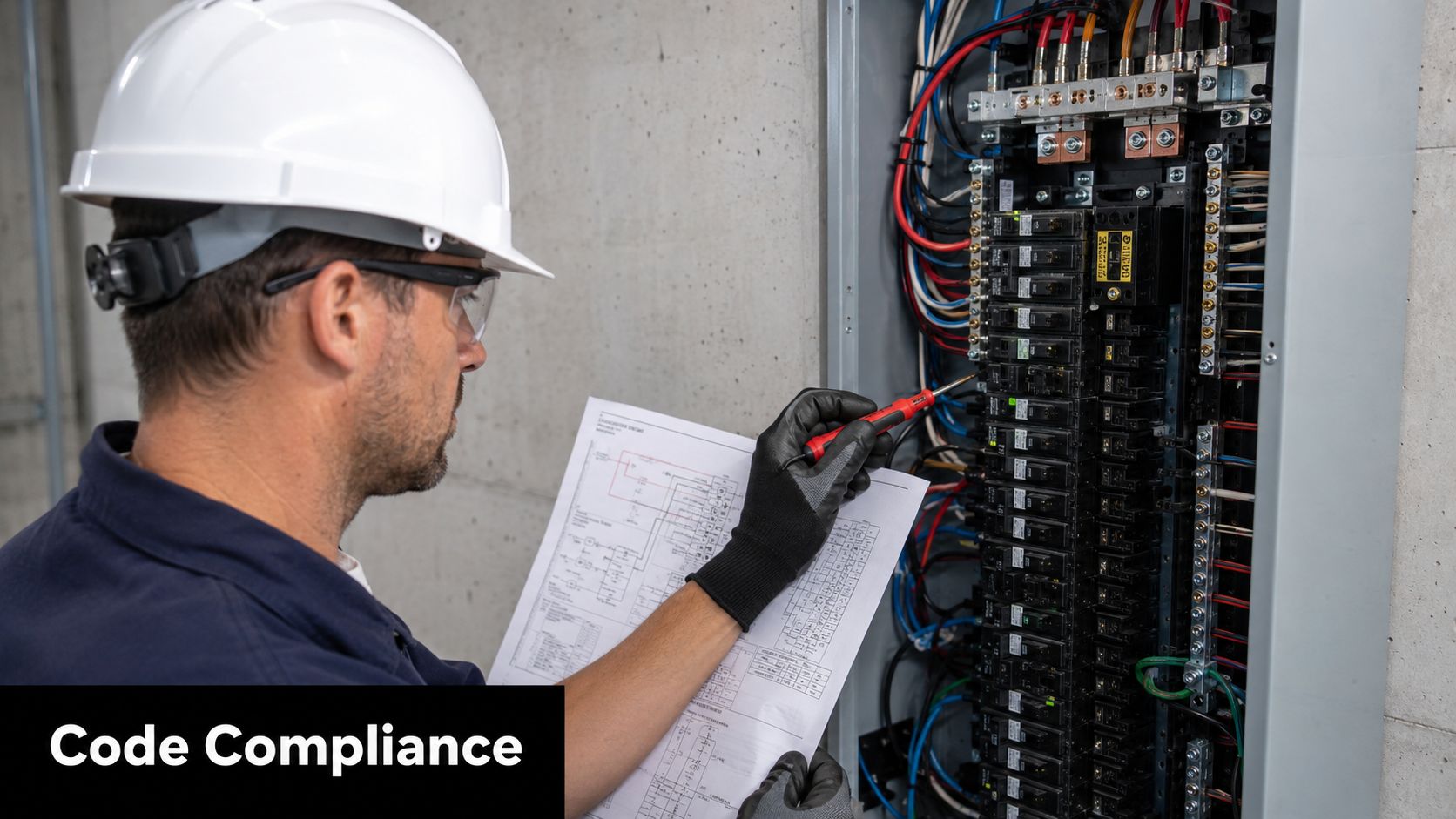
Code compliance on a service upgrade isn't about checking boxes. It's what separates a safe installation from one that creates hidden hazards.
One industry source notes that failing to upgrade the meter socket and service entrance cable during a 200 amp conversion can contribute to voltage drop beyond 3% under load, creating risk to equipment and increasing fire hazard concerns, as discussed in the earlier section's referenced service-upgrade source. That same source also ties the work to permit approvals and utility coordination, which is exactly why this isn't a casual handyman project.
A safe service upgrade depends on the contractor getting several fundamentals right:
- Correct service conductor sizing
- Proper grounding electrode connections
- Correct bonding at the service equipment
- Approved disconnecting means
- Clear, accurate circuit identification
- Inspection-ready workmanship
Cutting corners on service equipment usually doesn't save money. It shifts cost and risk forward to the homeowner.
What homeowners can do without touching anything live
Homeowners don't need to diagnose code violations themselves. They do need to ask direct questions:
| Good question to ask | Why it matters |
|---|---|
| Will permits be pulled for this work? | Confirms the job will be inspected |
| Does the upgrade include meter equipment if needed? | Helps avoid an incomplete scope |
| Will grounding and bonding be checked and corrected? | Critical for shock and fire safety |
| Who handles utility coordination? | Prevents scheduling confusion |
| Will the final setup be labeled clearly? | Makes future service safer and easier |
If the answers sound vague, the proposal probably is too.
Hiring the Right Electrician in Northern Utah
Choosing the contractor matters as much as choosing the upgrade itself. A 200 amp service can be installed cleanly, safely, and in a way that supports future projects, or it can turn into a patchwork job that causes trouble later.
Questions worth asking before signing anything
A good hiring conversation should be specific. Homeowners in Ogden, Roy, Layton, Clearfield, Bountiful, Farmington, Kaysville, Salt Lake City, and nearby communities should ask questions that match the actual work involved.
- Is the contractor a licensed electrician in Northern Utah? Service upgrades aren't basic repair work.
- Have they handled full 100 amp to 200 amp upgrades in older homes? That matters in neighborhoods with aging service equipment.
- Will they handle permit applications and inspections? The homeowner shouldn't be left chasing that process alone.
- Do they coordinate with the utility for meter disconnect and reconnect? That's part of the job.
- Will they review future plans like an EV charger, hot tub, or addition before sizing the work? A good design should look ahead.
What separates a solid proposal from a weak one
The strongest estimates usually explain what's included and what conditions could change the scope. The weaker ones tend to stay vague around meter equipment, grounding, permits, or utility coordination.
A careful homeowner should look for:
- Clear scope language that says whether the service entrance equipment is part of the upgrade
- Reasonable scheduling expectations instead of promises that sound rushed
- Discussion of inspection requirements in the city or county where the home sits
- Attention to future loads so the house isn't boxed in after the upgrade
For contractors managing a high volume of calls, scheduling and communication systems also affect the customer experience. Resources on Automating electrical service calls can give homeowners useful context on how organized dispatch and follow-up processes support smoother service visits.
One local option for this kind of work is Black Rhino Electric, which handles panel and service upgrade work for homeowners in Northern Utah, including homes adding EV charging, hot tub circuits, remodel wiring, or capacity improvements tied to older service equipment.
What the homeowner should expect during the visit
The visit should feel like an evaluation, not a sales pitch. The electrician should inspect the service equipment, ask about planned additions, explain likely permit and utility steps, and point out anything that affects safety or scope.
If the conversation stays focused only on swapping the box on the wall, that's not enough for a true service upgrade.
For homeowners in Weber County, Davis County, Salt Lake County, and nearby Northern Utah communities, Black Rhino Electric can evaluate whether a 100 amp to 200 amp upgrade is the right move, explain the permit and utility process, and provide a project quote. Call 385-396-7048 or request service through the online quote form.