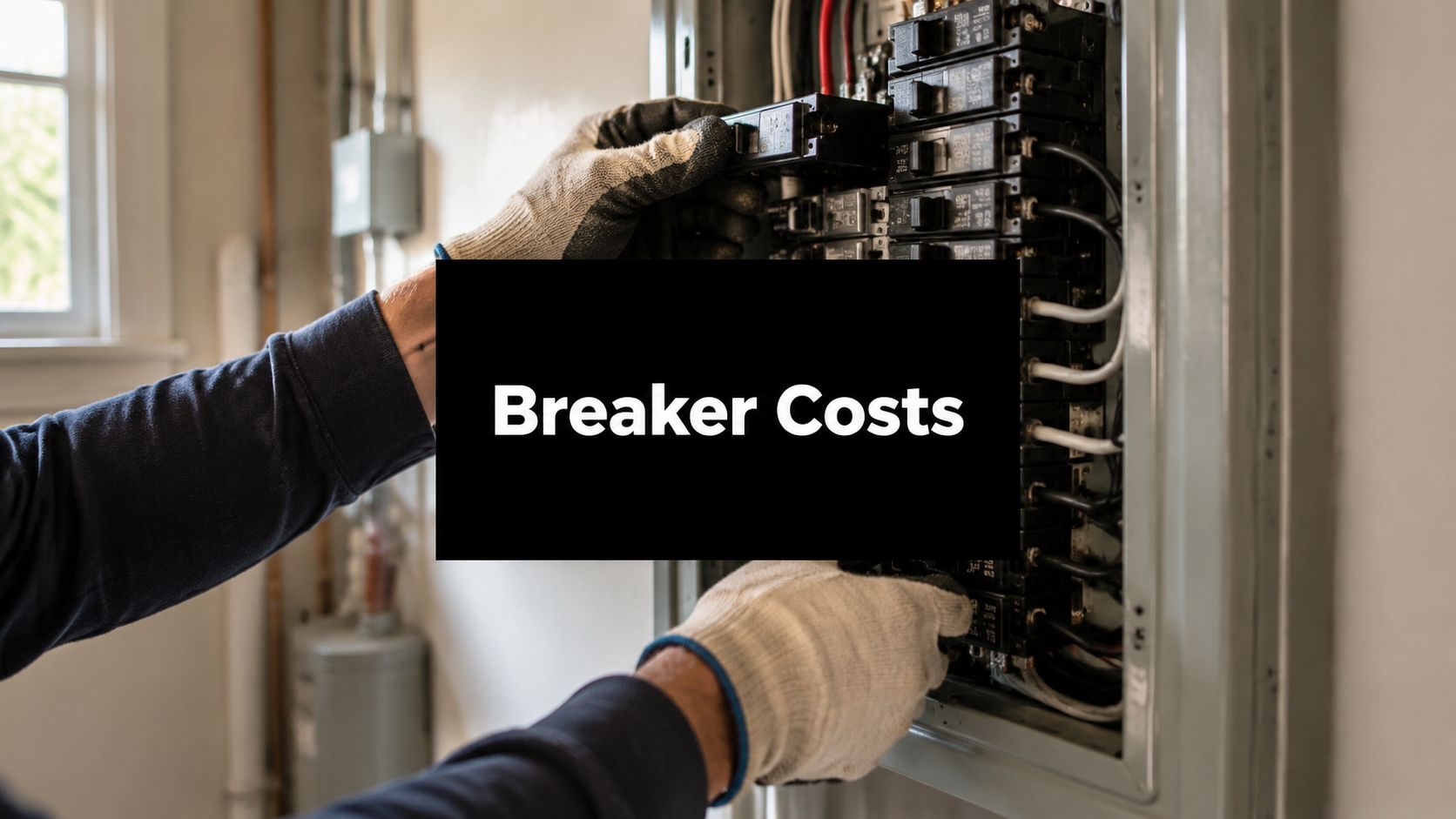
A standard single breaker replacement typically costs $100 to $260, while adding a new breaker usually runs $150 to $300. Once the job turns into main breaker work or a panel replacement, the total can move well past $600 and into the low thousands.
That's the part most homeowners in Weber, Davis, and Salt Lake County don't expect. The breaker itself is often the cheap piece, the labor, troubleshooting, accessibility, and code issues are what push the invoice up.
Breaker Replacement Cost at a Glance
A breaker call can look simple from the hallway and turn into a much bigger job once the panel cover comes off. A straightforward breaker replacement cost often lands in the $100 to $260 range, while adding a new breaker commonly runs $150 to $300. If the work expands into a main breaker replacement, the price often moves to $200 to $600, and a full panel replacement can reach $850 to $4,000 or more, depending on what the panel needs and whether the service itself has to be reworked. Those ranges line up with current cost guides from Homewyse and request a free electrical quote.
For homeowners in Northern Utah, the main cost driver is usually what the electrician finds after opening the panel. A breaker can be swapped fast if the part matches and the wiring is in good shape. The price climbs when the panel is crowded, the label is wrong, the breaker is obsolete, or the issue points to heat damage, loose connections, or a code problem that has to be corrected before the system is safe again.
Practical rule: if the quote starts low but the panel is older, crowded, or hard to access, expect the electrician to spend more time on diagnosis than on the actual replacement.
Labor is the other piece that surprises homeowners. Current industry cost guides, such as Angi, put electrical labor around $50 to $130 per hour, plus a $100 to $200 call-out fee in many cases. That is why a breaker that costs very little as a part can still produce a meaningful service invoice once troubleshooting, safety checks, and panel access are added in. A simple swap is one price. A panel with missing labels, outdated breakers, or failed components is a different job.
The hidden escalators are the ones that turn a small repair into a panel project. Diagnostic time matters. Obsolete parts matter. Code-required AFCI or GFCI upgrades matter too, especially when the existing breaker type no longer meets current requirements or the circuit has to be brought up to standard before the work is finished. In Northern Utah, permit rules can also add time and cost when the scope goes beyond a like-for-like replacement.
If a quote feels unclear, get the scope in writing before anyone starts work. Homeowners can request a free electrical quote and compare whether the price covers a like-for-like swap, a new breaker, or a larger panel issue.
Cost Breakdown by Breaker Type
Breaker pricing changes the moment the job moves from a standard circuit to a specialty device. A single-pole breaker handles a typical 120-volt branch circuit, while a double-pole breaker serves 240-volt loads. GFCI, AFCI, and dual-function breakers add safety features, and a main breaker controls the whole panel. The part price rises with each step, and the installed price usually rises even faster.
What the part price really tells you
A basic 1-pole 15 to 20 amp breaker is commonly about $3 to $20 for the part, while a 2-pole 15 to 20 amp breaker runs about $6 to $40. Add AFCI or GFCI protection, and the breaker itself often moves to about $25 to $120. A main breaker can run $100 to $500 before labor is added, which is why the quote changes so fast when the panel needs protection or capacity work rather than a plain replacement. Those figures come from LatestCost and Agway Energy.
| Breaker Type Cost Comparison | Part Cost | Installed Cost |
|---|---|---|
| Single-pole standard breaker | $3 to $20 | $10 to $60 |
| Double-pole standard breaker | $6 to $40 | $150 to $520 |
| AFCI or GFCI breaker | $25 to $120 | $110 to $480 |
| Main breaker | $100 to $500 | $150 to $800+ |
The installed range matters more than the part price because the electrician is also checking fit, panel compatibility, and whether the breaker type matches the circuit. A standard breaker swap is usually straightforward. Specialty breakers are different because they can require more troubleshooting, panel coordination, or code-driven changes to the circuit layout.
A useful comparison from current pricing guides shows how the market has settled into a broader, more standardized range in the 2020s. Standard residential replacement often lands around $100 to $400, while GFCI/AFCI breakers are commonly priced around $200 to $480 installed, and main breaker work is often quoted at $300 to $700 or more. That shift reflects the move toward better protection, not just a parts swap.
For local homeowners, that means two quotes for the same “breaker replacement” can be very different if one breaker is standard and the other is a safety upgrade. A licensed electrician looking at a panel in Ogden, Layton, or Kaysville will usually confirm whether the quote is for a simple replacement or a code-compliance device before the work starts. Homeowners seeking breaker replacement should always ask which breaker class is being installed and whether the panel accepts it without extra work.
Warning Signs Your Breaker Needs Replacement
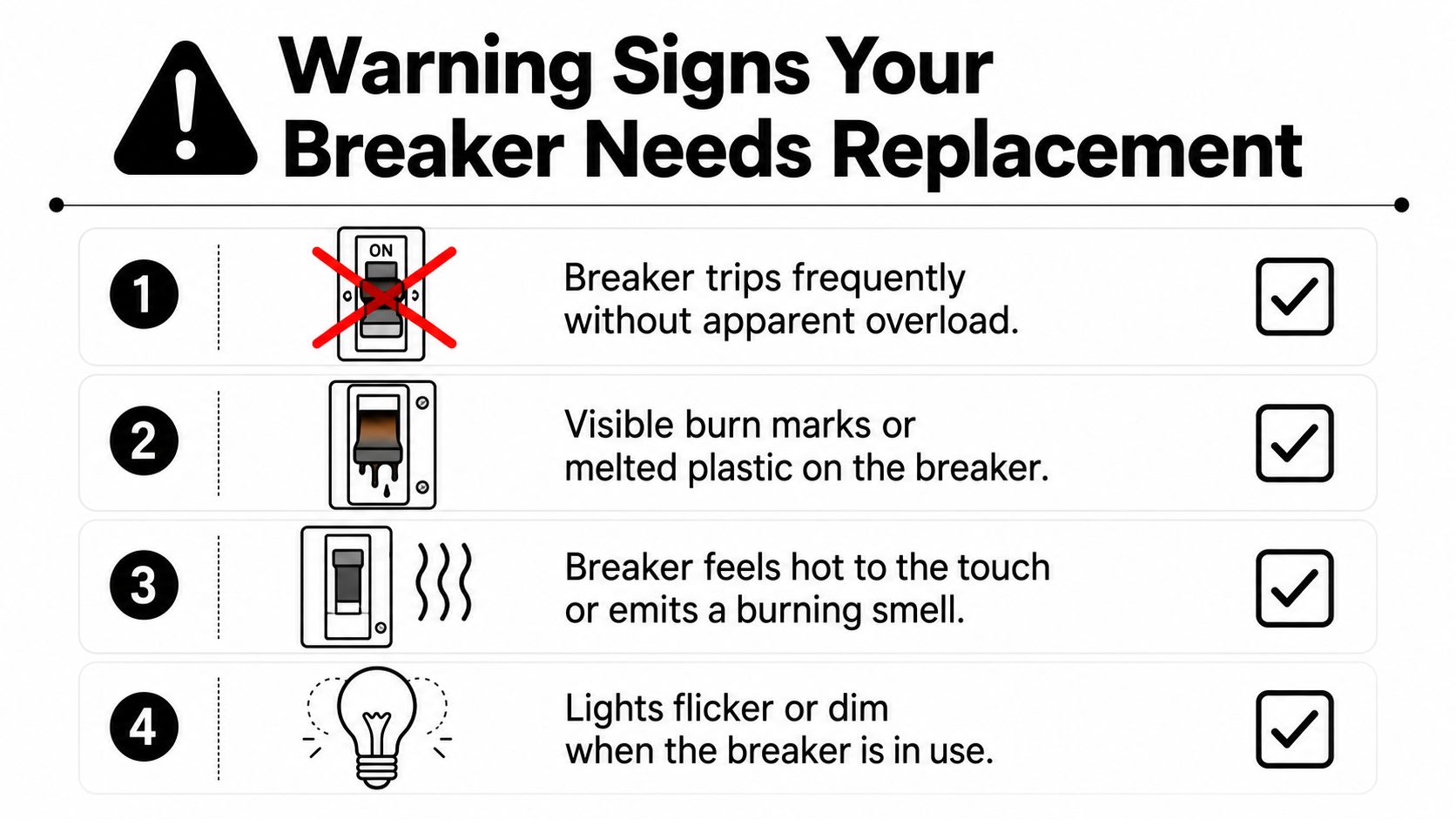
A breaker usually gives a few hints before it fails completely. Repeated tripping, a breaker that won't stay reset, heat at the panel, a burning odor, or visible discoloration all point to a circuit that needs attention. None of those symptoms should be dismissed as a nuisance, because the breaker may be protecting the circuit or it may be failing to do that job.
What homeowners can safely notice
A homeowner can usually spot a few warning signs without opening the panel. Look for a breaker that trips again and again, lights that dim when a large appliance starts, scorch marks near the panel door, or a smell that suggests overheating. A breaker that feels hot to the touch or seems loose in the panel needs a licensed electrician right away.
Do not ignore a burning smell near the electrical panel. A burning odor near the panel points to overheating at the circuit or connection.
What a licensed electrician checks
During a diagnostic visit, the electrician looks beyond the breaker itself. Load calculations help confirm whether the circuit is overloaded. Connection integrity matters because a loose termination can create heat even if the breaker still operates. Bus bar condition also matters, since worn or damaged bus bars can make a replacement breaker fail again.
Wire sizing is part of the check too. If the wire is undersized for the breaker, swapping the breaker alone will not solve the problem. That is why repeated tripping often leads to troubleshooting rather than a quick parts change. Homeowners dealing with a breaker keeps tripping issue should expect the electrician to test the circuit, not just reset it and leave.
A breaker can also fail because of age, internal wear, or a larger panel issue. In those cases, the breaker is the symptom, not the cause. A cheap replacement that fails again a week later costs more in the long run than a proper diagnosis on the first visit.
What Drives the Final Invoice Beyond the Part Price
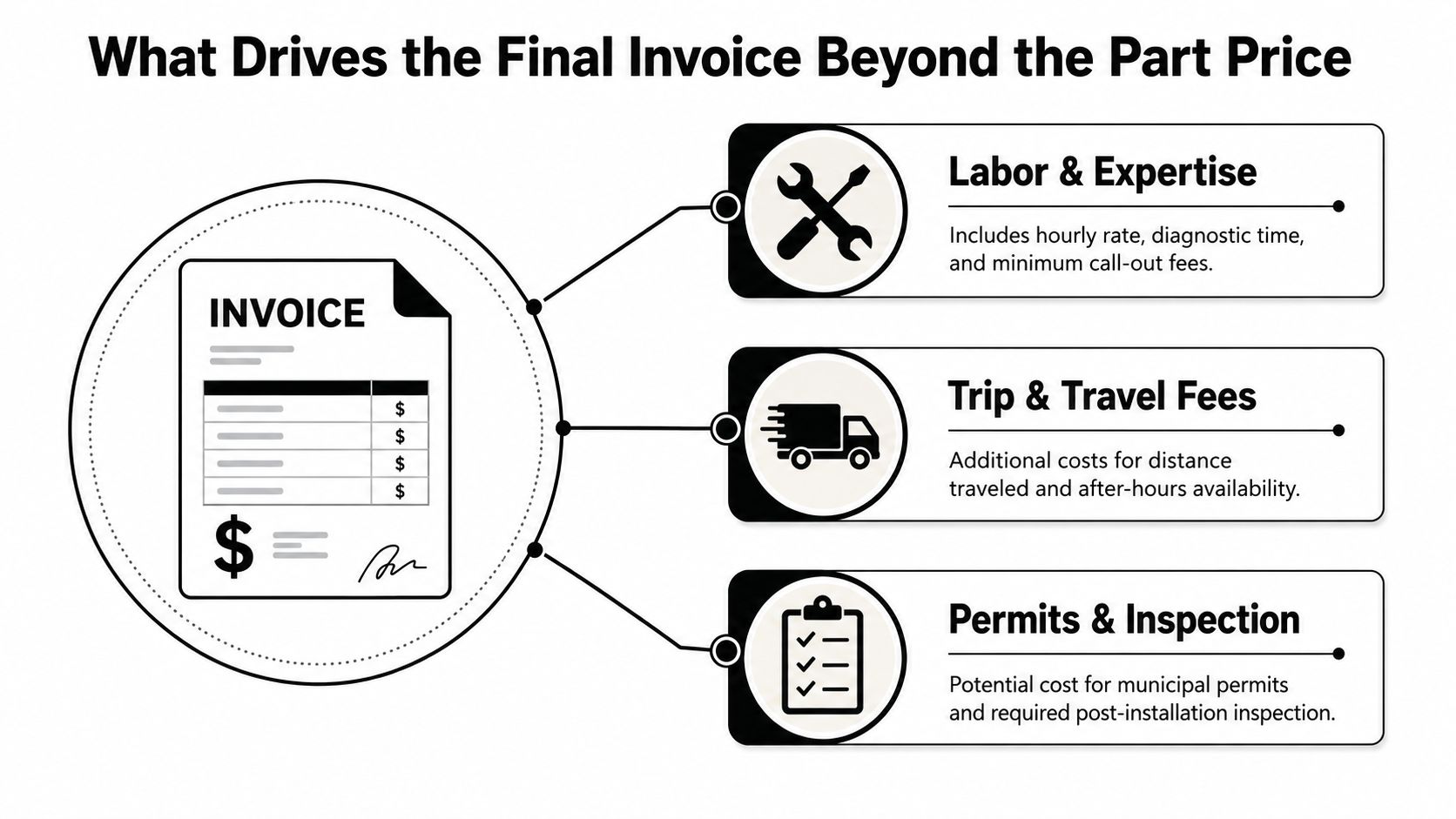
The invoice rises when the job stops being a device swap and starts becoming a service call. Labor, diagnosis, access, and compatibility all matter, and those are the line items that turn a small repair into a much larger one. A breaker may be inexpensive, but the electrician's time and the panel's condition decide what the work really costs.
Labor, access, and diagnostics
Electrical labor often lands in the $50 to $130 per hour range, and many jobs also carry a $100 to $200 call-out fee. That structure explains why a breaker with a low retail price can still generate a meaningful invoice. If the panel is cramped, in a garage corner, or packed with old wiring, the electrician spends more time just getting to the problem safely.
Diagnostics can also uncover issues that aren't obvious from the outside. A failed breaker might be tied to panel wear, a bad connection, or obsolete parts that are harder to source. Once the electrician has to test, trace, and verify the whole circuit, the bill reflects that work instead of only the breaker itself.
Permit realities and code upgrades
Northern Utah municipalities can require permits and inspections for some breaker and panel work, especially when the service scope grows. That's where the final number moves again. A code-driven upgrade to AFCI or GFCI protection can change a standard repair into a compliance job, which is why a quote should always say whether the breaker is being replaced like-for-like or upgraded for safety.
For homeowners comparing labor expectations, the electrician pricing guide for homeowners is a useful way to understand why the service call matters as much as the part.
A low breaker price is only a good deal if the panel is healthy, compatible, and easy to work in.
That's the budget trap. The breaker may cost little, but the invoice reflects the time needed to diagnose the fault, confirm safe installation, and make the panel compliant for the circuit it serves.
Why DIY Breaker Replacement Carries Real Risk
A breaker swap looks simple until you are standing at an open service panel. The work happens in a live electrical box, where arc flash, shock, and a loose termination can turn a small repair into a dangerous one. The hazard goes beyond touching the wrong wire. It also includes installing the wrong breaker type, the wrong amperage, or a breaker that does not match the panel.
Homeowners can handle only a narrow slice of the job. They can identify which circuit tripped, turn off the loads on that circuit, and reset a breaker that clearly tripped once. Stop there if the breaker will not reset, trips again, smells hot, or shows signs of damage.
Anything inside the panel that needs testing or replacement belongs with a licensed electrician. That includes confirming breaker fit, checking termination torque, and verifying that the breaker matches the circuit and panel design. If the work is done without a permit or inspection, the problem can show up later in insurance paperwork or during a sale, especially when there is no code review on record.
Practical rule: if the breaker is hot, discolored, or part of a recurring problem, the panel needs a professional diagnosis, not a guess.
Northern Utah homes add another layer of risk. Older panels are often crowded, and some are already carrying more load than they were built for. A quick DIY swap can make the issue disappear for a while, but it does nothing for poor connections, bus bar wear, or a circuit that does not belong in that panel. That is why breaker work belongs in the same category as the rest of the panel, not as a casual weekend repair.
For homeowners trying to separate a simple fix from a bigger electrical project, the Utah electrical panel upgrade cost gives useful context on how fast panel work can move beyond the price of a single breaker.
When a Panel Upgrade Makes More Sense Than a Breaker Swap
A breaker replacement makes sense when the trouble is limited to one device and one circuit. A panel upgrade makes more sense when the panel itself is the problem. Repeated failures, damaged bus bars, obsolete breaker availability, or clear signs of an aging service cabinet usually mean the cheaper repair is only buying time.
That is where hidden cost escalators show up. Diagnostic time can turn a simple service call into a longer visit, especially when the electrician has to trace recurring trips, verify breaker compatibility, and check whether the circuit is overstressing the panel. Obsolete parts add another layer, because some older panels take specialty breakers that are harder to source and cost more when they are still available.
Code requirements can also change the bill fast. If the circuit now needs AFCI or GFCI protection, the work may no longer be a straight breaker swap. The electrician may need to correct more than the failed part, and that can push the job toward a panel project instead of a small repair.
Full panel replacement costs can climb quickly. A 2026 Angi guide places the national range at $519 to $2,187 with an average of $1,342, and notes the total can rise to $4,500 when the panel has to be moved or the home's amperage needs to expand. Broader pricing data also shows full panel replacement can reach $850 to $4,000 or more, depending on scope and complexity.
Signs the panel may be the bigger issue
A panel upgrade is often the better call when the same circuit keeps failing, the panel brand is outdated, or the bus bars show wear. If the panel cannot accept the breaker type needed for the circuit, the problem is no longer a single device. It becomes a compatibility or capacity issue.
That matters even more in homes adding EV charging, hot tubs, remodel circuits, or other new loads. A panel that once handled the house may run out of headroom fast once the electrical demand grows. For homeowners comparing the larger project cost, the Utah electrical panel upgrade cost gives useful context on how quickly panel work can move beyond the price of one breaker.
What a sensible upgrade decision looks like
A good electrician does not recommend panel replacement just because a breaker failed. The decision usually comes after checking panel condition, breaker compatibility, and whether the service can safely handle the load. If the panel is modern and healthy, a breaker swap is the right fix. If it is not, replacing the breaker may only delay a much larger and more expensive service call.
For homeowners trying to separate repair money from a bigger electrical project, some people compare the decision the same way they'd compare financing options. A resource like find hard money lenders in Utah County may help with larger renovation planning, but electrical safety work still has to be judged on the panel's actual condition, not on a quick guess. Black Rhino Electric also handles panel work for homes and businesses, including electrical panels and meters, so the evaluation can cover both the breaker and the service equipment around it.
Real Northern Utah Scenarios and What They Cost
A homeowner in Roy calls because a single bedroom circuit keeps tripping. The panel is modern, the breaker is standard, and the electrician can verify that the circuit itself is the issue, not the service equipment. In a case like that, the job usually stays in the $100 to $260 replacement range, because the work is limited to one breaker and one circuit, with no panel rebuild or special sourcing needed.
A different call comes from a house in Kaysville with an older panel, a failed double-pole breaker, and a circuit that now needs AFCI protection to match current safety expectations. That's a much different repair. The electrician may have to source a specialty breaker, check panel compatibility, and confirm whether the panel can accept the upgrade without wider corrections. A job like that can move from a simple swap into the $150 to $800+ zone depending on the breaker class, panel condition, and whether more work is required.
If a property owner is weighing repair money against another major project, some people compare the decision the same way they'd compare financing options. A resource like find hard money lenders in Utah County may help with bigger renovation planning, but electrical safety work still needs to be judged on the panel's actual condition, not on a quick guess.
The lesson is that two neighbors can hear “breaker replacement” and get completely different quotes. One has a clean swap. The other has a panel problem dressed up as a breaker problem.
Black Rhino Electric helps homeowners and businesses across Marriott-Slaterville, Ogden, Layton, Clearfield, Bountiful, Farmington, Kaysville, Salt Lake City, and nearby communities with breaker work, panel repairs, troubleshooting, and upgrades. If a breaker keeps tripping or a quote looks higher than expected, call 385-396-7048 or send a request through Black Rhino Electric for a clear on-site evaluation and a practical price for the work that needs to be done.