A homeowner in Layton adds an EV charger, or a family in Ogden finishes a basement and wires a hot tub. Then someone notices the garage panel is full, the lights flicker under heavy use, or the old 100-amp service looks like it has already done enough work. The right answer in an electrical panel upgrade vs subpanel decision depends on capacity, not just on how many breaker spaces remain.
Why Northern Utah Homeowners Ask About Panel Upgrades and Subpanels
A Layton homeowner adds an EV charger, a family in Ogden finishes a basement, or a Salt Lake County garage gains a hot tub and workshop tools. The question is not just whether the breaker box has open spaces. The electrician must calculate what the home will run at the same time, then compare that demand with the existing service.
Older homes across Weber, Davis, and Salt Lake counties were built for lighter electrical use. Today, the same service may support electric heating equipment, an EV charger, a hot tub, a finished basement, and backup-power equipment. That combination can expose a capacity limit even when the panel still has room.
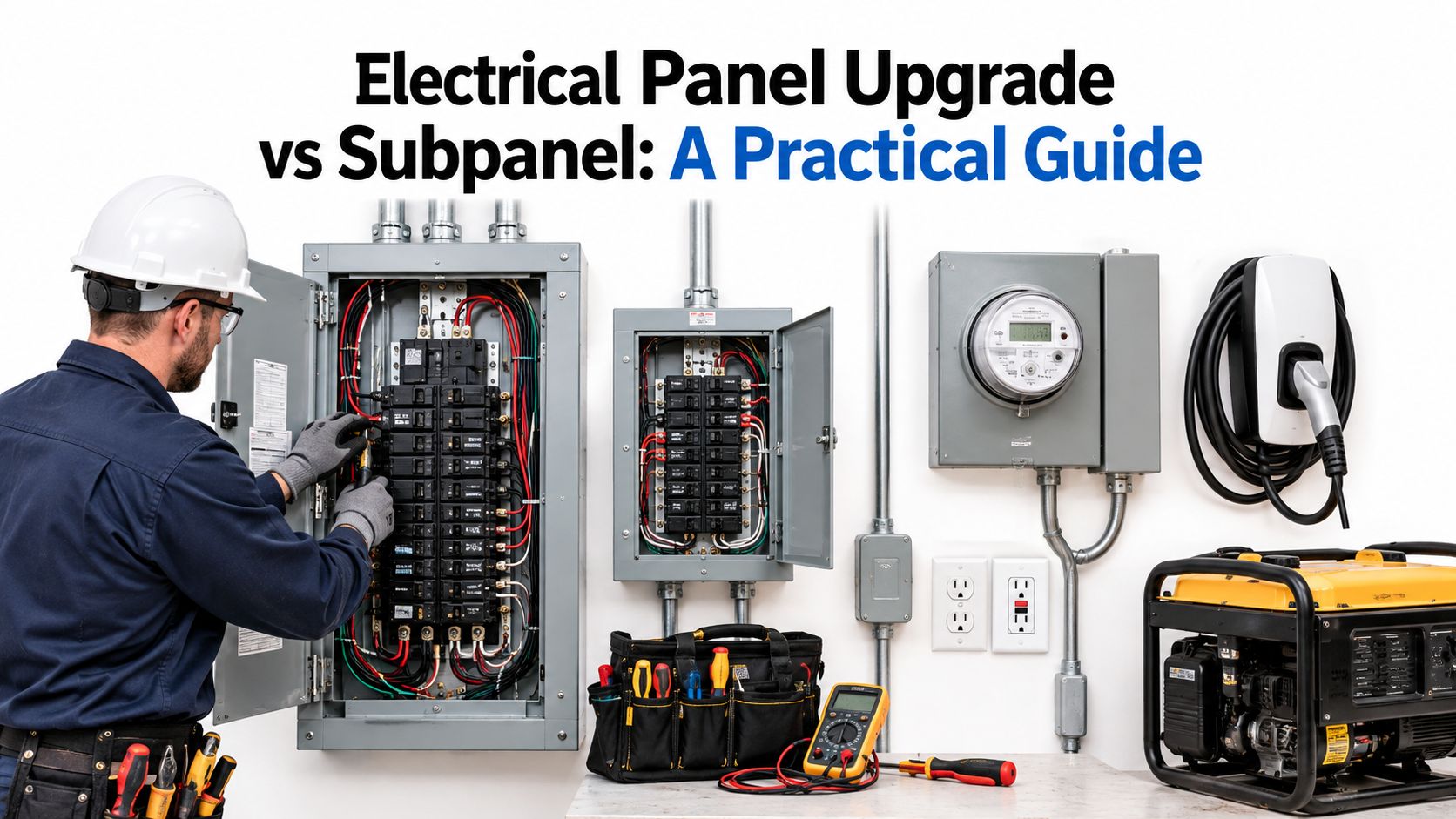
A panel upgrade replaces the main service equipment and can increase the property's available amperage. A subpanel is a secondary panel fed from the existing main panel. It provides more breaker spaces and organizes circuits closer to a garage, addition, or detached structure. It does not increase the property's total service capacity. Guidance on subpanel capacity and panel upgrade guidance supports that distinction.
Space is not the same as capacity
A crowded breaker box creates a distribution problem. An undersized service creates a load problem. A subpanel solves the first condition, not the second.
If a home has a 100A service, adding a subpanel leaves the property with 100A of total service capacity. Every new circuit still draws through the same upstream service. A service upgrade, such as moving from 100A to 200A, changes the maximum current available at the utility service level.
Practical rule: Choose a subpanel for circuit organization and location. Choose a service upgrade when the load calculation shows the home needs more capacity.
That calculation should include planned electrification and backup power, not just today's appliances. Ask what the home must run simultaneously, whether the existing service can support it, and whether the proposed setup leaves room for the next project.
The Core Difference Between a Panel Upgrade and a Subpanel
A garage remodel in Layton can expose the difference quickly. The main panel may have no open breaker spaces, while the home's service still has enough capacity for the planned circuits. In that case, a subpanel can organize the work. If a load calculation shows the service cannot support a heat pump, EV charger, electric range, or backup-power equipment together, adding another panel will not solve the problem.
Panel Upgrade vs Subpanel at a Glance
| Factor | Panel Upgrade | Subpanel |
|---|---|---|
| Scope of work | Replaces or upsizes the main service equipment and may require larger service conductors, a new meter base, and utility coordination. | Adds a secondary distribution panel fed from the existing main panel. |
| Effect on service amperage | Increases actual service capacity when the load calculation and utility equipment support the new rating. | Adds breaker positions, but total service capacity remains capped by the upstream service. |
| Typical cost band | Usually broader because service equipment, conductors, meter work, permits, utility coordination, and corrections may be involved. | Cost depends on panel size, location, wiring distance, trenching, access, and required corrections. |
| Permitting complexity | Often involves a service disconnect, inspection, meter equipment review, and utility approval. | Still requires proper permitting and inspection, especially for feeder, grounding, and local building work. |
| Effect on resale | Can address an undersized or obsolete service and document a larger electrical supply. | Can provide organized expansion for a garage, workshop, addition, or detached building when the main service has adequate headroom. |
| Timeline | May take longer because service equipment and utility scheduling must align. | Often has a simpler scope, though distance, trenching, access, and corrections can change the schedule. |
| Best-fit situation | The existing service is undersized, heavily loaded, obsolete, or unable to support planned electrification. | The existing service has capacity, but the project needs more local circuit spaces or a cleaner feeder layout. |
A subpanel's bus rating, commonly 60A, 100A, or 125A, does not create utility capacity. If the main service is 200A, the combined loads across the main panel and subpanel must remain within that 200A ceiling. The feeder also needs correctly sized conductors, overcurrent protection, grounding, and bonding.
That distinction matters for backup power. A subpanel may organize selected generator-backed circuits, but it does not create additional service capacity for the home. The service upgrade decision should account for planned electrification and the equipment expected to operate during an outage.
For a garage or recreational vehicle area, RV wiring basics for new buyers reinforces why circuit organization and total capacity are separate questions. For panel terminology, see what is a subpanel. Choose the equipment that matches the load calculation, not just the panel's available breaker spaces.
How an Electrician Decides Which Option You Actually Need
A licensed electrician starts with a load calculation, not the empty spaces in the breaker box. The calculation accounts for existing fixed loads, proposed equipment, and applicable NEC demand factors. That math shows whether the service can carry the planned combination safely.
For a remodel, the electrician may review the home's heating equipment, range, water heating, air conditioning, EV charging, hot tub, workshop equipment, and other significant loads. A dedicated circuit can still be necessary even when the overall service has room, but the service rating determines the ceiling for the property as a whole. Homeowners planning additions can review this explanation of a load calculation for remodel projects.
Warning signs that change the recommendation
Several conditions point beyond a simple space shortage:
- Frequent heavy-load trips: Repeated trips when major appliances run can indicate that the service or a branch circuit is strained.
- Older service equipment: A 60-amp panel, fuse box, or system with no main breaker deserves a closer evaluation before new loads are added.
- Questionable previous work: Double-tapped breakers, loose terminations, damaged conductors, or an unlabeled panel can require correction before expansion.
- Aging meter equipment: A meter base that predates much of the home's current electrical demand may not be suitable for a larger service.
- Known hazardous equipment: A panel on a recall or safety concern list shouldn't be expanded by attaching another box.
A subpanel also can't repair deteriorated aluminum service conductors, correct an unsafe main panel, or solve a service that already reaches its calculated capacity. It only redistributes available power. That's why a homeowner can spend money on a subpanel and still be unable to add the intended EV charger, hot tub, or basement equipment.
The recommendation should be made before price enters the conversation. If capacity is adequate, a subpanel can be the clean, sensible choice. If the service is undersized or compromised, an upgrade is the responsible starting point.
Real Northern Utah Projects That Tip the Decision
A homeowner in Roy may ask for a subpanel after buying an EV charger. The right answer depends on the home's calculated load, not merely on whether the main panel has open breaker spaces. Service capacity, existing equipment, and the loads expected to run together determine whether a subpanel is appropriate.
EV charger
A Level 2 EV charger in a Roy garage may work well with a subpanel when the home has a 200A service and enough calculated headroom. The subpanel can group the charger with garage circuits, shorten branch-circuit runs, and leave the main panel more organized.
An older home with a 100A service may need a panel upgrade instead, particularly when electric heating, a range, hot tub, or other large loads already operate there. The charger uses capacity from the whole home, not just the garage. If the homeowner may later add a heat pump, electric water heating, solar equipment, or backup power, the electrician should evaluate those future loads before choosing the smaller project.
Hot tub
Hot tub wiring usually requires a dedicated circuit and the specified protection. When the calculated service load has room, a nearby subpanel may provide a practical route for that circuit. If the service is already near capacity, the hot tub can reveal the need for a full upgrade.
Basement finish
A finished basement in an Ogden home often suits a subpanel when the service can support the planned lighting, receptacles, bathroom equipment, and other circuits. Local distribution can make the wiring easier to identify and reduce long runs to the main panel.
The recommendation changes when the basement includes electric space heating, workshop equipment, or several other substantial loads. Those additions belong in the whole-home load calculation. Treating them as ordinary receptacles can leave too little capacity for later electrification or backup-power equipment.
Detached garage or shop
A detached garage near Layton or Bountiful generally benefits from a separate subpanel because a feeder provides organized local distribution. The feeder route, distance, grounding, planned equipment, and available service capacity all affect the design. A detached structure also needs its own grounding arrangement, including a separate grounding electrode system, rather than relying only on the home's grounding connection (detached structure grounding guidance).
| Project | Typical Existing Service | Deciding Factor | Likely Call |
|---|---|---|---|
| EV charger | 200A service with available headroom | Charger load plus existing major equipment | Subpanel may fit |
| Hot tub | Varies by home age and existing loads | Total calculated demand and required dedicated circuit | Subpanel or upgrade |
| Basement finish | Older 100A or larger modern service | Heating and other major basement loads | Subpanel if capacity is adequate |
| Detached garage | Main service with feeder path available | Distance, grounding, future equipment, and service headroom | Separate subpanel, upgrade if the property lacks capacity |
The highest-risk combination is an EV charger, hot tub, and finished basement in an older Ogden home. Together, those loads can expose a 100A service limitation. A single lower-demand addition may need only better circuit distribution, while a home planned for broader electrification or backup power may justify upgrading the service now.
Permits, Codes, and Inspections in Weber Davis and Salt Lake Counties
Panel work affects service equipment, feeders, grounding, clearances, and sometimes utility coordination. A homeowner should not improvise inside an energized panel. The 2023 NEC is the current edition used for modern electrical guidance. Subpanel installations commonly involve NEC Article 225 for outside branch circuits and feeders and Article 408 for panelboards. Service sizing follows NEC Article 220 load calculations, which determine whether the home has enough capacity for planned electrification or backup-power equipment.
In Weber and Davis counties, the applicable county building department generally handles the project, while a state-licensed electrical contractor manages the residential electrical permit. Incorporated cities in Salt Lake County commonly issue permits through their own building divisions. Unincorporated properties use the county process. The property address determines the correct authority, so confirm it before scheduling the work.
What the inspection is checking
A service upgrade may require a planned disconnect coordinated with the serving utility. Before re-energization, the inspector and utility verify the meter base, service-entrance conductors, grounding, bonding, and equipment ratings.
Inspectors commonly flag:
- Insufficient working clearance around the panel.
- Missing AFCI or dual-function protection on applicable new circuits.
- Incomplete panel directories that fail to identify circuits clearly.
- Improper neutral and ground separation in a subpanel.
- Incorrect feeder protection, where the upstream breaker exceeds the feeder or panel rating.
A subpanel requires a 4-wire feeder: two hot conductors, one neutral, and one equipment grounding conductor. The neutral bus remains isolated from the enclosure, while the ground bus bonds to it, as required by NEC Article 408 and applicable feeder rules. The feeder breaker must stay within both the feeder ampacity and the subpanel bus rating.
Permit timing matters. Ask about the applicable permit requirements for panel upgrades before ordering materials. A proper load calculation and early inspection review prevent a breaker-space solution from passing initial review while leaving the home short of capacity for an EV charger, heat pump, or backup system.
What Happens During a Professional Panel or Subpanel Visit
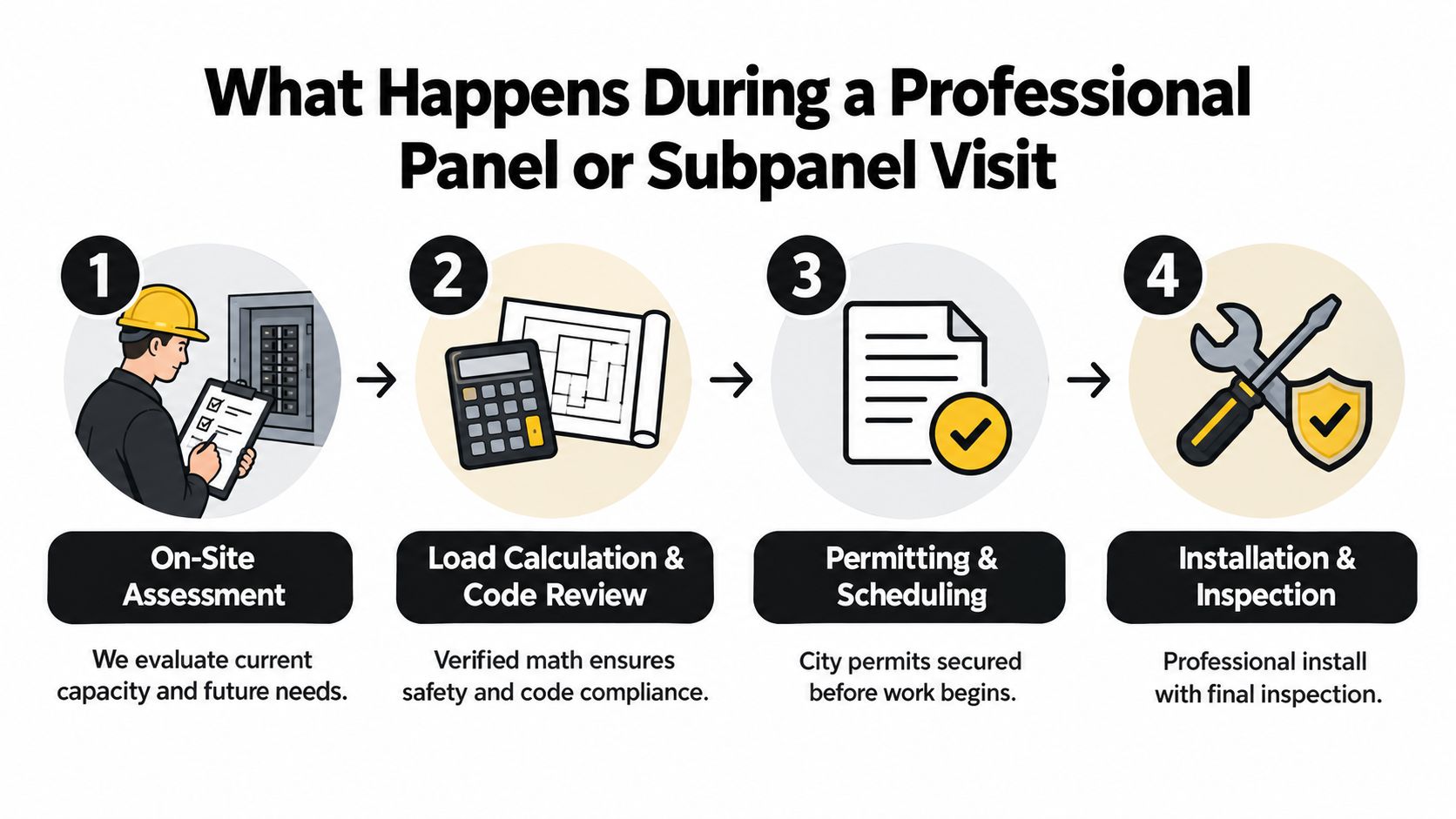
A well-run service visit starts with assessment, not a sales pitch. The electrician examines the existing panel, identifies the service rating, reviews visible previous work, considers the planned loads, and documents conditions that could affect the project.
The assessment and proposal
The load calculation follows the NEC Article 220 method. It compares present demand with the proposed equipment and helps determine whether the home needs more service capacity or a better distribution point. The written proposal should identify the panel rating, breaker spaces, feeder or service work, meter base requirements, utility coordination, permits, and inspection responsibilities.
Installation and closeout
On installation day, the household should expect a planned power shutoff. The crew protects floors and nearby belongings, completes the approved scope, checks terminations and labeling, and leaves the work area orderly when power is restored.
The process ends with the city or county inspection and, for a service upgrade, utility re-energization. The homeowner should receive a clear panel directory and an explanation of what changed. Black Rhino Electric provides electrical panel installation along with panel, breaker, meter, and related residential electrical services in Northern Utah.
The Decision Checklist and When to Call Black Rhino Electric
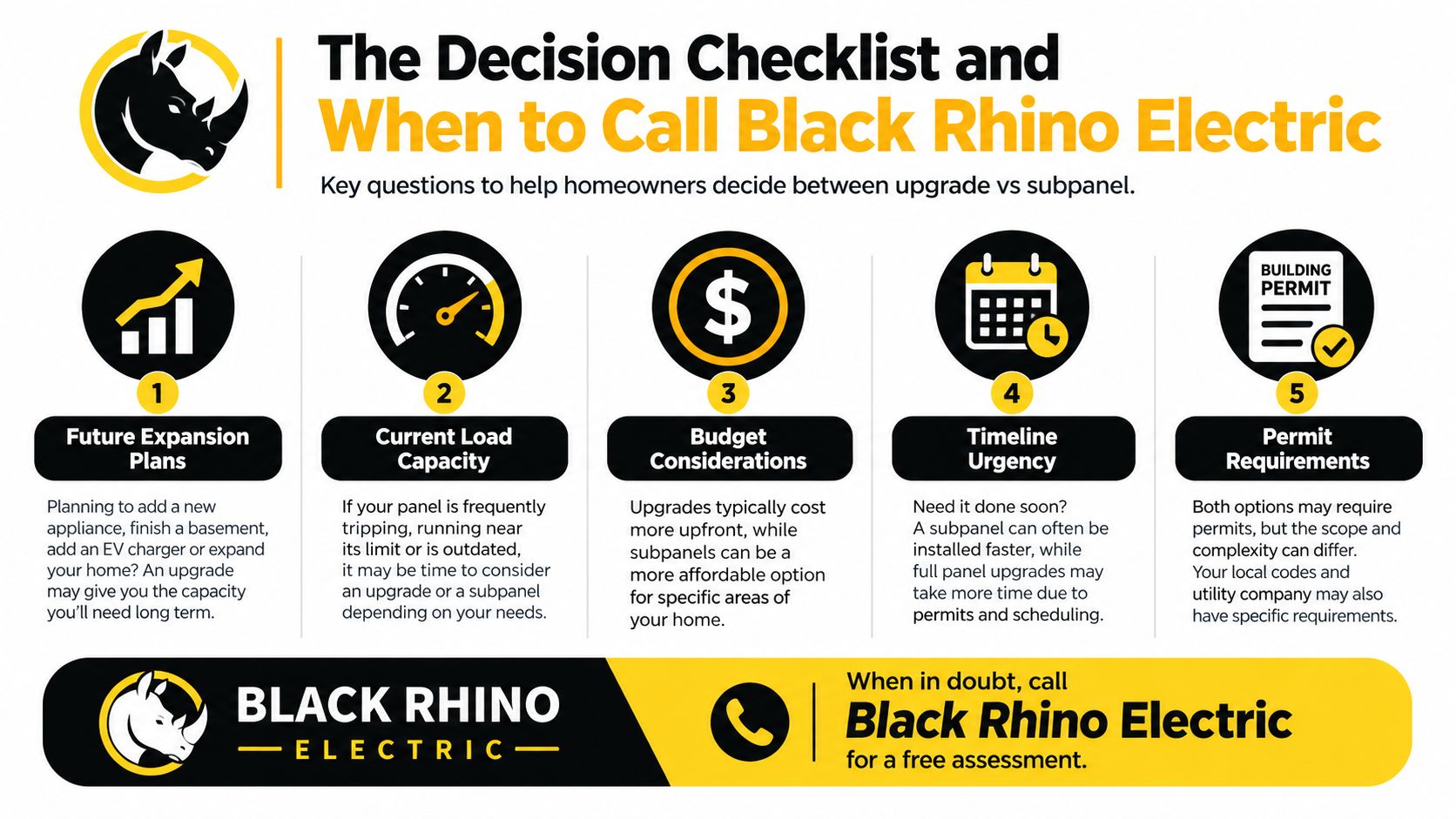
The right choice depends on calculated capacity, not the number of empty breaker spaces. A service upgrade can support future electrification and backup power, while a subpanel may solve distribution problems without replacing the main service.
Use this checklist before approving either scope:
- Service headroom: Did an electrician complete a load calculation, or is the recommendation based only on available breaker spaces?
- Simultaneous demand: Could the EV charger, hot tub, electric heating, kitchen equipment, and workshop loads run at the same time?
- Circuit location: Are new circuits concentrated in a garage, basement, addition, or detached structure where a local panel would shorten feeder runs?
- Future equipment: Is the household considering battery backup, a generator transfer switch, solar-related work, or managed loads? Subpanels can isolate selected backup loads, and neutral-ground separation must follow NEC Article 408 (whole-home backup load-center guidance).
- Property plans: Would a documented service upgrade better support remodeling plans or resale expectations?
For a capacity-based recommendation, request a free electrical quote. Black Rhino Electric can determine whether the home needs more amperage, more circuit space, or corrections before either project proceeds.
Black Rhino Electric handles panel and subpanel work, EV charging equipment, hot tub wiring, troubleshooting, and backup-power connections in Weber, Davis, and Salt Lake counties. Visit Black Rhino Electric or call 385-396-7048 for a load-calculation-driven assessment.