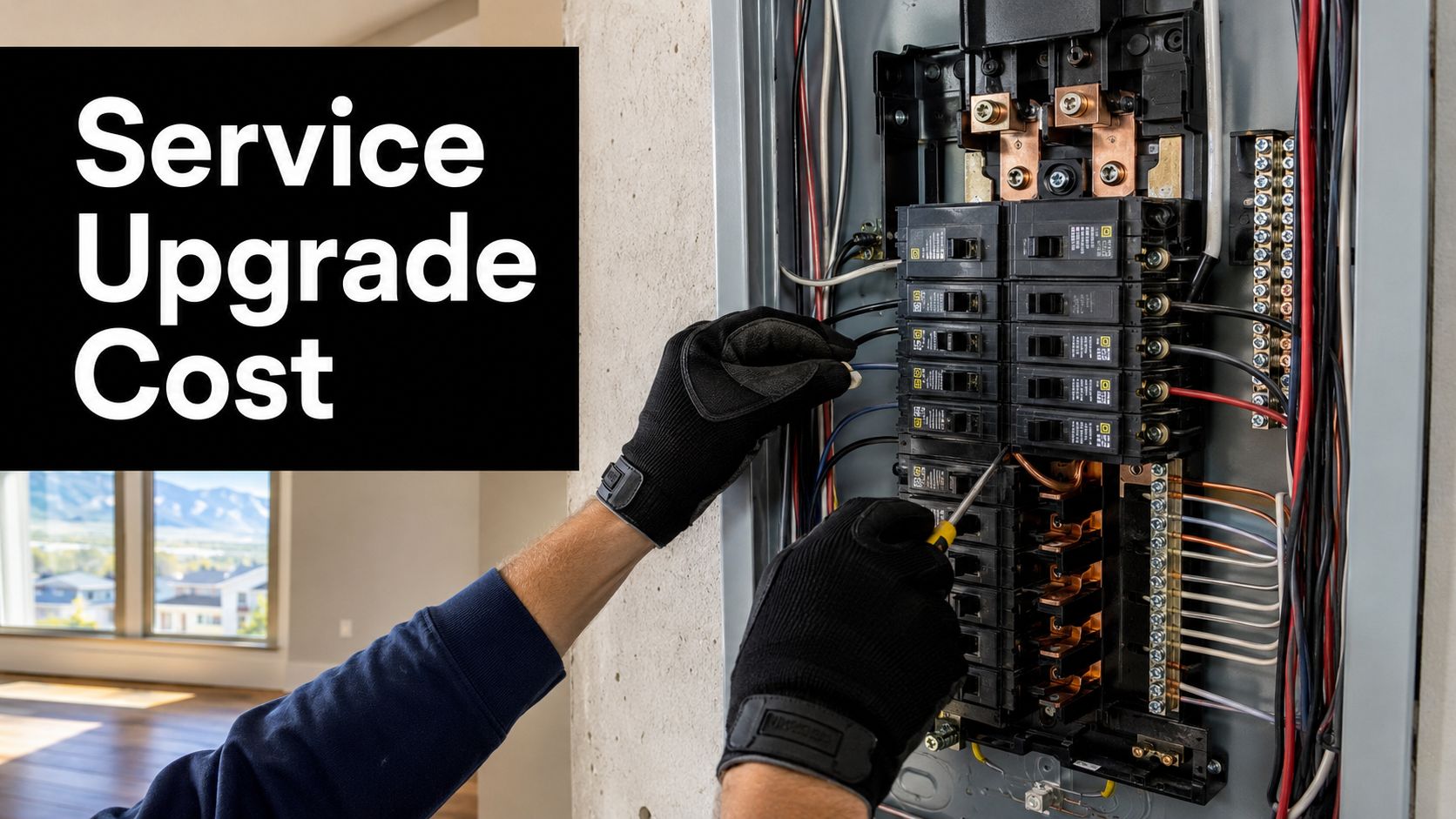
A standard 100-amp to 200-amp residential service upgrade typically costs $1,300 to $4,000 for straightforward jobs, and many land in the $1,300 to $3,000 range. The price climbs fast when utility coordination, trenching, or legacy wiring is part of the job.
That's the part many Northern Utah homeowners run into after adding an EV charger, hot tub, basement finish, or electric appliances. A quote that looks reasonable on paper can turn into a bigger project once the electrician sees what's feeding the house.
What an Electrical Service Upgrade Actually Means
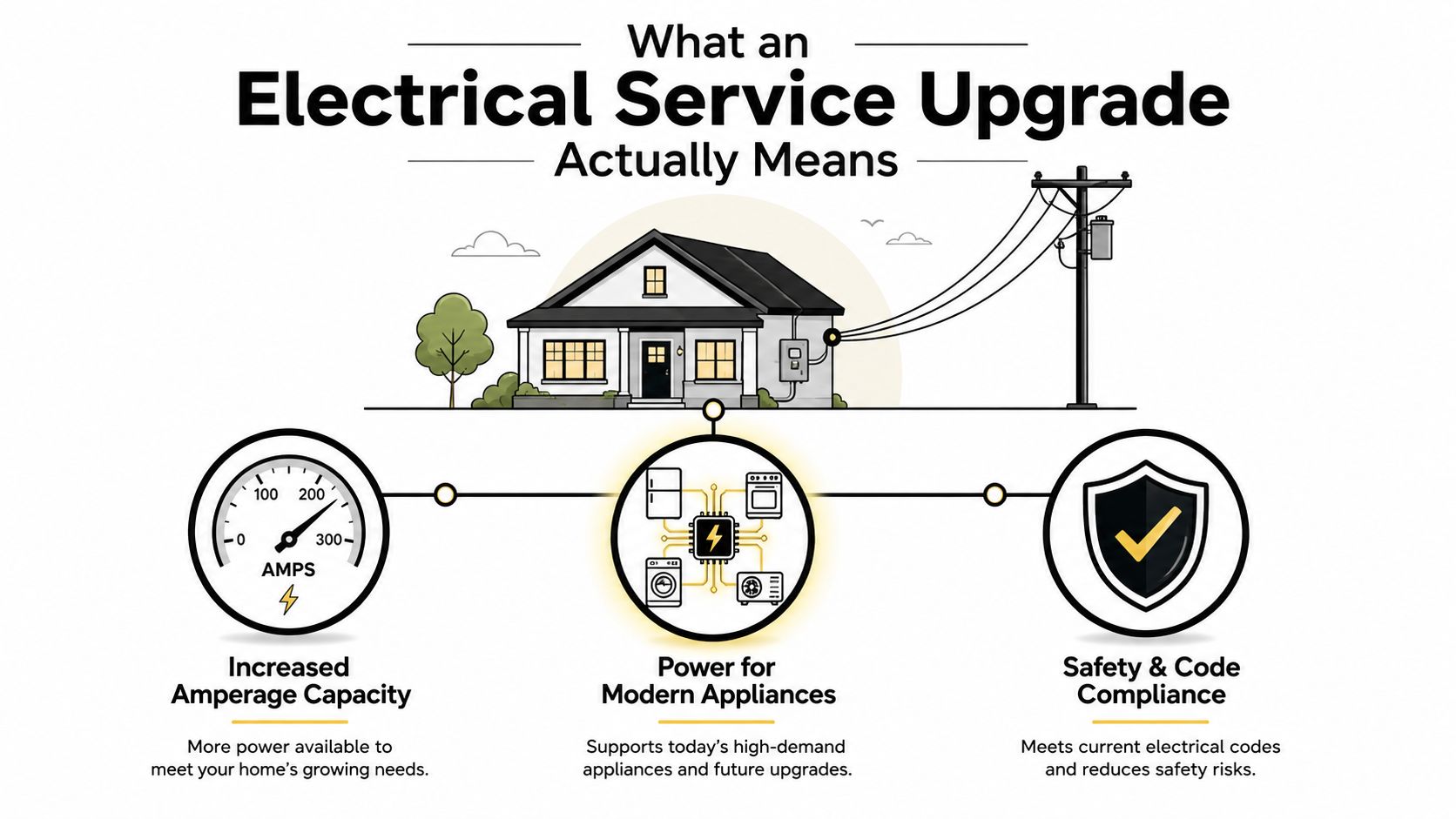
A lot of homeowners in Ogden, Layton, Roy, and older pockets of Salt Lake County think they need a new panel when the core issue is the amount of power the home can legally and safely draw from the utility. An electrical service upgrade raises that capacity. It's not just a metal box change, it's a capacity change from the utility connection inward.
A water line serves as a useful analogy. The panel is part of the distribution system inside the home, but the service wire and utility connection are the pipe feeding it. If that supply line is too small, a bigger panel alone won't solve the problem.
When the service, not just the panel, is the problem
Older homes with 60-amp or less service often run out of headroom once modern loads show up. EV charging, hot tubs, electric heating, and remodeled kitchens all stack demand quickly. That's why a house can look fine until a homeowner adds one more major circuit and the system starts showing its limits.
Warning signs are usually practical, not mysterious:
- Breaker trips under normal use. Not every trip means a bad breaker, but repeated trips under everyday loads deserve a load check.
- Lights dim or flicker when appliances start. That can point to a service issue, not just a loose bulb.
- Burning odors near the panel or meter area. That needs immediate attention from a licensed electrician.
- Insurance or inspection requirements. Some policies or sales inspections trigger upgrade discussions when the existing service is dated or undersized.
A true service upgrade usually involves more than the panel itself. It can include meter work, service conductor replacement, grounding updates, and utility coordination, which is why homeowners should treat it as a whole-system project, not a box swap. For homeowners comparing options, Black Rhino Electric's electrical panel upgrade page is a useful place to start if the question is whether the panel or the service needs attention.
Practical rule: if the problem appears only when several big loads run together, the service capacity deserves a look before any new appliance is added.
Realistic Service Upgrade Cost Ranges by Amperage
A homeowner gets a quote for a service upgrade, then the price jumps once the electrician opens the meter area and checks the utility side. That is normal. Online pricing often looks simple until the full scope surfaces, and the job starts to include conduit changes, grounding updates, or utility coordination that were never visible in the first number.
A standard 100A-to-200A residential upgrade is commonly listed at $1,300 to $4,000 for straightforward work, and modern guides often place similar projects in the $1,500 to $5,000 range (service upgrade cost guide, modern pricing guide). Once the service work expands beyond the panel, the quote stops behaving like a simple equipment swap and starts reflecting the full path of power into the house.
Cost ranges by scope
| Upgrade Type | Typical Cost Range | Key Cost Drivers |
|---|---|---|
| 100A to 200A residential upgrade | $1,300 to $4,000 | Panel, breakers, labor, permits, service-side work |
| 100A to 200A modern pricing range | $1,500 to $5,000 | Existing equipment, utility coordination, service changes |
| 200A to 400A upgrade | $4,500 to $18,000+ | Meter socket, main breaker, trenching, headroom constraints |
| Full service upgrade with utility coordination | $5,000 to $30,000 | Permits, utility work, transformer or pole/trenching work |
The spread gets wider as soon as the project leaves the indoor panel and touches the utility side. A straightforward overhead service upgrade can land around $3,500 to $5,500, while a job that needs trenching has been reported closer to $13,500 to $19,000 in contractor discussion (discussion of service upgrade pricing). Digging, restoration, and coordination add time, and that extra scope shows up fast in the final bill.
Regional pricing also shifts the number. The Western U.S., especially California, is commonly listed at $2,000 to $10,000+ for service upgrade work, while the Northeast is often $1,500 to $4,500, the Southern U.S. $1,300 to $3,500, and the Midwest $1,200 to $3,000 (regional pricing guide). Northern Utah usually falls somewhere between the simple-home end and the utility-heavy end, depending on whether the job stays overhead or turns into a trenching project.
For homeowners comparing quotes, Black Rhino Electric's panel upgrade costs and process article gives a clear view of what a standard service change includes and where a project starts moving into the higher range.
Where Your Money Goes in a Service Upgrade
A clean quote should separate the panel hardware from the work needed to make the service safe, legal, and ready for utility reconnection. The headline price alone does not tell the whole story. In the field, the cost usually comes from the parts you do not see at first glance, like meter-side work, grounding updates, trenching, and the time needed to get the utility and inspector on the same page.
The biggest share usually falls into a few buckets.
The panel and related gear are only part of the bill. That includes the panel itself, breakers, service conductors, meter socket, grounding rods, and the fittings needed to tie everything together correctly. Labor is the next major piece, and it covers the time spent at the wall, at the meter, and in the coordination that keeps the work code-compliant.
Permits also belong in the budget. Local permitting is a required part of the code-compliant process. If the scope changes, the permit scope often changes with it, especially once the work touches the service side.
Old equipment brings its own costs. Delivery, removal, and disposal are part of a real upgrade, because the old gear has to come out before the new service can go in. In older homes, hidden wiring issues can show up once the panel is opened and the service is examined. That is where a quote that looked tidy on paper starts to grow.
A basic panel replacement is typically $1,000 to $3,000 and can often be completed in 1 to 2 days when the existing service is adequate (panel replacement guide). A true full service upgrade costs more because the electrician is dealing with more than the indoor equipment. On older homes with 60-amp or less service, a 200-amp upgrade commonly brings added work, and if knob-and-tube wiring turns up, the repair scope can expand sharply as the service work exposes conductors that no longer match modern load and safety expectations.
That is why two quotes for the same house can look very different. One contractor may be pricing only the visible panel change, while another is including the meter socket, grounding improvements, utility-side work, and the cleanup needed to finish the job correctly.
For homeowners trying to read the fine print, the question is simple. What is included, and what is being treated as an extra? That is the same reason a permit question for a project like an EV charger matters. The scope drives the permit, not the homeowner's preference, and the same logic applies to service work as well, as discussed in does EV charger need a permit.
A quote that leaves out meter work, grounding, or utility coordination may only cover part of the project.
What a homeowner should ask
Before signing, ask whether the estimate includes the meter socket, service wire, grounding corrections, permit fees, inspection coordination, and disposal of the old equipment. Ask what happens if the electrician finds damaged legacy wiring once the service is opened up. Also ask what would trigger a change order, since that is usually where a low quote turns into a bigger final bill.
The Service Upgrade Process From Start to Finish
A service upgrade starts with a load assessment at the kitchen table or in the panel room, not with a promise on paper. A licensed electrician looks at what the home uses now, what it may need next, and whether the existing service can handle it safely. That review decides whether the job stays at the panel level or turns into a full service change with utility work, grounding corrections, and new equipment.
Permitting and utility coordination come next, and that waiting period often shapes the schedule more than the wiring itself. A panel replacement can move faster when the service is already suitable, but a full service upgrade can still stretch out while the utility, inspector, and electrician each do their part. Homeowners who want to upgrade your electrical panel should plan for that pause, because the project is not just an install day. It also includes approvals, scheduling, and making sure the scope matches what the permit office expects. If you want to avoid estimation errors with Revlit, the best move is to confirm what the quote includes before anyone starts pulling wire.
What happens on work day
On work day, the house is scheduled for a shutdown and the service gear is taken apart in a controlled order. The crew may remove the old panel, replace the meter-side equipment, install new service conductors, and correct grounding so the new service is tied in properly. If the home needs meter mast changes or other utility-side adjustments, that work has to fit the approved plan and the clearances the utility will accept.
Homeowners should make the site ready before the crew arrives. Clear access to the panel, meter, and any exterior equipment, move stored items away from the work area, and make sure someone can answer questions about attic access, crawlspace access, or older wiring paths if the electrician needs to trace anything. Power will be off for part of the day, so plan around refrigerators, medical devices, garage access, and anything else that cannot sit idle. The cleaner the prep, the less time the crew spends working around clutter or waiting on access.
Once the installation is complete, the utility reconnects service after the inspection and signoff are in place. If the final check is delayed, the home waits until the approval chain is finished. That is normal on service work, and it is one reason the same-looking upgrade can move smoothly on one house and stall on another.
The cleanest projects are the ones where the electrician, permit office, and utility all know the scope before the first wire comes off the wall.
Hidden Costs and Surprises That Inflate Your Quote
The quote that looks biggest at first sometimes ends up being the safer one. That's because service upgrades often pick up hidden scope once the electrician opens the system and sees how the house is fed. The biggest surprises usually come from the utility side, the meter side, or the age of the home itself.
Common adders that change the price
Utility-driven work is where budgets move fast. Trenching for underground service can add a major dig and restore phase, while mast or conduit relocation can be required if the overhead feed doesn't have enough clearance or the existing mast is undersized. Transformer upgrades or pole work can also push the job into a utility-coordinated category, which is where the range starts to open up.
Other adders are less visible but just as real:
- Mast or conduit relocation. Needed when the existing route won't pass inspection or doesn't meet clearance.
- Subpanel additions. Sometimes the home's layout needs a new distribution point after the service upgrade.
- Aging wiring repairs. Old branches may need correction once the panel work reveals how much of the system is dated.
- Additional permit fees. More scope often means more paperwork and inspection steps.
The main pitfall is comparing a panel-only quote with a full service quote. Much of the content people find online quotes a simple panel swap, but the actual price changes once meter work, grounding changes, or utility coordination are part of the job. That's why it helps to avoid estimation errors with Revlit when reading any contractor number, because a quote should spell out what's included and what isn't.
Utility allowances can also leave customers exposed. A study on electrification retrofits reported service-upgrade allowances of $2,154 for PG&E and $3,241 for SDG&E, while utility contractors reported customer payments to the utility could reach $300 to $16,000 or more when costs exceeded the allowance (service upgrades for electrification retrofits study). That gap is why the utility side needs attention early, not after the contract is signed.
Smart Ways to Budget and Plan Your Upgrade
A good budget starts with a scope review, not a guess. Homeowners in Weber, Davis, and Salt Lake counties should compare bids line by line and ask which parts include the panel, meter work, grounding, utility coordination, permits, and cleanup. If a quote feels vague, it usually is.
Planning for future load matters too. A house that's barely enough for today can become underpowered once EV charging, heat pumps, or a remodeled kitchen gets added later. The cost of undersizing a service can be higher than doing the right upgrade once, because a second round means another permit, more labor, and another utility appointment.
Questions that keep the budget honest
- What's included and excluded? Ask for the full list, not just the total.
- Is this panel-only or full service work? Those are not the same job.
- Will the utility need to coordinate? That can change timing and cost.
- What legacy issues could add scope? Old wiring, grounding, or mast problems can appear during the visit.
- How will future loads be handled? EV chargers and other large draws should be part of the sizing discussion.
For homeowners comparing broader budget decisions, New American Funding building costs offers a useful way to think about contingency planning, because the same principle applies here, a project budget works better when there's room for unknowns.
When the estimate is being gathered, homeowners can get an electrical estimate and ask for an itemized scope from a licensed electrician who works with local utility requirements. Black Rhino Electric handles residential and commercial panel work, meter work, troubleshooting, EV charger installation, and code corrections across Northern Utah, so the quote can reflect what the house needs instead of a generic number.
Black Rhino Electric helps homeowners and businesses in Northern Utah sort out panel upgrades, meter work, service changes, and the hidden scope that changes the final bill. If the next step is a clear, itemized assessment for a home in Weber, Davis, or Salt Lake County, visit Black Rhino Electric or call 385-396-7048 to request a quote through the team's local service desk.