
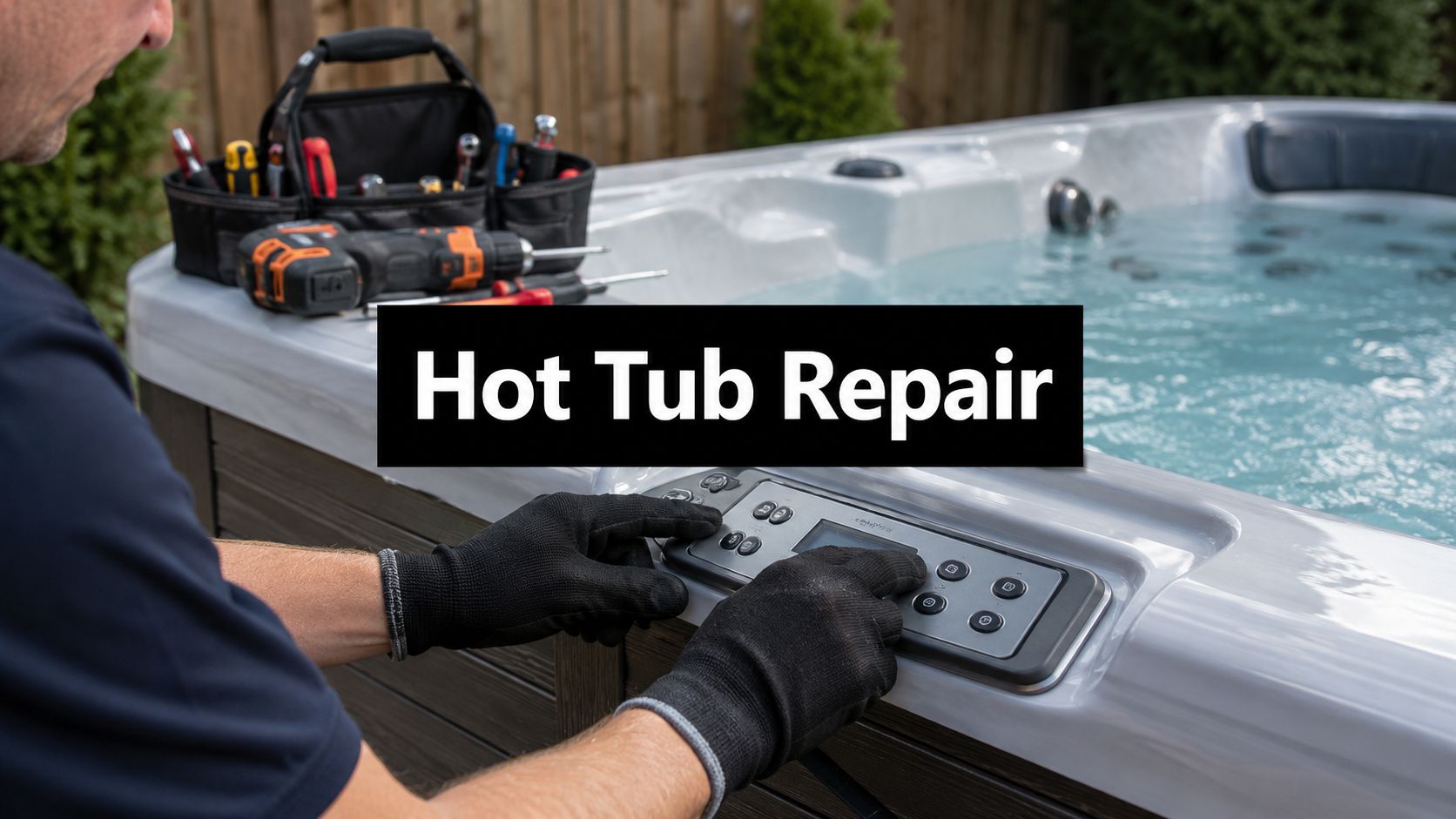
Most hot tub repair cost jobs land between $181 and $567, and the average repair bill is about $349 according to Thumbtack's 2025 to 2026 pricing data. If your spa has a failed pump, heater, control panel, or a hard-to-reach leak, the bill can climb well beyond that baseline.
If you're standing on a patio in Weber, Davis, or Salt Lake County staring at cold water, a tripped breaker, or a dead control panel, you're probably asking one thing. Is this going to be a manageable repair, or the start of a much bigger problem?
What to Expect for Hot Tub Repair Costs in Utah

You step outside on a January evening, lift the cover, and find cold water and a tripped breaker. In Northern Utah, that usually means the repair bill depends less on the symptom you see and more on which electrical part failed behind the access panel.
The invoice usually has three parts. A service call, diagnostic labor, and the replacement part. For spa owners here, the biggest surprise is often the electrical side. A bad GFCI breaker, heater relay, topside control, sensor, or circuit board can look like a pump or heating problem until someone tests it properly.
Labor matters because electrical diagnosis takes time. HomeAdvisor notes that labor commonly runs $75 to $125 per hour, with troubleshooting time varying by access and complexity in its hot tub repair pricing overview. In the field, I see the same pattern. A visible leak is one kind of visit. Intermittent power loss, nuisance tripping, or a spa that goes dead only under load usually takes more testing.
That is why two tubs with the same symptom can produce very different invoices.
Utah conditions push costs around more than many national guides admit. Outdoor spas in Weber, Davis, Box Elder, and Salt Lake counties deal with freeze exposure, snow, mineral-heavy water in some areas, and equipment pads tucked against decks or fences. If the cabinet is iced up, the disconnect is corroded, or the equipment bay is packed tight, labor goes up because safe access and testing take longer.
For homeowners trying to budget, it helps to separate general spa repairs from electrical repairs. A small plumbing fix may stay modest. An electrical repair can climb faster because the failed part is more expensive, diagnosis is more technical, and code requirements may force related work at the same time. If the spa pack, breaker, or disconnect shows heat damage, loose conductors, or water intrusion, the repair stops being a handyman job.
A good comparison is water heater repair logic. The decision is not just part price. It is part price, age, safety, and whether the failure points to a larger system problem, as explained from Boston Budget Plumbing.
Before you schedule service, gather the spa brand, model number, any error codes, and a clear description of what happens when it tries to start. If you want an electrician to look at the power side, breaker, disconnect, or control components, you can request a free quote for hot tub electrical troubleshooting. That gives you a more useful starting point than guessing from a national average.
The Biggest Drivers of Your Repair Bill
Repair bills usually climb for two reasons. The failed part is expensive, or the technician has to spend time proving which part failed before replacing anything.
That matters more with hot tubs than homeowners expect. A spa that will not heat, trips the breaker, or shuts down at random can have a heater problem, a flow problem, a sensor problem, or an electrical control problem that looks similar at first. HomeGuide's hot tub repair breakdown shows the common price pattern. Heater repairs commonly run $200 to $700, pump repairs $300 to $1,000, and leak repairs $200 to $1,500+ depending on access.
In Northern Utah, access and weather add their own cost pressure. If the cabinet is tight to a deck, fittings are crusted with mineral buildup, or a freeze event cracked plumbing and soaked nearby wiring, diagnosis takes longer and the repair scope can widen fast.
Four systems that move the price
The biggest swings usually come from these categories:
- Heater problems: Cold water does not always mean a bad heater tube or element. I see plenty of cases where the heater is fine, but a failed sensor, pressure switch issue, dirty filter, or circulation problem keeps the system from energizing heat. Part cost matters, but accurate testing matters more.
- Pump problems: Humming, grinding, weak jet pressure, or a motor that trips the breaker often points here. Costs rise when the motor is seized, the wet end is leaking into the motor, or the pump is buried behind tight plumbing that has to be cut out and rebuilt.
- Control system issues: This is the category that confuses homeowners most. A dead topside panel might be the panel itself, but it can also be a board problem, a low-voltage power supply issue, corroded terminals, or damage inside the spa pack. Electrical diagnosis is what separates a targeted repair from swapping parts until something works.
- Plumbing leaks: A visible drip at a union is usually cheaper than a leak hidden in foam or under framing. Once water has been leaking for a while, the bill can rise because soaked insulation, rusted fasteners, and damaged electrical connections all add labor.
Typical Hot Tub Repair Costs by Component (2026 Estimates)
| Component / Issue | Typical Repair Cost Range | Notes |
|---|---|---|
| Heater | $200 to $700 | Can involve heating element, sensors, or flow-related diagnosis |
| Pump | $300 to $1,000 | Costs rise when motor damage or difficult access is involved |
| Control panel | $300 to $1,200 | Higher-cost electrical and electronic repair category |
| Plumbing fix | $150 to $500 | Simpler visible leaks tend to stay lower |
| Leak repair | $200 to $1,500+ | Buried or foam-hidden leaks cost more to locate and reach |
The expensive jobs are often mixed failures, not single-part failures. A leaking pump seal can damage the motor. A low-flow condition can overheat the heater. Water intrusion around the equipment bay can corrode terminals, trip the GFCI, and turn a basic spa repair into electrical troubleshooting.
That is why age alone does not decide whether a repair makes sense. The better question is whether you are fixing one clear failure or chasing a chain of related ones. The same logic applies to other home equipment, as explained from Boston Budget Plumbing.
When the symptom points to wiring, the breaker, the disconnect, or the spa pack, the budget needs to account for licensed electrical diagnosis. A hot tub troubleshooting electrician can test the power side safely and narrow down whether the problem is the incoming feed, GFCI protection, control board, heater circuit, or a component fault downstream.
When You Absolutely Need a Licensed Electrician
Some hot tub problems are not handyman jobs. They aren't “maybe DIY if you're careful” jobs either.
If the issue touches incoming power, the disconnect, the GFCI breaker, the control pack, burnt terminals, or signs of overheating, a licensed electrician needs to take over. That's a safety issue first and a cost issue second.

Red flags that shouldn't wait
Call an electrician when you notice any of these:
- A GFCI that keeps tripping: That can point to moisture intrusion, a failing heater, damaged wiring, or a ground fault.
- Burn marks or melted insulation: Heat damage at lugs, terminals, or breakers is urgent.
- A blank or flickering control panel: The keypad might be bad, but power supply problems can cause the same symptom.
- Intermittent operation: If pumps, lights, or heat cut in and out, loose connections or control faults may be involved.
- Any sign of water around live electrical components: Shut it down and keep people away.
Why this line matters
An experienced spa technician may handle pumps, seals, unions, and some packaged component swaps. But once diagnosis requires opening electrical compartments, testing live circuits, evaluating bonding or grounding, or checking code compliance at the disconnect, the work needs an electrician.
Let me explain. A hot tub combines water, metal, heating, and high-amperage power in one place. That's exactly the kind of system where guessing gets expensive and dangerous.
If a repair starts with “the breaker only trips sometimes,” don't assume it's minor. Intermittent electrical faults are often the ones that waste the most time and create the most risk.
If water damage has spread beyond the spa and created a contaminated or unsafe area, broader site cleanup may be needed before repairs continue. In more severe property situations, resources like expert Phoenix hazardous cleanup show the kind of specialized remediation standards those jobs can require.
For Northern Utah homeowners, the safest move is to bring in a licensed pro for any suspected supply-side or control-side issue. If your problem involves tripping power, damaged wiring, or the spa's electrical pack, a hot tub electrician is the right specialist.
Smart Ways to Lower Your Repair Costs
A common Utah repair story starts the same way. The spa still runs, so the small drip, weak heat, or occasional breaker trip gets ignored for a few weeks. Then a simple service call turns into a bigger bill because moisture reached a control pack, a heater kept straining against poor flow, or winter cold exposed a problem that would have been cheap to catch early.

The maintenance habits that help
The goal is simple. Protect the expensive parts, especially heaters, pumps, topside controls, and electrical connections.
- Clean filters on schedule: Poor flow forces the heater and pump to work harder and can create symptoms that look like a bigger failure.
- Watch water level and circulation: Low water, trapped air, or weak circulation can trigger heating complaints and shutdowns.
- Inspect the equipment bay: Check for drips, rust staining, mineral deposits, or damp insulation. Those signs usually show up before a component fully fails.
- Winterize correctly if the spa will sit unused: In Northern Utah, freeze damage can crack plumbing, split fittings, and turn a manageable repair into a major one.
- Act on small leaks early: Water and electricity are a costly combination. A minor leak can corrode terminals, damage a control board, or trip a breaker after enough moisture builds up.
Small symptoms rarely stay small.
Be the kind of customer who saves labor time
Good prep helps shorten diagnosis, and labor is part of the bill. If a technician arrives with clear information, there is less time spent chasing basic history and more time spent testing the right components.
Have these ready:
- Model and serial information: This helps confirm compatible parts before anyone starts guessing.
- Photos of the equipment area: Burn marks, corrosion, and water tracks can point the repair in the right direction fast.
- A simple symptom timeline: Note what happened first. No heat, error code, tripped breaker, or dead keypad.
- Notes on recent changes: Fresh fill, power outage, winter startup, or recent repair work can all matter.
This matters even more with electrical complaints. If the issue keeps coming back, having a local electrician, like those at Black Rhino Electric, inspect the dedicated circuit, disconnect, and GFCI can prevent repeat service calls spent proving the spa is not the only problem.
When repair stops making financial sense
Some repairs are worth doing right away. Others need a harder look, especially on older tubs with repeated electrical or control issues.
A common rule of thumb in the spa industry is that repair usually makes sense when the cost is well below replacement cost. Once repairs start stacking up, especially on a tub that is already aging, replacement often becomes the better long-term value, based on Epic Hot Tubs' repair-versus-replace guidance.
I tell homeowners to look at the pattern, not just the current invoice. One failed sensor or a single pump repair is one thing. A heater problem followed by a control issue, moisture in the equipment bay, and recurring breaker trips is a different conversation.
Real-World Hot Tub Repair Scenarios
Numbers help, but symptoms are what homeowners see. Here are three common situations that come up around Northern Utah patios and backyards.
The cold water surprise
It's Friday, the cover comes off, the jets run, and the water feels nowhere near right.
The likely causes include a failed heater, a flow problem that prevents heating, or an electrical issue that keeps the heater from energizing. A technician usually checks circulation first, then tests the heater circuit and related controls. Based on the pricing covered earlier, heater-related repairs commonly fall in the mid-hundreds, but the final bill depends on whether the heater itself failed or the problem sits upstream in controls or power delivery.
Cold water with working jets doesn't automatically mean “bad heater.” Low flow and electrical faults can produce the same complaint.
The gurgling pump
This one often starts with a sound change. The spa still runs, but it growls, hums, gurgles, or struggles to push water through the jets.
A technician will usually look at filter restriction, air lock, impeller condition, unions, and the motor itself. If the pump has started failing mechanically, the repair tends to cost more than a minor plumbing issue because you're dealing with a major moving component. If the pump is starving for water because of blockage or a leak, catching it early can prevent the more expensive version of the same problem.
The dead keypad
The topside control goes blank, or the display flickers and stops responding. Homeowners often assume the keypad is the whole issue, but that isn't always true.
The actual fault could be the control panel, the spa pack, a failed connection, or a power problem feeding the system. This is one of the clearest examples of why electrical diagnosis matters. A quick parts swap may not solve it if the actual issue is voltage irregularity, corrosion at terminals, or a failing control board.
For Utah homeowners, these scenarios usually come down to one practical question. Is this a contained repair on one part, or a symptom of a larger electrical or age-related decline? That's the question a good diagnosis answers before you spend money on the wrong fix.
Frequently Asked Questions About Hot Tub Repair
Some questions come up again and again in Northern Utah, especially after a cold stretch, a power issue, or the first spring startup. The right answer usually depends on whether you are paying for one contained repair or stepping into a series of age, moisture, and electrical problems.
Is it worth fixing an older hot tub?
Sometimes. I usually look at three things first: the age of the spa, the condition of the shell and cabinet, and whether the current problem is isolated or part of a pattern.
A useful rule is to compare this repair, plus the likely next repair, against the remaining value of the tub to your household. If a 12 to 15-year-old spa needs a control board now and a pump is already getting noisy, many homeowners decide that money is better saved for replacement. If the shell is sound and the issue is limited to one electrical component, repair can still make sense.
Why can two tubs with the same symptom have very different repair costs?
Because the failed part is only part of the bill. Access, wiring condition, corrosion, brand-specific parts, and how long diagnosis takes all affect the total.
For example, a heater relay issue on a clean, accessible pack is a different job than tracing heat loss back to a damaged terminal block or melted connection. In older Utah installations, I also see costs rise when freeze exposure, rodents, or moisture have affected the wiring around the spa disconnect or equipment bay.
What makes electrical repairs more expensive than expected?
Electrical hot tub repairs often include testing time, not just part replacement. A licensed electrician may need to verify incoming voltage, inspect the GFCI disconnect, test heater and pump loads, and check for heat damage at lugs and terminals before replacing anything.
That work saves money in the long run because it reduces guesswork. It also matters for safety. Burnt insulation, water intrusion, and failed ground-fault protection are not the kind of problems to treat like a simple parts swap.
When should I call an electrician first instead of a spa repair company?
Call an electrician first if you have any sign of power supply trouble. That includes a breaker that will not hold, a disconnect that looks overheated, a burnt smell near the equipment area, visible wire damage, flickering controls tied to power loss, or a tub that lost power after other electrical work on the property.
In Northern Utah, this also comes up after storms, winter moisture, and long periods of disuse. A spa tech may handle pumps, plumbing, and standard component replacement well, but line-voltage diagnosis, feeder problems, bonding, GFCI protection, and damaged conductors belong with a licensed electrician.
Can a bad electrical connection really damage other hot tub parts?
Yes. Loose or overheated connections create resistance. Resistance creates heat. Heat shortens the life of boards, relays, heaters, and wiring insulation.
That is one reason a repair estimate can widen after inspection. The original failed connection may be a modest fix, but if that heat has already damaged the terminal block or board, more than one part may need to be replaced.
Should I repair the spa if parts are getting hard to find?
Usually only if the tub is otherwise in good shape. Obsolete boards, discontinued keypads, and older proprietary heaters can turn a straightforward repair into a long wait with uncertain pricing.
Ask one practical question: if this part fails again or another control component fails next season, will parts still be available? If the answer is unclear, it may not make sense to keep investing in an aging unit.
Why do electricians care about the disconnect, GFCI, and bonding so much?
Because those pieces protect people, not just equipment. A hot tub mixes water, metal, and high amperage in one place. If the disconnect is wrong, the GFCI is failing, or bonding is missing or compromised, the problem is bigger than convenience.
Utah homeowners sometimes focus on the heater, pump, or panel because that is the symptom they can see. The safer approach is to confirm the protection system is right before spending money on downstream parts.
A final practical point. Good diagnosis is cheaper than replacing the wrong electrical component twice.
If your hot tub is tripping breakers, not heating, showing signs of wiring trouble, or you just want a clear diagnosis before spending more money, contact Black Rhino Electric by calling 385-396-7048 or request a free quote.