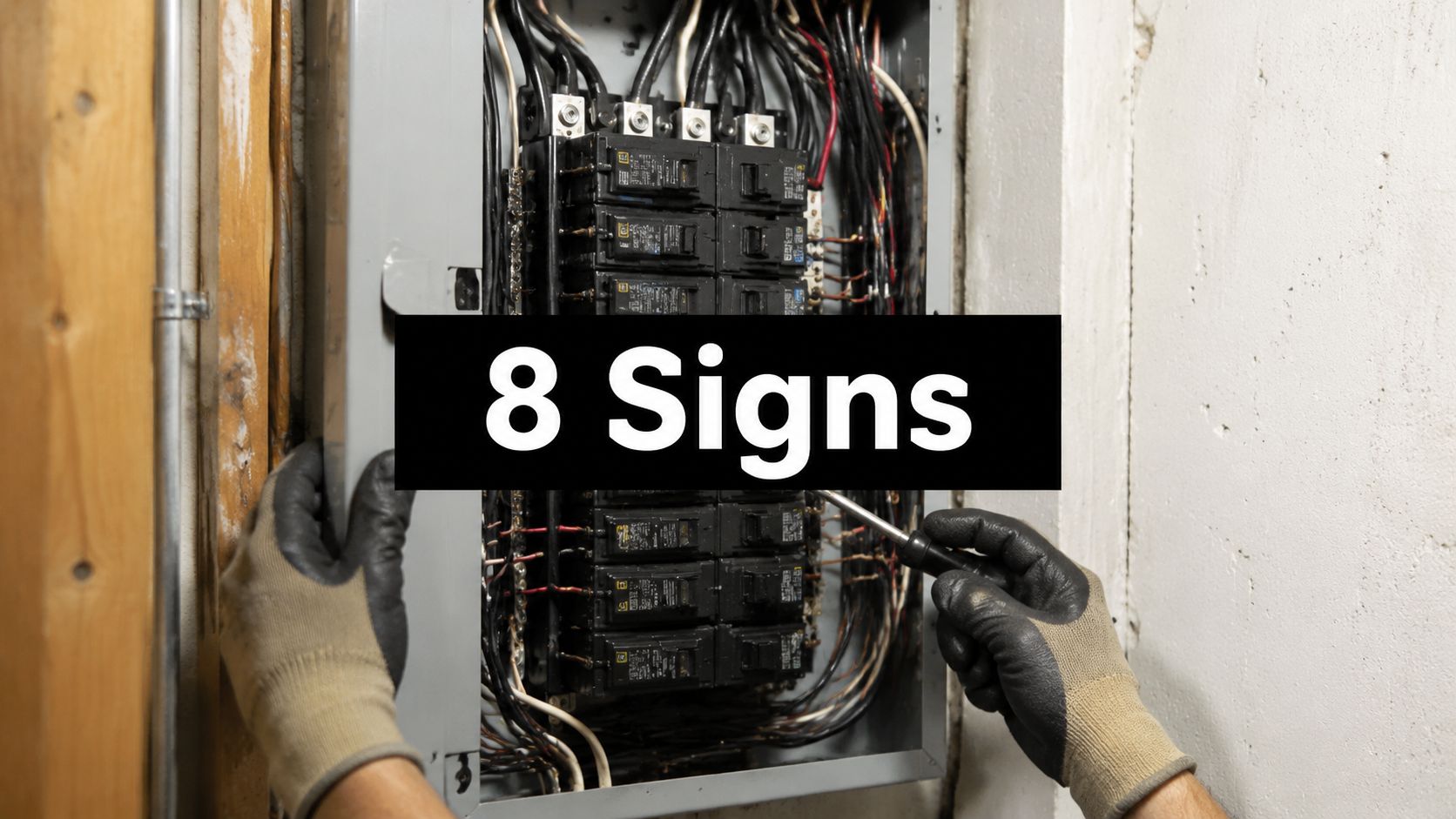
Repeated breaker trips, heat or burning damage, obsolete equipment, inadequate capacity for new loads, voltage issues, outdated grounding, missing GFCI/AFCI protection, and aluminum wiring or corrosion are the main signs that warrant professional panel evaluation. Electrical failures or malfunctions cause about 47,700 home fires annually in the United States, with about 418 deaths, 1,570 injuries, and roughly $1.4 billion in property damage each year, according to the Electrical Safety Foundation's overload guidance.
A homeowner in Ogden may be dealing with a breaker that trips whenever the dryer starts, while a Layton homeowner may be planning a Tesla Wall Connector and wondering whether an older panel can support it. The phrase signs an electrical panel needs an upgrade covers both urgent hazards and planned capacity decisions. Homeowners can safely observe symptoms, record when they occur, and photograph labels, but a licensed electrician should inspect energized equipment, perform load calculations, and determine whether the right answer is a breaker repair, rewiring, a subpanel, or a full panel or service upgrade. Some electrical-fire situations also require specialized restoration guidance, such as Restore Heroes fire damage help.
1. Frequent Breaker Trips or Breakers That Won't Stay Reset
A breaker that trips repeatedly is doing its job by interrupting power when it detects an overload, short circuit, ground fault, or internal wear. A breaker that immediately returns to the off position after a reset attempt deserves particular attention. Electrical troubleshooting guidance identifies repeated trips across multiple circuits as a stronger indicator of panel-capacity or panel-aging problems than one isolated circuit.
Consider a home office where a space heater and laptop charger share a bedroom circuit. A small business may see the dedicated refrigerator and microwave circuit trip during lunch. In either case, the panel may not be the only problem. The circuit could have a defective breaker, damaged wiring, a loose connection, or more demand than that branch circuit was designed to carry.
What the pattern tells an electrician
A useful log records the affected breaker, the equipment running at the time, and whether the trip occurs during startup or after sustained use. That information helps separate a localized circuit issue from broader service stress. A single kitchen circuit that trips under one appliance may need repair or a dedicated circuit, while several unrelated breakers tripping under normal use point toward a larger capacity review.
Practical rule: Never tape a breaker in place or replace it with a higher-amp breaker. That removes protection without correcting the wiring or capacity problem.
Avoid daisy-chaining high-power devices as a temporary workaround. A licensed electrician can inspect the breaker, test the circuit, check connections, and explain whether the breaker keeps tripping because of a repairable fault or an undersized panel.
2. Burning Smell, Scorch Marks, or Discoloration on the Electrical Panel
An acrid or burnt-plastic smell near the panel, blackening, or scorch marks around breakers and openings should be treated as heat or arcing damage until an electrician rules it out. Loose, corroded, or undersized connections can create resistance, overheat conductors, and damage insulation. This is an urgent hazard, not a condition to monitor.
A homeowner might notice the odor near a basement panel. A property manager may find black marks on an older commercial panel, while a tenant may smell hot plastic in a garage without knowing whether the source is a breaker, terminal, panel interior, or nearby cable connection. The location and timing help the electrician plan the inspection, but they do not make the condition safe to ignore.
What to do before help arrives
Do not remove the panel cover, touch a discolored breaker, or tighten any connection. If smoke is visible or the smell is strong, leave the building and call 911. If there is no active emergency, record the location from a safe distance and tell the electrician what you observed.
The electrician may inspect overheated terminals, damaged bus sections, loose service conductors, corrosion, and signs that a breaker failed to interrupt a fault. The repair might be limited to a connection, breaker, or circuit, or it may require panel replacement. A mark does not establish the full scope, but it does justify prompt service.
Northern Utah commercial customers should notify the property manager or facilities contact and document the discovery. The service visit should address business continuity, equipment protection, permitting, and whether the panel affects other connected work. Ask what must be shut down, how long access may be needed, and whether follow-up inspection is required. For broader building planning, owners can also review expert fire safety design.
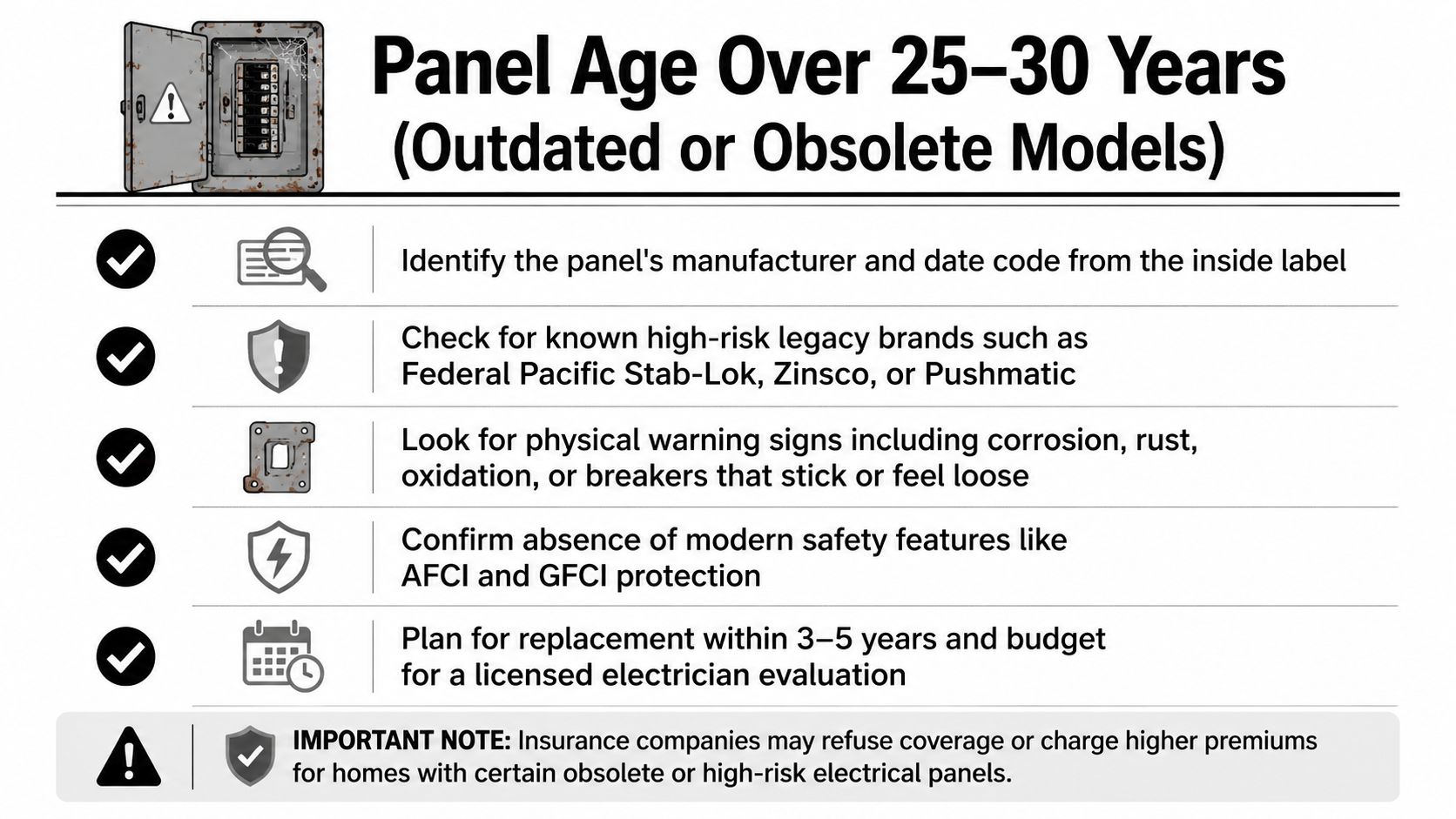
3. Panel Age Over 25–30 Years
A panel installed decades ago may still operate normally while carrying worn connections, corrosion, limited breaker space, or components that are difficult to replace. Age alone does not prove a hazard, but an older panel that has never been upgraded deserves an electrician's assessment. The door label can identify a manufacturer and model that need closer evaluation.
A homeowner preparing to sell in Weber County might find an older Pushmatic panel during inspection. A landlord may learn that compatible replacement breakers are difficult to source. A business owner could face an uneconomical repair when specialized parts are no longer readily available. In each case, planned replacement may make more sense than waiting for a breakdown.
How to start the age check safely
Read the information on the panel door without removing the cover or exposing energized equipment. The label may list the manufacturer, model, and installation information. If the markings are unclear, photograph the closed panel and visible label from a safe position for the electrician.
The electrician should check the panel's physical condition, breaker compatibility, bus integrity, grounding and bonding, available spaces, service rating, and ability to support planned loads. A panel more than 30 years old may support replacement planning within 3–5 years, depending on its condition, use, and known equipment concerns, as explained in the electrical panel upgrade service information.
Plan the work around renovations when possible. New circuits, permits, and code corrections can be coordinated during one project rather than handled in separate visits. The inspection should also distinguish an outdated panel from a broader electrical system that needs selective rewiring. For renovation or insurance planning, homeowners can review building code coverage. Ask the electrician what the panel can support now, what future equipment could change the load calculation, and whether the project requires service changes or additional permitting.
4. Adding a Major New Load
A panel may work normally yet lack capacity for a new EV charger, hot tub, air-conditioning system, electric heating equipment, or commercial machinery. Planned equipment can expose a limitation before breakers trip or other warning signs appear. Before buying the equipment, confirm that the service and panel can support it safely.
A Lawrence Berkeley National Laboratory summary reviewed 10,446 heat-pump upgrades and found that 480 required panel upgrades, or 4.6%. Most upgrades in that sample moved from 200A to 300A, while a smaller share moved from 100A to 200A. The figures describe that specific group of projects, not every Northern Utah property. A project-specific load calculation still determines the right scope. Review the Lawrence Berkeley National Laboratory heat-pump electrification summary.
Capacity review before equipment purchase
A load calculation reviews existing circuits, fixed equipment, service rating, continuous demand, and the nameplate ratings of proposed equipment. Under National Electrical Code Article 220 methods, inputs can include 3 VA per square foot for general lighting, 1,500 VA for each required small-appliance circuit, 1,500 VA for the laundry circuit, and equipment ratings for EV chargers, ranges, and hot tubs, as described in panel load-calculation guidance.
Ask for the electrical scope before finalizing the purchase. An electrician handling EV charger installation can check panel capacity, dedicated-circuit requirements, grounding, conductor routing, permits, and inspection expectations. The same review applies to a hot tub or commercial HVAC connection. A larger breaker alone does not create capacity and can introduce a serious hazard if the conductors or panel are not rated for it.
The electrician should explain whether the project needs a panel upgrade, service work, load management, or only a new circuit. Do not open the panel or change breakers yourself.
5. Dimming or Flickering Lights, Especially Under Load
Lights that dim when a large motor starts can signal voltage drop, a loose connection, a corroded termination, or limited service capacity. One flickering bulb may have a fixture or lamp fault. Repeated dimming across rooms, especially as equipment starts, calls for an electrical assessment.
A Kaysville home might see kitchen lights dip when a central air-conditioning compressor starts. In a small office, lighting may flicker while an espresso machine and milk frother run together. A home theater could show dimming during high-demand audio scenes. The timing, affected rooms, and equipment operating at the moment help an electrician identify whether the issue is local, circuit-related, or service-wide.
What gets tested
A service visit may include voltage tests at the panel and selected outlets, inspection of service connections, circuit-loading checks, and examination of loose or corroded terminations. Voltage drop can begin at the meter, service conductors, panel connections, branch wiring, or the equipment itself. An electrician should recommend a panel upgrade only if testing shows that capacity or service equipment is the underlying limitation.
Keep a simple record of which lights flicker, when it happens, and which equipment is running. Do not open the panel or change breakers to investigate. Commercial operators should note whether the problem affects computers, lighting controls, refrigeration, or production equipment, since that impact can help prioritize testing.
For a homeowner-friendly explanation of possible causes, see the flickering light guide from Black Rhino Electric. Frequent or worsening flicker, particularly with buzzing, heat, or odor, warrants an on-site evaluation rather than continued observation.
6. Only Two-Prong Ungrounded Outlets Throughout the Home or Building
A home or building with two-prong outlets throughout may lack an equipment grounding path across much of its electrical system. That affects shock protection, appliance grounding, and the safe use of modern equipment. It commonly appears with older wiring and limited protective devices, but the outlets alone do not prove that a panel upgrade is required.
A Northern Utah home from the early 1970s may still have two-prong outlets in most rooms. In a rental, occupants may rely on adapters because kitchens and bathrooms were never updated. A small office may need grounded circuits before adding computers, a kitchenette, or other major equipment. These conditions point to the wiring behind the receptacles, not just the receptacle style.
What homeowners can observe
Without disturbing power, check representative outlets in different rooms. Note whether each has two slots or three, and record areas where appliances, computers, or other equipment are used. Do not install a three-prong receptacle assuming it creates a ground. Two-prong-to-three-prong adapters are not a permanent substitute for evaluated wiring.
An electrician can check for grounding conductors, trace circuit paths, inspect connections, and determine whether GFCI protection is an appropriate interim measure in a specific location. The recommendation may be selective circuit work, rewiring, or a panel and service upgrade. Kitchens, bathrooms, laundry spaces, and other damp areas usually deserve early review, subject to the wiring method and applicable code requirements.
An EV charger needs a dedicated circuit, proper grounding, suitable protection, and equipment installation that matches the manufacturer's requirements. In a building with widespread ungrounded outlets, the work may involve branch wiring or service capacity, not only the panel. Ask the electrician what permitting is required, what the service visit will test, and whether an upgrade is urgent or can be planned. Do not open the panel or modify wiring yourself.
7. No GFCI or AFCI Protection
GFCI and AFCI devices address different electrical hazards. A GFCI detects current escaping along an unintended path and interrupts power to reduce shock risk. An AFCI responds to conditions associated with arcing, which can reduce fire risk from damaged or deteriorated wiring. Missing, failed, or outdated protection may require targeted corrections or a broader panel upgrade.
A Northern Utah homeowner may find no GFCI protection in kitchen, bathroom, laundry, or exterior areas. An older office may lack AFCI protection on circuits affected by current code requirements. A property manager may press a GFCI TEST button and find that power continues. Document the location and result, then have an electrician evaluate the circuit instead of swapping devices at random.
Prioritize protection by risk and scope
Use the TEST button on an accessible GFCI receptacle according to its instructions. If it fails to interrupt power, will not reset, or behaves erratically, stop using the affected receptacle as appropriate and contact a qualified electrician. Do not open the panel or work on energized wiring to add AFCI protection.
Nuisance AFCI trips also need diagnosis. A failed device, incompatible equipment, damaged wiring, or a genuine arc fault can produce similar symptoms. Replacing the breaker without testing may remove the symptom while leaving the cause in place.
An electrician can map circuits, identify missing protection, inspect grounding and neutral arrangements, verify panel compatibility, and explain which corrections apply to existing work. New circuits for remodels, EV chargers, hot tubs, and other major loads may bring added protection, permitting, and inspection requirements. The panel may need replacement if it cannot accept compatible protective devices or lacks practical room for the required circuits.
Ask what the service visit will test, whether the issue is urgent, and which work can be planned. A proper evaluation separates an immediate hazard from an upgrade needed to support future loads. Never modify panel wiring yourself.
8. Aluminum Wiring or Corroded Connections
In an older Northern Utah home, aluminum branch-circuit wiring may appear during a sale, inspection, or remodel. Corroded or oxidized connections can also develop at receptacles, breakers, splices, or service equipment. These conditions deserve an electrician's assessment because aluminum expands and contracts differently from copper, while oxidation and poor terminations can increase resistance, heat, and arcing risk.
A kitchen renovation may expose aluminum conductors behind existing receptacles. A landlord or commercial owner may find corrosion at a main-breaker terminal or service connection. Corrosion at service equipment receives higher priority because that connection supplies much of the building.
Repair, selective replacement, or rewiring
An electrician should inspect accessible conductors, terminals, breakers, splices, service cables, and any heat damage. The work may involve approved termination repairs, correcting connections, replacing selected circuits, or rewiring a larger portion of the building. The appropriate scope depends on the conductor type, installation method, equipment compatibility, condition, and how widely the issue appears.
Do not scrape corrosion, tighten panel connections, or handle oxidized terminals. Service cables entering the meter or panel are observation points for a qualified electrician, not DIY repair locations. In a multi-unit or commercial building, the electrician may also recommend a load study and broader visual inspection to determine whether the condition is isolated or widespread.
For a remodel or older-property purchase, guidance on how to replace aluminum wiring safely can help you prepare questions for the electrician. It does not establish one replacement method or cost for every property. Ask what was inspected, whether any connection needs prompt attention, what permits apply, and which repairs can be planned. The service professional must evaluate the actual installation and explain the required correction.
8 Key Signs Your Electrical Panel Needs an Upgrade
| Sign / Indicator | Implementation complexity | Resource requirements | Expected outcomes | Ideal use cases | Key advantages |
|---|---|---|---|---|---|
| Frequent breaker trips / breakers won't stay reset | Low–Moderate (diagnose quickly; may need panel/upgrade) | Licensed electrician, breaker replacement or service upgrade, moderate cost/time | Reduced nuisance trips; circuits stabilized; may require capacity upgrade | Repeated tripping under normal appliance use or seasonal high demand | Immediate overload protection; easy to notice |
| Burning smell, scorch marks, or discoloration | High (urgent, potentially complex repairs) | Immediate electrician inspection, likely component or panel replacement, potentially high cost | Eliminate arcing/fire sources; restore safe operation; possible full replacement | Any detection of burning odor or visible burn marks | Prevents imminent fire/electrocution; pinpoints serious faults |
| Panel age over 25–30 years (outdated/obsolete models) | Moderate–High (planning and replacement) | Inspection, replacement panel, permits, electrician, budget/time planning | Modern safety features, code compliance, longer reliable service life | Panels >25–30 years old, pre-sale, refinance, or planned renovations | Preventative risk reduction; aligns with current code/insurance |
| Adding a major new load (EV, hot tub, AC, heating) | Moderate–High (load calculation, possible service upgrade) | Licensed electrician, load study, permits, utility coordination, variable/high cost | Properly sized service and circuits; reliable operation of new equipment | Installing EV charger, hot tub, central AC, or major electric heat | Prevents overloads and installation delays; future-proofs service |
| Dimming or flickering lights, especially under load | Low–Moderate (diagnostic testing; targeted repairs) | Electrician for voltage testing and connection repair, possible service work, moderate cost | Stable voltage, protected electronics, reduced flicker | Lights dim when compressors/motors start or during heavy use | Early indicator of poor connections or undersized service |
| Only two-prong (ungrounded) outlets throughout building | Moderate–High (selective upgrades or rewiring) | Electrician, GFCI installs or rewiring, moderate–high cost and time | Grounded outlets, improved protection, code compliance | Older homes with widespread two-prong outlets or before installing grounded equipment | Restores grounding and safety for modern devices |
| No GFCI or AFCI outlets (or non-functional protection) | Low–Moderate (often retrofit-able) | GFCI/AFCI devices, electrician labor, moderate cost | Reduced shock and arc-fire risk; improved code compliance | Homes lacking protection in wet areas/bedrooms or failing devices | High safety benefit with targeted upgrades |
| Aluminum wiring or corroded/oxidized connections | High (may need remediation or full rewiring) | Urgent electrician inspection, selective corrections or full rewiring, potentially high cost; insurer involvement possible | Eliminated loose/arcing connections; reduced fire risk; restored reliability | Homes with aluminum conductors or visible corrosion at terminals | Addresses a documented high-fire-risk condition; long-term safety improvement |
Turn the Warning Signs Into a Safe Plan
The most urgent signs are burning smells, smoke, scorch marks, severe buzzing, and hot panel components. Occupants should keep away from the equipment, leave the building if smoke or fire is present, and call 911 for an active emergency. An electrician should then assess whether heat damage has affected breakers, bus connections, service conductors, or nearby wiring.
Repeated trips, flickering lights, corrosion, unsafe aluminum wiring, failed GFCI devices, and missing protection deserve prompt evaluation even when there isn't visible smoke. A single tripped breaker may be a localized fault, but repeated trips across circuits, a panel with no spare spaces, and symptoms that appear under sustained load suggest a broader capacity or aging problem. A common practical benchmark treats continuous loading above 80% of a panel's rating as a concern, so a 200-amp service has about 160 amps of usable continuous capacity under that approach, as explained in whole-house load calculation guidance. That benchmark doesn't replace the required calculation for the actual property.
Planned work deserves an assessment before equipment arrives. An EV charger, Tesla Wall Connector, hot tub, air-conditioning system, electric heating equipment, or commercial installation may require a dedicated circuit, service changes, grounding corrections, permit coordination, or a larger panel. In one Massachusetts baseline study, 85% of homes exceeded 100-amp capacity at a higher electrification level, which illustrates why future-load planning matters even when current symptoms are limited. See the Massachusetts residential electrification readiness analysis.
A Northern Utah service visit may include:
- Visual inspection: Review the panel, breakers, enclosure, labeling, accessible wiring, grounding, bonding, corrosion, and signs of heat.
- Load calculation: Compare existing demand and proposed equipment with the service rating and available capacity.
- Circuit evaluation: Test suspected breakers, connections, voltage behavior, and branch circuits.
- Protection review: Identify GFCI and AFCI gaps, failed devices, and compatibility concerns.
- Project coordination: Address permits, inspections, utility coordination, outage timing, and service or meter work when required.
- Written scope: Separate repair, rewiring, subpanel, panel replacement, and service-upgrade options.
Cost depends on the service rating, panel location, equipment condition, utility requirements, permit work, grounding corrections, wiring changes, access, outage planning, and the amount of code correction needed. Homeowners and business owners should ask about total amperage, included permits, utility coordination, required code corrections, future capacity, outage timing, and warranty terms before approving work. Residential customers can review panel and breaker service, while commercial owners and property managers can review commercial electrical panels and meters.
Black Rhino Electric serves residential and commercial customers from its Marriott-Slaterville headquarters across Northern Utah, including Weber, Davis, and Salt Lake counties. For a panel symptom, planned EV charger, older building, or commercial capacity concern, call 385-396-7048 or submit the panel evaluation and upgrade quote request.
Black Rhino Electric handles panel upgrades, breaker troubleshooting, EV charger and Tesla Wall Connector installations, hot tub wiring, GFCI and AFCI corrections, meter work, rewiring, and commercial electrical service. Northern Utah homeowners, property managers, and businesses can visit Black Rhino Electric to schedule an evaluation and discuss a safe repair or upgrade plan.