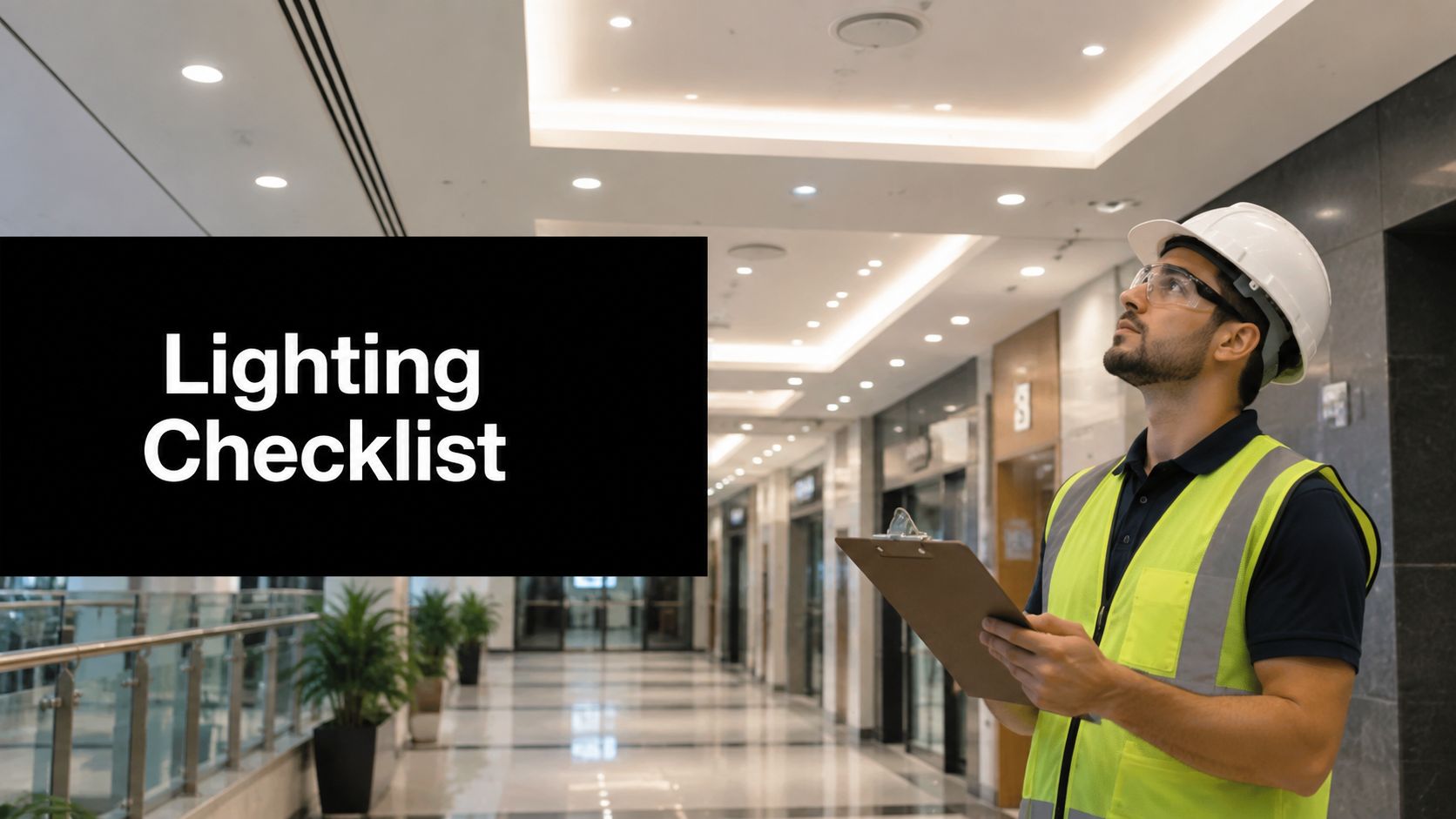
A property manager in Ogden notices three flickering fixtures during a morning walk-through, an exit sign that stays dark, and warehouse lights that remain on after closing. A useful commercial lighting maintenance checklist connects those observations to scheduled inspections, emergency-lighting tests, control checks, records, and timely escalation to a licensed electrician. Black Rhino Electric supports commercial lighting repairs and maintenance for businesses across Northern Utah, including Weber, Davis, and Salt Lake counties.
1. Fixture Inspection and Cleaning
Dirty lenses, damaged covers, and neglected housings can reduce usable illumination before a fixture stops working. A warehouse in Roy may collect dust around high-bay fixtures, while a retail space in Salt Lake City may accumulate debris in display lighting and entrance canopies. Staff can safely observe these conditions, but any work near energized wiring or overhead fixtures belongs with qualified personnel.
Commercial lighting checklists commonly use monthly visual checks, quarterly cleaning and testing, and an annual professional inspection. Quarterly cleaning should include lenses, diffusers, reflectors, and accessible fixture surfaces. Use a soft, non-abrasive cloth and a cleaner approved for the fixture material. Do not spray liquid into a housing, and never clean electrical equipment while the circuit is energized. Commercial maintenance guidance supports pairing physical cleaning with inspection and documentation rather than treating cleaning as a standalone task.
What staff should record
A walk-through should identify:
- Visible failures: Note flickering, dark lamps, delayed startup, uneven illumination, and fixtures that appear dimmer than neighboring units.
- Physical damage: Record cracked lenses, missing covers, bent housings, loose trim, and impact damage.
- Moisture and corrosion: Photograph rust, water marks, corroded fasteners, or failed seals. Moisture intrusion can point to a larger enclosure or conduit problem.
- Location and identification: Record the area, fixture ID, mounting height, and any access concern so the service technician can plan properly.
Photos create a useful record of deterioration over time. They also help a facility manager decide whether a fixture needs cleaning, repair, weatherproofing, or replacement.
Practical rule: A light that turns on can still be a maintenance problem if dirt, corrosion, a damaged lens, or a control fault leaves the space poorly illuminated.
High ceilings, lifts, ladders, exterior fixtures, and fixtures above occupied work areas create additional hazards. Staff should report the condition instead of attempting work at height or energized work.

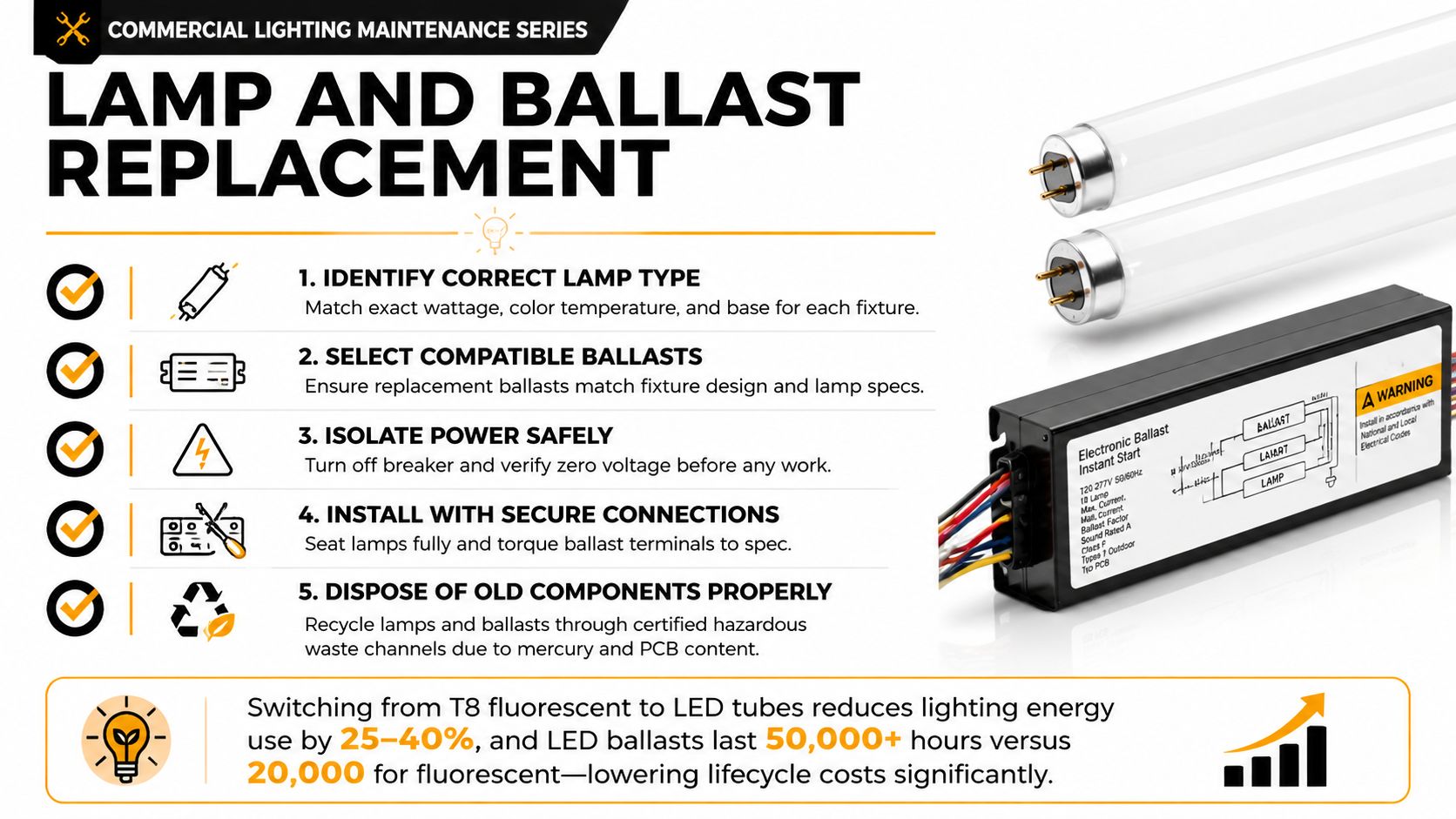
2. Lamp and Ballast Replacement
A lamp that fails once may need only a compatible replacement. Repeated flicker, delayed startup, ballast noise, or a dark fixture points to a larger equipment problem. Review the manufacturer's specifications, fixture listing, and applicable electrical requirements before ordering parts. A lamp, ballast, driver, and control must work together. Substituting by appearance alone can create poor dimming, overheating, or early failure.
Use the replacement history to choose the next maintenance decision. A widely used commercial maintenance benchmark is to consider a broader retrofit or replacement when 15% to 20% of fixtures require lamp or ballast replacement in a single year. That level can indicate that the installation is nearing the end of its economic life. Compare the annual failure rate with service calls, energy performance, and repair records. Commercial lighting lifecycle guidance explains how replacement thresholds can support budgeting rather than one-off purchasing.
Decide whether the failure is isolated
Selective replacement fits an installation with isolated failures, available compatible parts, and reliable surrounding fixtures. Plan a broader upgrade when the evidence shows a pattern:
- Failures repeat in one fixture family: Recurring ballast or driver failures may indicate a system issue instead of defective lamps.
- Parts are difficult to match: Incompatible lamps, ballasts, drivers, or controls can cause flicker, overheating, poor dimming, and premature failure.
- Outages disrupt operations: Group work during planned off-hours, while accounting for access equipment, tenant activity, and areas that cannot lose light.
- LED conversion changes wiring: Some retrofit methods require compatibility checks, ballast removal, or other electrical alterations.
The 15% to 20% replacement threshold is a decision trigger, not an automatic order to replace every fixture. Confirm condition, compatibility, controls, access requirements, and code requirements before approving a project. A facility manager in Northern Utah should record the fixture location, failure symptom, replacement date, part number, and follow-up requirement.
Staff can report a failed lamp or unusual behavior from a safe location. A licensed electrician should perform ballast replacement, driver replacement, rewiring, ballast bypass work, and any task involving internal electrical connections. Coordinate that work through a commercial lighting electrician, particularly when the repair requires de-energizing, testing, or modifying the fixture.
3. Emergency and Exit Lighting Testing
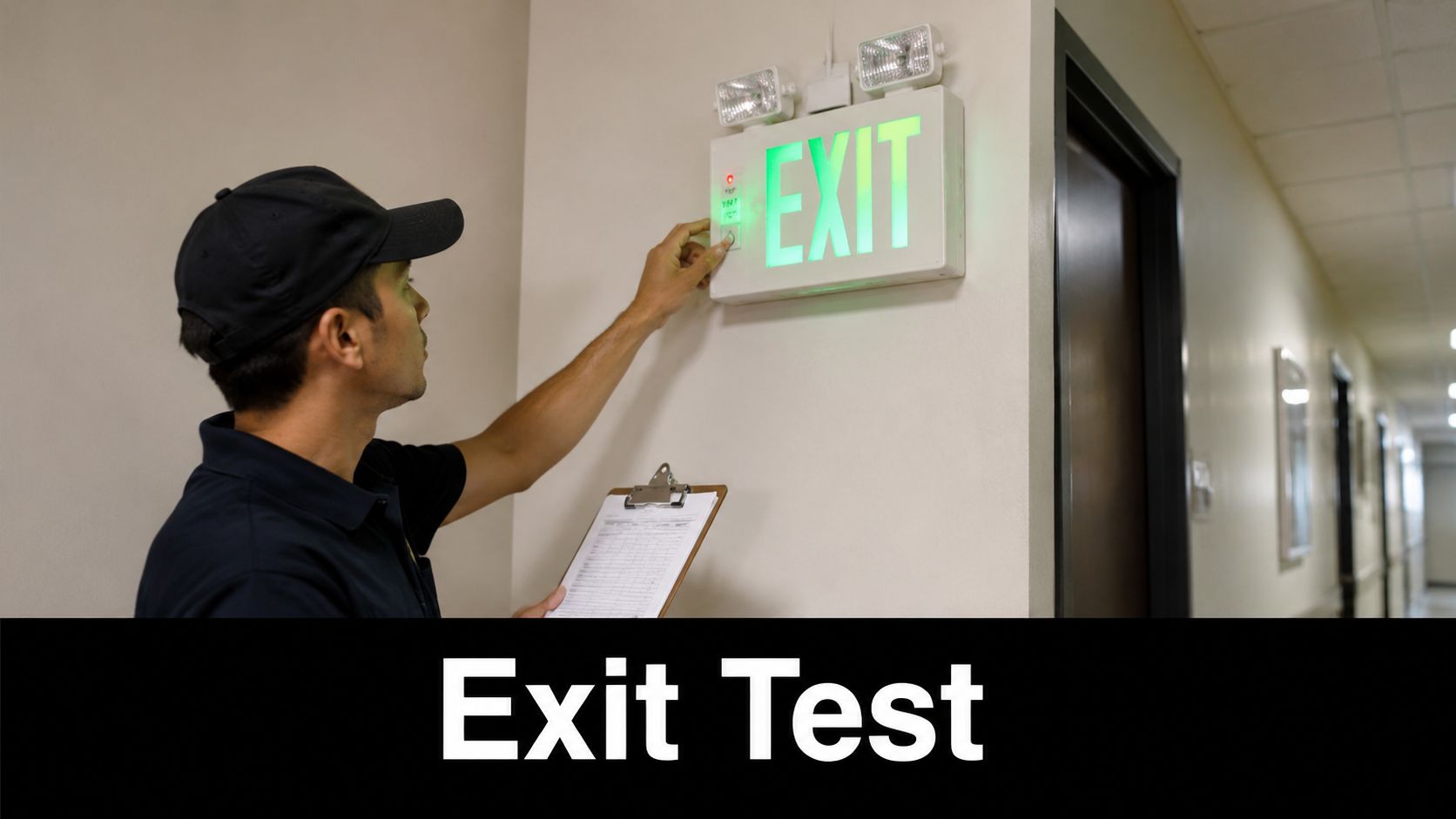
A power interruption in a Northern Utah office, warehouse, or retail space can expose a problem that ordinary fixture checks miss. Emergency luminaires and exit signs must transfer to backup power, illuminate the path, and continue operating for their rated duration. Treat this work as a separate life-safety decision, with a clear record for every unit.
Use a monthly 30-second functional test to check transfer and immediate operation, then complete an annual 90-minute full-duration test to confirm battery-backed equipment can maintain illumination through the full emergency period. The shorter test can reveal a failed lamp, weak battery, or transfer-switch fault. The longer test shows whether the equipment continues working after the initial changeover. Emergency-light inspection guidance recommends documenting the date, equipment tested, result, and repair action.
Record each test in a posted log or digital file:
- Test date: Identify whether the entry covers the functional or full-duration test.
- Equipment tested: List exit signs, emergency luminaires, stairwell fixtures, and other battery-backed units.
- Result: Mark each unit passed, failed, or requiring follow-up.
- Corrective action: Note a battery replacement, fixture repair, electrical troubleshooting, or scheduled return visit.
- Responsible person: Add the staff member's initials or technician's name.
The two tests answer different questions and should not substitute for one another. Schedule testing during lower-occupancy periods when practical, then verify that affected equipment is restored and the outcome is documented.
Facility staff can safely report an exit sign that is dark, dim, cracked, obstructed, or missing directional information. They should not open the housing, handle battery wiring, or troubleshoot a transfer circuit. A licensed electrician should address failed batteries, charging faults, emergency-circuit problems, damaged signs, inaccessible equipment, and any condition that could leave an egress path without required illumination.
For facility planning, this preventive-maintenance checklist separates emergency and exit lighting from general lighting and supports scheduled testing, prompt repairs, and logged results.
4. Lighting Control and Occupancy Sensor Maintenance
A control fault can hide behind a working fixture. In a Kaysville office, lights may remain on after closing because the schedule or hold time is wrong. In a Davis County warehouse, sensors may shut fixtures off while employees are still working because coverage, sensitivity, or zoning does not match the space. Record the symptom before changing settings. The cause determines the safe next step.
Use a walkthrough to check the conditions staff can verify without opening equipment:
- Follow normal work paths and note areas where lights fail to respond.
- Remain in restrooms, aisles, offices, and loading areas long enough to identify premature shutoff.
- Compare fixture behavior near windows and skylights with available daylight.
- Review operating schedules against tenant access, cleaning hours, and seasonal changes.
- Look for dust, damage, blocked lenses, or sensors that have shifted from their intended coverage area.
A dark zone, delayed response, or lights that stay on after occupancy should be logged by location, device type, zone, observed time, and programmed schedule when available. Include whether the condition is repeatable and whether it affects one fixture, a room, or a larger control group. This evidence gives the technician a clearer starting point than a general report that “the sensors are bad.”
Do not disable every sensor to hide an operating complaint. That may restore illumination temporarily while removing the intended control strategy and leaving the underlying fault unresolved. A technician should compare the reported behavior with the control sequence, zone layout, and building use before recommending a setting change or redesign.
Sensor recalibration, firmware updates, control-panel adjustments, line-voltage troubleshooting, and changes to connected lighting circuits require a qualified electrician or controls professional. Facility staff can observe, record, clean an accessible exterior lens when permitted by site procedures, and report changes in coverage. They should not open a sensor, work inside a control panel, or alter energized wiring.
If maintenance shows that the original layout or control zones no longer fit the building, Black Rhino Electric design services may help evaluate a revised arrangement. Keep the final settings, affected zones, corrective action, and verification result with the facility record. Commercial lighting maintenance information also identifies sensor validation, calibration, and control-logic checks as checklist tasks.

5. Electrical Connections and Termination Inspection
A Layton retail space may have a fixture connection that heats during normal operation but looks normal after closing. In Roy, intermittent lighting may reflect equipment interference, a control fault, or a poor termination rather than a failed lamp. Record when the symptom occurs, which fixtures are affected, and what other equipment is running.
Loose or corroded connections can cause flicker, buzzing, heat, arcing, and repeated fixture failures. A floor-level walk-through will not reveal every problem because terminations may be inside a junction box, fixture body, disconnect, or panel.
Schedule this inspection as professional electrical work. A qualified technician can examine fixture terminals, junction boxes, disconnects, branch-circuit terminations, and breaker connections. Thermal imaging during operation may show abnormal heat that an idle visual check misses. Torque testing must follow the equipment manufacturer's requirements and be performed by someone qualified for the specific equipment.
Facility staff should document observations, not open enclosures or disturb energized parts. Give the electrician:
- Location and circuit: Record the area, fixture or junction-box identifier, and associated circuit when known.
- Operating conditions: Note whether the issue appears during occupancy, equipment operation, startup, or wet conditions.
- Observed condition: Describe looseness, corrosion, discoloration, heat evidence, damaged insulation, or moisture exposure.
- Corrective action: Record whether the connection was tightened, cleaned, replaced, or referred for broader repair.
- Verification: State whether the fixture was tested afterward and whether further monitoring is required.
A thermal scan during operation can provide better evidence than appearance alone. Repeated lamp failure may involve the connection, driver, ballast, branch circuit, or control, so replacing lamps without recording the pattern can leave the fault unresolved.
Grounding and bonding require the electrician's assessment. The technician should verify that fixtures and associated equipment meet applicable requirements, including provisions associated with NEC Article 250. Moisture-damaged aluminum conductors, terminals, and enclosure parts may need replacement rather than tightening.
Stop routine lighting work when inspection indicates overheating, arcing, damaged conductors, or a repeatedly tripping breaker. Request commercial electrical repair to address the broader fault safely. Use the ASHRAE preventive lighting maintenance checklist to support consistent records and scheduled review.
6. Wiring, Conduit, and Support Structure Assessment
A fixture can operate normally while its support or wiring condition worsens. During a visual round, facility staff should check for sagging fixtures, loose hardware, cracked conduit, exposed conductors, damaged insulation, water marks, and corrosion. Do not remove covers, open junction boxes, or handle wiring to investigate a suspected defect.
Use the building and environment to guide the inspection. In a Clearfield warehouse, older insulation may become brittle after prolonged exposure to heat, vibration, or surrounding conditions. In Roy, failed seals at outdoor conduit entries can allow moisture to reach the raceway or connections. In a Bountiful office, a shifting fixture may require support correction even when all lamps remain on.
Make the report specific
Record the location, equipment type, visible condition, and immediate risk. These observations give the electrician useful evidence:
- Loose or sagging fixtures: Note movement, missing hardware, vibration, or signs that the mounting surface has shifted.
- Damaged conduit: Photograph cracks, open fittings, corrosion, missing seals, or impact damage without disturbing the installation.
- Exposed wiring: Treat a visible conductor, open junction box, or missing cover as a safety concern. Keep people away from the area.
- Water intrusion: Document staining, dripping, condensation, or corrosion near lighting equipment, and identify whether the area is outdoors, wet, or exposed to washdown.
- Physical damage: Record impacts from forklifts, construction work, ceiling movement, or stored materials that may have affected supports or raceways.
A licensed electrician must assess conductor insulation, conduit, junction boxes, support methods, grounding, and circuit protection. Corrective work may require isolating the circuit, replacing cable or conduit, resealing an outdoor entry, correcting the mounting system, or investigating a breaker or panel issue. The proper method depends on the installation, environment, equipment listing, and local jurisdiction.
Outdoor and industrial areas need closer review because moisture, dust, vibration, and temperature changes can accelerate deterioration. During a retrofit, remodel, or service upgrade, have the electrician confirm that existing wiring and supports suit the new fixture load and control arrangement.
Escalate immediately when inspection suggests overheating, arcing, damaged conductors, or repeated breaker trips. If the concern reaches circuit capacity, terminations, breakers, or service equipment, request a commercial electrical panel assessment instead of replacing another fixture. Document the affected area, photos, observed conditions, and access restrictions before service begins.
7. Dimmer and Controller Testing, Energy Audits, and Documentation
A dimmer can pass a basic on-or-off check and still create operational problems. In a Salt Lake City theater, watch for uneven fades or delayed response. In a Marriott-Slaterville conference room, confirm that network commands reach the intended fixture group. Test smooth dimming, correct load compatibility, communication, timer behavior, and safe operation.
Use the system's equipment information before testing. A qualified technician should confirm that each dimmer rating matches the connected fixtures and that LED drivers are compatible. Mismatches can cause flicker, dropouts, buzzing, uneven output, or overheating. Controller checks may also cover firmware status, device synchronization, schedules, daylight response, and communication between control points.
Record observations in a format another technician can use:
- Fixture map: Identify fixture types, locations, zones, emergency units, sensors, drivers, and controllers. Add photographs where labels or locations may be unclear.
- Test results: Note fade quality, control response, abnormal noise, delayed startup, communication failures, and visible changes in light output.
- Energy observations: Mark lights operating outside occupied hours, zones remaining fully illuminated near daylight, and schedules that no longer match building use.
- Action tracking: Assign each finding a status, responsible person, and target service date. Do not leave unresolved items in informal notes.
A useful energy audit reflects normal building operation. Review a Weber County manufacturing facility during representative production conditions, not during an unusually quiet shutdown. The results can guide decisions about controls, fixture replacement, wiring changes, or a broader retrofit. Facility managers can also review electricity consumption reduction strategies while organizing wider energy planning.
Document the setting, not just the failure. A replacement controller is easier to commission when the technician knows the intended schedule, zone, sensor location, and dimming behavior.
Set dimmer testing intervals according to the control system, occupancy, and manufacturer guidance. Monthly or quarterly checks may suit some installations. Record the chosen interval and the reason for it, then update it after a retrofit, control change, or recurring fault.
Facility staff can perform visual checks, review schedules, and report symptoms. Energized testing, controller wiring, driver compatibility, and corrective electrical work belong with a qualified electrician. Planned maintenance plans from Black Rhino Electric may suit facilities that need recurring commercial electrical support, records, and repairs rather than isolated service calls.
7-Point Commercial Lighting Maintenance Comparison
| Service | Implementation complexity | Resource requirements | Expected outcomes | Ideal use cases | Key advantages |
|---|---|---|---|---|---|
| Fixture Inspection and Cleaning | Low–Medium: routine visual and wipe tasks, safe access needed | Ladders/lifts, PPE, cleaning supplies, basic tools, technician | Improved light output, extended fixture life, early fault detection | Warehouses, retail, medical offices, seasonal maintenance | Quick performance boost without replacement; energy and safety benefits |
| Lamp and Ballast Replacement | Medium: electrical isolation and correct component selection | Replacement lamps/ballasts, disposal for hazardous materials, licensed electrician | Restored brightness and color, reduced flicker, improved efficiency (esp. with LED) | End-of-life lamps, retrofits to LED, frequent outages | Energy savings with LED upgrades; reduced maintenance and improved light quality |
| Emergency and Exit Lighting Testing | Medium: scheduled monthly/annual tests and documentation | Trained personnel/electrician, test logs, spare batteries/lamps | Reliable emergency operation, code compliance, reduced liability | Multi-tenant buildings, healthcare, high-occupancy spaces | Ensures occupant safety; avoids fines; proactive battery failure detection |
| Lighting Control and Occupancy Sensor Maintenance | Medium–High: calibration, firmware and network checks | Technical technician, calibration tools, network access, cleaning tools | Responsive controls, reduced energy use, improved occupant comfort | Offices, perimeter lighting, intermittently occupied areas, warehouses | Significant energy savings; automation and occupant comfort; flexible scheduling |
| Electrical Connections and Termination Inspection | Medium: de-energize, torque testing, thermal imaging often required | Insulated tools, torque wrench, thermal camera, licensed electrician | Fewer outages, reduced overheating/fire risk, extended component life | Older facilities, high-load zones, safety-critical lighting | Prevents overheating/arcing; detects hidden hotspots early |
| Wiring, Conduit, and Support Structure Assessment | High: comprehensive inspection, may require invasive access | Skilled electrician, access equipment, diagnostic tools, documentation | Identification of major hazards, code compliance, planning for rewiring | Buildings with aged infrastructure, moisture-exposed areas, pre-inspection | Detects structural/wiring hazards; enables long-term remediation planning |
| Dimmer/Controller Testing & Energy Audits plus Documentation | High: specialized testing, audits, data collection and controls expertise | Power meters, control testers, software, experienced auditor/technician | Quantified energy savings, optimized controls, documented maintenance schedules | Theaters, conference centers, large campuses, sustainability projects | ROI-driven upgrades; supports certifications; improves control reliability and reporting |
Turn the Checklist Into a Safer Service Plan
A workable plan gives each task a clear owner, frequency, and escalation path. Daily or weekly observations should focus on visible conditions, including flickering fixtures, dark areas, damaged lenses, exposed wiring, unusual buzzing, burning odors, hot surfaces, tripped breakers, and emergency or exit lights that appear dim or unlit. Staff don't need to diagnose the cause. They need to identify the symptom, protect the area when necessary, and report it promptly.
The recurring schedule can follow this structure:
- Daily and weekly observations: Walk occupied areas, entrances, stairwells, loading zones, parking areas, and critical workspaces. Record outages, flicker, dark spots, physical damage, and lights that remain on unexpectedly.
- Monthly emergency checks: Complete the 30-second functional test for emergency lighting and exit signs, then record the equipment tested, result, date, and corrective action. The monthly testing interval and duration are described in emergency-light inspection guidance.
- Quarterly equipment and control reviews: Clean lenses and diffusers, inspect accessible fixture condition, review sensors and timers, test controls, and look for signs of corrosion, heat, loose supports, or moisture.
- Annual professional review: Schedule the 90-minute full-duration emergency-lighting test, a professional inspection of wiring and connections, an energy and controls review, and a documentation check. Preventive-maintenance guidance separates emergency and exit lighting requirements from general fixture maintenance.
A printable log can use one line for each finding with these fields: date, area, fixture or device ID, observed symptom, action taken, initials, and follow-up status. The record should also retain photos, test results, part numbers, service notes, and any permit or inspection documentation that applies to the work.
Staff can safely report conditions, clean accessible exterior surfaces only when the equipment is made safe according to site procedures, and verify that a light is visibly operating. They shouldn't open energized equipment, test live terminals, replace ballasts or drivers without the proper qualification, enter panels, reset a repeatedly tripping breaker, or work on inaccessible fixtures from an unsafe ladder position.
A licensed electrician should be called when troubleshooting reaches wiring, ballast or driver replacement, panel or breaker work, inaccessible fixtures, code corrections, permits, or any condition involving shock or fire risk. Local permit and inspection requirements should be confirmed for the specific jurisdiction in Weber County, Davis County, or Salt Lake County, because the correct process can depend on the property and scope of work.
Commercial customers in Weber, Davis, or Salt Lake County can contact Black Rhino Electric at 385-396-7048 or submit a commercial service request. For fixture repairs, controls, panel-related faults, or planned upgrades, the team can also coordinate commercial electrical repairs and commercial lighting service.
Black Rhino Electric provides commercial lighting installation, maintenance, troubleshooting, repairs, controls work, and electrical upgrades for Northern Utah businesses. Call 385-396-7048 or visit Black Rhino Electric to discuss a safer lighting maintenance plan for a property in Marriott-Slaterville, Ogden, Layton, Clearfield, Roy, Kaysville, Bountiful, Salt Lake City, or the surrounding service area.