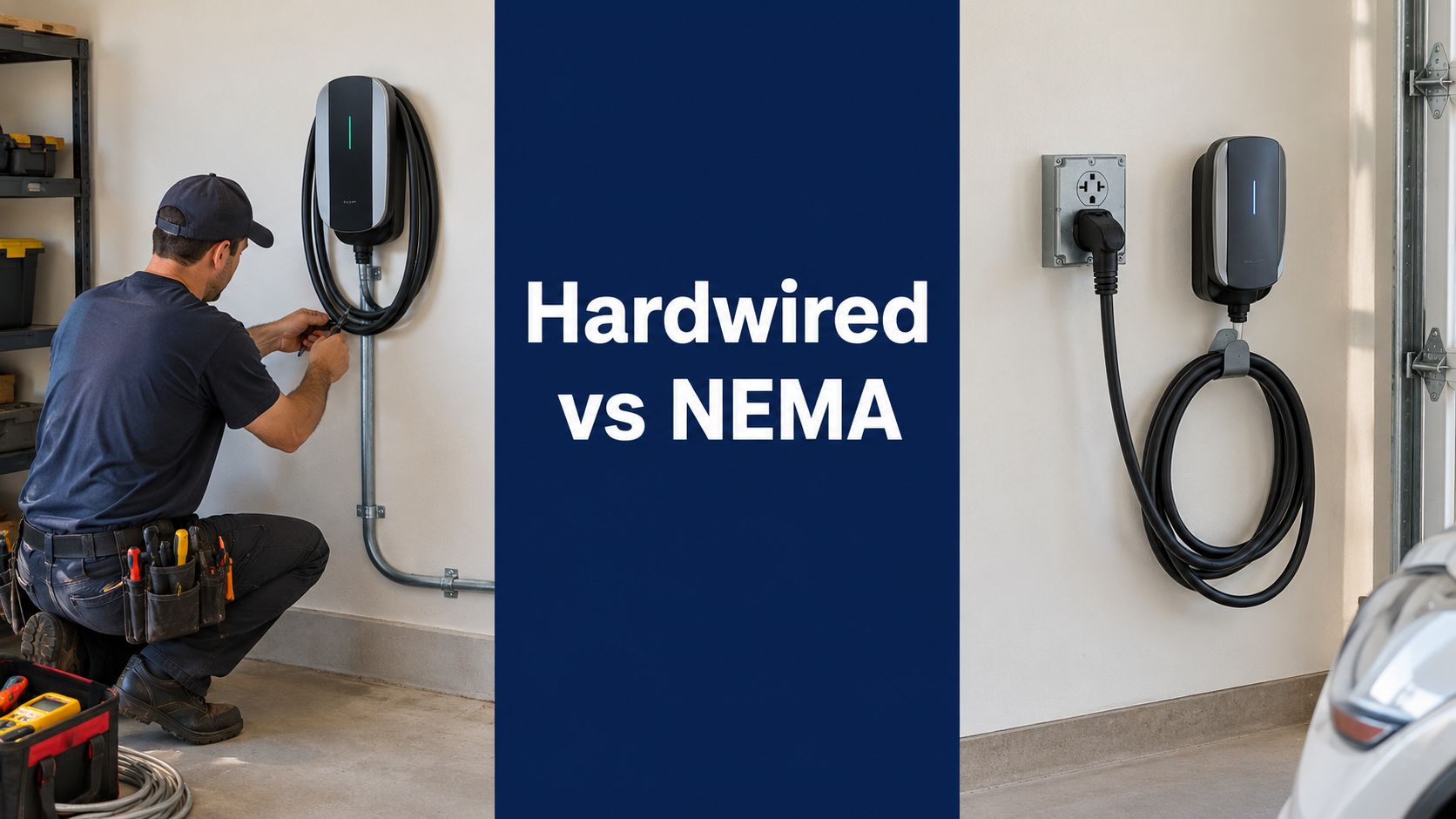
A homeowner in Northern Utah may already have a Level 2 charger in the garage, yet still be unsure whether a permanent connection or a plug-in setup makes more sense. The hardwired EV charger vs NEMA 14-50 outlet decision affects charging power, inspection requirements, durability, portability, and how well the home's electrical system handles winter and summer demand.
What Each Option Actually Means for Your Home
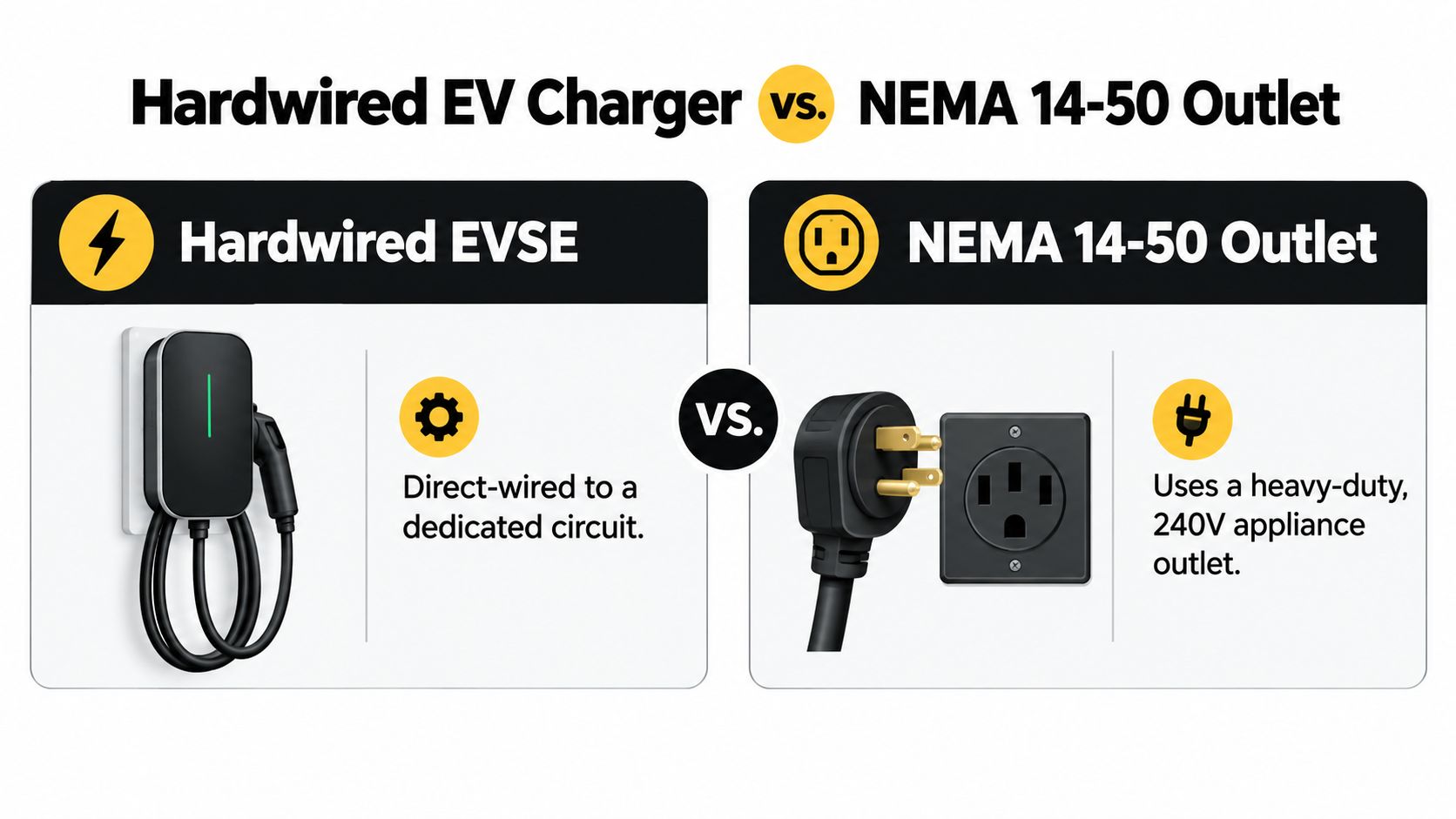
A hardwired EV charger is connected directly to a dedicated circuit from the electrical panel. The charger is fixed in place, with conductors terminating inside the equipment rather than at a wall receptacle. This arrangement is typically selected for a permanent garage or commercial charging location where the equipment won't be moved regularly.
A NEMA 14-50 outlet is a 50-amp, 125/250-volt receptacle designed to accept a compatible plug-in EV charger. It gives the homeowner a removable charging unit and can make future equipment swaps simpler. The outlet itself still requires a properly sized dedicated circuit, suitable conductors, appropriate overcurrent protection, and installation that meets the adopted electrical code.
Both options are Level 2, 240-volt approaches. The meaningful difference isn't whether the vehicle receives 240-volt power. It's how the equipment connects, how much continuous output the circuit can support, and whether the homeowner values permanence or portability.
| Consideration | Hardwired EV charger | NEMA 14-50 outlet |
|---|---|---|
| Connection | Directly wired to the charger | Plug and receptacle |
| Permanence | Fixed installation | Removable equipment |
| Continuous output | Can support higher output when designed for it | Commonly limited by the 80% rule |
| Flexibility | Lower portability | Easier to unplug and move |
| Inspection focus | Circuit, equipment, terminations, location | All of those, plus receptacle and GFCI requirements |
| Best fit | Permanent home or business charging | Portable equipment or future relocation |
Northern Utah homes vary widely. A newer home may have a convenient garage panel and a short wiring path, while an older Ogden, Roy, Layton, or Bountiful property may have limited panel capacity, an aging service, or a garage layout that makes conductor routing more involved. The right choice starts with the electrical system, not the charger box.
Charging Performance and How the 80 Percent Rule Limits Power
A winter evening can expose the difference between a charger's nameplate and its usable output. EV charging is a continuous load under the National Electrical Code, so the circuit and overcurrent protection must be sized at 125% of the charger's maximum load, as described in NEC Article 625 guidance. The breaker or receptacle rating therefore does not equal the amperage the vehicle may receive continuously.
A 50-amp NEMA 14-50 circuit can deliver 40 amps continuously, or about 9.6 kW at 240 volts, under the code's 80% rule. A hardwired installation commonly uses a 48-amp EVSE on a 60-amp circuit, producing roughly 11.5 kW. That is about 20% more charging power than the 40-amp plug-in setup. Technical guidance on NEMA 14-50 outlet safety explains the relationship between circuit rating and continuous charging.
| Configuration | Circuit rating | Continuous amps | Power at 240V |
|---|---|---|---|
| Plug-in EVSE on NEMA 14-50 | 50 amps | 40 amps | About 9.6 kW |
| Hardwired EVSE | 60 amps | 48 amps | About 11.5 kW |
The added output may help a driver returning to Northern Utah with a low battery after commuting from Weber or Davis County into Salt Lake County. A higher-output hardwired unit can restore more energy during the same overnight window. Actual charging time still depends on the vehicle's onboard charging limit, battery temperature, and the EVSE's programmed output.
The electrician must evaluate the breaker size, conductor ampacity, EVSE rating, and service capacity together. A charger rated for 50 amps does not automatically permit 50 amps of continuous charging. The home's distribution equipment and available capacity set the practical limit, as described in Electrical distribution guidance.
Homeowners planning to prepare home for electric vehicle charging should account for loads that may run at the same time. Electric heating, cooking equipment, water heating, hot tubs, and workshop equipment can affect the load calculation, especially during Northern Utah's coldest weather or periods of heavy summer cooling. A permit and inspection also help confirm that the selected output matches the home's existing capacity.
Safety Code and Durability Differences That Matter Long Term
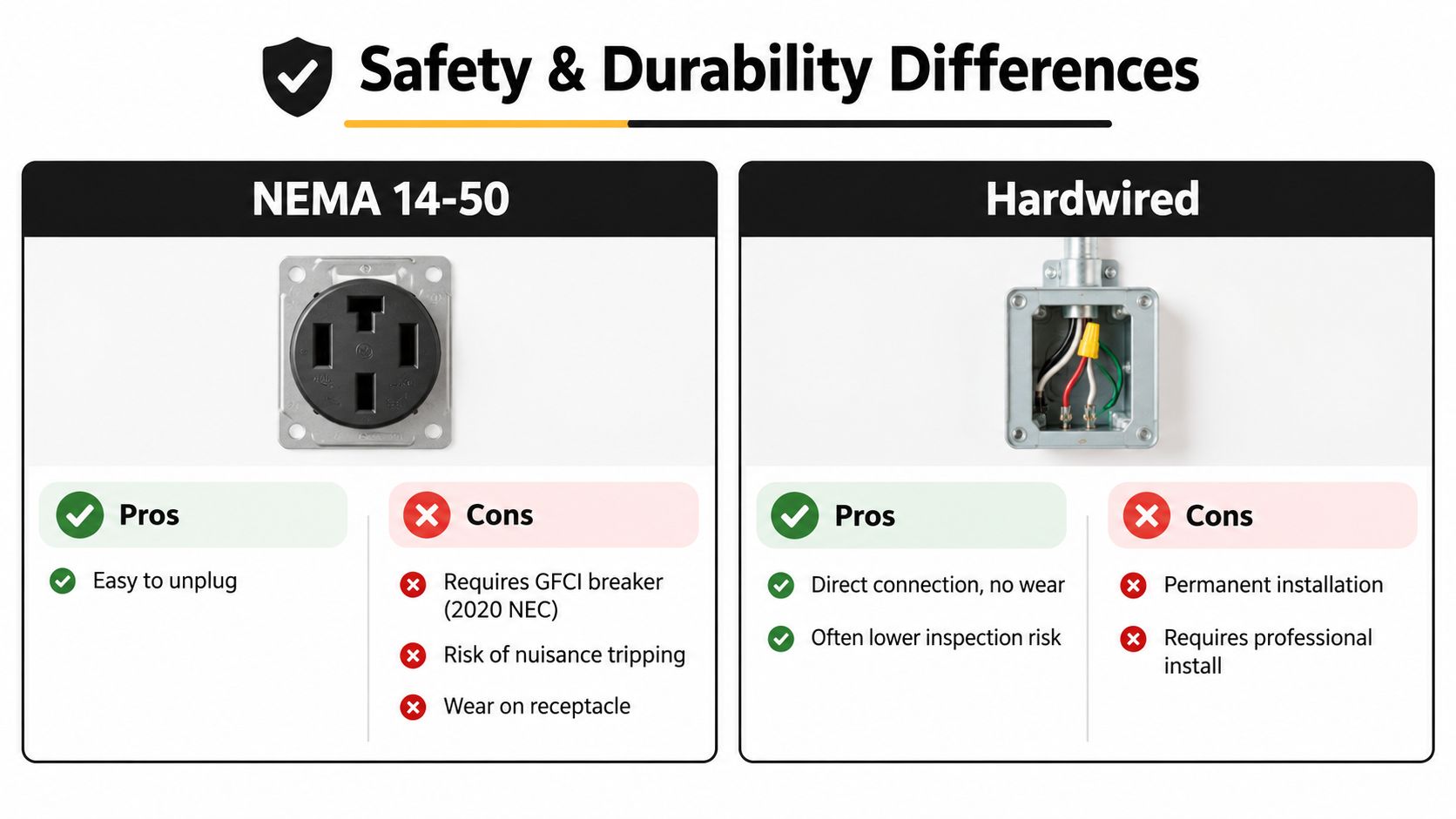
A NEMA 14-50 installation leaves a receptacle, plug, blades, terminations, and enclosure in the charging path. A hardwired connection removes the receptacle and plug interface, creating fewer points where heat, looseness, or wear can develop. That distinction matters in a Northern Utah garage, where seasonal temperature changes and repeated daily charging can expose weak connections over time.
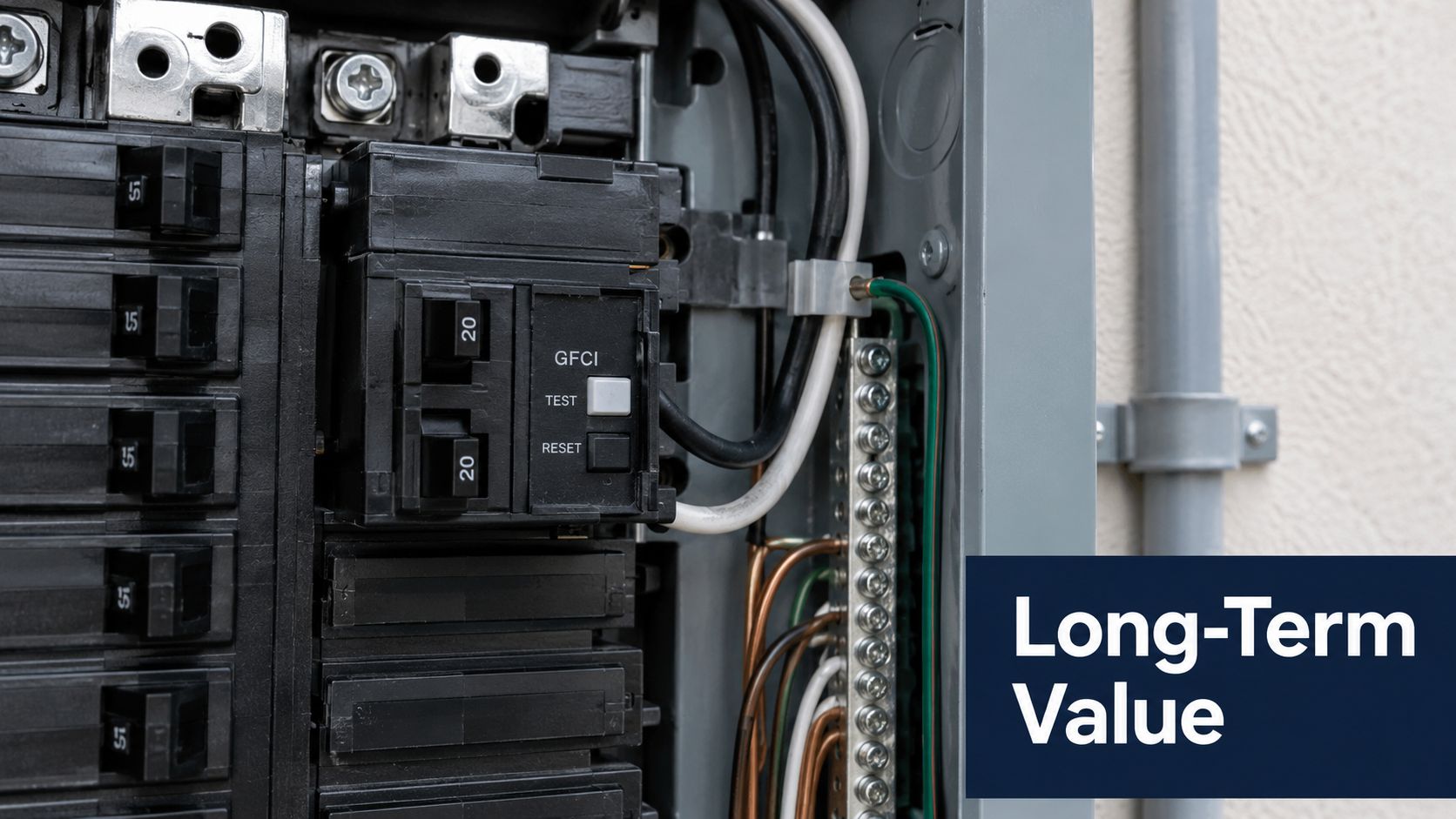
Under the 2020 NEC, a NEMA 14-50 receptacle installed for EV charging generally requires GFCI protection. The requirement can affect breaker selection and may contribute to nuisance trips in some installations. Hardwired equipment typically avoids that receptacle-specific requirement, but the charger's listing, installation instructions, and local authority still determine the permitted configuration. EV charger installation guidance
Practical rule: A plug-in charger needs more than a matching outlet. The receptacle, GFCI protection, breaker, conductors, equipment rating, and installation location must work together.
Hardwiring also avoids repeated insertion and removal of the plug. Its copper-to-terminal connection stays in place, while a plug-in setup relies on a properly rated receptacle, correct termination torque, and a receptacle that remains in good condition. Neutral technical guidance on NEMA 14-50 and hardwired installations describes fewer connection points and less plug-interface wear as durability advantages of hardwiring.
What an inspection can reveal
A Northern Utah inspector may verify the dedicated circuit, required receptacle protection, equipment listing, installation instructions, and wiring method for the location. Older homes may need closer review if the garage circuit is exposed to moisture, physical damage, or an unconditioned space. Permit and inspection requirements vary by city or county, so the installer should confirm them with the authority having jurisdiction.
Watch for discoloration, a hot plug or receptacle, a burning odor, crackling, damaged plastic, or repeated breaker trips. Stop charging if any symptom appears and have a qualified electrician inspect the equipment. A charger that usually works can still have an unsafe connection.
Installation Requirements and What an Electrician Will Check
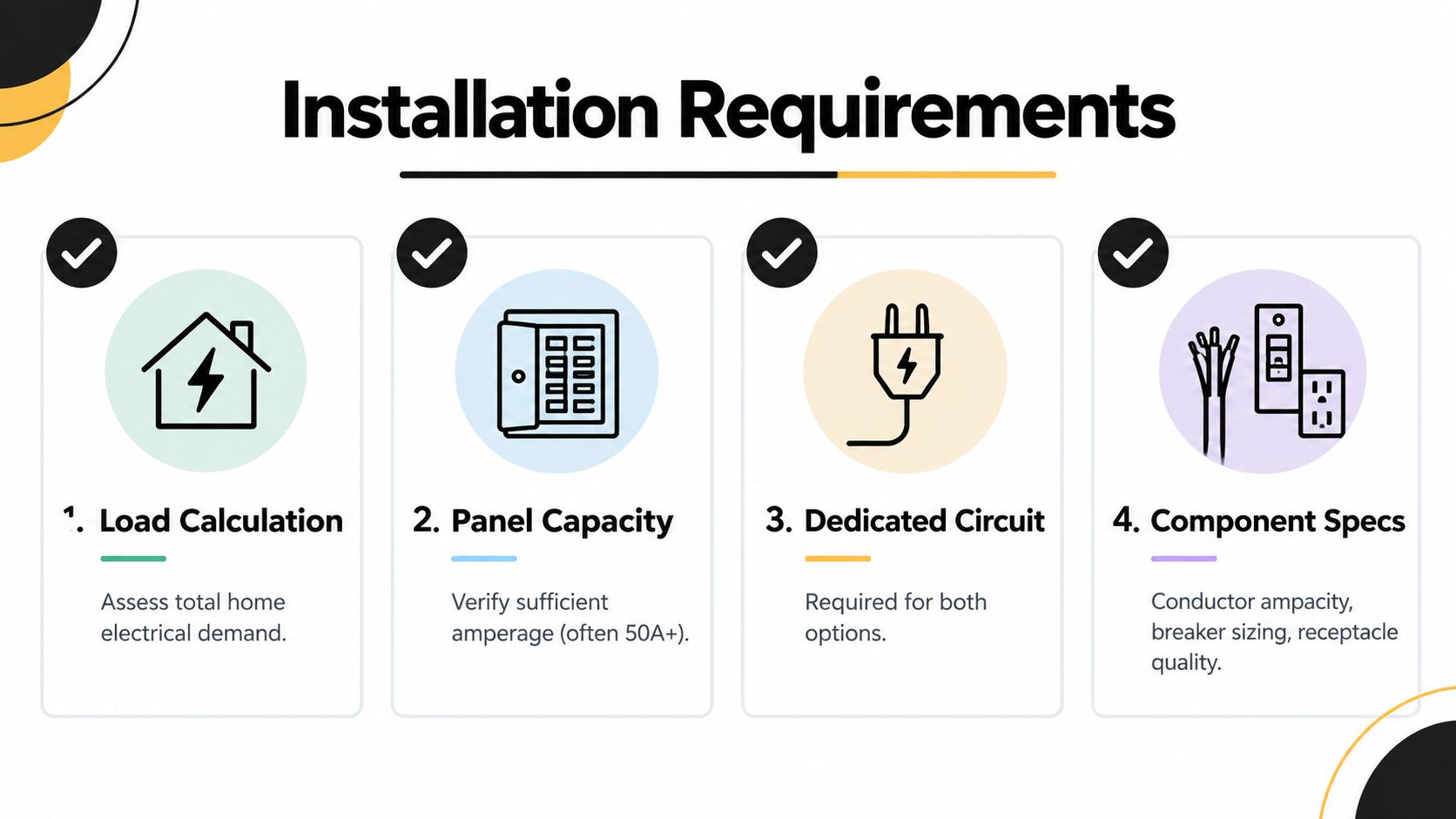
The installation process begins at the service equipment, not at the garage wall. A licensed electrician evaluates the existing panel, the utility service, available breaker space, the route to the charger, and the home's expected electrical demand before recommending either connection method.
The assessment
The load calculation accounts for existing equipment and planned use. In an older Northern Utah home, the electrician may find an older panel, crowded wiring, limited breaker space, or a service that needs further evaluation before adding a substantial continuous load. A newer panel isn't automatically sufficient either, because the total demand still has to be calculated.
The dedicated circuit must match the EVSE's maximum load. Under the continuous-load rule, a 40-amp EVSE needs a 50-amp circuit, while a higher-output unit requires a correspondingly larger circuit and equipment rating. The electrician verifies conductor ampacity, breaker selection, terminations, routing, disconnect considerations where applicable, and the charger's installation instructions.
The physical installation
For a NEMA 14-50 setup, the receptacle must be suitable for long-duration EV charging and installed in an appropriate box and location. For hardwiring, the electrician routes the conductors directly into the charger and secures the equipment according to its listing. Neither option should share a general-purpose circuit with garage outlets or other loads.
During a service visit for EV charger installation, Black Rhino Electric can assess the panel and wiring path, explain whether a plug-in or hardwired design fits the property, and identify code corrections or a panel upgrade if needed. The homeowner can safely provide the charger model, identify the intended parking location, show the panel, and describe other major electrical loads.
The homeowner shouldn't remove the panel cover, adjust terminals, change breaker settings, or troubleshoot energized wiring. Winter heating demand and summer cooling loads can change the practical capacity available for charging, so the electrician should evaluate the home as an operating system rather than treating the charger as an isolated appliance.
Cost Factors and Ownership Flexibility Over Time
The lower-complexity option on paper isn't always the lower-cost ownership choice. A NEMA 14-50 installation can involve a GFCI breaker, a suitable heavy-duty receptacle, an enclosure, wiring, a long cable route, permitting, and possible panel work. Hardwiring may avoid the receptacle and its receptacle-specific GFCI requirement, but the total scope still depends on the circuit, distance, panel condition, charger rating, and site access.
A homeowner comparing proposals should ask for the scope behind the price rather than comparing only the connection type. Utah EV charger cost factors can include:
- Panel condition: Whether the existing service can accept the calculated load.
- Circuit path: The distance, access, and wiring method between panel and charger.
- Protection: The breaker type and any GFCI requirement for a receptacle installation.
- Permitting: The applicable permit and inspection process for the local jurisdiction.
- Equipment changes: Whether a panel upgrade, correction, or other electrical work is necessary.
The value of flexibility
Portability is the strongest reason to choose a NEMA 14-50 outlet. Renters can take a compatible charger when they move, and homeowners who expect to relocate may value an outlet that allows equipment replacement without rewiring the charger connection. A plug-in arrangement can also suit a household that deliberately wants a removable EVSE.
Hardwiring generally makes more sense for a long-term home, especially when the owner wants the cleaner installation and higher output described earlier. The receptacle adds flexibility, but it also adds a device that must remain suitable for continuous charging and stay in good condition.
When to Choose Hardwired and When a NEMA 14-50 Makes Sense
The choice becomes clearer when the homeowner starts with the property and charging routine rather than a general preference. A driver who travels daily from Ogden or Layton to Salt Lake City may value the higher available output of a properly designed hardwired circuit. A household that charges occasionally may place more value on removing the equipment or changing chargers later.
Hardwired usually fits when
- The garage is permanent: The charger will stay at the same home and location for the foreseeable future.
- Charging speed matters: The vehicle and circuit can use the higher hardwired output.
- The installation should stay clean: The owner wants fewer connection points and a fixed wall-mounted system.
- Troubleshooting simplicity matters: Removing the receptacle eliminates one heat- and wear-prone interface.
- A business needs fixed equipment: A workplace or commercial property may benefit from a planned, permanent charging location.
A hardwired connection doesn't solve an undersized service or an overloaded panel by itself. It still requires a load calculation and code-compliant design.
NEMA 14-50 can fit when
- Portability is important: The owner may move the charger to another home.
- Equipment swaps are likely: A plug-in unit can be removed without disconnecting hardwired terminals.
- The property is temporary: Renters may not want a permanent charger connection.
- The charging routine is modest: The owner may not need the highest available Level 2 output.
- The outlet has another planned use: The circuit design and local requirements must still permit that use, and EV charging must remain treated as a continuous load.
For a homeowner comparing a permanent charger with a Level 2 charger outlet setup, the key question is whether portability outweighs receptacle complexity. An older Ogden home with limited panel space may need electrical corrections before either option can be approved, while a newer home with a dedicated garage and a long-term owner may be a natural hardwire candidate.
Next Steps for a Safe Code Compliant Install in Northern Utah
Start by photographing the panel label and charger specifications without opening the equipment. Note the proposed parking location, approximate cable route, existing warning signs, and major loads such as electric heat, hot tubs, cooking equipment, or workshop circuits. Repeated trips, heat, odor, discoloration, buzzing, and damaged receptacles call for professional evaluation rather than continued charging.
Permit and inspection requirements should be confirmed with the city or county having jurisdiction. Black Rhino Electric serves Weber, Davis, and Salt Lake counties from Marriott-Slaterville, including nearby communities such as Ogden, South Ogden, Roy, Layton, Clearfield, Bountiful, Farmington, Kaysville, and Salt Lake City. A service visit can include load calculations, panel and breaker evaluation, dedicated-circuit planning, charger installation, troubleshooting, and code-correction work.
Homeowners can request a free electrical quote with the charger details and property information ready. The final decision should match the home's capacity, the local inspection requirements, the charging routine, and the owner's plans for the equipment.
Black Rhino Electric evaluates hardwired and NEMA 14-50 charging installations, including panel capacity, dedicated circuits, GFCI requirements, and code corrections. Call 385-396-7048 or visit Black Rhino Electric to discuss a safe charging setup for a Northern Utah home or business.