If you're trying to sort through the top commercial electrical contractors in Utah, you're probably already staring at plans, schedules, bids, and one big question. Who can get the job done without turning your project into a headache? This guide is built to help you compare real fit, not just names on a list, and if you're hiring or growing a crew, it's also worth keeping an eye on electrician employment opportunities.
1. Black Rhino Electric

Black Rhino Electric stands out because it covers the kind of commercial work that shows up every day in Northern Utah. Not just big new builds, but the jobs owners and property managers lose sleep over. Panel issues, code-violation repairs, tenant improvements, after-hours troubleshooting, lighting upgrades, EV charging, and low-voltage work that has to play nice with the rest of the building.
That mix matters. A lot of lists about top commercial electrical contractors treat every firm like they're interchangeable. They aren't. Some are built for large bid-spec work. Some are better when a business needs a contractor who can fix a service problem on Tuesday and wire a remodel on Thursday.
Best Fit for Northern Utah Commercial Work
Black Rhino Electric is a practical fit for businesses in Weber, Davis, and Salt Lake counties that want one contractor for both project work and ongoing support. The company is fully licensed and insured in Northern Utah, with local experience handling meter and panel work, rewiring, lighting design, troubleshooting, GFCI and safety devices, and commercial build-outs. If you want a closer look at their commercial scope, review Black Rhino Electric's commercial electrical services.
From a boots-on-the-ground standpoint, this is the kind of contractor that makes sense when the job isn't neatly boxed into one category. A retail suite remodel may need power changes, new lighting, low-voltage cabling, and a code cleanup before inspection. That's common around here, especially in older buildings along the Wasatch Front.
Practical rule: If your project mixes service, retrofit, and small construction work, pick a contractor that's comfortable in all three. Otherwise you end up babysitting handoffs.
What Works Well and What to Watch
What works
- Broad commercial coverage: Handles troubleshooting, wiring, rewiring, panel upgrades, lighting, low-voltage systems, and new construction installs.
- Strong local fit: Focused on Northern Utah, with experience in the kinds of code and service issues older local properties tend to have.
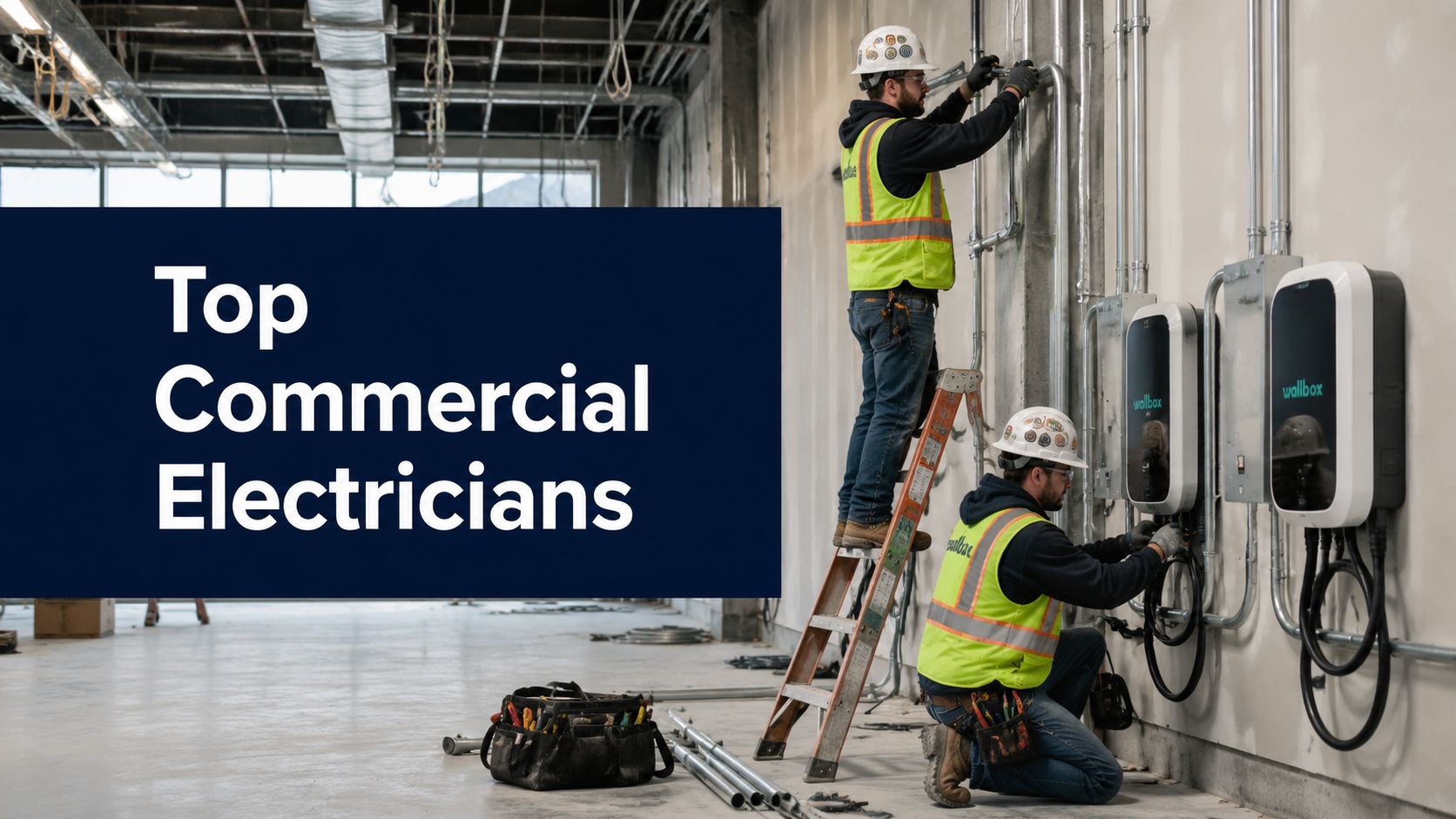
- EV charger capability: Useful for offices, mixed-use properties, and owners adding workplace charging, including Tesla Wall Connector installs.
- Responsive support: After-hours emergency service and scheduled maintenance are valuable when downtime costs money.
Trade-offs
- Regional footprint: Service is centered on Weber, Davis, and Salt Lake counties, so it isn't the pick for multi-state rollouts.
- Quote-based pricing: There isn't published flat-rate pricing online, which means you'll need a direct estimate for firm numbers.
For many local businesses, that's not a drawback. It's just reality. Commercial electrical work isn't like buying fence posts at the yard. Scope drives price.
2. Wasatch Electric

Wasatch Electric is the kind of contractor you call when the project has real scale, real layers, and very little room for improvising. They bring long-standing Utah presence plus the backing of EMCOR, which makes them a serious option for owners and general contractors who need design-build, plan/spec execution, facility services, and more specialized infrastructure capability under one roof.
Their bench is broader than what smaller local shops can usually offer. That includes commercial and industrial electrical work, low-voltage, retrofits, maintenance, power systems, and higher-end utility or substation-related capabilities.
Where Wasatch Fits Best
This firm makes the most sense on large commercial, institutional, industrial, and critical-facility projects where coordination matters as much as installation quality. If your project needs in-house engineering support and a contractor that can work through formal processes without getting lost, Wasatch is a strong candidate.
You know what? Bigger firms can feel slower on little jobs, but that same structure can save a project when there are a lot of stakeholders in the room. RFIs, submittals, phasing plans, shutdown coordination, all of that tends to get handled more cleanly by teams used to complexity.
Pros
- Deep delivery range: Design-build, plan/spec, installation, maintenance, retrofits, and facility services.
- Large-project support: Good fit for projects that need high-voltage, utility, or critical-facility experience.
- Strong backing: EMCOR affiliation adds scale and specialty depth.
Cons
- Small jobs may wait: Tiny time-and-material calls can get pushed behind larger contract work.
- More process-heavy: Owners used to calling a smaller shop owner directly may find the workflow more formal.
On a complex job, formal process isn't red tape for its own sake. It's what keeps one late answer from becoming three weeks of rework.
For buyers comparing top commercial electrical contractors, Wasatch is less about speed on minor service calls and more about dependable delivery on serious commercial scopes. Their website is Wasatch Electric.
3. Cache Valley Electric (CVE)

Cache Valley Electric has been around long enough to earn a reputation the hard way, by showing up on difficult projects and carrying them through. They handle commercial electrical construction with added strength in industrial work, telecom, network integration, preconstruction, project management, engineering, and commissioning. That makes them a strong pick when the electrical scope touches more than branch circuits and lighting.
If your build is schedule-driven and spans multiple systems, CVE deserves a look. They're especially relevant when owners want one electrical partner that understands both construction and the infrastructure behind it.
Why They Matter in the Utah Conversation
Nationally, the electrical contracting field is massive. IBISWorld projects the U.S. electricians industry at $347.5 billion in revenue in 2026, with about 262,000 businesses and 4.8% compound annual growth over the prior five years. In that same dataset, large firms such as Quanta Services, Cleveland Electric, and Five Star Electric are named among the biggest players. That gives useful context for Utah buyers. The firms that rise to the top usually do it through scale, repeatable systems, and reach across multiple markets.
CVE fits that mold better than a neighborhood-only contractor. It has the depth for large commercial and industrial jobs across the Intermountain West, not just one-off local service work.
Real-World Trade-Offs
What they do well
- Big-project readiness: In-house engineering, preconstruction, and project management support schedule control.
- Multi-discipline strength: Electrical construction plus telecom and network integration can simplify coordination.
- Complex facility experience: Useful on industrial and infrastructure-heavy jobs.
Where they may not fit
- Small TI work isn't the sweet spot: If you're wiring a single small tenant space, they may be more contractor than you need.
- Budget expectations: Larger organizations with broader capabilities often aren't the low bid for simple scopes.
Their website is Cache Valley Electric.
4. Hunt Electric
Hunt Electric is one of the more versatile names on this list because they don't stop at standard commercial installation. They operate across electrical construction, design-build, service, preventive maintenance, traffic and infrastructure, technology systems, industrial automation, and high-voltage work. That gives them range a lot of building owners appreciate once a project starts shifting under their feet.
One thing I respect in a contractor is whether they can help before, during, and after the build. Hunt checks that box better than many firms that lean only toward construction.
Why Hunt Works for Ongoing Commercial Needs
Hunt Electric is especially useful when a customer needs both project delivery and a service relationship after turnover. Their use of BIM/VDC, prefabrication, in-house engineering, and commissioning support can help hold a complicated commercial schedule together. Then their service and PM side gives owners somewhere to go once the ribbon cutting is over.
That matters because commercial buyers don't just need installers anymore. They need contractors who can support retrofits, maintenance, low-voltage integration, and modernization work after the original job is done. That's a common gap in typical rankings of top commercial electrical contractors, which often list company names without helping buyers compare actual project fit, as discussed in this review of how buyers evaluate top electrical contractors.
Strengths
- Balanced service model: Construction plus maintenance is a better long-term setup for many facilities.
- Technical depth: High-voltage, low-voltage, automation, and infrastructure divisions widen their usefulness.
- Project tools: BIM/VDC and prefabrication can improve coordination on larger builds.
Limitations
- Lead times can stretch: Busy seasons can make quick-turn work harder to slot.
- Small jobs may feel formal: Very small tenant improvements can get routed through a process built for bigger work.
Their website is Hunt Electric.
5. Taylor Electric
Taylor Electric sits in a useful middle ground. They're not a tiny call-and-fix shop, and they're not so large that every customer feels like a file number. For commercial owners and general contractors, that can be a sweet spot. You get modern delivery methods like VDC, BIM, prefabrication, design-build support, and 24/7 service, but often with a little more agility than the biggest enterprise contractors.
They also have experience with EV charging infrastructure, which is becoming more relevant on office, mixed-use, healthcare, and institutional properties.
Best Use Cases
Taylor Electric is a good fit when the project is complicated enough to need planning and coordination, but not so specialized that you need a utility-scale contractor. Healthcare, education, large commercial, and industrial occupancies are where a company like this tends to make sense.
The market backdrop supports that focus. Arizton estimates the U.S. electrical contractors market at USD 237.59 billion in 2023, rising to USD 256.65 billion by 2029 at a 1.29% CAGR. That same market view pairs well with the point that a meaningful share of industry revenue comes from upgrades rather than only new construction. For buyers, that means firms with retrofit and modernization capability are worth serious attention.
Field note: In a slower-growth market, contractors that know retrofits and upgrades usually stay busier and sharper than shops waiting on only ground-up work.
Practical Pros and Cons
Pros
- Modern workflow: VDC, BIM, and prefabrication can reduce field surprises.
- Good for complex occupancies: Useful on projects where shutdown planning and coordination really matter.
- Service availability: 24/7 support helps owners who need continuity after installation.
Cons
- Not ideal for tiny one-off jobs: They appear more focused on substantial commercial and industrial scopes.
- Availability can tighten: Rush tenant work may compete with larger scheduled projects.
Their website is Taylor Electric.
6. Salmon Electrical Contractors
Salmon Electrical Contractors makes sense for buyers who want a local commercial electrician that can still handle real project work. They work in new construction, remodels, tenant improvements, and commercial power distribution, and they have a reputation for being approachable on Wasatch Front jobs where communication with the GC matters just as much as craftsmanship.
Not every project needs a giant contractor. A lot of jobs around Northern Utah need a team that's responsive, practical, and willing to solve problems in the field without making everything feel like a board meeting.
Where Salmon Can Be the Better Pick
Salmon is worth considering when larger firms are stretched thin or when your project sits in that middle lane. Too big for a handyman-style electrician, too small to interest the mega-contractors. Tenant improvements, remodels, office build-outs, and regional commercial work are the kinds of scopes where this type of contractor can be a strong match.
Their local responsiveness is a real advantage. If a GC needs answers quickly, or an owner needs a contractor who'll stay engaged through punch and closeout, smaller regional players often do well there.
Pros
- Responsive regional fit: Good option for Wasatch Front commercial jobs that need timely scheduling.
- GC-friendly approach: Helpful on remodels and TI work where coordination changes by the week.
- Solid service mix: Covers ground-up, remodel, and distribution needs.
Cons
- Less scale than the largest firms: Some specialized scopes may require outside partners.
- Lighter public portfolio detail: Buyers may need to ask more direct questions during vetting.
Their website is Salmon Electrical Contractors.
7. LMS Lighting, Electrical & Signs

LMS takes a slightly different angle than the rest of the list. If your project touches electrical work, lighting, and signage, that bundled capability can save a lot of back-and-forth. For retail, storefront, and small-to-mid commercial jobs, that matters more than people think. One missed coordination point between sign power and final finish can burn a surprising amount of time.
They handle new commercial power systems, remodels, service upgrades, troubleshooting, and on-site support across the Wasatch Front. That puts them in a practical lane for businesses that need quick mobilization and straightforward execution.
Why LMS Can Be a Smart Niche Choice
LMS isn't trying to be everything to everyone. That's a plus. When lighting and signage are part of the scope, one contractor coordinating those moving pieces can simplify the job.
And if you're reworking lighting inside a space, it helps to understand basics beyond fixture counts. Details like how CRI affects your home's colors come from the same bigger conversation about visual quality, tenant feel, and how a finished space reads. Commercial buyers usually care more about productivity, merchandising, and appearance than they first admit.
Good electrical work disappears into the background. Bad lighting never does.
Pros and Cons
Pros
- Useful bundled scope: Electrical, lighting, and signage coordination can reduce friction.
- Good for fast regional work: Better fit for smaller and mid-sized jobs than many large contractors.
- On-site support: Helpful for troubleshooting and service upgrades.
Cons
- Limited large-scale capacity: Not the strongest match for major multi-site programs.
- Less technical documentation online: Buyers may need a call to understand depth and fit.
Their website is LMS Lighting, Electrical & Signs.
Top 7 Commercial Electrical Contractors Comparison
| Company | Implementation complexity | Resource requirements | Expected outcomes | Ideal use cases | Key advantages |
|---|---|---|---|---|---|
| Black Rhino Electric | Low–Moderate (routine repairs to full rewires) | Small local crews, standard electrical and EV charger tools | Code-compliant, timely residential/commercial installs; responsive service | Homeowners, property managers, small–mid businesses, EV charger installs | Local licensed team, safety-first, transparent scheduling, emergency service |
| Wasatch Electric | High (design-build, large commercial/industrial) | Large-firm resources, in-house engineering, high-voltage crews | Robust, scalable delivery for complex utility and critical projects | Large commercial, industrial, utility/substation, critical facilities | Century of local experience, EMCOR backing, broad multidisciplinary capabilities |
| Cache Valley Electric (CVE) | High (schedule-driven large builds) | Union workforce, in-house engineering, project management | Reliable execution on complex commercial/industrial projects across region | Large regional builds, industrial, network/telecom, commissioning scopes | Long track record, regional scale, strong industrial experience |
| Hunt Electric | High (end-to-end with BIM/VDC and prefabrication) | Multi-division teams, BIM/VDC, prefabrication and commissioning resources | Turnkey, warranty-backed delivery with ongoing service/maintenance | Office, healthcare, resorts, roadway, industrial automation projects | Strong service division, BIM/VDC and prefabrication, high-voltage and automation expertise |
| Taylor Electric | Moderate–High (VDC/BIM and design-build) | Mid-to-large crews, prefabrication, 24/7 service capability | Compressed schedules and high-quality delivery for complex occupancies | Healthcare, education, large commercial and statewide projects | Modern delivery methods, agility, EV charging experience |
| Salmon Electrical Contractors | Moderate (tenant improvements to new builds) | Mid-sized local crews, GC-focused coordination | Responsive local delivery for mid-sized commercial projects | Wasatch Front tenant improvements, remodels, mid-sized builds | Quick local mobilization, strong GC relationships, responsive scheduling |
| LMS Lighting, Electrical & Signs | Low–Moderate (power systems, lighting/signage integration) | Small–mid crews, lighting and signage technical skills | Fast mobilization with integrated lighting and signage solutions | Small to mid-sized commercial projects needing lighting/signage coordination | One-stop lighting/signage integration, practical for quick regional projects |
Final Thoughts
Picking among the top commercial electrical contractors isn't really about finding the biggest name. It's about finding the right fit for the work in front of you. New construction, tenant improvements, service calls, panel upgrades, low-voltage integration, EV charging, retrofit work, and maintenance all pull on different strengths. If you hire a contractor that's built for the wrong kind of work, you'll feel it in delays, change orders, weak communication, or a lot of finger-pointing.
Utah buyers should also remember the market is bigger and more layered than it looks from the curb. ConsumerAffairs reports there were nearly 713,000 electricians employed in the U.S. as of May 2023, with more than $200 billion in annual revenue and about 239,000 electrician-based businesses in 2023. In that same review, Quanta Services was identified as the top U.S. electrical contracting business in 2022 with nearly $17 billion in revenue, followed by MYR Group at more than $3 billion, with Rosendin Electric in third place. That tells you something important. There are a few very large players, but most buyers are still choosing among regional and local contractors that vary a lot in specialty and responsiveness.
From the contractor side, the difference between a stable commercial shop and a fragile one often comes down to service mix. CT Acquisitions notes that well-run electrical contractors with strong commercial service books trade at 6x to 8x EBITDA in 2026, while new-construction-dependent operators trade around 4x, and data-center, EV, and solar specialty platforms can reach 9x+. You don't need to be buying a company for that to matter. It points to what usually makes a contractor more durable: recurring service, specialization, and visible backlog.
So when you compare contractors, ask plain questions. Do they mainly chase new construction, or can they support the building after turnover? Are they strong in service, retrofits, or tenant improvements? Can they handle low-voltage, EV charging, after-hours calls, and code-driven upgrades without farming everything out? Let me clarify. The right contractor should fit your building the way the right breaker fits a panel. Not close enough. Exactly right.
If you need a commercial electrician that knows Northern Utah buildings, code realities, and the difference between a simple install and a job that can derail operations, Black Rhino Electric is a practical place to start. You can call Black Rhino Electric at 385-396-7048 or request a free quote for commercial repairs, upgrades, tenant improvements, maintenance, and new construction work.