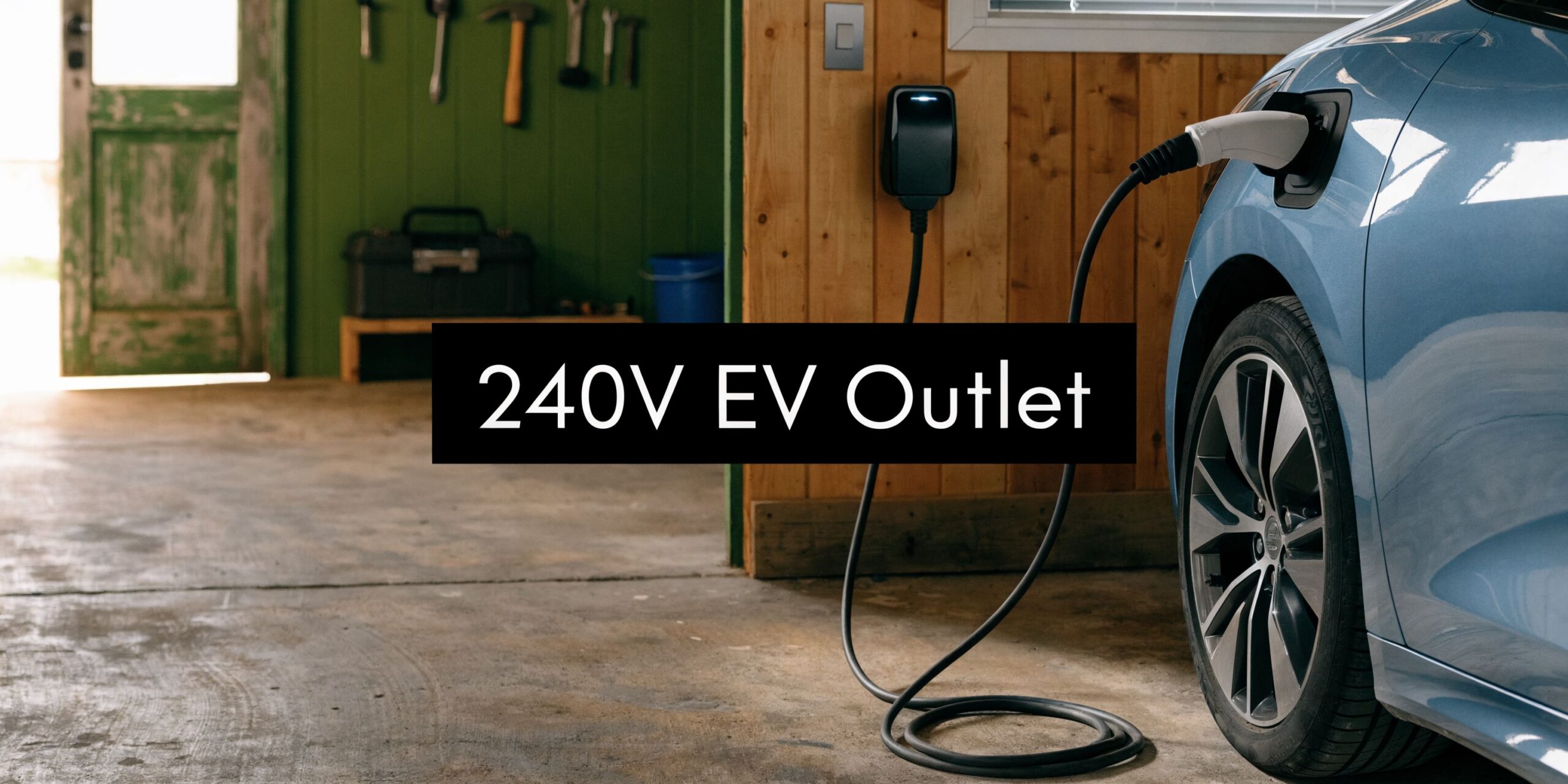
Bringing home an EV is exciting right up until you realize the standard garage outlet is painfully slow. A properly installed 240 volt outlet for electric car charging changes that fast, giving you a setup that fits daily driving in Northern Utah.
Your Guide to Home EV Charging Starts Here
Most homeowners call after the same moment. They plug the car into a regular outlet, watch the charging estimate crawl, and realize that “overnight” does not always mean “ready by morning.”
That is why Level 2 charging has become the standard at home. Level 2 EV chargers use 240-volt outlets and deliver 3.3 kW to 19.2 kW, which typically adds 20 to 30 miles of range per hour according to EV Volumes. The same source notes that global EV sales reached 17.8 million in 2024, representing nearly 20% of the light-vehicle market, so this is not a niche upgrade anymore.

Why a standard outlet falls short
A standard 120-volt outlet works for very light use. It is fine if you drive very little, have plenty of downtime, and do not mind slow recovery.
Most Utah drivers want something more practical:
- Daily commuting support that restores meaningful range overnight
- Cold-weather flexibility when winter conditions can affect real-world efficiency
- Less dependence on public charging when schedules get tight
- A dedicated circuit designed specifically for EV equipment, not a shared convenience outlet
You know what? The biggest benefit is not speed alone. It is predictability. You plug in at night and stop thinking about it.
Questions to answer before you install
Before an electrician gives you a recommendation, these are the questions that matter:
How much do you drive most days
A short commute may leave you with more options. A long daily drive usually pushes you toward a dedicated Level 2 setup.Where do you park
Attached garage, detached garage, driveway, or carport all change the installation path.What charger does your vehicle use
Some homeowners want a plug-in charger on a NEMA outlet. Others want a hardwired wall unit.How old is your electrical system
In Northern Utah, older homes often have tighter panel capacity and less room for a new two-pole breaker.Do you want flexibility later
If you may switch vehicles or move, that can affect whether a receptacle or hardwired charger makes more sense.
What usually works best in Utah homes
For many homes in Weber, Davis, and Salt Lake counties, the practical answer is a dedicated garage circuit installed by a licensed electrician. That allows the circuit, wire size, breaker, GFCI protection, and outlet type to all match the charging equipment.
Practical tip: A good EV setup is not just about making the charger turn on. It is about matching the charger, breaker, wire, and outlet to continuous load use so the system stays safe over time.
If you are still comparing charging approaches, this EV home charging station guide gives a helpful high-level look at home charging decisions from a homeowner’s point of view.
What homeowners often underestimate
People usually focus on the charger itself. The charger matters, but the house side matters just as much.
The outlet location, the available amperage in the panel, the wiring path, and the local inspection requirements are what decide whether the install is simple or more involved. That is especially true in older Utah homes where garages were never designed with EV charging in mind.
A clean install starts with planning. Not guesswork.
Decoding Outlets Amps and Your Electrical Panel
A lot of Northern Utah homeowners start by asking for a 240 volt outlet in the garage. Fair question. The key decision usually starts at the panel, not at the wall.
Here’s the thing. In Weber, Davis, and Salt Lake County homes, especially anything older, I see two problems all the time. The charger plug does not match the outlet the homeowner had in mind, or the panel looks like it has room but does not have enough capacity for another continuous load. Those are two different issues, and both matter.
The two outlet styles homeowners ask about most
For plug-in EV chargers, the two receptacles that come up most are NEMA 14-50 and NEMA 6-50. Both are 240-volt outlets. They do different jobs.
| Feature | NEMA 14-50 | NEMA 6-50 |
|---|---|---|
| Common use | EV charging, RV use, some ranges | EV charging, welders |
| Prongs | Four-prong | Three-prong |
| Neutral wire | Yes | No |
| Ground | Yes | Yes |
| Typical homeowner appeal | Broad charger compatibility | Simpler configuration for equipment that does not need neutral |
| Best fit | Plug-in chargers designed for 14-50 | Plug-in chargers designed for 6-50 |
The plug shape matters. The charger has to match the receptacle, and building the circuit around adapters is a bad habit that causes problems later.
In practice, 14-50 is the one homeowners recognize because many portable Level 2 chargers ship with that plug. 6-50 can still be the right answer if the charging equipment is built for it and does not need a neutral. The right choice comes from the charger specs first, then the wiring plan.
Amps matter more than the outlet name
A 14-50 outlet does not automatically mean you are charging at 50 amps. That is one of the biggest points of confusion.
EV charging is a continuous load. That means the circuit has to be sized for hours of sustained draw, not a quick burst like a power tool. A charger may be set to 32 amps, 40 amps, or another output level, and the breaker and wire have to be matched to that actual load. If the charger is rated at 40 amps, the circuit is commonly built on a 50-amp breaker with conductors sized to match the installation method and code requirements.
That is why these numbers matter:
30A circuit
A workable option for lower-output charging.40A charging setup
Common in houses where the goal is faster overnight charging without pushing the service too hard.50A circuit
Common for plug-in chargers that use a NEMA 14-50 receptacle.
The breaker size is only part of the answer. Wire size, terminations, ambient conditions, conduit fill, and the charger’s actual maximum draw all have to line up.
What to check at your panel
Open the panel door and start with the basics:
Breaker space
A 240V EV circuit needs room for a two-pole breaker.Service size
Many Utah homes have 100-amp or 200-amp service. Older 100-amp services are where EV projects get tight fast.Panel condition
The panel has to be in good shape, properly labeled, and suitable for another breaker.Household load
Electric range, dryer, hot tub, basement finish, electric heat, and newer AC equipment all add up.
I tell homeowners this all the time. Space is not capacity. I can open a panel and see two open slots, and that still does not mean the house is ready for a new EV circuit.
For homes that may already be close to their limit, this page on breakers and panels electrician services gives a useful overview of the panel issues that often decide whether the job stays simple or turns into a service or panel upgrade discussion.
Residential-grade versus industrial-grade outlet
This is the part many online articles skip, and it matters more than people think.
A residential-grade 14-50 from the hardware store is usually built for occasional appliance use. EV charging puts repeated, sustained load on that receptacle. Over time, weak contact tension creates heat. Heat leads to loose connections, discoloration, nuisance problems, and in some cases a damaged outlet or plug.
Industrial-grade NEMA 14-50 outlets are a better choice for EV charging than standard residential-grade outlets because they are built with stronger contact pressure and better materials for repeated heavy use. NeoCharge’s comparison of industrial vs residential-grade 240V outlets explains the difference in durability and contact quality.
If a bid says “install 14-50 outlet,” ask what receptacle brand and grade is included. That one question tells you a lot about how the electrician is approaching the job.
What usually works, and what causes trouble
What works:
- Matching the receptacle to the charger model
- Sizing the breaker and conductors for continuous EV load
- Using an industrial-grade receptacle for plug-in charging
- Checking panel capacity before the job is quoted
- Planning around the house you have, especially in older Utah neighborhoods
What causes trouble:
- Treating EV charging like a dryer circuit without checking the charger specs
- Buying the cheapest 14-50 on the shelf
- Assuming two open breaker spaces solve the problem
- Using adapters as the plan instead of as a temporary workaround
- Ignoring how older 100-amp services in Northern Utah can limit options
A safe EV outlet install is usually straightforward. It just has to be sized correctly, built with the right parts, and tied into a panel that can support it.
The Installation Path From Panel to Plug
You buy the EV, park it in the garage, and then realize the charger location is the easy part. The main job is getting a dedicated 240 volt circuit from the panel to that spot without overloading older equipment, cutting up finished walls, or building something the inspector will reject.
That path matters a lot in Northern Utah. I see plenty of homes in Weber, Davis, and Salt Lake county with older panels, crowded breaker spaces, or service sizes that worked fine for a range and dryer but get tight once EV charging enters the picture.
The first site visit
The first stop is the panel. That tells us whether the house can support the charger you want, whether there is room for a new two-pole breaker, and whether the panel itself is in shape for another continuous load.
Route planning comes right after that. In a lot of Northern Utah homes, the cleanest run is through an unfinished basement, mechanical room, or straight into an attached garage. Finished spaces take more planning. Sometimes the best answer is a neat surface conduit run instead of opening drywall in three different places.
Circuit sizing follows the charger, not guesswork. EV charging is a continuous load, so the breaker and wire have to be sized for that duty. A charger set to 40 amps typically goes on a 50 amp circuit. If the equipment allows a different setting, that can open up better options for homes with limited panel capacity.
How the wiring gets there
The house layout decides the method.
For a garage wall run, EMT conduit is common because it protects the conductors well and holds up better to everyday garage use. That matters in a real garage where ladders, bikes, storage bins, and winter gear get moved around. Inside finished walls, or at short transitions, other wiring methods may make sense if code allows them and the install stays protected.
A few common job conditions change the plan:
Attached garage
Usually the cleanest install. The wiring can often stay inside the structure with less labor and less patchwork.Detached garage
This takes more coordination. Underground routing, trench depth, conduit type, and where the feeder enters the building all have to be planned correctly.Finished garage with limited access
Clean exposed conduit often looks better than a drywall repair project that still leaves access problems.Long distance from panel to charger location
Voltage drop starts to matter, and conductor sizing may need another look.
From breaker to receptacle
A clean EV outlet install follows a straightforward sequence:
- Install a dedicated two-pole breaker matched to the charging load.
- Run properly sized conductors along the planned route with the right protection.
- Mount the box at a usable height and location so the charging cord reaches without strain or awkward bends.
- Make solid terminations at the breaker, outlet, or charger.
- Test the circuit for correct voltage, polarity, and operation before inspection and use.
That sounds simple because it should be. The problems show up when somebody rushes the layout, uses the wrong device, or treats EV charging like a spare dryer circuit.
One detail many online guides skip is the outlet itself. A plug-in EV charger puts sustained load on a receptacle for hours at a time. Residential-grade devices are where I see more heat damage and loose contact issues. If you are installing a 14-50 for regular charging, the grade and brand of receptacle matter just as much as the wire size.
Hardwired charger or plug-in outlet
Both can be good options. The right one depends on the charger, the panel, and how you plan to use the space.
A hardwired charger removes one connection point and often gives a cleaner finished install. A plug-in setup gives you flexibility if you may swap chargers later or want to take the unit with you. In older Utah homes with tighter panel capacity, the best answer is sometimes a hardwired unit set to a lower output that fits the available load calculation better.
If you are comparing options for a Tesla setup, this page on Tesla EV charger installation shows one common residential approach.
Where DIY jobs usually go sideways
The same mistakes come up again and again:
- Wire sized too small for the charger setting
- Loose terminations at the breaker or receptacle
- A bad routing plan that leaves wiring exposed or poorly protected
- Cheap outlet devices that are not built for repeated EV charging
- No coordination with permit and inspection requirements
- Missing protection devices required for the location
Here’s the thing. A charger can light up and still be installed wrong. The unsafe jobs are often the ones that look fine from across the garage wall.
A permit is not the annoying extra. It is part of the job.
In Weber, Davis, and Salt Lake county areas, a new 240-volt EV circuit is the kind of work that should be permitted and inspected. That inspection protects the homeowner as much as it protects the jurisdiction.

What the inspector is really checking
The inspector is not there to make your project harder. They are checking whether the new circuit is safe to energize and safe to leave in your home for years.
That usually includes:
- Breaker sizing
- Wire sizing
- Conductor terminations
- Conduit support and protection
- Outlet or hardwire installation
- Labeling and workmanship
- Required safety protection
A permit also creates a clean paper trail. If you sell the home later, a permitted EV circuit is easier to defend than a mystery receptacle added without records.
The code issue many DIY guides skip
One of the biggest inspection issues now is GFCI protection.
Since the 2020 NEC update, Article 210.8(F) requires GFCI protection for 240V, 30-50A outlets in garages and basements, including most EV charging circuits, as noted in this code discussion on 210.8(F). Installations without the required GFCI protection can fail inspection in places like Weber and Davis counties.
That catches homeowners off guard because they watched an older install video, bought a standard breaker, and assumed that was enough. It is not.
Why this matters in older Utah homes
Many older homes in Northern Utah already have a few layers of past electrical work. Some was done well. Some was not.
When you add a new EV circuit, the inspector may notice issues that were hidden before:
- Crowded panel spaces
- Improper breaker types
- Aging service equipment
- Garage wiring that does not match current code expectations
Let me explain. The EV outlet itself may be simple, but once you tie it into the home’s electrical system, the whole path needs to hold up to scrutiny.
Key takeaway: Passing inspection is not about pleasing a city office. It is about making sure the circuit protecting your car and your garage is built correctly from the first connection to the last.
Local homeowners benefit from doing it right
Permitted work usually goes smoother in the long run. You avoid surprise corrections later, and you reduce the chance of finding out about a code problem only after drywall is patched or the charger is already mounted.
That matters for safety. It also matters for resale, insurance conversations, and plain peace of mind.
Estimating Costs and Timelines for Your Project
Homeowners often want a straightforward answer here. The accurate one is that EV outlet pricing depends on the house more than the charger.
A simple garage install is one kind of project. An older home with limited panel capacity, a long run, or a detached garage is another.
What affects the final price
The main cost drivers are usually easy to identify during a site visit:
Panel capacity and condition
If the panel can accept the new circuit cleanly, the project stays simpler.Distance from panel to charging location
More wire, more conduit, and more labor all change the number.Garage type
Attached garages are usually more straightforward than detached structures.Outlet versus hardwired charger
The material list and labor scope can differ.Finish surfaces
Working through finished spaces often takes more planning than unfinished utility areas.Permit and inspection coordination
This is part of legitimate electrical work, not an optional add-on.
Typical timeline expectations
A straightforward install can move quickly once the plan is set. More complex jobs take longer because the prep is heavier.
A normal project timeline often includes:
| Project stage | What happens |
|---|---|
| Initial visit | Site review, panel check, route planning |
| Proposal | Scope, materials, and installation method are defined |
| Permit phase | Local approval process begins |
| Installation day | Circuit, wiring path, breaker, and outlet or charger are installed |
| Inspection | Final approval before the project is fully wrapped |
Some jobs finish in a short work window. Others take longer because of panel work, detached garage routing, or scheduling around local inspections.
Why the investment is getting easier to justify
This upgrade is no longer just about convenience. It aligns with where the vehicle market is going.
According to Virta’s global electric vehicle market overview, the global EV fleet was expected to reach nearly 60 million vehicles by the end of 2024, and over 22% of new car sales in 2024 were electric. That matters because a properly installed home charging setup is becoming a more recognizable property feature.
Practical perspective: The cheapest bid is not always the lowest total cost. Rework, failed inspections, and replacing overheated components cost more than getting the circuit built correctly the first time.
A good estimate should explain why your home falls into a certain cost range. If it does not, ask more questions.
How to Hire the Right Electrician and Evaluate Bids
The right contractor makes this project feel simple. The wrong one makes it expensive twice.
A homeowner should be able to compare bids without guessing what got left out. That means looking past the bottom-line price and into the actual scope.
What to verify before hiring anyone
Start with essential requirements:
Utah licensing and insurance
If a contractor cannot clearly provide this, stop there.EV charging experience
Not just “general electrical.” EV circuits have load, outlet, breaker, and code details that need to be understood.Permit handling
Ask who is pulling the permit and who is scheduling inspection.Material details
The bid should say what receptacle, breaker type, wiring method, and protection devices are included.Local familiarity
Contractors working regularly in Weber, Davis, and Salt Lake county areas tend to manage city and county expectations more smoothly.
If you want a broader homeowner checklist before comparing electrical bids, this guide on how to hire contractors effectively is a useful companion.
What a strong bid looks like
A quality estimate usually includes:
- The charger type or receptacle type
- Circuit size
- Whether GFCI protection is included
- Whether the outlet is residential-grade or industrial-grade
- Whether panel upgrades are excluded, included, or conditional
- Permit and inspection scope
- Basic routing plan
That level of detail protects both sides. It tells you what you are paying for, and it tells the electrician what they are committing to install.
Red flags that show up in cheap bids
Watch for these:
- No permit mentioned
- No discussion of panel capacity
- No mention of GFCI where required
- Very vague language like “install EV plug” with no circuit details
- No product or receptacle grade specified
- Promises made from photos alone without seeing the panel
A low bid often means one of two things. The contractor has not thought through the work, or they are counting on shortcuts.
One practical question to ask
Ask this directly: “What exact receptacle and breaker are you planning to install, and why?”
That one question reveals a lot. A contractor who works on EV charging regularly should be able to answer clearly. If they get vague, that tells you something.
Black Rhino Electric is one local option homeowners use for licensed EV charging work in Northern Utah, including dedicated circuits, panel evaluation, and Tesla charger installations. The key is not the brand name on the truck. The key is whether the scope is code-compliant and clearly defined.
Your Next Steps for Fast Home EV Charging
A good home EV setup comes down to a few essentials. Confirm your panel can support the load, choose the right outlet or hardwired charger, insist on code-compliant protection, and make sure the installation is permitted and inspected.
That is what turns charging from a hassle into part of the routine.
A quick homeowner checklist helps:
- Check your parking location
- Identify your panel size and available breaker space
- Decide between plug-in and hardwired charging
- Ask for industrial-grade receptacle options if using a NEMA outlet
- Make sure permit and inspection are part of the quote
If you are ready to move forward, you can review the next step at https://blackrhinoelectric.com/request-quote/.
Frequently Asked Questions About 240V Outlets
Can I use an extension cord for my EV charger
No. A 240-volt EV charger draws sustained current, and extension cords add another connection point that can overheat. The charger should plug directly into a properly installed receptacle or be hardwired.
Is a hardwired charger better than a plug-in outlet
It depends on the goal.
A plug-in charger gives you flexibility. If you move, you can usually take the charger with you. A hardwired charger removes the receptacle as a wear point and can be a cleaner permanent solution.
Both can be correct when the circuit is designed properly.
Will a 240 volt outlet for electric car charging help home value
In many cases, yes. Buyers increasingly recognize EV readiness as a useful home feature, especially when the installation is permitted, dedicated, and professionally done.
Can my older Utah home still get EV charging
Usually, yes. The key question is what the panel can support.
Some older homes can accept a new dedicated circuit with minimal changes. Others need panel work first. That is why an on-site evaluation matters more than online guesswork.
Should I use my dryer outlet instead
Sometimes a shared approach can work, but it is not always the best long-term answer. For most homeowners who charge regularly, a dedicated EV circuit is cleaner, safer, and more convenient.
If you want a code-compliant EV charging setup in Weber, Davis, or Salt Lake County, Black Rhino Electric can help you plan it correctly from the panel to the final inspection. To get started, request a free quote online or call 385-396-7048.