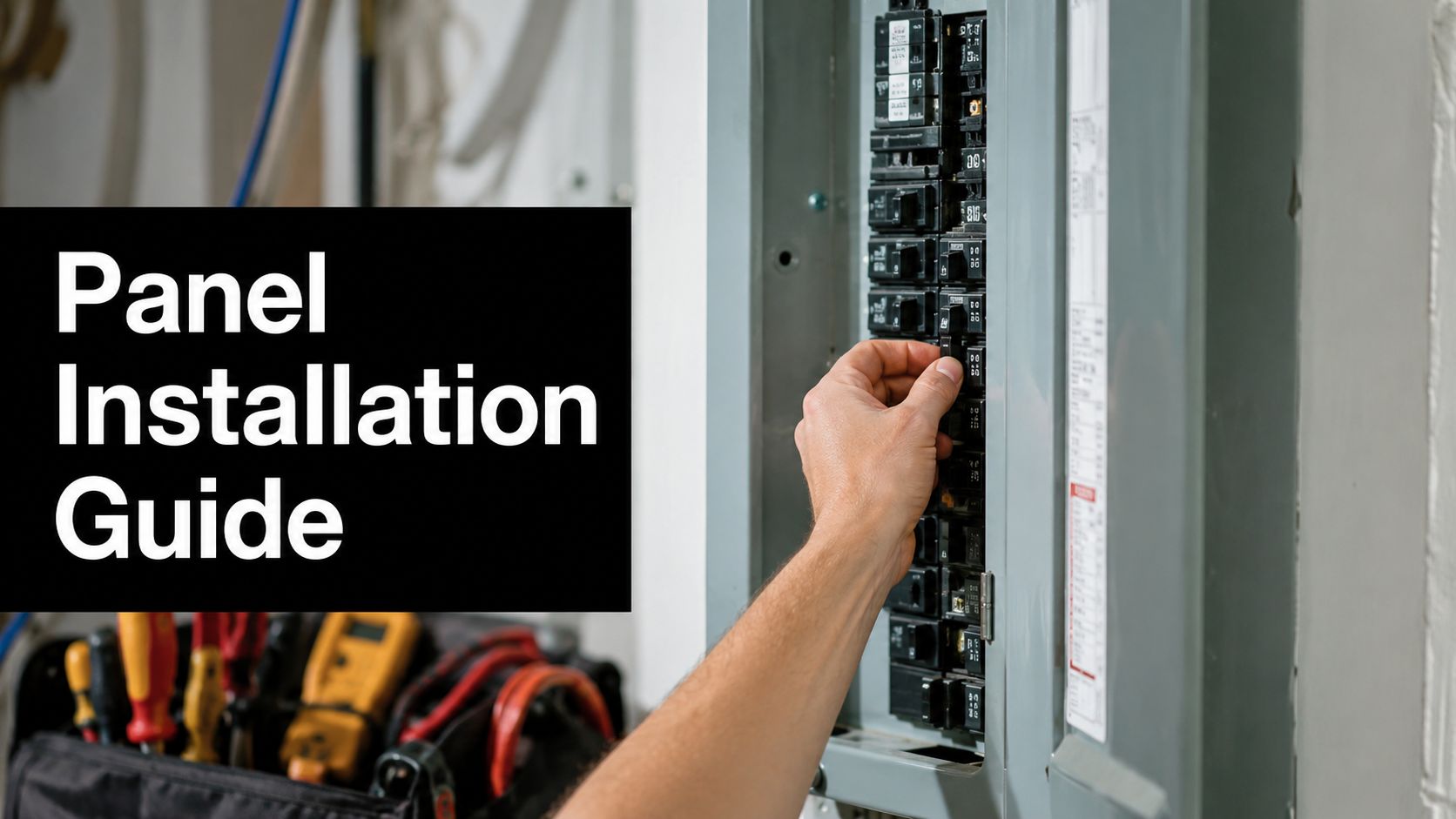
A homeowner in Weber or Davis County may start with a simple project, such as adding an EV charger, wiring a hot tub, or finishing a basement, then discover that the existing panel can't safely support the new load. Electrical panel installation isn't just a box replacement. It involves capacity, utility coordination, permits, inspections, and a plan for the electrical demands the property will add later.
Why Northern Utah Homeowners Are Scheduling Panel Work Right Now
Older homes around Ogden, Roy, Layton, and nearby communities often weren't built around today's electrical habits. A house may have operated comfortably for years, then begin showing flickering lights or nuisance breaker trips after the owner adds a Level 2 EV charger, a hot tub, a workshop circuit, or a finished basement.
The first question isn't always whether the panel looks old. The more useful question is whether the service can safely supply the loads that are already present and the loads being planned. A panel can have open breaker spaces and still lack enough total capacity.
The four decisions behind a panel project
Homeowners eventually need clear answers to four separate questions:
- Is an upgrade necessary? A load calculation and inspection can distinguish a capacity problem from a circuit, breaker, wiring, or connection fault.
- What size makes sense? The replacement service should match the calculated demand, available utility service, property plans, and applicable local requirements.
- Can the existing service support the addition? EV charging, hot tubs, electric cooking, and other substantial loads may change the calculation.
- How will the work fit the permit process? The panel swap may be straightforward, but utility scheduling, permit approval, and inspection timing can control the calendar.
A national survey gives useful context. About 60% of U.S. homes have 200-amp panels, while 35% have panels rated at 125 amps or less, according to Lawrence Berkeley National Laboratory and U.S. Department of Energy panel survey data. That uneven housing stock is why a service visit matters more than a generic recommendation.
What an Electrical Panel Actually Does Inside Your Home
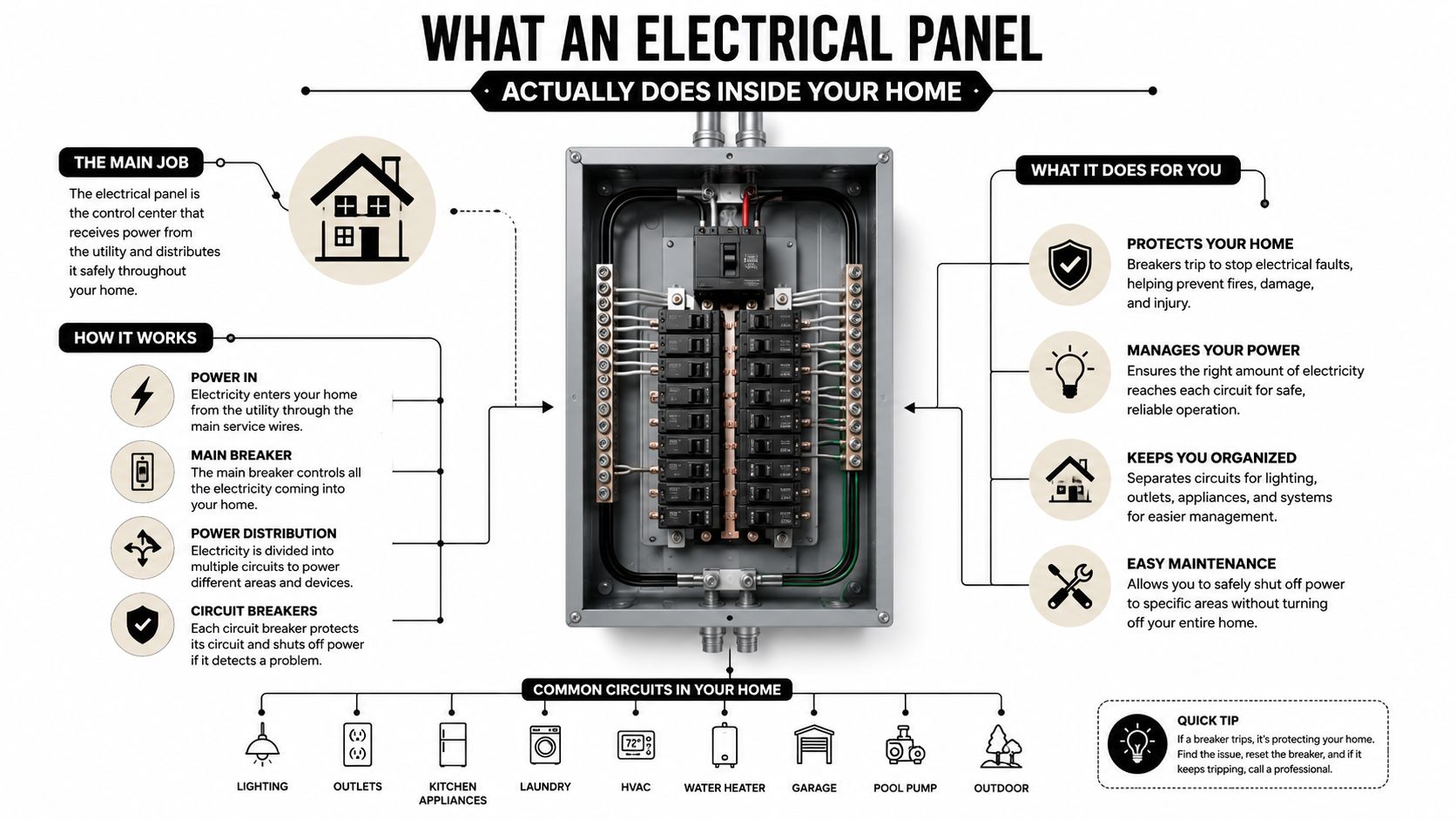
An electrical panel is the distribution and protection point for the property. Power enters through the service entrance, passes through the meter and main disconnect, and reaches the panel, where branch breakers divide it among circuits for lighting, receptacles, appliances, equipment, and dedicated loads.
A water-pipe analogy helps. The utility service is the main supply pipe, the main breaker is the master shutoff, branch breakers act like individual valves, and the circuits are the smaller pipes carrying power to different parts of the building. If the main supply is undersized, adding more branch circuits doesn't solve the underlying capacity problem.
Amps, volts, and watts in practical terms
Amperage describes how much current the service can carry. A 100-amp, 150-amp, or 200-amp service rating describes the maximum service class, not the amount of electricity every circuit uses at every moment.
Voltage is the electrical pressure available to the equipment. Many residential loads use 120 volts, while larger equipment commonly uses a 240-volt circuit. Wattage describes power consumption. In simplified form, watts equal volts multiplied by amps, although a professional calculation also considers demand, continuous operation, and the equipment's nameplate requirements.
A 200-amp service doesn't mean every branch circuit can draw 200 amps. Each breaker protects its own conductors, while the main service equipment limits the combined demand entering the property. The meter base and service entrance conductors matter because a larger panel alone can't correct an undersized or deteriorated service path.
Why panel capacity affects safety
A panel isn't just a metal enclosure with a row of switches. It houses overcurrent protection, supports grounding and bonding components, and organizes the circuits that keep power available without allowing conductors to overheat under permitted operating conditions.
The practical takeaway is simple: service sizing determines what the property can power safely, while breaker spaces only determine how many circuits can be physically arranged. A professional installation evaluates the entire service, not just the panel label.
Warning Signs Your Panel Needs Attention Sooner Than You Think
Some panel problems are inconvenient. Others require prompt attention because heat, damaged insulation, moisture, or loose connections can create a serious hazard. A licensed electrician doesn't diagnose the problem from one symptom alone. The inspection connects the visible sign to the condition of the breakers, conductors, enclosure, service equipment, and grounding system.
Symptoms that should not be ignored
- Frequent breaker trips: The electrician checks for overloaded circuits, short circuits, failing breakers, and equipment faults. Repeatedly resetting a breaker without finding the cause isn't a repair.
- Dimming or flickering lights: The inspection looks for loose terminations, voltage drop, overloaded service, or a large load starting on a shared or poorly arranged circuit.
- Warm or discolored handles: Heat can point to a loose connection, an overloaded breaker, or damaged equipment. A hot panel surface or visible discoloration warrants prompt professional evaluation.
- Burning odor or buzzing: These signs may indicate arcing, overheating, or failing components. The panel should remain closed while the electrician assesses it.
- Rust, condensation, or moisture: Water intrusion can corrode bus components and terminations. Outdoor panels also require weather-rated equipment, proper seals, and suitable placement.
- Fuses instead of breakers: Fuse-era equipment may lack the circuit organization and capacity needed for modern additions. Replacement decisions still require an evaluation of the service conductors and existing wiring.
- Double-tapped breakers: More than one conductor under a terminal not designed for it can create a poor connection. The electrician verifies whether the equipment is listed for the arrangement and corrects it when necessary.
A healthy-looking 100-amp service can still become inadequate after an EV charger, hot tub, or new living area is added. Conversely, a nuisance trip may come from a single faulty circuit rather than a full service-capacity problem. Black Rhino Electric panel services can include the inspection needed to separate those situations.
Safety boundary: A burning smell, visible scorching, water inside the enclosure, or repeated electrical noise is a call-now condition. The homeowner should avoid touching the equipment and request professional help.
Common Panel Types and Service Sizes Explained
Service size should follow the property's calculated demand, not a sales script or the number of empty spaces in the enclosure. The U.S. Department of Energy panel survey found that more than 62.5% of single-family homes had 200-amp capacity or higher, while about 29.5% had 100-amp capacity or less. That spread reflects how unevenly older and newer service standards are distributed.
Residential service sizes at a glance
| Service Size | Typical Home Profile | Common Use Case |
|---|---|---|
| 100 A | Older or smaller home with limited electric loads | Existing basic circuits, subject to a load review before major additions |
| 125 A | Modest service with more capacity than older 100-amp systems | Small remodels or targeted additions when the calculation supports it |
| 150 A | Mid-capacity service with a mixed electrical load profile | Homes adding equipment where 100 amps is tight but a larger service may not be required |
| 200 A | Common modern residential service class | Broad residential demand, EV charging, remodel work, and electrified loads when calculated and approved |
| 300 A or more | Larger residence or property with unusually substantial demand | Multiple major loads, extensive electrification, or specialized service requirements |
| Smart panel option | Service equipment with monitoring or load-management functions | Properties needing better visibility or coordinated control of competing loads |
A main panel contains the primary disconnect and distributes service throughout the property. A subpanel adds circuit space in another location, such as a detached structure or remodeled area. It can be appropriate when the main service has adequate capacity but lacks practical breaker space. It won't solve an overloaded service.
Fuse boxes and breaker panels also differ in age, protection, available circuit arrangements, and compatibility with new equipment. Smart panels can add monitoring and load management, but they still need correct service sizing, installation, grounding, labeling, and approval.
In California, the cited household-capacity study reported roughly 39% to 47% of homes with 200-amp panels and about 32% to 33% with 100-amp panels, reinforcing that 200 amps is dominant in a major market while older services remain common. Northern Utah contractors see the same basic decision pattern: inspect the complete service, calculate demand, then choose between targeted work, a subpanel, or a service upgrade.
How a Professional Panel Installation Actually Goes
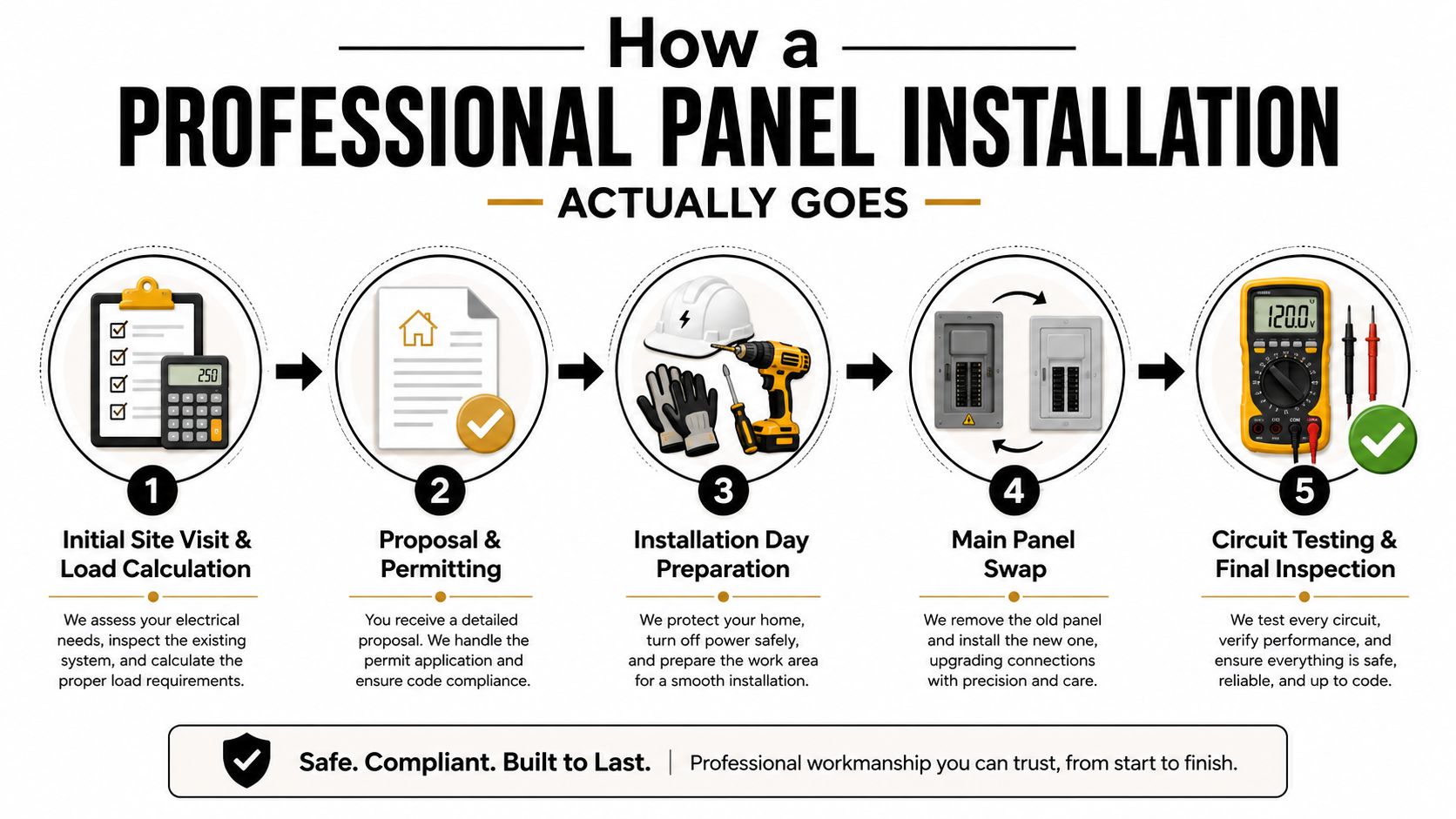
A professional project starts before the old panel comes off the wall. The electrician identifies the existing service rating, inspects the panel and meter area, reviews the planned loads, and completes the required load calculation. That calculation supports the proposed size and helps expose problems that a visual panel swap would miss.
The project sequence
- Site visit and scope review: The electrician records existing equipment, circuit conditions, service conductors, grounding, meter equipment, access, and planned additions.
- Load calculation: NEC Article 220 methods convert connected loads into volt-amperes, apply demand factors, and determine the service requirement. The PNNL electrical calculator guidance describes the dwelling-unit benchmark of 3 VA per square foot, plus required small-appliance and laundry circuits, with the larger of heating or cooling included in the calculation.
- Proposal and permitting: The scope identifies the panel, breakers, meter work, grounding or bonding corrections, wiring changes, utility coordination, and inspection responsibilities.
- Utility disconnect coordination: A service upgrade may require the utility to disconnect and later restore power. The timing depends on the local process and the utility schedule.
- Installation day: Power is shut off, the service equipment is made safe, and the panel and associated components are replaced or modified. Circuit conductors are re-terminated, grounding and bonding are addressed, and circuits are labeled.
- Testing and inspection: The electrician checks circuit operation, breaker placement, terminations, polarity where applicable, and equipment function before the required inspections and reconnection are completed.
Many panel replacements can be completed the same day once all approvals and utility arrangements are ready, but the property may be without power for several hours. Delays usually come from utility scheduling, permit review, inspector availability, or damaged and outdated wiring discovered during the work. Permit approvals can vary widely, with one analysis finding many panel approvals landing between about 7 and 19 days, while projects needing extra review may take longer, according to ACEEE permitting and construction-delay analysis.
Before hiring, homeowners can also use a resource such as HomeProBadge contractor trust verification to understand what documentation and verification questions to ask. For the electrical scope itself, electrical panel installation should include a clear plan for permits, utility contact, circuit testing, and final inspection.
Permits, Codes, and Inspections in Northern Utah
Electrical panel work falls under the National Electrical Code, but the adopted requirements come through the authority having jurisdiction. The National Fire Protection Association has published 17 NEC editions since 1897, and the code follows a three-year update cycle. The current published edition is the 2023 NEC, effective January 1, 2023, while local adoption can vary by jurisdiction, as explained in the NFPA and local permit context.
That means a project in Weber County may not follow every administrative detail of a project in Davis County or Salt Lake County. The electrician must confirm the applicable city or county process, submit the right permit information, coordinate utility requirements, and arrange inspections.
What the permit process protects
The permit gives the building department a chance to review the proposed work and verify the completed installation. Inspectors may look at working space, conductor sizing, overcurrent protection, grounding, bonding, panel listing, circuit identification, required protection, and workmanship.
A municipal checklist explicitly states that an electrical permit and inspections are required to upgrade a home's main electrical service panel. Homeowners should treat that requirement as part of the installation, not an optional administrative add-on. Unpermitted work can create complications during a sale, remodel, insurance claim, or later inspection.
Clear labeling matters, especially when a building has a main panel, subpanels, exterior disconnects, and dedicated equipment. A concise switchboard labelling guide from Evright Industrial offers useful general context on why identification and durable labels support safer service work.
For Northern Utah property owners, the practical questions are:
- Who pulls the permit? The proposal should state whether the contractor handles it.
- Who coordinates the utility? Service disconnects and reconnections need defined responsibility.
- What happens if the inspector finds a correction? The contractor should explain the correction process before work begins.
- Which projects require an electrical permit? This guide to what projects require an electrical permit helps homeowners frame that conversation.
Costs, Safety Boundaries, and When to Call a Licensed Electrician
Panel upgrade pricing follows scope, not a universal flat rate. A basic replacement with suitable existing service equipment differs substantially from a project that requires a larger service, a new meter base, service entrance cable work, grounding corrections, rewiring, code corrections, utility coordination, or difficult access.
A useful estimate should identify each cost driver rather than hide everything in one line. Permit fees, utility charges, regional labor rates, material choices, and inspection corrections can all affect the final scope. A structured electrical estimating software resource can help contractors organize estimates, but homeowners still need a site-specific explanation from the electrician.
What homeowners can safely check
Homeowners can observe the panel without opening the dead front or touching conductors. They can note the main breaker rating, look for missing circuit labels, identify visible rust or scorching from outside the enclosure, and record which breakers trip. They can also test accessible GFCI devices according to the device instructions and report unusual sounds, odors, or warmth.
The safe boundary stops there. Live conductor work, service entrance changes, meter work, energized troubleshooting, panel replacement, and whole-home rewiring belong to a licensed electrician. A main breaker may not remove every hazard inside service equipment, and turning off a branch breaker isn't a substitute for proper testing and safe work practices.
Practical rule: Empty spaces don't prove available capacity, and a reset breaker doesn't prove the circuit is safe. The load calculation and inspection determine that.
The electrical panel upgrade price guide can help homeowners prepare questions about scope. A responsible proposal should explain the service size, equipment condition, required corrections, permit handling, utility work, inspection plan, and any assumptions that could change the work.
Preparing Your Home and Planning Around Future Loads
Good preparation reduces disruption and gives the crew a safer work area. The panel and meter must remain accessible, and the electrician needs room to remove equipment, handle conductors, test circuits, and complete the installation without working around stored items or household traffic.
Before the crew arrives
- Clear the work area: Remove storage and obstacles around the panel and meter. Keep the access path open from the entry point to the equipment.
- Secure pets and inform occupants: Children and pets should stay away from the work zone. Everyone in the home should know that power will be interrupted.
- Plan for the outage: Save work, protect sensitive electronics as advised by the electrician, and plan meals and access around the expected shutdown.
- List known problems: Tell the electrician which breakers trip, which rooms flicker, and which circuits seem mislabeled.
- Confirm the scope: Ask whether the work includes circuit labeling, grounding corrections, meter equipment, utility coordination, permits, and inspections.
Future-load planning deserves attention before the replacement size is selected. An EV charger, hot tub, accessory dwelling unit, finished basement, workshop, or major electrification project can change the service calculation. The electrical load calculation Northern Utah experts panel provides a useful starting point for the questions a contractor should answer, but the property still needs a professional evaluation.
A subpanel may provide circuit space for a detached garage or remodel when the main service has adequate capacity. A full service upgrade is more appropriate when the calculated demand exceeds the existing service, the service equipment is deteriorated, or future loads would leave too little practical headroom. Planning that work together can avoid opening the same walls and coordinating another outage later.
A 2025 home-energy survey reported that 22% of people were unsure what their electrical panel does, and 16% didn't know where it was, according to Schneider Electric's home-energy discussion. That knowledge gap is why a clear walkthrough matters as much as the replacement itself. The homeowner should finish the visit knowing which panel serves which circuits, what the new service supports, and what future additions require another review.
Black Rhino Electric handles residential and commercial panel work, breaker troubleshooting, meter coordination, EV charger and Tesla Wall Connector circuits, hot tub wiring, code corrections, and related electrical upgrades across Northern Utah. Schedule a site visit by calling 385-396-7048, submitting the Black Rhino Electric quote form, or reviewing the residential panel and breaker and commercial panel and meter service options before the project begins.