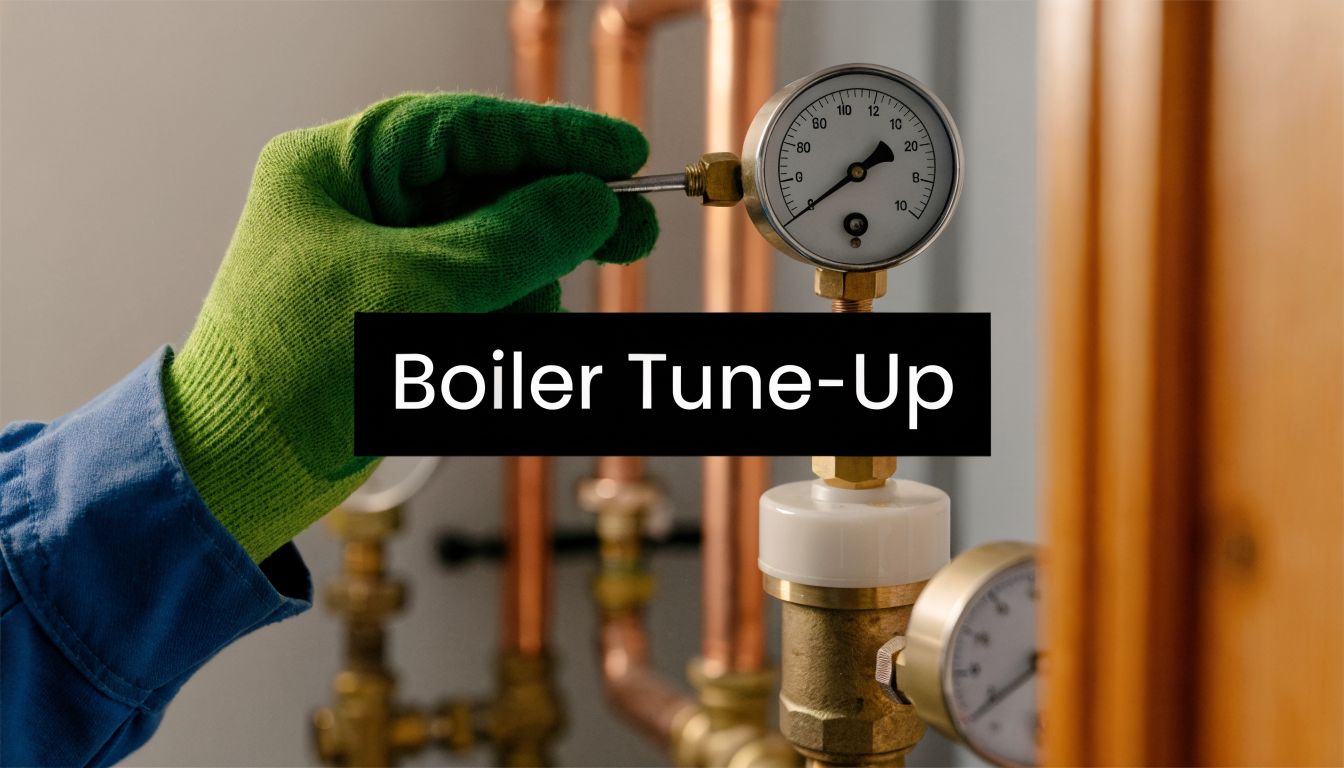
If you're hearing odd noises from the basement, noticing rooms that never quite warm up, or just bracing for the next cold snap in Weber or Davis County, you're asking the right question. Boiler tune-up services aren't just about keeping heat on. They're about safety, efficiency, and catching the problems that usually get missed until winter makes them expensive.
What a Boiler Tune-Up Really Is and What It Is Not
A proper boiler tune-up is a preventive service visit, not a rushed repair call after the system quits. This is similar to a vehicle inspection before a long mountain drive. You’re not waiting for the engine light and smoke. You’re checking the parts that fail subtly first.
That distinction matters because a lot of homeowners hear “tune-up” and picture a quick wipe-down, maybe a filter change, and someone glancing at the unit for ten minutes. That’s not real maintenance. A real tune-up checks combustion, heat transfer, controls, safety devices, venting, water-side condition, and the electrical pieces that tell the whole system what to do.

What a tune-up includes in practical terms
A boiler has to do several jobs at once:
- Burn fuel correctly: The burner needs the right air-fuel mixture and a stable flame.
- Transfer heat efficiently: The heat exchanger has to stay clean enough to move heat into the water instead of sending it up the flue.
- Move water safely: Pumps, pressure controls, and expansion components have to operate within design limits.
- Shut down when something is wrong: Low-water cutoff controls, relief valves, and limit controls aren’t optional.
- Respond to electrical commands: Thermostat calls, relays, aquastats, ignition controls, and pump circuits all have to work together.
That’s why I don’t treat boilers as “just plumbing.” They’re mechanical, combustion, and electrical systems sharing one cabinet.
For homeowners who want a plain-English overview from another industry angle, Hallmoore has a useful explainer on what is involved in a boiler service. It helps separate the idea of routine service from emergency troubleshooting.
What a tune-up is not
A tune-up isn't a guarantee that every old part suddenly becomes new. It also isn't the same as a major repair, replacement quote, or full system redesign. If a circulator pump is failing, wiring is heat-damaged, or a combustion chamber is compromised, the tune-up reveals that. It doesn't magically erase it.
Practical rule: If a company can't clearly explain what they're testing, cleaning, adjusting, and documenting, you're probably getting a superficial inspection, not a true tune-up.
Scheduled maintenance buys you information before you need heat the most. That's its core value. Peace of mind comes from knowing the system has been checked under controlled conditions, not from hoping it survives January.
Why Annual Boiler Maintenance Is Non-Negotiable in Utah
You know that feeling when the first real cold stretch hits and the house suddenly feels like it’s working harder to stay comfortable? That’s when neglected boilers show their age. In Northern Utah, especially across Weber, Davis, and Salt Lake counties, heating systems don’t get much forgiveness once winter settles in.
A boiler can limp through mild weather and still fail when demand ramps up. That’s one reason annual service matters. The system may have soot buildup, scale, control drift, venting issues, or a weak ignition component that doesn’t show itself until the unit starts cycling more often.
Safety comes first
This is the part homeowners should take seriously. Heat exchanger inspection and cleaning during boiler tune-ups addresses soot and mineral buildup that can reduce heat transfer and lead to efficiency losses of 5% to 20% over time, and in Northern Utah’s cold climate, annual tune-ups for hydronic boilers help prevent carbon monoxide leaks from exchanger fissures that trained technicians can detect with professional borescopes, according to Petro’s boiler and furnace tune-up guidance.
That isn’t theoretical. A boiler with compromised combustion or venting can create a real hazard inside the home.
If your property doesn’t already have current life-safety protection in the right locations, it’s worth reviewing smoke and CO2 detector solutions as part of the bigger heating safety picture.
Efficiency matters more than people think
A neglected boiler rarely fails all at once. More often, it wastes fuel first. Heat transfer drops, combustion goes out of spec, and controls don’t respond as cleanly as they should. The system runs longer, and comfort gets less consistent.
The homeowner usually notices this in ordinary ways:
- Longer heating cycles: The boiler runs, but the house takes too long to recover.
- Uneven room temperatures: Some rooms feel fine, others never catch up.
- Strange operating behavior: Short cycling, delayed starts, or inconsistent calls from the thermostat.
- A creeping utility bill: The system is doing more work for the same result.
Winter punishes small neglected problems
Utah homes see wide temperature swings, older housing stock, remodel additions, and systems that may have gone years without full review. A boiler that’s mostly functional in October can become a no-heat emergency by January.
Annual maintenance is less about polishing equipment and more about reducing the odds of a cold-weather failure when service schedules are packed and every hour without heat feels long.
This is why skipping maintenance is usually a false economy. Homeowners aren’t just paying for cleaning. They’re paying to find the weak points before winter does.
A Professional Boiler Tune-Up Checklist
The fastest way to judge the quality of boiler tune-up services is to ask what gets checked, what gets measured, and what gets documented. A real service visit should leave a paper trail or digital record of findings, not just a verbal “looks fine.”
The U.S. Department of Energy recommends combustion-efficiency tests during servicing to check for cracks in combustion chambers and carbon monoxide levels, and it also notes that steam systems need float chambers drained to prevent sediment clogs in low-water cutoff controls, as outlined in the DOE’s guidance on furnaces and boilers.

The three systems that must be checked
A good tune-up looks at the boiler in layers. Mechanical parts keep water moving. Combustion parts create heat safely. Electrical parts coordinate every call for heat, every pump start, and every safety shutdown.
For a broader homeowner-friendly reference, Bear Valley Plumbing & Heating shares a comprehensive heating tune-up checklist that lines up well with what a thorough service visit should cover.
Professional Boiler Tune-Up Task Summary
| System Category | Key Tasks Performed | Why It Matters |
|---|---|---|
| Mechanical systems | Inspect circulator pumps, check for leaks, verify pressure and temperature readings, inspect expansion tank condition, inspect valves and piping connections | Mechanical faults can cause poor heat delivery, pressure instability, and water damage |
| Mechanical systems | Flush sediment where needed, inspect water-side condition, confirm relief and control components are working as intended | Sediment and water-quality problems reduce heat transfer and strain the system |
| Combustion systems | Clean burners and heat exchanger surfaces, inspect combustion chamber condition, check flue path and venting | Clean combustion surfaces help the boiler burn cleaner and transfer heat more effectively |
| Combustion systems | Perform combustion testing, verify flame characteristics, check for signs of incomplete combustion or unsafe operation | Combustion issues affect safety, fuel use, and reliable ignition |
| Electrical systems | Inspect thermostat wiring, relays, aquastats, ignition controls, and safety circuit connections | Loose or damaged electrical connections can cause nuisance shutdowns and unsafe operation |
| Electrical systems | Test control response, inspect pump power connections, verify shutoff and limit controls operate correctly | Boilers depend on accurate electrical control to start, stop, and protect themselves |
What experienced techs look for
Some problems show up visually. Others only show up under test conditions. That’s why tools matter. A technician may use gauges, a combustion analyzer, electrical test instruments, and inspection tools to verify actual operation instead of guessing from appearance alone.
Key checkpoints often include:
- Control response: Does the boiler answer a thermostat call cleanly?
- Limit function: Do high-limit and low-water safety devices interrupt operation when they should?
- Venting condition: Is the exhaust path clear and intact?
- Ignition reliability: Does the burner light consistently without delayed ignition behavior?
- Water-side health: Are there signs of sludge, corrosion, or pressure irregularities?
The electrical line items that often get skipped
Many 'boiler services' often prove to be lacking in thoroughness. Some providers cover combustion and piping but only glance at the electrical controls. That’s a mistake.
A proper checklist should include:
- Wiring condition: Looking for brittle insulation, discoloration, loose terminations, and makeshift splices
- Control integrity: Confirming relays, aquastats, and ignition controls are responding properly
- Pump circuit checks: Making sure circulators have sound power delivery and secure connections
- Safety shutdown verification: Confirming the boiler can stop itself when a limit or fault condition appears
A boiler can have clean burners and still operate unreliably if the control circuit is unstable. Good maintenance doesn't stop at the gas valve or piping jacket.
If a provider can’t explain how they inspect the electrical side of the system, ask more questions.
The Hidden Electrical Dangers in Your Boiler System
Most homeowners think of a boiler as a vessel, burner, and a set of pipes. That’s only part of it. The modern boiler is also an electrical appliance with control logic, switching components, motors, and safety circuits that must operate in the right sequence.
That’s why electrical faults can look like heating problems when they’re really control problems. A boiler that locks out randomly, overheats, won’t circulate properly, or behaves differently room to room may have an electrical issue at the root.

The components people overlook
Boilers rely on a chain of electrical parts to run safely:
- Thermostat wiring: Carries the call for heat
- Aquastats and limit controls: Tell the system when to stop heating
- Relays and control boards: Switch loads and sequence operation
- Circulator pump wiring: Powers water movement through the system
- Safety circuits: Interrupt operation during unsafe conditions
- Service disconnects and panel connections: Supply stable power from the home’s electrical system
A weak connection at any one of those points can create nuisance shutdowns or dangerous operating conditions.
Why an electrician’s eye matters
A significant gap in typical boiler service content is the lack of focus on electrical safety inspections. U.S. Consumer Product Safety Commission data indicates over 50,000 heating equipment fires annually, many with electrical causes, yet standard tune-up guides rarely advise homeowners to have a qualified electrician verify wiring integrity or panel load during the service, as noted in this discussion of boiler service gaps and electrical risks.
That tracks with what electricians see in the field. Older homes across the Wasatch Front often have legacy controls, past handyman repairs, crowded panels, or add-on components tied in over time. The boiler may still run, but that doesn’t mean it’s wired well.
If your heating equipment shares an aging or overloaded service setup, reviewing breaker and panel conditions can be just as important as checking the burner.
Common electrical issues behind boiler trouble
These are the problems that get missed when a service call focuses only on flame and water:
- Loose terminals: They create heat, intermittent faults, and unreliable starts.
- Damaged insulation: It can expose conductors to moisture, vibration, or cabinet edges.
- Miswired controls: They cause short cycling, incorrect temperature response, or safety bypasses.
- Undersized or deteriorated power supply components: They can affect pump performance and control reliability.
- Panel-related issues: Tripping breakers, weak connections, or poor load management can mimic equipment failure.
If the boiler is the heart of the heating system, the control wiring is the nervous system. Ignore it, and the whole system can act unpredictably.
That’s why a complete tune-up shouldn’t treat electrical inspection as an afterthought.
Tune-Up Costs and Frequency for Wasatch Front Homeowners
Homeowners usually want two straight answers. How much will a proper tune-up cost, and how often should it happen?
According to 2026 data from Angi, boiler tune-up services typically cost between $200 and $500. That price reflects a standard service call fee plus labor for cleaning and inspection, and Angi notes that average repair costs can range from $150 to $750 or more, which helps explain why maintenance is usually the cheaper move before something breaks.
What affects the price
Not every boiler takes the same amount of work. Cost usually shifts based on the system’s type, age, fuel, condition, and whether the technician finds issues that need additional repair.
A few practical factors that influence the scope:
- Fuel type: Gas and oil systems don't service exactly the same way.
- System condition: A boiler that hasn't been cleaned or tested in years usually needs more attention.
- Access and layout: Tight mechanical rooms slow everything down.
- Control complexity: Multi-zone systems and older controls can add diagnostic time.
How often should service be scheduled
For most homeowners, annual service is the right baseline. Late summer or early fall is usually the smart window because you’re checking the system before it becomes mission-critical.
Let me explain. If you wait until the first freeze, you’re competing with every no-heat call in town. If the tune-up uncovers a failing control, a venting problem, or a pump issue, you want time to address it before the boiler is needed every day.
The cheapest boiler problem to fix is the one found during scheduled maintenance, not during a winter outage.
For Wasatch Front homeowners, the annual visit is less about tradition and more about timing. You want the system inspected before weather turns urgency into a scheduling problem.
Signs Your Boiler Is Crying Out for a Tune-Up
Sometimes the boiler doesn’t fail cleanly. It complains first. It gets noisy, inconsistent, or fussy in ways homeowners notice but don’t always connect to service.
That’s worth paying attention to, because the warning signs are often obvious once you know what they mean.

What to listen for and watch for
A boiler that needs attention often gives off one or more of these signals:
- Rumbling or kettling sounds: That boiling-kettle noise can point to scale or sediment affecting heat transfer.
- Clanking or banging: Water movement, pressure issues, or component wear may be involved.
- Whistling: Restricted flow or pressure irregularities can be part of the problem.
- Cold spots in the home: If some radiators or zones lag behind, circulation or control issues may be developing.
- Visible water around the unit: Even a small leak can signal pressure, valve, or connection trouble.
- An unreliable pilot or ignition sequence: Delayed or inconsistent starts shouldn't be ignored.
- A sudden jump in fuel use: If comfort hasn't improved but consumption has, something is off.
What those symptoms can mean
The details matter. A noisy boiler doesn’t always mean disaster, but it does mean the system is no longer operating cleanly. Likewise, a higher energy bill may not be a utility-rate story if the boiler has become less efficient.
The EPA’s tune-up guide notes that optimizing the air-fuel mixture is critical because incomplete combustion, often caused by fouled nozzles or improper electrode gaps, can cause carbon monoxide spikes and reduce efficiency, and an efficiency drop of over 10% annually can often be traced back to preventable maintenance issues.
That’s why little symptoms deserve attention.
When not to wait
If the boiler is making new noises, shutting off unpredictably, smelling unusual, or failing to heat consistently, don’t assume it will sort itself out. It usually won’t.
You know what? Homeowners are often more observant than they think. If the system sounds different, smells different, or heats differently, that’s enough reason to schedule a professional inspection.
How to Choose the Right Boiler Service Provider in Northern Utah
Not all boiler tune-up services are equal. Some companies provide a careful inspection with testing, cleaning, and clear documentation. Others give you a quick once-over and call it done. The difference usually shows up later, when the boiler starts acting up again.
A strong provider should check the basic business boxes first. That means proper licensing, insurance, local experience, and a record of work in Northern Utah homes and light commercial settings. It also helps when they’re familiar with older systems, remodel additions, and the kind of mixed equipment found across Weber, Davis, and Salt Lake counties.
Questions worth asking before you book
Use a short screening list:
- Ask about service scope: Will they perform combustion testing, inspect venting, and verify safety controls?
- Ask about documentation: Will you get findings in writing, including recommended repairs?
- Ask about system familiarity: Do they regularly work on hydronic and steam boiler components?
- Ask about electrical inspection: Do they inspect wiring, controls, relays, and shutdown circuits as part of the tune-up?
- Ask who is doing the work: Experience matters with older boilers and multi-trade systems.
That fourth question is the one many homeowners never ask, and it matters. A boiler is not just a heating appliance. It’s a controlled electrical system with fuel and water attached. If the provider treats the electrical side as incidental, they may miss the faults that cause intermittent shutdowns, unsafe operation, or repeat service calls.
You can also review a contractor’s background and service philosophy on their about us page to see whether safety, licensing, and local experience are central to how they work.
Choose the provider who can explain their process in plain language and who respects the electrical side of the boiler as much as the mechanical side.
If you want a boiler checked with a true safety-first electrical perspective, contact Black Rhino Electric. For complete peace of mind before winter, call 385-396-7048 or request a free quote.