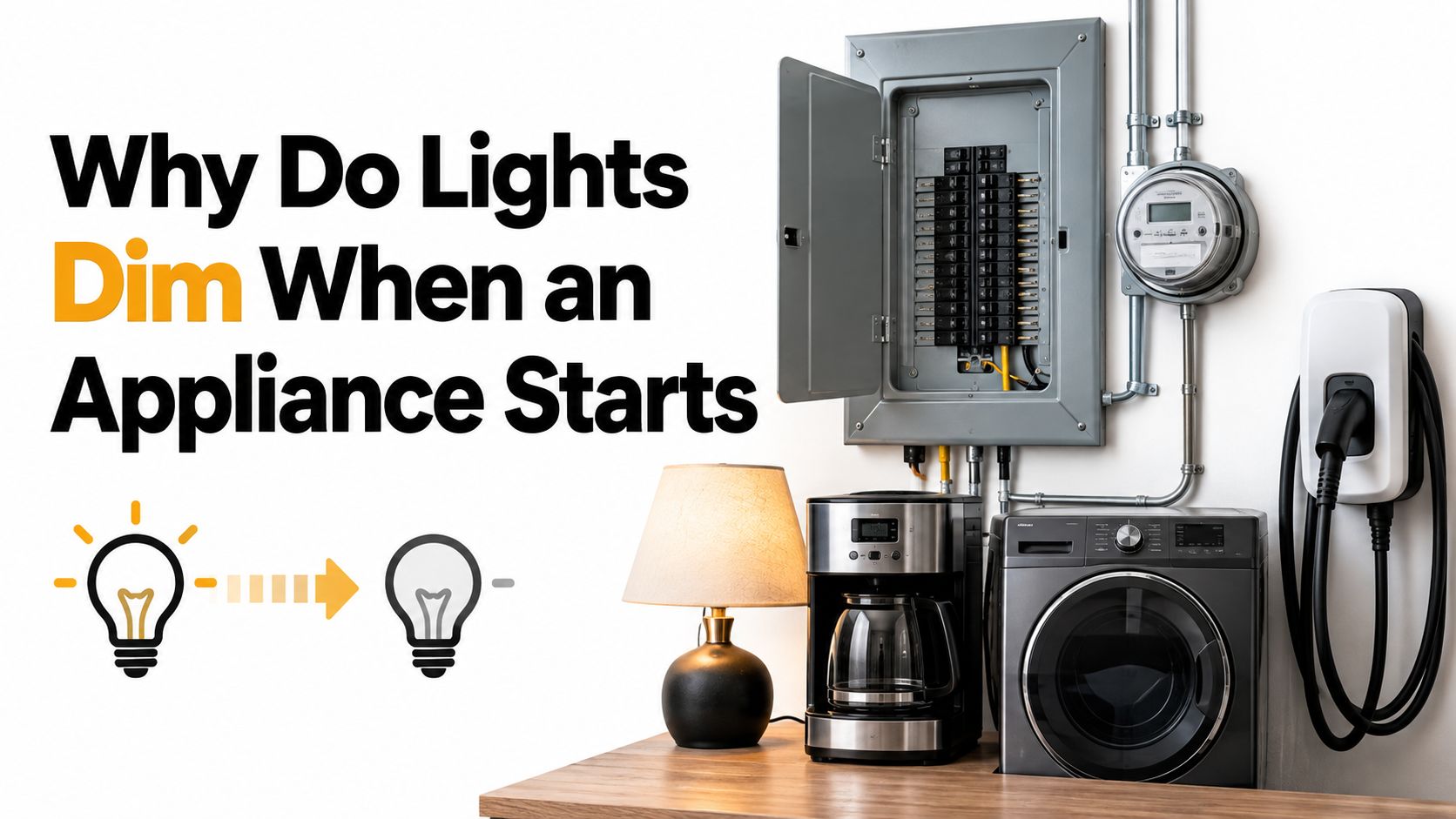
The microwave starts, the washing machine changes cycles, or the refrigerator compressor kicks on, and the kitchen light dips for an instant. If you're asking why do lights dim when an appliance starts, the short answer is usually motor inrush current, but the pattern matters more than the flicker alone.
What You're Actually Seeing When the Lights Dip
The kitchen light drops for an instant when the microwave starts, the dishwasher begins its cycle, or the washing machine starts spinning. It may look like a tiny brownout, then return to full brightness before you have time to react.
That brief change is usually a voltage sag. A motor-driven appliance demands a sudden burst of current when it starts. The wiring supplying both the appliance and nearby lights has some resistance, so the temporary demand produces a short voltage drop. As the motor reaches operating speed, its demand decreases and the light recovers.
A dip lasting only a moment and affecting nearby fixtures can be a normal motor-start event. The same appliance may cause the same brief change each time it starts, while lights elsewhere remain steady. If the dimming lasts, spreads through the house, worsens, or appears uneven, the pattern deserves investigation.
Practical rule: Brief and localized usually means observe. Persistent or whole-house dimming means call an electrician.
During a service call, an electrician checks whether the appliance and lights share a circuit, measures voltage while the load starts, and inspects connections at the panel, receptacle, and fixture. Those checks help separate normal startup behavior from a loose connection, overloaded circuit, wiring problem, or issue with the incoming electrical service.
Homeowners can also confuse one appliance-linked dip with broader mixed? light flickering. Repeated fluttering, buzzing fixtures, or changing brightness throughout the home point to a different concern than one quick dim tied to one appliance. The timing, duration, and location provide the first diagnostic clues.
The Physics Behind a Half-Second Dim
A brief dim has a straightforward electrical cause. Voltage works like water pressure, current like the amount of water moving, and the home's wiring like the hose carrying that flow to outlets and lights. The wiring has resistance and impedance, so a sudden increase in current can briefly reduce the voltage available at a light.
A motor at rest needs extra force to begin turning. During startup, it draws much more current than it does while running. Electricians call this temporary demand inrush current or locked-rotor current. Once the motor reaches operating speed, its demand falls and the light usually returns to its previous brightness.
The effect is easiest to notice when the appliance and light share part of the same electrical path. Air conditioners, refrigerators, washing machines, compressors, and other motor-driven loads can create this brief change. The light is responding to a temporary supply variation, not necessarily failing.
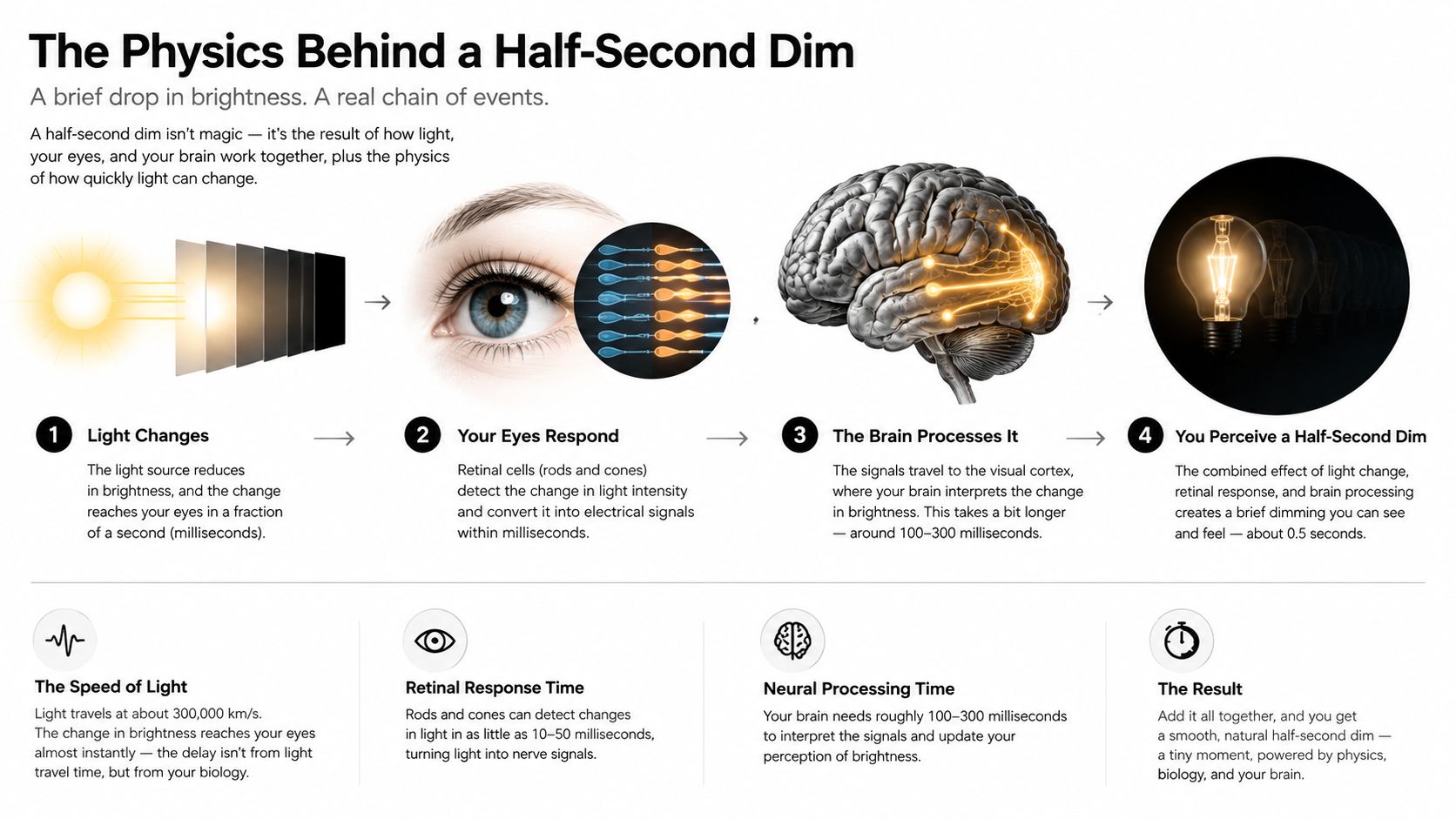
LED lamps often make a short dip easier to see because their electronic drivers react quickly to voltage changes. An incandescent lamp's hot filament cools more slowly, which can soften the visible effect.
The size of the dim depends on the motor's starting demand, conductor length and gauge, and the other loads using that circuit or service leg. Brief, localized dimming is usually an observation point. Persistent dimming, or a change affecting much of the house, calls for an electrical inspection. During a service visit, Northern Utah electrical load experts can assess whether the home's wiring and available capacity fit its connected loads.
Other Common Causes Beyond Motor Inrush
A brief startup dip is often related to motor inrush, but the same symptom can point to circuit layout, high service demand, or a connection that has begun to fail. The pattern helps an electrician decide what to test.
A large appliance and nearby lighting may use part of the same branch circuit or service path. When the appliance starts, its sudden current demand creates a momentary voltage sag, much like water pressure dropping when another tap opens. Older homes may have fewer circuits serving more rooms and devices, making the effect easier to notice.
Aging or undersized wiring
Older Northern Utah homes may not have wiring arranged for today's combination of refrigeration, laundry equipment, electronics, heating, cooling, and workshop loads. Long runs, small conductors, or added appliances increase voltage drop. During a service call, an electrician checks conductor size, circuit length, load distribution, and the condition of terminations.
Loose or deteriorated connections
A loose neutral or weak termination can make voltage unstable beyond one lamp. Do not remove a panel cover or tighten wiring yourself. Note the scope instead. Dimming in one room may point to a branch-circuit issue, while uneven changes across several areas deserve faster attention.
A damaged receptacle or worn plug connection can also create heat and voltage drop. A warm outlet caused by aluminum wiring is not a harmless variation. Stop using it and arrange an evaluation.
Service capacity and competing loads
Space heaters, air conditioning, electric water heating, laundry equipment, EV charging, and other substantial loads can place greater demand on the whole service. A voltage sag is a short reduction in supply voltage after a sudden current increase. Its severity depends on the wiring and on which other loads are operating.
The diagnostic threshold is practical: a brief, localized dip is usually an observation point. Persistent dimming, whole-house changes, worsening symptoms, heat, odor, buzzing, or equipment disruption call for an inspection. Homeowners comparing backup-power categories can compare home UPS types, but that information will not identify an overloaded circuit, loose neutral, or unsafe connection.
Normal Dim vs Warning Sign Decision Table
The most useful triage method is to record duration, scope, appliance, and accompanying symptoms. A single smooth dip that ends immediately belongs in a different category from a whole-house flicker that is getting worse.
| Observable Clue | Normal Brief Dim | Warning Sign |
|---|---|---|
| Duration | A short dip that ends almost immediately | Dimming lasts more than one second or continues after startup |
| Scope | One nearby light or a limited group on the same electrical path | Multiple rooms or much of the house changes together |
| Appliance involved | One motor-driven appliance causes the same brief event | Several appliances cause strong dimming, or small loads trigger it |
| Light behavior | Smooth dim, then full brightness returns | Repeated flickering, fluttering, or uneven brightness |
| Timing | Happens at startup and stops once the motor settles | Appears at different times, worsens over weeks, or occurs when loads cycle off |
| Other symptoms | No odor, warmth, noise, or equipment disruption | Breaker trips, buzzing, burning smell, warm covers, or affected electronics |
The table isn't a substitute for testing. It helps determine whether observation is reasonable or whether a service call should move up the list.
A recurring half-second dip from one compressor may be normal even when it's noticeable. A change that spreads from one room to several, lasts longer, or arrives with heat or odor can indicate a loose connection, limited service capacity, or another condition that needs professional diagnosis.
Safe DIY Observations Before Calling an Electrician
Homeowners can gather valuable information without opening the electrical system. The purpose is to document the pattern, not to repair a circuit.
Identify the trigger. Note whether the dim starts with a refrigerator, washer, microwave, furnace blower, air conditioner, shop vacuum, or another appliance.
Record the location. Check whether the change affects one light, one room, nearby rooms, or the whole house. Don't remove covers or access wiring while checking.
Note the conditions. Record the time of day and which major loads were already running. Summer cooling demand and winter heating loads can produce different patterns.
Use the existing breaker labels. If the panel schedule already identifies the affected circuit, record that information for the electrician. Homeowners shouldn't open the panel, swap breakers, or inspect live wiring.
Document a repeatable event. If the dip happens safely and predictably, a phone video from a normal standing position can help show duration and severity. No one should create a test by overloading circuits or repeatedly starting equipment.
Older homes in Ogden, Layton, and Kaysville may have more shared circuits than newer construction. That context helps a technician interpret the symptom, but it doesn't prove that the wiring is unsafe.
A useful handoff includes:
- Appliance: which device starts the dip
- Timing: whether it happens at startup, shutdown, or both
- Duration: instant, prolonged, or variable
- Location: affected lights and unaffected lights
- Load context: heaters, cooling equipment, chargers, or other major devices running
- History: whether the condition is new or becoming more noticeable
Property owners and contractors who need broader project planning may also review Exayard electrical estimating software, but software can't replace field diagnosis. For the actual issue, home electrical troubleshooting starts with observing the symptom and testing the system safely.
Permanent Fixes a Licensed Electrician Provides
The repair starts with testing, not with replacing the light fixture. An electrician measures voltage as the appliance starts, identifies circuits sharing the affected path, checks accessible connections, and reviews panel and service capacity. These checks show whether the brief dip is expected startup voltage drop or evidence of excess drop, heat, or limited capacity.
A dedicated circuit can give a large motor or appliance a steadier supply. Microwaves, refrigerators, freezers, window air conditioners, and shop vacuums may operate more reliably when lighting and other substantial loads are not on the same branch circuit. The electrician confirms that the circuit, breaker, receptacle, and installation method match the equipment.
If the household has added electric heating, vehicle charging, hot tubs, or workshop circuits, the service and panel need a broader capacity review. Older homes in Davis and Weber counties may have less available capacity than current household use requires. An electrical panel upgrade may be appropriate, but replacing a panel alone does not automatically increase the electrical service. The electrician evaluates the complete system before recommending that work.
Possible repairs include:
- Neutral repairs: finding and correcting a loose, damaged, or improperly terminated neutral connection
- Connection repairs: replacing worn receptacles, correcting junction-box terminations, or replacing heat-damaged components
- Aluminum wiring corrections: applying an approved repair method after confirming the wiring type and condition
- Circuit protection updates: considering AFCI protection where current Utah-adopted code requires it for applicable living-area circuits
- Load redistribution: moving compatible loads to improve circuit balance when the existing system permits it
Permits and inspections may apply to service changes, panel work, new circuits, and other alterations. Before work begins, the electrician should explain which approvals are required and include them in the repair plan.
Seasonal conditions can reveal a problem that was not apparent during a summer visit. In Northern Utah, space heaters and furnace blowers may operate alongside other heating loads, increasing demand on the system. A proper service call checks that real winter load, rather than treating the affected light as an isolated fixture. Persistent or whole-house dimming warrants that investigation even when no single appliance appears unusual.
Warning Signs That Mean Call a Pro Now
A brief startup dip without other symptoms often isn't urgent. The following signs change the decision because they suggest heat, unstable voltage, deteriorating connections, or a system-wide limitation.
Stop if there is heat or an odor
Call an electrician promptly if an outlet, switch plate, or panel area feels warm, smells burning or acrid, shows discoloration, or has scorch marks around a receptacle. A warm cover isn't a normal form of motor inrush, and a burning smell shouldn't be monitored casually.
Don't continue using the affected outlet or appliance while waiting for advice if doing so produces heat, odor, smoke, or visible damage. Keep people away from damaged equipment, and use emergency services if there is an active fire or immediate danger.
Treat sound and sparking as electrical warnings
Buzzing, crackling, sizzling, or visible sparking when a device is plugged in requires professional attention. These sounds can indicate a poor connection or arcing condition, and the homeowner shouldn't remove the receptacle or attempt to inspect the panel.
A breaker that trips repeatedly when a particular appliance starts is also a call signal. Resetting it again and again doesn't identify or correct the underlying fault.
Watch the scope of the dimming
Whole-house flickering is more concerning than a brief change at one nearby light. Dimming across multiple rooms, especially when appliances are on different circuits, can point toward a neutral, service, or supply issue rather than a single shared branch circuit.
Dimming that grows worse over days or weeks deserves inspection even if each individual event remains short. The same applies when lights dim as a large load cycles off, rather than only when it starts. That pattern doesn't fit the simplest motor-inrush explanation and should be assessed.
Consider local load conditions
Older Ogden and Layton homes may have wiring and service arrangements that predate today's combination of heating equipment, cooling, electronics, EV charging, hot tubs, and remodeled spaces. A winter cold snap can bring space heaters and furnace blowers into operation at the same time, while summer cooling loads can reveal a different capacity issue.
Black Rhino Electric provides residential and commercial troubleshooting, breaker and panel work, wiring repairs, lighting services, and service-capacity evaluations in Marriott-Slaterville and nearby Northern Utah communities, including Weber, Davis, and Salt Lake counties. Homeowners who notice persistent or whole-house dimming can call 385-396-7048 or schedule an evaluation through the quote request.
For appliance-related dimming, Black Rhino Electric can test the affected circuits, inspect connections, evaluate panel capacity, and recommend repairs or dedicated wiring where appropriate. Visit Black Rhino Electric to request a quote, or call 385-396-7048 when the symptom includes heat, odor, buzzing, sparking, breaker trips, or whole-house flicker.