

A lot of Northern Utah homeowners call when the project is already in motion. The remodel plans are drawn, the hot tub is ordered, or the EV is in the driveway, and then a critical question shows up. Can the house handle the added demand?
That's where an electrical load calculation matters. It's the first step that tells whether the existing service is safe, code-compliant, and realistic for both today's work and the upgrades that may come next.
Table of Contents
- What an Electrical Load Calculation Determines
- How Electricians Calculate Your Home's Electrical Needs
- Common Scenarios Requiring a Load Calculation
- Load Calculations for Northern Utah Businesses
- Why a Professional Calculation is Non-Negotiable
- Schedule Your Load Calculation and Panel Assessment
What an Electrical Load Calculation Determines
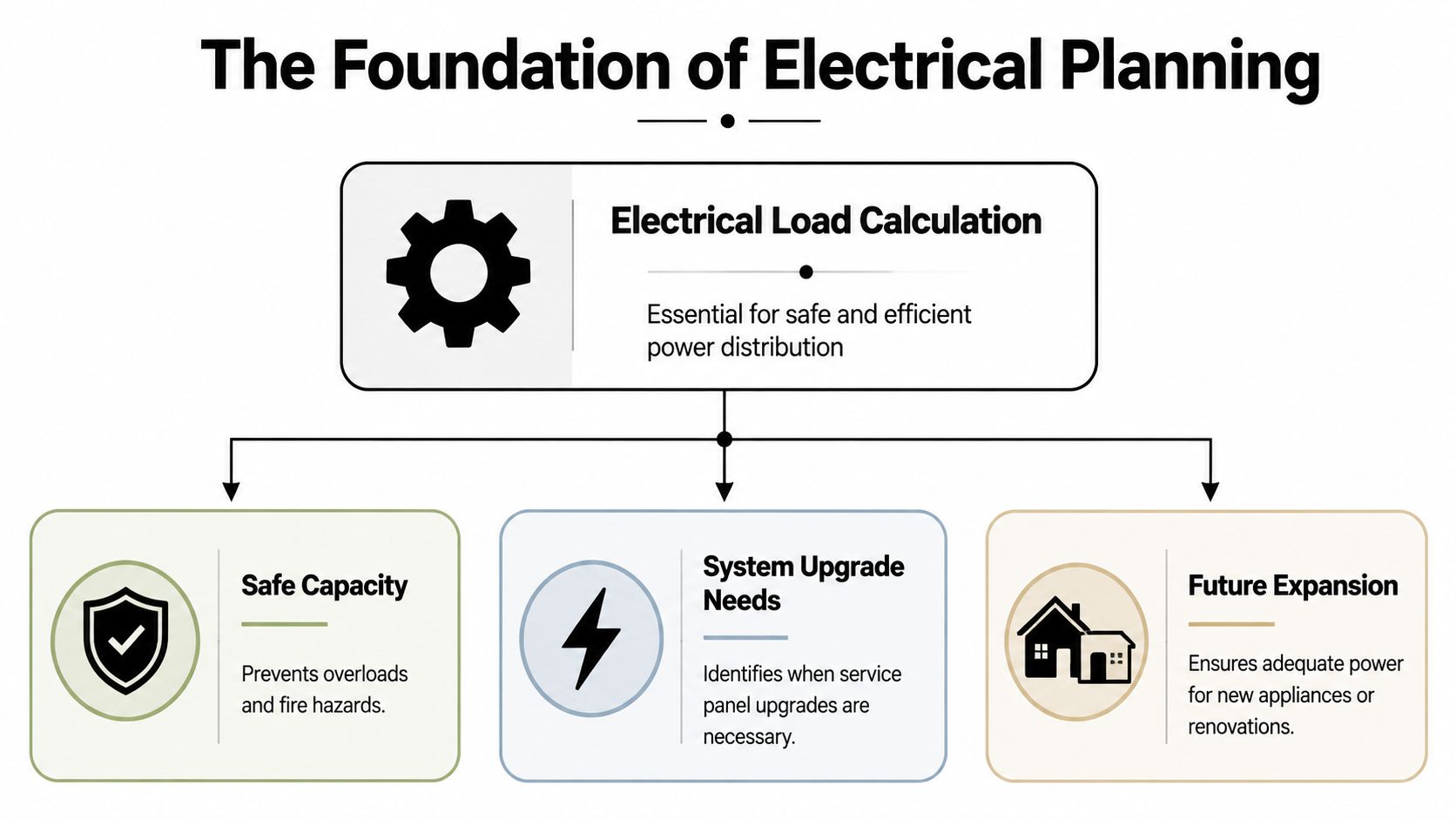
An electrical system has a limit, just like a budget. A proper load calculation shows how much of that capacity is already spoken for and whether there's enough room for the work a homeowner wants to add.
Why it matters before any major electrical project
For a remodel, panel change, spa circuit, or electrical panel upgrade, the load calculation answers the basic question that should come before material gets ordered. Is the service large enough for the actual demand on the house?
The National Electrical Code's Article 220 framework standardized this process for dwellings by using area-based lighting loads, appliance loads, demand factors, and motor loads. That framework matters because it turns a complicated, house-specific problem into a repeatable engineering method used by contractors and inspectors (NEC Article 220 load calculation framework).
Practical rule: A panel isn't judged by how many empty breaker spaces it has. It's judged by whether the calculated demand fits the service safely.
What the calculation answers
A good calculation does three jobs at once:
- Safety first: It helps prevent overloaded conductors, nuisance tripping, overheated equipment, and the kind of hidden strain that shows up after a remodel is finished.
- Capacity planning: It shows whether the home can support added loads like a hot tub, range, workshop equipment, or EV charging without forcing compromises later.
- Code compliance: For major work, inspectors and permitting authorities typically want the sizing to be based on accepted code methods, not guesswork.
Homeowners don't need to perform this math themselves, and they shouldn't be opening energized equipment to try. What helps is understanding that the calculation isn't paperwork for its own sake. It's the basis for deciding whether the existing service is adequate, borderline, or already undersized for the way the house is being used.
In older parts of Ogden, South Ogden, Bountiful, and Salt Lake City, that planning step is even more important. Many homes were built around a very different mix of loads than what families use now.
How Electricians Calculate Your Home's Electrical Needs
A lot of panel upgrade calls start the same way. The remodel is underway, the EV charger is on the wish list, and someone notices the existing service was sized for a house from a different era of living. The calculation is the point where assumptions stop and planning starts.
What gets counted
An electrician starts with the home's baseline demand, then adds the loads that can change the recommendation in a real way. That includes square footage, required kitchen and laundry circuits, fixed appliances, heating and cooling equipment, water heating, and any equipment that draws a significant load for long periods. The larger of the heating or cooling load is usually what matters in the calculation, because the home is not designed around both peaks happening at once under standard dwelling rules.
Then we look at what is changing. In Northern Utah, that often means an EV charger in the garage, a heat pump replacing gas equipment, a basement finish, a hot tub, or a detached shop that was never part of the original service design.
Future plans belong in the calculation discussion, even if they are not being installed this month.
That matters because the best answer is not always “your current load fits.” A service can pass the math for today and still be the wrong choice for a remodel if the homeowner is clearly heading toward more electrification over the next few years. I would rather tell a homeowner the hard truth before drywall, concrete, or finished landscaping make the next upgrade more expensive.
How the process works in practice
The math follows a code-based method, but the field work matters just as much. The electrician verifies what equipment is installed, reads nameplates, checks whether past additions were documented accurately, and compares the calculated demand to the service size and panel condition. A 200-amp label on a panel does not answer whether the service conductors, meter equipment, grounding, and overall layout still make sense for the house.
Older homes are where this gets interesting. I see houses that started with gas heat, no central air, no EV charging, and a much smaller kitchen load than a modern remodel will bring. Then years of upgrades get layered on top. New microwave. New range. Finished basement. Garage freezer. Patio circuit. Car charger. Each one looks manageable by itself. Taken together, they can push an older 100-amp service from marginal to clearly undersized.
What homeowners can gather before the visit
Homeowners can help without opening live equipment or removing panel covers. The useful information is straightforward:
- Home details: Finished square footage, approximate age of the home, and any additions, basement finishes, or garage conversions
- Major equipment list: Range, dryer, water heater, furnace, air conditioner, heat pump, electric heat, hot tub, well pump, shop equipment, and other fixed loads
- Planned upgrades: EV charger, induction range, new HVAC equipment, heated outbuilding, spa, or a switch from gas appliances to electric
- Known panel history: Breakers that were added later, vague circuit labels, past nuisance tripping, or any recommendation you have already received about the panel
That prep saves time, but it also improves the recommendation. A load calculation is not just about passing inspection for the current permit. It helps decide whether a homeowner should keep the existing service, increase capacity now, or leave room for the next round of electrification while the walls are already open.
A good electrician also checks for issues the worksheet does not solve by itself. Feeder condition, corrosion, limited breaker space, obsolete equipment, and long runs to garages or outbuildings all affect the final plan. If you want to better understand electrical voltage loss, that is a separate question from load. One asks whether the system is large enough. The other asks whether power will still perform properly where you need it.
Common Scenarios Requiring a Load Calculation
A lot of panel problems show up the same way. The remodel is underway, the EV purchase is scheduled, the hot tub quote looks good, and then someone finally asks whether the existing service can carry all of it at the same time.
That question should come first.
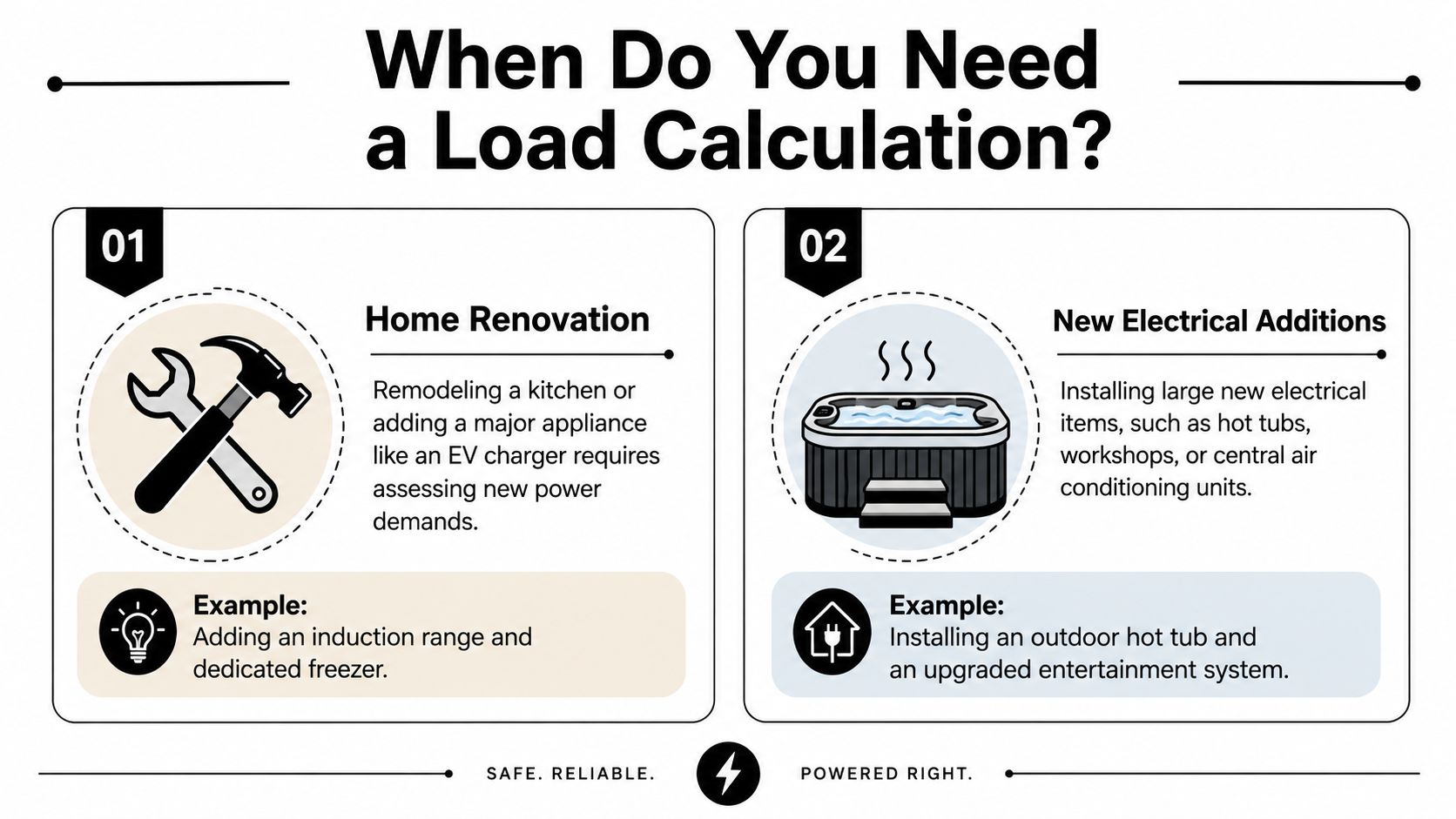
In Northern Utah, the pattern is familiar. A house that handled yesterday's loads just fine starts adding tomorrow's loads too. EV charging, heat pump conversions, electric water heating, finished basements, patio spas, and shop equipment all pull on the same service. A proper load calculation helps decide whether the house can support those changes now and what should be planned while the walls are already open.
A Layton home adding EV charging and a hot tub
A newer panel can be misleading. Homeowners see open breaker spaces and assume they have plenty of capacity left. Breaker space only tells part of the story. Service size, existing demand, and the likelihood of multiple large loads running in the same season matter more.
A Level 2 charger and a hot tub are a common combination because they usually arrive during the same stage of ownership. The family is settling in, improving the backyard, and adding a second electric vehicle or preparing for one. If that same home may switch from gas to an induction range or heat pump in the next few years, the calculation should reflect that conversation now, not after the first upgrade is installed.
That is why a family planning EV charger installation should treat the load calculation as a planning tool, not just a permit checkbox. The best answer is not always a full service upgrade. Sometimes the right path is load management. Sometimes it is a panel replacement with room for future circuits. Sometimes it is a staged plan that prepares for the next major electric load without paying for more service than the home needs today.
What usually helps
- Planning related upgrades together: Charger, spa, water heater, and HVAC changes should be reviewed as one electrical picture.
- Using actual equipment specs: Nameplate information gives a far better answer than rough guesses.
- Leaving room for electrification: If a second EV, heat pump, or electric range is realistic, include it in the discussion before permits are pulled.
What usually creates problems
- Approving one load at a time: That often leads to repeated service work and higher total cost.
- Judging capacity by the panel cover: Open spaces do not mean the service can support another large load.
- Waiting until equipment is on site: By then, choices get rushed and the cheaper option upfront can become the expensive fix later.
An older Ogden kitchen remodel
Older homes raise a different issue. The existing service may have worked for years because the original house asked less from it. The kitchen had fewer dedicated circuits, smaller appliance loads, and less simultaneous use.
A remodel changes that fast. Add a new range, microwave, dishwasher, disposal, lighting upgrades, and more countertop circuits, and the demand profile of the whole house shifts. If the homeowner also wants to prepare for a future heat pump or garage charger, the kitchen project becomes the right time to decide whether the current service is still a good long-term fit.
I often tell homeowners that remodel work is the cheapest time to make smart electrical decisions. Drywall, cabinetry, and finish work drive up the cost of changing direction later.
In that setting, the load calculation helps compare options instead of forcing a guess. One home may support the remodel with careful circuit planning and no service change. Another may technically squeeze by today but leave no reasonable room for the next electric upgrade. That is usually when a panel replacement starts to make more sense than trying to patch around the limits of older equipment.
| Condition observed | Typical planning response |
|---|---|
| Older service with limited capacity and a major kitchen upgrade | Review panel replacement or service upgrade before adding new branch circuits |
| Existing panel appears adequate but future electric upgrades are likely | Calculate with those future loads in mind and decide whether to size for the next phase now |
| Remodel includes several dedicated appliances | Use actual equipment data and coordinated circuit design instead of rough assumptions |
Other times this step should not be skipped
Some projects look small until the total demand is added up.
- Hot tubs and spas: These can change the recommendation quickly, especially if the home already has air conditioning, electric heat, or EV charging plans.
- Basement finishes and additions: More square footage means more lighting, receptacles, and often more fixed equipment.
- Fuel switching: Moving from gas appliances to electric ones changes the long-term service picture, even if the work happens in phases.
- Detached garages, shops, and outbuildings: These spaces often start with lights and a few receptacles, then grow into heaters, compressors, welders, or chargers.
- Older service equipment: Even if the math is close, aging panels and limited breaker options can make replacement the safer and more practical choice.
Homeowners in Weber, Davis, and Salt Lake counties usually avoid the worst mid-project surprises by getting this review done before buying equipment. That is especially true for homes moving toward full or partial electrification. The calculation is not only about what the house uses today. It helps answer whether the service can support the way the home is likely to be used over the next ten years.
Load Calculations for Northern Utah Businesses
Commercial load calculations follow the same broad idea as residential work, but the details are different enough that shortcuts cause real problems. A storefront, office suite, HOA common area, or mixed-use tenant space can't be sized by casually adding breaker ratings and calling it done.

Why commercial work is different
For non-dwelling spaces, the NEC uses separate treatment for receptacles, show windows, and motors, and it allows demand factor reductions in certain cases. One technical course notes that loads above 10,000 VA may be reduced to 50% in specific situations, which is one reason a one-size-fits-all approach fails on commercial projects (non-dwelling load calculation guidance).
That complexity matters because occupancy type changes the math. The right calculation for a retail bay isn't the same as the right calculation for a back-office suite or a mechanical room serving a multi-family property. Lighting, receptacle use, motor loads, and likely simultaneous demand all have to be evaluated under the correct code path.
A tenant improvement example
Take a small coffee shop buildout in a Bountiful retail center. The space may look simple from the leasing brochure, but the electrical design has to reflect what's going in. Counter equipment, refrigeration, water heating, lighting, receptacle concentration, and ventilation-related loads can all change the feeder and panel requirements.
That's why a property manager or tenant should ask specific questions early:
- What occupancy assumptions are being used: The load path depends on the intended use of the space.
- Is the existing panel flexible enough for tenant turnover: A panel can be adequate for one use and tight for the next.
- Are future changes likely: If the lease space may rotate between service types, rigid sizing can become a problem.
A commercial electrical panel assessment is often part of that review, especially when the existing service history is unclear or the panel directory doesn't reflect years of prior tenant modifications.
Commercial panel planning works best when the electrician, owner, and contractor are solving for both the current buildout and the next likely use of the space.
Why a Professional Calculation is Non-Negotiable
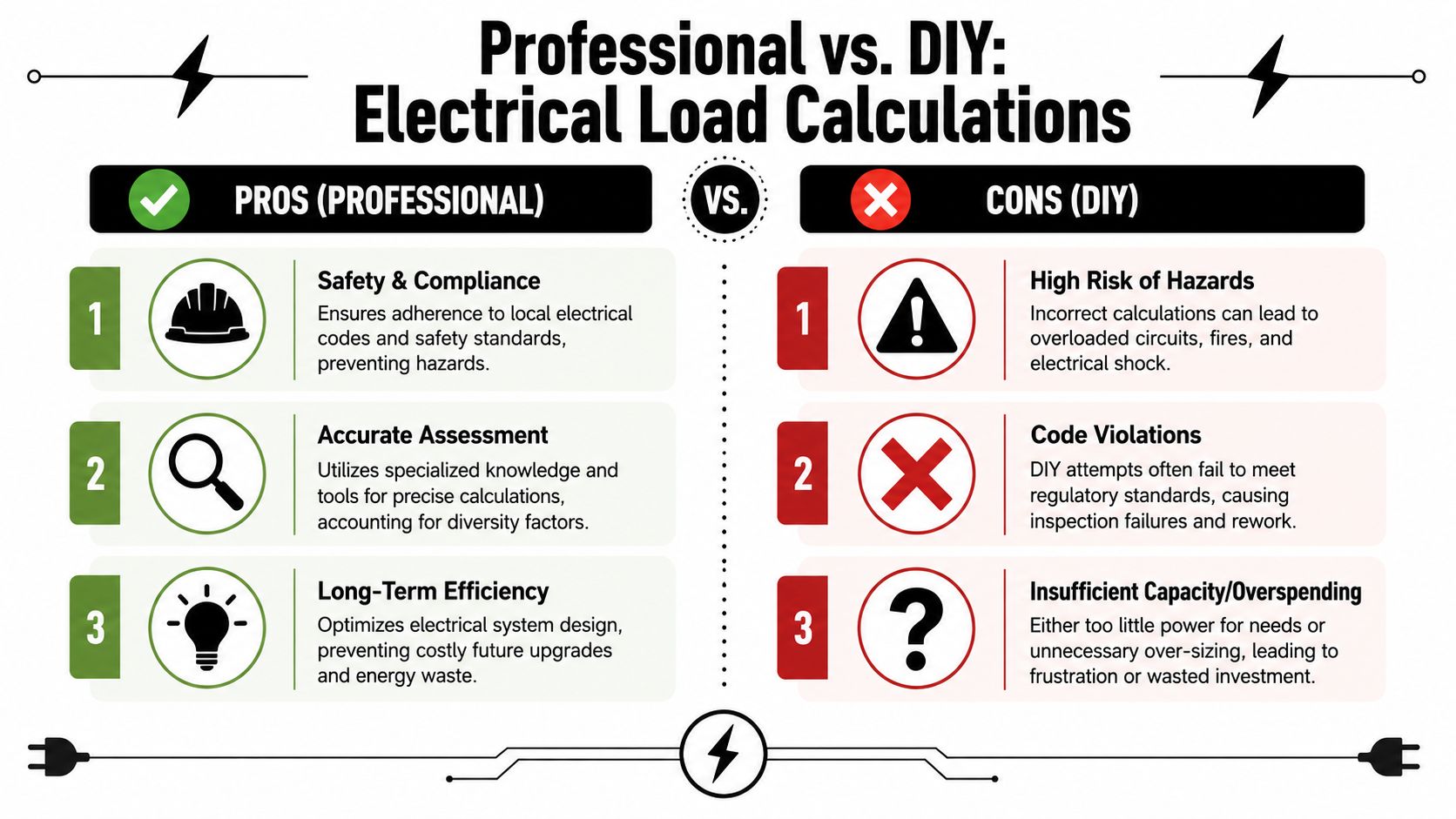
There are a few misconceptions that keep showing up in remodels and panel conversations. The most common one is the idea that homeowners can just total the breaker handles in the panel and see whether there's “room.” That isn't how service sizing works.
What doesn't work
A breaker directory is useful, but it's not a load calculation. It doesn't apply demand factors. It doesn't sort out which loads are noncoincident. It doesn't account for equipment nameplates, conductor limitations, or whether the service has been stretched by years of additions.
Here are three approaches that regularly create trouble:
- Adding up breaker sizes: Breakers represent circuit protection, not actual diversified demand.
- Using rules of thumb from a neighbor or online comment: Every house has a different mix of loads and future plans.
- Planning only for today's equipment: That can force another upgrade as soon as the next major appliance arrives.
Permitting also matters. For major work in Northern Utah, inspectors typically expect a documented, code-based approach to service sizing. That protects the homeowner, the contractor, and the long-term reliability of the installation.
For electrical contractors trying to communicate that value online, resources on local SEO for electricians can help explain technical services in plain language. That doesn't replace field expertise, but it does help homeowners understand why panel planning is more than a breaker count.
Why future planning matters
Many standard worksheets still center on current connected loads, yet newer additions can change the picture quickly. Public worksheets have started giving separate attention to equipment such as heat-pump water heaters, and forward-looking guidance increasingly stresses using nameplate loads and adjusted demand. That matters because a homeowner may pass a calculation today, but adding a Level 2 EV charger or heat-pump water heater later can overload the system. A forward-looking calculation models those likely additions and helps avoid a second upgrade (future electrification planning in load worksheets).
That's the part many simple articles miss. The question usually isn't just, “Can the house handle this one project?” The practical question is, “If this remodel happens now, will the service still make sense after the next round of electrification?”
Black Rhino Electric handles that kind of panel and load planning for homeowners and businesses in Northern Utah when the work involves remodels, EV charging, service changes, and code-driven upgrades.
Schedule Your Load Calculation and Panel Assessment
A proper load calculation gives a homeowner something better than a guess. It gives a defensible answer before money is spent on equipment, permits, finish work, or a panel that may be too small or larger than the project requires.
What to expect from the next step
For most households, the right time to schedule this review is before:
- A remodel starts: Especially kitchens, additions, basement finishes, and garage conversions.
- A major load is added: EV chargers, hot tubs, spas, workshop equipment, or large fixed appliances.
- An older panel becomes a concern: Flickering, crowding, repeated tripping, or unclear service capacity all justify a closer look.
- Electrification is part of the long-term plan: Even if the next upgrade won't happen until later, it should be part of the discussion now.
A homeowner can speed up the visit by gathering appliance information, project plans, and a list of likely future additions. The electrician can then evaluate the service, review the panel condition, and recommend whether the home needs no change, a targeted adjustment, or a larger panel strategy.
For contractors and service businesses interested in how online inquiries get screened before a truck is dispatched, tools built around AI lead generation for contractors are becoming part of that process. For homeowners, the simpler takeaway is this: if the project affects the panel or the home's overall demand, it's worth request a free electrical quote before the electrical scope gets locked in.
If a remodel, EV charger, hot tub, addition, or panel concern is on the calendar, Black Rhino Electric can review the service capacity and load requirements for the property. Homeowners in Northern Utah can call 385-396-7048 or use the online quote form to get the project started.