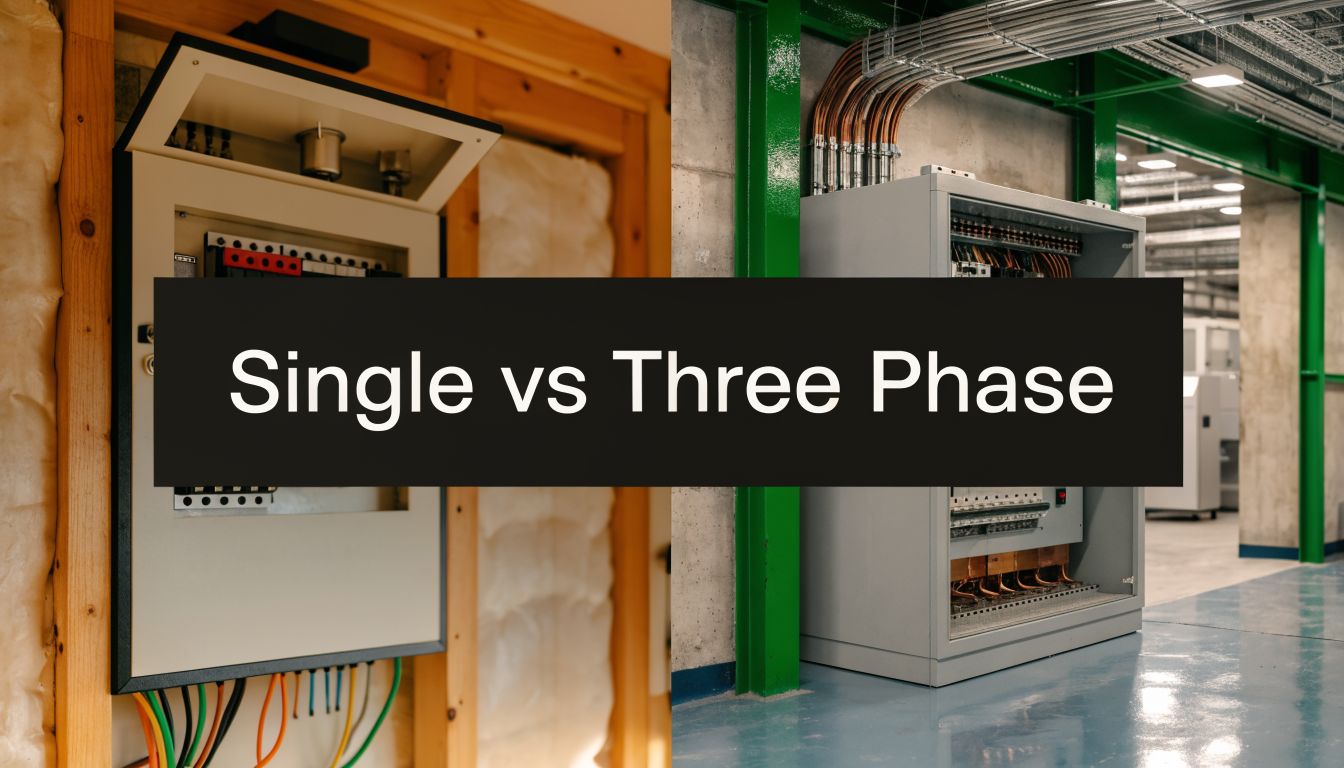
If you’re planning a remodel, adding an EV charger, or trying to stop the lights from dipping every time a big load starts, the difference between single phase and three phase power matters more than is commonly understood. For homeowners and small business owners in Northern Utah, the right choice usually comes down to load, equipment, and whether an upgrade is worth the disruption.
The Basics of Single-Phase and Three-Phase Power
A homeowner in Northern Utah usually runs into this question after adding more load than the house was originally built for. Maybe it is an EV charger in the garage, a hot tub out back, or a larger shop heater that makes the lights blink when it kicks on. At that point, it helps to understand what single-phase and three-phase power do.
With single-phase power, the electrical supply rises and falls on one alternating current wave. That works well for normal residential loads because a typical house is full of equipment designed for 120/240V service. Lighting, kitchen appliances, dryers, and standard air conditioning all fit that setup.

Three-phase power uses three AC waveforms spaced apart so power delivery stays more consistent across the cycle. That steadier delivery is why larger motors, commercial HVAC equipment, lifts, pumps, and kitchen equipment tend to run better on it. The equipment starts cleaner, runs smoother, and handles continuous duty with less strain.
That difference matters most with motors.
A resistance load like a toaster or baseboard heater does not care much about the distinction. A motor does. Compressors, larger fans, machine tools, and refrigeration equipment benefit from more even power because they are doing mechanical work every second they run.
How the power flow actually differs
Single-phase power drops and rises as the waveform cycles. In a house with ordinary loads, that is usually no problem. In a building with heavier equipment, those swings are more noticeable during startup and under sustained demand.
Three-phase spreads the work across three offset waveforms. The result is a smoother flow of power to the equipment. On job sites, that usually shows up as fewer complaints from motors and less dramatic voltage dip when something big starts.
The voltage side of the conversation
In most Northern Utah homes, utility service is single-phase 120/240V. That is the standard service Rocky Mountain Power supplies to typical residences, and for most families it is enough, even with a few modern upgrades.
Three-phase is more common in commercial buildings, mixed-use properties, agricultural sites, and shops with larger equipment. Some small business owners assume three-phase automatically means "more power." Sometimes it does. Sometimes the actual issue is service size, panel capacity, or how the loads are distributed. I have seen buildings with single-phase service that performed fine after a proper load calculation and panel upgrade, and I have seen buildings where three-phase was the right call because the equipment lineup left no practical alternative.
Why lights dim and motors complain
When a large single-phase load starts, the demand hits all at once. That is why lights may flicker when an air conditioner, compressor, or well pump kicks on. The system is responding to a big momentary draw, not always a defect.
Three-phase softens that effect because the load is supported more evenly. For businesses running equipment all day, that can mean better motor performance and fewer nuisance problems. For a house, it usually means one of two things. Either the service is adequate and the circuits need to be planned better, or the property is starting to behave more like a light commercial site than a standard residence.
What works well in real life
For most homes in Weber, Davis, and Salt Lake County, single-phase is still the right fit. Even with an EV charger, hot tub, electric range, and newer HVAC, many houses do fine with single-phase if the panel, service rating, and branch circuits are set up correctly.
Three-phase starts to make sense when the property has equipment that needs it, or when a business depends on larger motor loads and long operating hours. It is not automatically better. It is better for the right load, in the right building, where the utility can provide it without turning the project into an expensive fight with the service entrance, meter stack, and gear.
Single-Phase vs Three-Phase A Direct Comparison
If you're trying to decide whether your property needs three-phase, the fast answer is this. Single-phase handles most homes just fine. Three-phase earns its keep when the building has larger motors, heavier daily demand, or equipment that was built around commercial power from the start.
| Attribute | Single-Phase Power | Three-Phase Power |
|---|---|---|
| Power delivery | Power rises and falls through one AC cycle | Power is spread across three offset cycles for steadier delivery |
| Typical wiring | Usually one phase and one neutral in residential service | Three phases, with or without a neutral depending on the system |
| Common voltage context | Common in homes with 120/240V service | Common in commercial buildings with 208V or 480V service |
| Best fit | Houses, condos, small offices, and normal appliance loads | Commercial spaces, larger HVAC, motor loads, and heavier equipment |
| Motor performance | Fine for smaller residential loads | Better for larger motors and long run times |
| Material efficiency | Less efficient at higher power levels | More efficient for carrying larger loads |
| Installation complexity | Simpler for standard residential work | Requires more planning at the service, panel, and load level |
| Upgrade question | Usually enough with a properly sized panel and good circuit layout | Worth a look when the equipment or load profile justifies it |

Power delivery and performance
The practical difference shows up when equipment starts and runs.
Single-phase power has a stronger rise-and-fall pattern, so larger loads hit harder when they kick on. Three-phase spreads that work out more evenly. That is why bigger compressors, pumps, lifts, and rooftop units usually run happier on three-phase. They start cleaner, run smoother, and put less strain on the system.
For a homeowner, that smoother operation usually matters less than service size and circuit layout. For a shop or commercial tenant, it can matter every day.
Voltage and capacity
Single-phase is common because it fits the job. A typical 120/240V residential service can support a lot of modern living in Northern Utah, including an EV charger, hot tub, electric range, and central air, if the load calculation and panel setup are done right.
Three-phase starts to make sense when the property has larger mechanical equipment, multiple heavy loads operating at the same time, or tenant equipment that calls for commercial service. Before anyone talks upgrade, it helps to look at the actual service equipment, meter position, and electrical panels and meters for the building. That usually tells the story faster than the sales pitch.
Wiring and hardware complexity
Single-phase is simpler to install and simpler to troubleshoot. In a house, that often means lower upgrade cost and fewer surprises inside the panel.
Three-phase adds another layer of planning because loads need to be balanced across phases. If that part is done poorly, the system gives up some of the benefit you were paying for in the first place. The gear is also different. Panels, disconnects, breakers, and motor controls all need to match the service type.
Efficiency and conductor use
This is one reason commercial projects often favor three-phase. It carries larger loads more efficiently and supports motor-driven equipment better.
That advantage means a lot on a building with long operating hours or several large machines. It usually means very little to a homeowner adding a bathroom circuit or upgrading a kitchen.
Cost and practicality
The primary decision is not which system sounds better on paper. It is which one fits the property without turning the project into a utility and service-gear rebuild.
In Northern Utah, that often comes down to whether Rocky Mountain Power can provide three-phase at that address, what the existing service looks like, and whether the load justifies the expense. A lot of homes asking about three-phase do not need it. They need a larger single-phase service, a panel change, dedicated circuits, or better load distribution. That is a much more practical fix in many cases.
Where You Find Each Power Type in Northern Utah
A homeowner in Davis or Weber County usually calls about power phases after adding something big. An EV charger in the garage. A hot tub out back. A shop heater or compressor that keeps tripping things when everything else is running. In most of those cases, the property still has single-phase service, and that is normal for the area.

Where single-phase is the normal answer
Across Northern Utah neighborhoods, single-phase is what you see in the typical house, condo, and townhome. That includes older homes in Ogden, newer subdivisions in Layton and Syracuse, and a lot of properties through Salt Lake County. It handles everyday residential use well as long as the service size and panel capacity match the way the house is being used.
Typical single-phase residential loads include:
- Lighting and general receptacles
- Kitchen circuits for ranges, microwaves, and dishwashers
- Electric dryers and laundry equipment
- Standard residential heating and cooling equipment
- Normal remodel additions that stay within household demand
For most homes, the question is not whether single-phase is the wrong type of service. The question is whether the existing panel, service rating, and circuit layout are still enough for how the home is being used now.
Where three-phase usually shows up
Three-phase is far more common once you get into commercial buildings, service bays, mixed-use properties, and light industrial spaces. In Northern Utah, that often means buildings with larger HVAC equipment, refrigeration, pumps, compressors, or motor-driven machinery that runs for long hours.
You will often find three-phase service in:
- Commercial kitchens
- Retail and office buildings with larger rooftop units
- Machine shops and fabrication spaces
- Auto shops and service bays
- Multi-tenant commercial properties
- Small industrial buildings with heavier equipment
That does not mean every commercial address has it. I have seen plenty of small tenant spaces on single-phase service because the actual equipment load did not justify anything bigger. Availability also matters. In some areas, Rocky Mountain Power can supply three-phase without much trouble. At other addresses, getting it can be expensive, slow, or not practical at all.
For owners sorting out building service capacity, commercial electrical panels and meters often become part of the discussion once the existing setup is evaluated.
A building needs three-phase when the equipment calls for it and the utility can reasonably provide it. The label on the building matters a lot less than the actual load.
The gray area more properties are running into
This is the part that catches people off guard.
A lot of Northern Utah homes still have standard single-phase service, but the load profile has changed. One house may have two EV chargers, a hot tub, electric heat in an addition, a second kitchen in the basement, and a garage full of tools. The service type may be the same as it was years ago, but the way the property uses power is not.
For homeowners, that usually points to a service upgrade, panel replacement, load calculation, or better circuit planning before anyone starts talking about three-phase. For small businesses, the decision often comes down to lease terms, existing utility service, and whether the equipment list includes motors or HVAC loads that really benefit from three-phase.
A few common local examples
Here is how it usually shakes out on real jobs:
| Property situation | What usually makes sense |
|---|---|
| Standard home with ordinary appliances | Single-phase is usually the right fit |
| Home adding an EV charger or hot tub | Single-phase often still works, but the panel and service may need upgrading |
| Garage workshop with larger tools or compressors | Depends on the actual nameplate load and how often the equipment runs |
| Small commercial tenant space | Depends on the landlord's service, the panel setup, and the equipment being installed |
| Building with large motors, refrigeration, or bigger HVAC | Three-phase becomes much more likely |
A lot of owners assume bigger is automatically better. On plenty of homes, the smarter move is staying with single-phase and fixing the bottleneck. On plenty of commercial jobs, three-phase is the right answer because the equipment is built for it and the building will run better that way.
Understanding the Equipment and Wiring Differences
When an electrician says a building is single-phase or three-phase, that’s not just abstract utility language. You can usually see the difference in the panel, the breakers, and sometimes the meter setup.

What the panel tells you
In a typical residential single-phase panel, the layout is built around the service most homes use. Standard branch circuits snap onto alternating bus positions, and larger two-pole breakers pick up both legs for 240V loads like dryers or ranges.
A three-phase panel is arranged differently because it has to distribute load across three separate phases. That changes breaker placement, circuit planning, and how equipment gets fed.
The inside of a three-phase panel just looks a lot busier, and for good reason.
If you want a reference point for the kind of panel work that often starts this conversation, residential breaker and panel service is usually where homeowners first learn whether they’ve got enough capacity or not.
Breakers and circuit arrangement
Here’s the practical difference a property owner notices:
- Single-pole breakers usually serve standard 120V circuits
- Double-pole breakers usually serve 240V residential equipment
- Three-pole breakers are used for three-phase loads that need all three phases together
That last category is where things get more specialized. The breaker itself is only part of the story. The equipment has to be designed for that kind of supply, and the panel has to support it correctly.
Wiring paths and conductors
Single-phase branch circuits in homes are widely recognized. Hot, neutral, and ground are common in everyday residential circuits. Service conductors and feeder arrangements vary by application, but the overall system is simpler.
Three-phase setups introduce more complexity because there are more phase conductors to manage and more balancing concerns. Depending on the configuration, you may see three hot conductors plus neutral and grounding paths.
On the jobsite test: If the equipment needs careful phase balancing and phase-specific breaker positions, you’re not dealing with ordinary home wiring anymore.
Meters and service equipment
The meter itself can also signal a different class of service. Utility-side equipment, meter bases, disconnects, and panelboards all have to match the service configuration.
That’s one reason service upgrades aren’t just “swap the panel and move on.” If the utility feed, meter arrangement, or service entrance conductors don’t support the new design, the project grows quickly.
For homeowners, that usually means the primary question isn’t “Can I buy a three-phase panel?” It’s “Can this property receive and support three-phase service in a code-compliant way?”
When to Consider a Three-Phase Upgrade for Your Home or Business
You buy a second EV, add a hot tub, and start finishing out the garage for a serious workshop. Then the central question shows up. Do you need more planning within a single-phase service, or is it finally time to look at three-phase?
In Northern Utah, that answer often comes down to two practical limits. What the building needs, and what Rocky Mountain Power can realistically provide at that address.
Signs an upgrade might be justified
Three-phase starts to make sense when the property is no longer acting like a typical house or a light-duty storefront. I usually look for stacked loads, long equipment run times, and machines that are happier on three-phase power.
Common triggers include:
- Multiple Level 2 EV chargers planned for the same property
- A workshop or small commercial space with larger motors or equipment that struggles on single-phase
- A remodel or expansion that adds several major electrical loads at once
- A business buildout with equipment specified for three-phase service
- Repeated performance problems caused by demand piling up, not by a bad breaker or one failed circuit
If EV charging is part of the plan, a proper review during home EV charger installation can tell you whether your existing service still has room or whether the whole load picture is getting too crowded.
Cases where single-phase still wins
A lot of owners assume more power means three-phase. That is not always true.
One EV charger does not automatically justify a service conversion. A hot tub usually does not either. Even a well-equipped garage shop can often stay on single-phase if the load calculation is honest and the panel, feeder, and circuits are laid out correctly.
That is a big distinction.
Sometimes the appropriate fix is a larger single-phase service, a new subpanel, or a better distribution of loads. That costs less, takes less utility coordination, and fits the way the building is used.
Single-phase often remains the better option when:
- You are adding one major load instead of several at the same time
- The panel is overcrowded, but the utility service is still adequate
- A subpanel solves the space and circuit layout problem
- Your equipment can run normally on single-phase power
- The property is still primarily residential in how it is used day to day
If the equipment does not require three-phase and the service can be upgraded within a single-phase design, a full conversion is often more project than benefit.
What property owners often underestimate
Utility availability decides a lot.
Even if you are ready to pay for three-phase, that does not mean it is available on your street or practical for your lot. Rocky Mountain Power may need to confirm service availability, meter requirements, and utility-side changes before the job even gets off the ground. For some small businesses, that effort makes sense. For a house adding a charger, a spa, and a few new circuits, it often does not.
That is the trade-off clearly stated. A single-phase upgrade is usually the practical move when you need more capacity, better circuit layout, or room for future additions. A true three-phase conversion makes sense when the equipment demands it or the building use has shifted beyond normal residential service.
A straightforward decision filter
Ask these questions before you spend money on the wrong upgrade:
| Question | If yes | If no |
|---|---|---|
| Does your equipment require three-phase input? | Upgrade may be necessary | Single-phase may still work |
| Are you adding several heavy loads at once? | Review service capacity carefully | Simpler upgrades may be enough |
| Is the building already close to its service limit? | Larger changes may be needed | A panel upgrade may solve it |
| Is three-phase service actually available at your location? | Conversion may be feasible | Plan around single-phase options |
The right answer is not the biggest system. It is the service that fits the actual load, the property, and the budget without creating a utility project you never needed.
Safety, Code Compliance, and Professional Installation
Electrical work gets less forgiving as power levels and system complexity increase.
Single-phase residential work already carries real risk. Three-phase adds another layer because the load has to be distributed correctly, service equipment has to match, and code compliance becomes more involved. A mistake in this kind of work doesn’t just trip a breaker. It can damage equipment, create overheating conditions, and leave a building with a system that isn’t safe to operate.
Load balancing is not optional
The verified data tied to local upgrade decisions notes that NEC 2023 requires balanced loads for three-phase retrofits. That matters because the whole point of three-phase is smooth, even delivery. If one phase ends up carrying too much of the burden, the system stops behaving the way it should.
This is one of those areas where experience matters more than confidence. Someone can be comfortable replacing a receptacle and still be completely out of their depth on service-level work.
What professional installation protects you from
A proper installation helps prevent problems like:
- Misapplied equipment that isn’t rated for the service
- Improper breaker selection for the actual load
- Unbalanced phase loading that causes poor performance
- Service and meter mismatches during upgrade work
- Permit and inspection issues that slow occupancy or resale
Here’s the thing, electricity doesn’t give second chances.
Good electrical work is not just about making the power turn on. It’s about making sure the system stays stable, safe, and inspectable years from now.
Why local experience matters
Northern Utah jobs come with real-world variables. Older homes, remodel tie-ins, mixed-use properties, HOA restrictions, and utility coordination all change the plan. A code book matters, but so does knowing how these projects move from estimate to final inspection in Weber, Davis, and Salt Lake counties.
That’s why the right electrician doesn’t just install hardware. They evaluate the service, the load path, the utility side, and the long-term use of the building before recommending a solution.
Frequently Asked Questions About Power Phases
Can my entire home run on three-phase power
It can, in the sense that a property can be served that way if the utility and equipment setup support it. The better question is whether it’s necessary. For most homes, single-phase remains the practical choice unless the load profile starts resembling a small commercial site.
Will normal 120V appliances still work if a property has three-phase service
Yes, they can, provided the electrical system is designed to supply the appropriate branch circuits correctly. Standard appliances still need the voltage and circuit type they were built for. The presence of three-phase service doesn’t mean every load in the building becomes a three-phase load.
Do I need a different electric meter for three-phase power
Possibly. Metering and service equipment have to match the service type approved for the property. That part is usually tied to utility coordination and service design, not just the panel inside the building.
Is three-phase always better than single-phase
No. It’s better for the right loads. For a typical house, it’s often unnecessary. For a building with larger motors, more continuous demand, or multiple heavy loads operating together, it can be the smarter long-term setup.
What’s the biggest mistake people make
They focus on the idea of “more power” instead of the actual problem. Sometimes the property needs three-phase. Sometimes it just needs proper load calculation, a panel upgrade, or a cleaner circuit layout.
If you’re weighing the best option for your property, Black Rhino Electric can help you sort out what’s necessary, what isn’t, and what will hold up long term. Call 385-396-7048 or request a free quote for practical guidance on panel upgrades, EV charger planning, and service evaluations across Northern Utah.