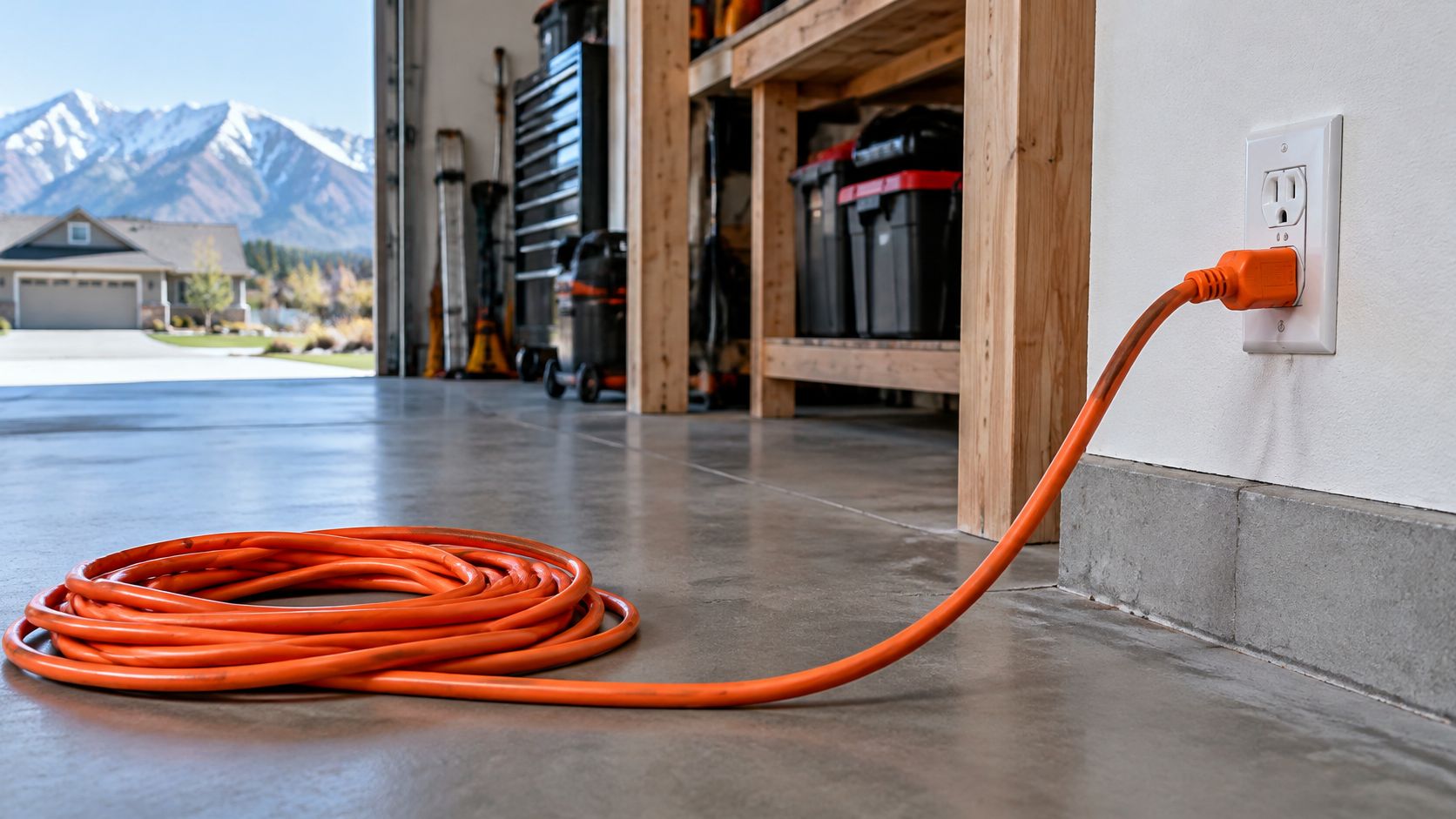
No, the answer to “can extension cords be used as permanent wiring” is generally no, because a cord is a portable temporary supply, not a fixed branch circuit. Even a correctly rated, heavy-duty cord can be the wrong fix when its route exposes it to damage or the equipment needs power in the same place every day.
Why an Extension Cord Cannot Serve as Permanent Wiring
A cord that stays plugged in because the receptacle is inconvenient is doing the job of fixed wiring. That is where the trouble starts. A garden hose works for watering a task, while building plumbing is routed, supported, and protected to remain in place. An extension cord works like the hose, not like the wiring inside the walls.
An OSHA interpretation on flexible cords prohibits using them as substitutes for fixed wiring in permanent workplace installations. Homes follow the locally adopted electrical code and the building department requirements for the property. The workplace rule still shows the safety principle behind the restriction.
Practical distinction: A cord that stays because an outlet is inconvenient is functioning as substitute wiring, even when the outlet supplying it was properly installed.
The whole installation matters
A sound connection at the wall says little about the route, the load, and the equipment at the far end. In a Northern Utah garage, a freezer on a cord through a door gap can look tidy from across the room. The cord still crosses a moving door path, loses protection where it passes the opening, and leaves the appliance dependent on a portable supply.
A proper assessment should cover the whole setup:
- Circuit capacity and appliance demand: The fixed wiring and overcurrent device must suit the freezer, workshop tool, or other equipment served.
- Receptacle location: A correctly placed outlet should let the equipment connect without a cord becoming part of the room layout.
- Physical protection and connection points: The route, boxes, and fittings need to suit the conditions, including door gaps, damp locations, and areas where the cord can be rubbed or pinched.
- Required electrical protection: Grounding and GFCI protection need to match the location and use.
A thicker cord addresses one part of the picture. It does not create approved building-wiring methods, protected routing, suitable boxes, or a planned circuit. Those decisions belong with a licensed electrician. Black Rhino Electric is fully licensed and insured in Utah for both residential and commercial electrical work.
Telling Temporary Use From a Fixed Power Need
The useful test is whether equipment moves to a short task or operates routinely in the same location. Matching the cord's rating to the equipment label is necessary for temporary use, but it isn't permission to establish a permanent supply.
Run length, exposure, operating duration, and repeated reconnection also matter. A cord that gets put away after a project has a different role from one supplying a desk, freezer, or workshop indefinitely.
Temporary use versus fixed supply by room and setup
| Room or setup | Typical load pattern | Proper role of the cord | Safe escalation |
|---|---|---|---|
| Home office desk used daily | Computers and monitors used every workday | Portable use only, not the permanent route to the desk | Evaluate receptacles at the desk location |
| Garage freezer or fridge | Appliance remains connected continuously | Not appropriate as the ongoing appliance supply | Evaluate a dedicated receptacle or circuit |
| Garage tool for one weekend job | Sander or saw used briefly | Temporary task; remove after the job | Assess the supply if the cord keeps returning for routine use |
| Seasonal outdoor decor | Lights operate during a defined display season | Temporary for the display period only | Evaluate outdoor receptacles when cords return every season |
| Finished basement space heater | Operates for hours during cold periods | Not appropriate as the heating supply | Review circuit capacity and receptacle placement |
| Hot tub or spa | High, sustained demand | Not appropriate; assess required fixed wiring | Licensed electrician evaluates a dedicated circuit |
| Level 2 EV charger | Sustained demand during charging | Not appropriate | Evaluate a dedicated circuit and panel capacity |
| Detached shed or workshop | House-fed lights and tools | Temporary only, if suitable for the task | Evaluate the building supply and branch circuits |
A sander used during a weekend project creates a temporary task. A workbench that always needs the same cord has a recurring power need, even if the tools operate intermittently.
Seasonal doesn't mean automatically safe, either. Holiday lights can have a temporary display period, but annual cords crossing the same walkway or window justify an outdoor receptacle assessment.
Worksite arrangements require a separate evaluation, including the protections described in the guide to temporary power for construction sites. For homes, no universal day count replaces examining the actual use: when a setup reaches the table's escalation column, the cord shouldn't remain the solution.
Warning Signs and When to Stop Using a Cord
Smoke, fire, sparking, or an active burning smell require immediate action. Equipment use must stop; unplugging is appropriate only when it's clearly safe and won't delay leaving the area. Occupants should move away and call emergency services when there's an active fire or suspected electrical burning.
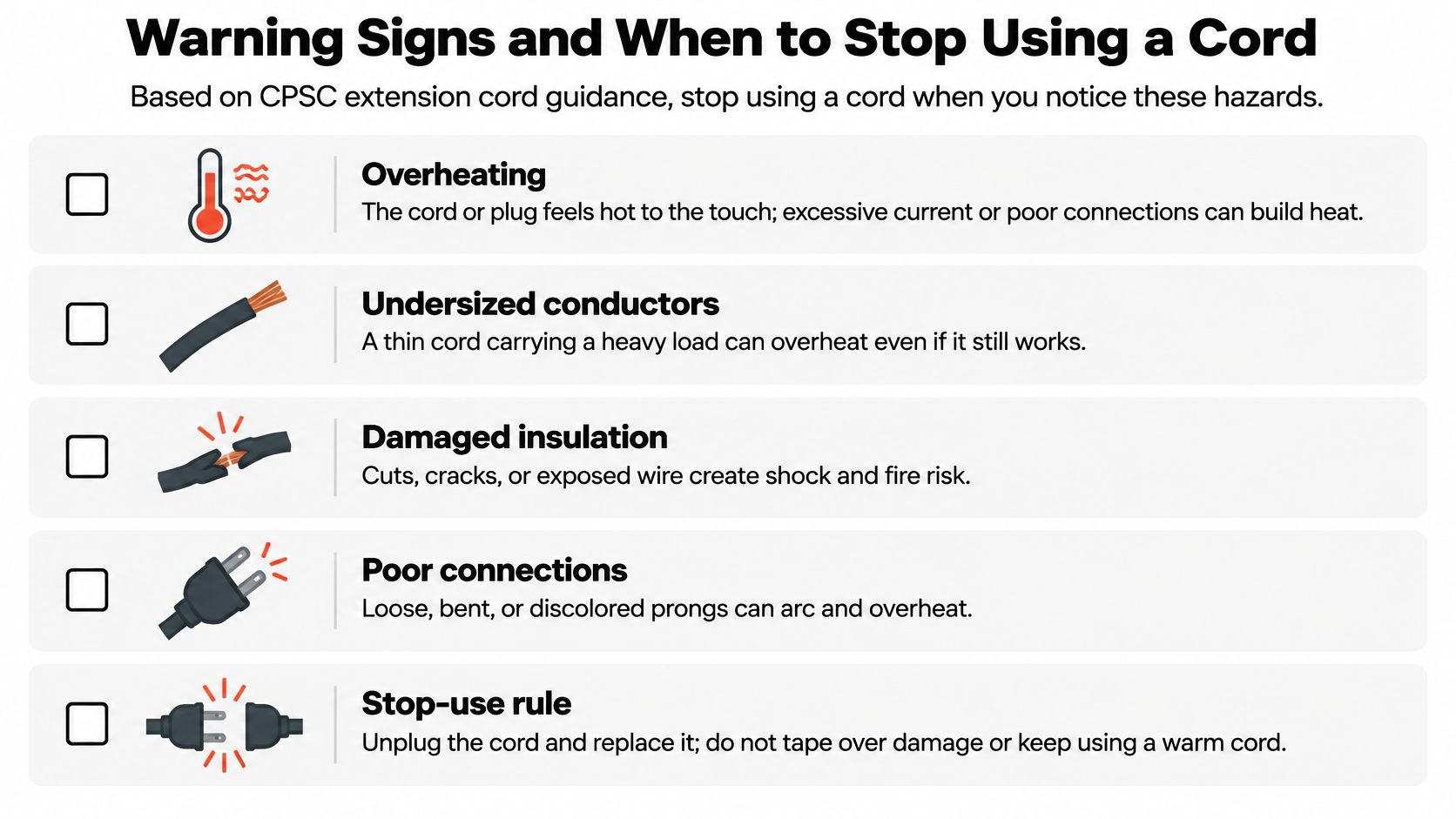
Overheating and recurring protective-device trips also require stopping use, even without visible flames. The Consumer Product Safety Commission's extension-cord guidance warns that cords can overheat and cause fires when equipment draws more power than the cord can carry.
Observable stop-use signs
- Heat: A warm or hot cord, plug, or receptacle warrants stopping use rather than testing whether it gets worse.
- Visible damage: Scorch marks, discoloration, cuts, exposed wire, or a softened or melted jacket require removal from use.
- Connection problems: Buzzing, crackling, or a loose-fitting plug can indicate a connection that needs evaluation.
- Operating changes: Lights flickering when equipment starts, or repeated breaker or GFCI trips, need professional attention.
The infographic summarizes common hazards; suspected damaged electrical parts shouldn't be touched to investigate them.
What the symptoms require
Excessive current, inadequate conductor size, damaged insulation, and poor connections can all produce dangerous heating. Longer runs also add resistance, so a cord that operates equipment isn't necessarily delivering power appropriately.
A GFCI reduces shock risk; it doesn't prevent overload heating or approve permanent cord use. Repeated trips are symptoms to evaluate, not faults to override with repeated resets.
During electrical troubleshooting, an electrician checks circuit loading, conductor size, connections, and receptacle condition. Replacing the cord alone won't correct a damaged outlet or an unsuitable circuit.
Doorways, Walls and Other Hidden Routing Problems
A closed door can crush a cord jacket at the hinge side, and repeated movement can abrade insulation without leaving an obvious mark on the visible section. A rug can conceal both damage and heat buildup. Furniture can press a plug sideways or trap a cable against a sharp edge, leaving the connection difficult to inspect. A correctly rated cord can still be the wrong fix when the route puts it under pressure, friction, or hidden wear.
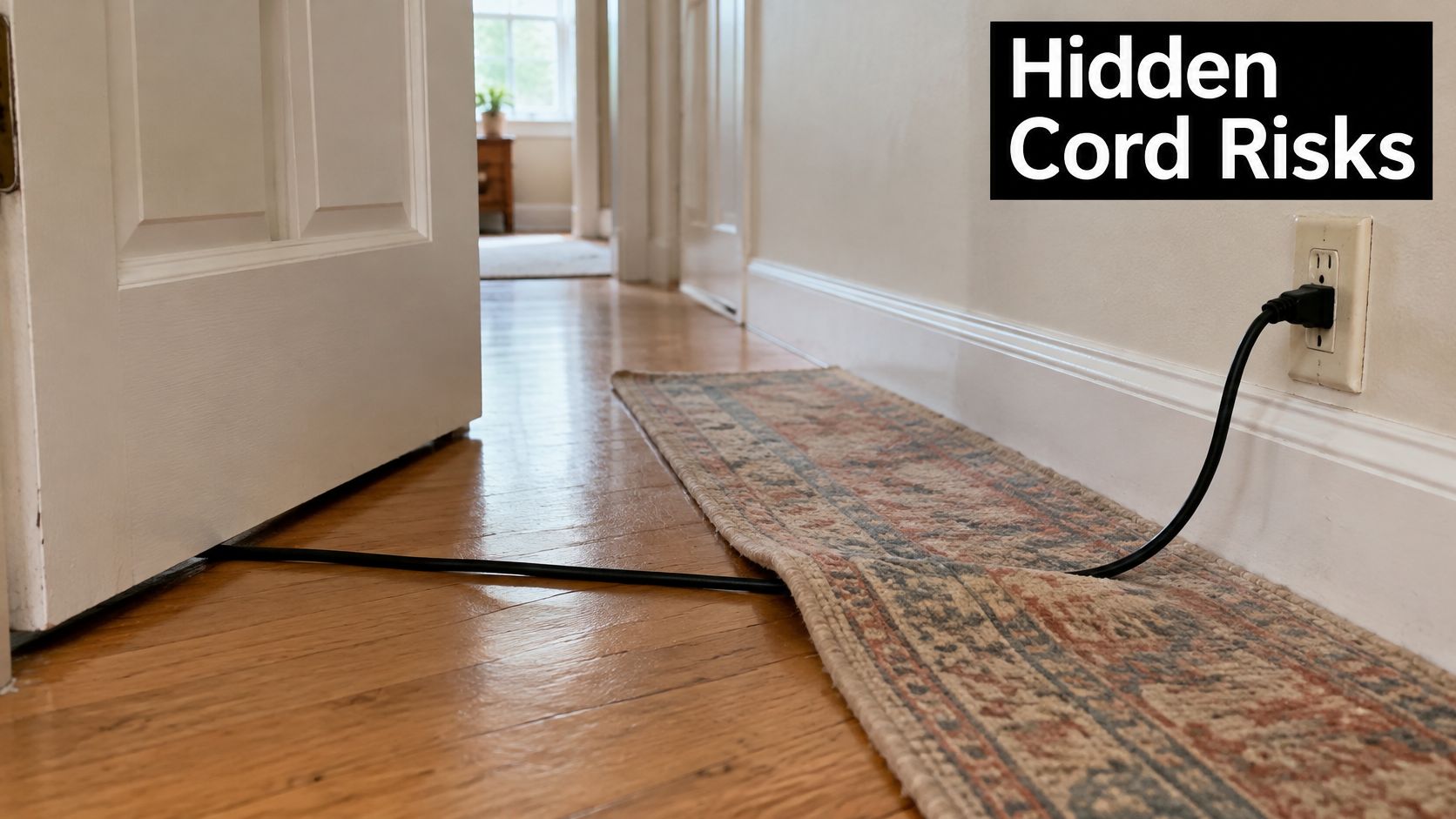
Routing that needs attention
- Staples and nails: Fasteners can penetrate or compress insulation.
- Wall, ceiling, or floor openings: Passing a cord through an opening conceals its condition and exposes it to edge damage.
- Trim and concealed spaces: Hiding a cord prevents routine observation and treats portable equipment like building wiring.
- Chained cords and strips: Additional connections introduce more potential loose-contact and heating points.
Federal consumer-safety guidance reproduced in the Naval Postgraduate School extension-cord fact sheet warns against hazardous cord routing and interconnected cords and power strips.
A compliant outlet doesn't approve the route
OSHA's construction-site interpretation explains that cords connected to permanent building wiring still constitute temporary wiring in that setting. The routing point carries over to homes: a cord running through a doorway, under trim, or behind furniture creates a hidden hazard that a proper outlet or branch circuit should remove.
An outdoor-rated cord tolerates wet locations better than an indoor cord, while passage through a wall calls for wiring methods that protect the conductor, maintain the building assembly, and remain inspectable. Homeowners should stop relying on these arrangements, leave the cord visible, and have the route assessed. Do not add fasteners, coverings, or a neater concealment while the arrangement remains in use.
For a finished lower level, the Utah basement electrical wiring guide provides context for planning permanent power instead of hiding an existing workaround.
What Extra Receptacles or Dedicated Circuits Can Solve
The right repair starts with identifying whether the problem is outlet location, circuit capacity, deteriorated wiring, or a combination. Adding a receptacle solves a reach problem only when the circuit supplying it can properly serve the intended load.
Older Northern Utah homes may have older panels, limited capacity, or alterations that need evaluation. A full-looking panel doesn't by itself establish whether an upgrade is necessary, and an unused breaker position doesn't prove capacity is available.
Options after assessment
- Additional receptacle on an existing circuit: Appropriate only after checking circuit loading, wiring condition, grounding, and a suitable box location.
- New branch circuit: Can serve an area with recurring demand when the panel, wiring route, and installation conditions support it.
- Dedicated equipment circuit: May be necessary for a spa, EV charger, or other demanding equipment. Repeated space-heater use also warrants a capacity review, not automatic approval of a new outlet.
- Required GFCI protection: Must match the location and applicable code requirements; it isn't a substitute for correcting damaged wiring.
- Relocated receptacle: Can match the actual desk or equipment position when the existing location forces an unsuitable route.
- Outdoor receptacle: Can reduce seasonal workarounds, with an appropriate weather-rated enclosure and cover selected for the installation.
The explanation from Black Rhino Electric on dedicated circuits helps distinguish a separate equipment supply from adding another connection point.
What affects scope and cost
Access often determines how much work an installation requires. An accessible unfinished wall presents a different wiring route from a finished basement ceiling or a detached workshop.
Other cost factors include panel compatibility, existing wiring condition, circuit distance, required protection, and permit and inspection requirements. The electrician must confirm the adopted requirements with the property's actual jurisdiction rather than assuming every city in Weber, Davis, and Salt Lake counties applies identical procedures.
A useful estimate explains what the proposed circuit will serve, how wiring will reach it, and which existing conditions could change the scope.
Owner Tasks Versus Electrician Tasks
Homeowners observe and record; electricians diagnose and install. Useful observations include the cord's route, equipment operating schedule, shared plug loads, and visible damage noticed without moving or touching suspect parts. Equipment labels can also help, provided they're accessible without opening an enclosure or disturbing a questionable connection. A homeowner doesn't need to identify the fault before requesting an assessment. The practical limit is simple: collect what can be seen and used safely, then leave testing and installation to a licensed electrician.
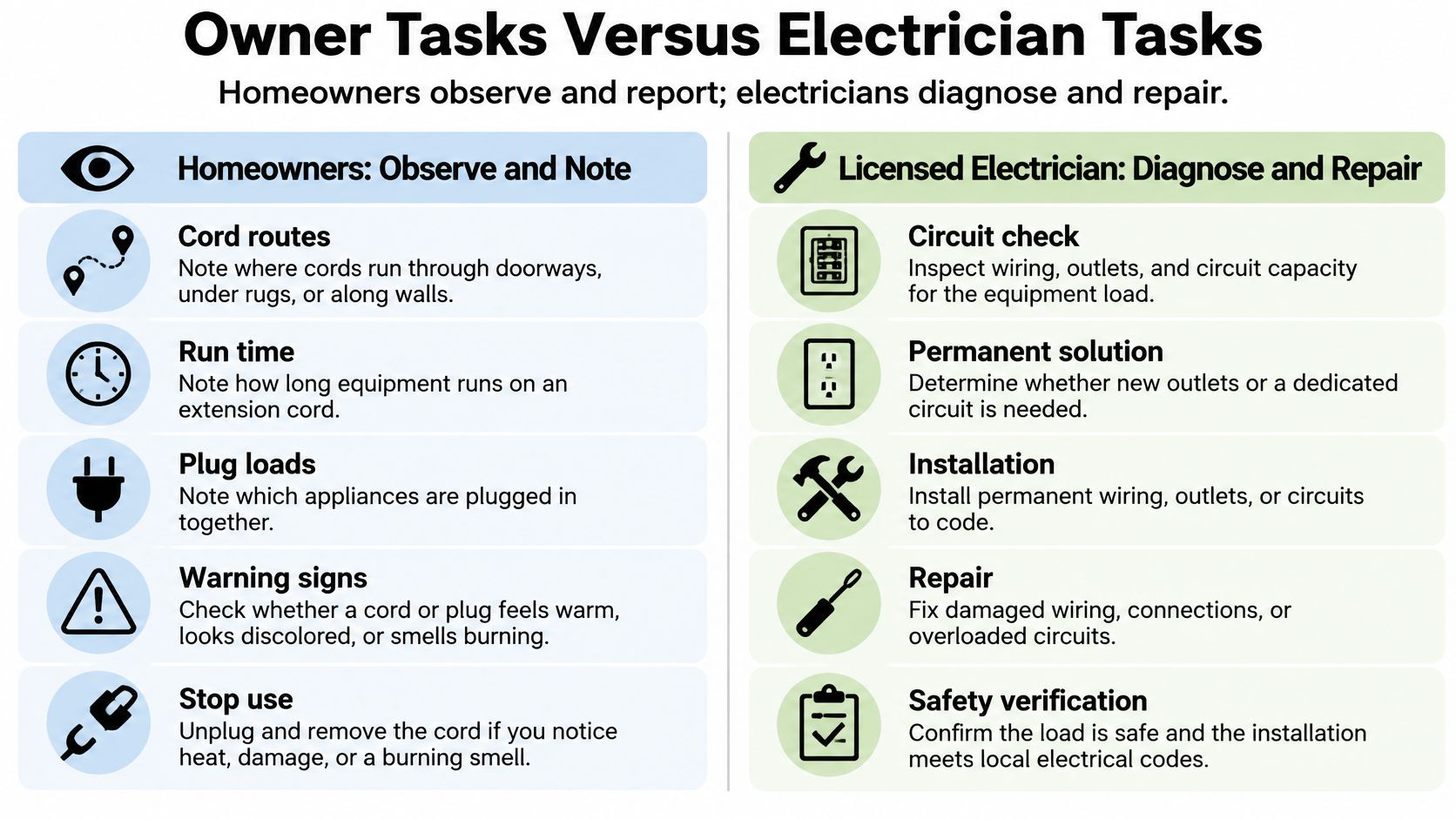
Safe observations and professional evaluation
| Homeowner observations | Electrician evaluation |
|---|---|
| Equipment location and normal operating pattern | Load requirements and circuit suitability |
| Visible cord routing and nearby outlets | Approved wiring route, boxes, and receptacle placement |
| Damage, smells, sounds, or trips already noticed | Connections, conductors, grounding, and protective devices |
| Accessible equipment-label information | Circuit sizing and installation requirements |
| Desired future equipment | Panel capacity and potential supply changes |
OSHA's construction electrical requirements address temporary wiring and prohibit flexible cords as substitutes for fixed wiring in covered workplaces. Those worksite rules show why a cord that seems adequately rated can still be the wrong fix. Routing, run length, and what the cord powers often matter as much as matching amperage to an appliance label.
Boundaries that shouldn't be crossed
Opening panels or device enclosures and changing wiring are professional tasks. Fastening cords into place, bypassing protection, and repeatedly resetting a tripping device aren't acceptable homeowner fixes. Those actions can turn a temporary workaround into a hidden wiring problem, especially when a cord crosses doorways, runs under rugs, or feeds equipment that cycles automatically.
When calling for an assessment, expect to explain the equipment, its location, the symptoms, and whether the unsafe setup is no longer in use. 24/7 call answering for electricians can help capture those details outside normal business hours. State the desired outcome plainly, such as a safer receptacle location, a dedicated supply, or an evaluation of existing wiring. For urgent needs, ask directly about after hours emergency electrical service so the response matches the situation.
Recurring Power Needs Worksheet for an Electrician Estimate
This worksheet records what's already known; it doesn't establish that a circuit is safe. Each piece of equipment or recurring power need should receive a separate entry.
The nameplate voltage, amperage, or wattage should be copied from an accessible equipment label rather than recalled from memory. Unknown fields can be marked with a question mark in the homeowner's notes instead of guessed.
Recurring power needs worksheet for an electrician estimate
| Field | What to record | Example entry | Why it matters |
|---|---|---|---|
| Equipment name | Exact item and its use | Chest freezer in garage | Identifies appliance type and operating pattern |
| Nameplate rating | Voltage, amps, or watts from the label | Copy accessible label values | Establishes equipment electrical requirements |
| Run time | Hours per day and days per week | Connected continuously; cycles automatically | Distinguishes operating duration from connection time |
| Current supply | Cord or strip type and approximate length | Outdoor cord from rear garage outlet | Identifies the workaround being replaced |
| Desired location | Room, wall, or exterior face | Garage north wall | Guides receptacle placement |
| Nearest existing outlet | Whether present and approximate distance | Present on opposite wall | Helps evaluate possible wiring routes |
| Other loads on the same circuit | Known appliances or lights sharing supply | Garage lights, if already known | Helps evaluate simultaneous demand |
| Planned future equipment | Expected additions and timing | EV charger planned; timing unconfirmed | Broadens the panel-capacity review |
Record use without testing the circuit
A freezer may remain plugged in continuously while its compressor cycles. A heater may operate for extended periods, while a sander runs intermittently; those distinctions help the electrician evaluate the actual demand.
Known shared loads are useful, but homeowners shouldn't trip breakers, open equipment, or reconnect suspect devices to complete the worksheet. Information about an intended spa or EV charger also belongs in the notes before a circuit is proposed.
Questions worth bringing
- Existing capacity: Can an appropriate existing circuit serve the need?
- Installation route: Will the work require access through finished surfaces?
- Approvals: Which permits and inspections apply at this address?
- Estimate limits: What conditions remain unconfirmed until the site evaluation?
The worksheet helps prepare a more informed estimate. Price and scope still require an assessment of the actual installation.
Book an Electrical Assessment Before the Cord Becomes Permanent
A cord feeding a daily workspace, continuously connected appliance, or recurring outdoor setup is doing more than temporary duty. A correctly rated cord can still be the wrong fix. Routing, run length, and what the cord powers usually matter more than matching amperage to an appliance label. Warning signs make stopping use more urgent, and the next step is to have the supply evaluated.
Black Rhino Electric is fully licensed and insured in Utah for residential and commercial electrical work. Headquartered in Marriott-Slaterville, the company serves homeowners across Weber, Davis, and Salt Lake counties.
Establish the scope before installation
Home electrical inspections, panel upgrades, and wiring or rewiring can address the conditions behind recurring cord use. The residential home improvement electrical page provides homeowner context, while the details needed to get an electrical estimate start with the equipment, desired location, and known symptoms. Include where the cord runs, what stays plugged in, and whether the load cycles or runs for long periods.
An assessment request doesn't guarantee a price, scope, or appointment time. The electrician determines the appropriate solution after evaluating the installation, including whether an existing circuit can serve the need or new wiring is the better fit.
Black Rhino Electric offers electrical assessments, troubleshooting, panel upgrades, lighting installation, and permanent wiring solutions for recurring power needs. Bring the completed worksheet and get an electrical estimate before an extension cord becomes the room's ongoing supply.