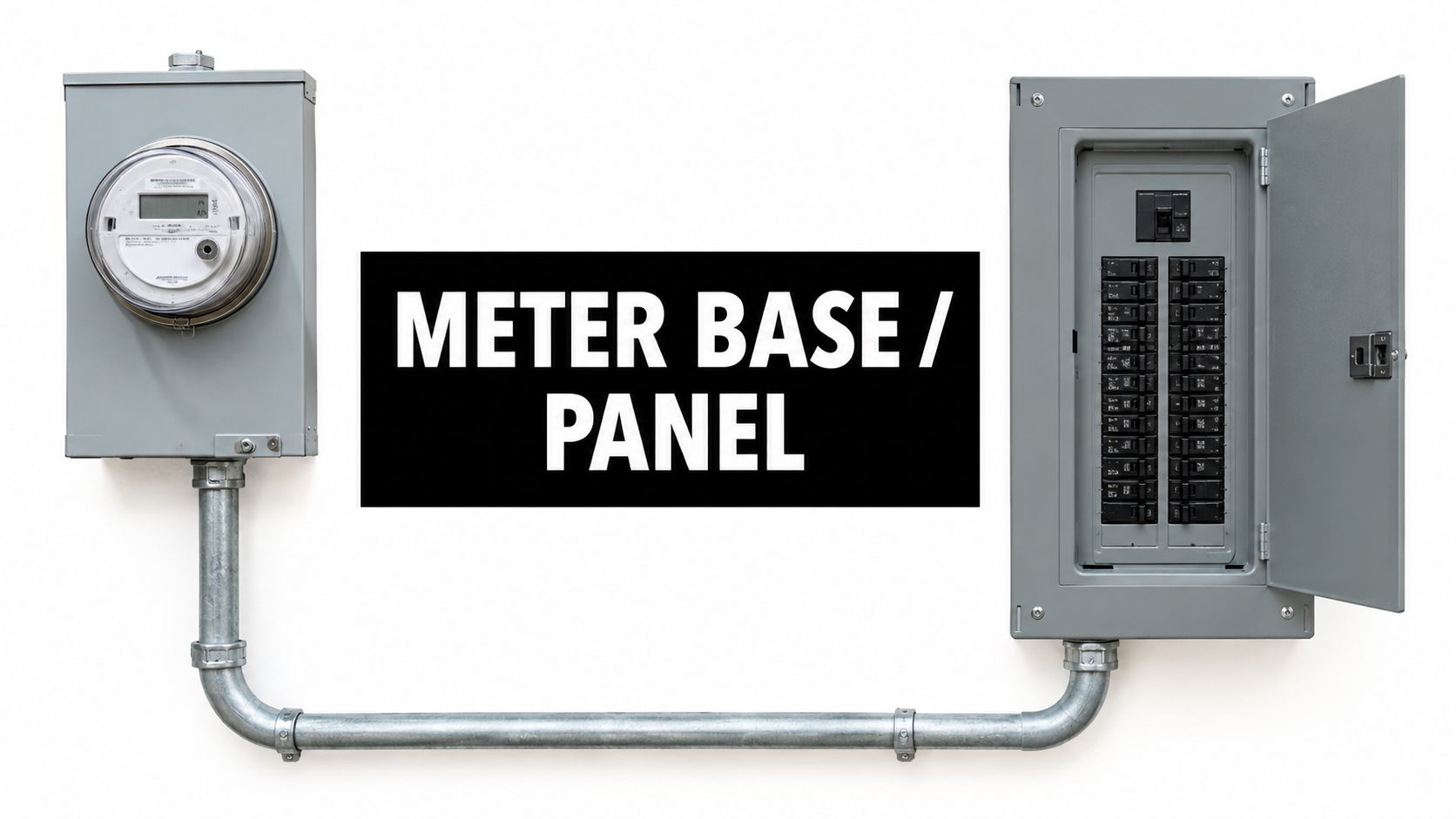
A larger panel doesn't create a larger electrical service, despite the common advice to upgrade to more amps. In a meter base vs electrical panel comparison, the meter base is the enclosure that accepts the utility meter and connects the service conductors, while the electrical panel receives power after the meter and divides it into branch circuits.
Meter Base and Electrical Panel Side by Side
The meter records energy use in kilowatt-hours for billing. The panel doesn't measure that use. Its breakers interrupt overcurrent and short circuits so branch-circuit wiring and connected equipment aren't left carrying fault current.
That split explains why problems need different responses. A corroded meter base is a service-connection problem. A crowded panel with a failed breaker is a distribution problem. Treating them as one part leads to the wrong scope, the wrong approval path, and sometimes work on equipment that didn't need replacement.
| Criteria | Meter base | Electrical panel |
|---|---|---|
| Primary job | Houses the utility meter and connects service conductors to it | Receives power after the meter and distributes it to branch circuits |
| What it measures or protects | Doesn't measure billing energy itself; the meter does | Protects branch circuits with breakers against overcurrent and short circuits |
| Typical location | Outdoors at the service point | Usually indoors, such as a garage, basement, or utility room |
| Main rating basis | Service-current rating and utility-approved listing | Continuous current rating and short-circuit interrupting rating |
| Typical owner | Set by serving utility rules; often customer-owned enclosure with utility-owned meter | Customer |
| Common failures | Corrosion, water intrusion, damaged seal, loose connections | Overheated breakers, scorching, overloaded or crowded bus, failed breakers |
| Who works on it | Licensed electrician, coordinated with the utility | Licensed electrician, with a permit where required |
The two components connect in sequence, but they're often separate scopes of work. Ownership and ratings decide where one scope ends and the other begins.
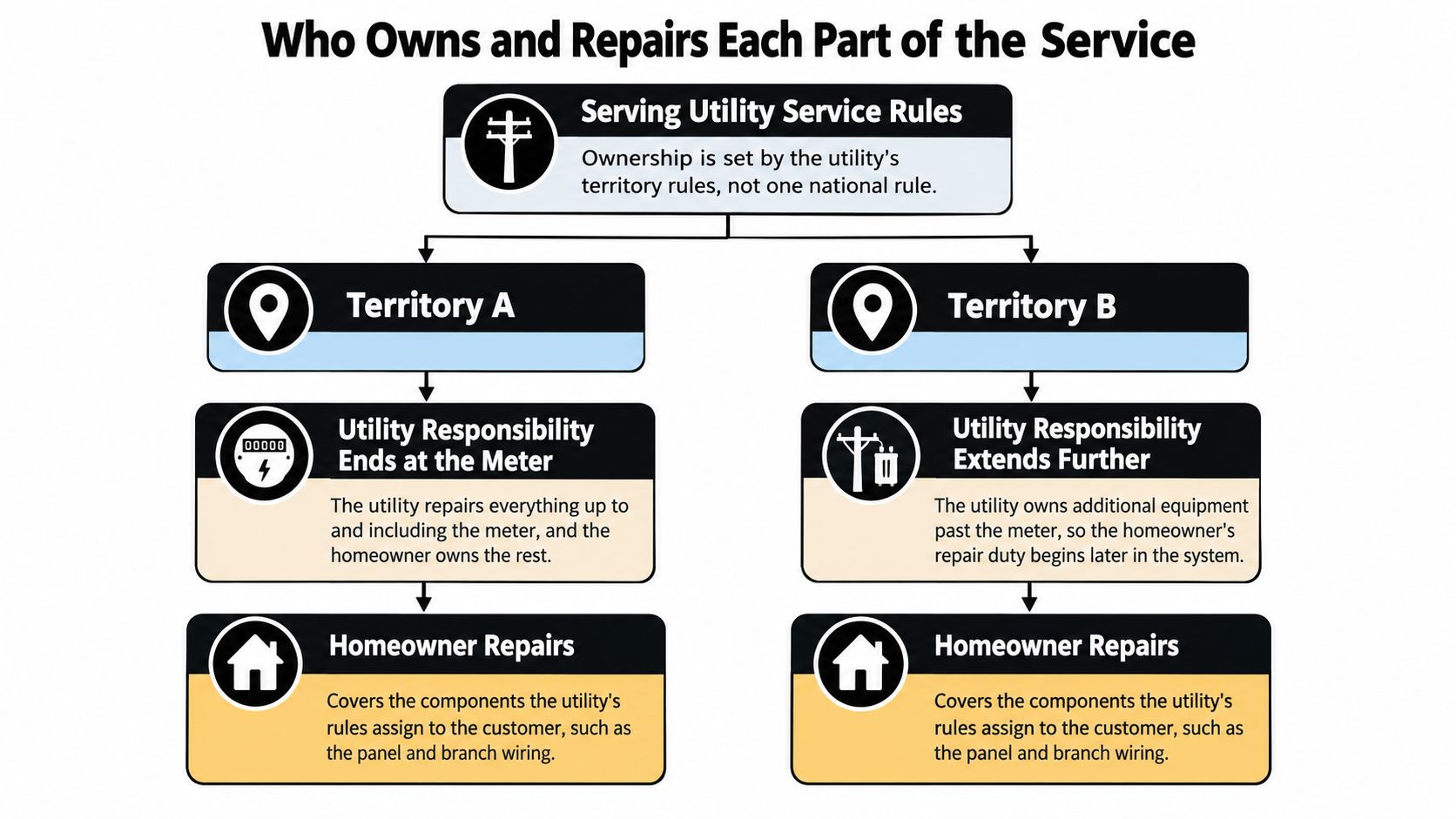
Who Owns and Repairs Each Part of the Service
Ownership isn't set by one national rule. It's set by the serving utility's service rules, and the line moves by territory. The Clark Public Utilities residential handbook states that the utility assumes responsibility for the secondary service up to the meter, while the customer owns and maintains equipment on the load side.
Other utility rules split the same equipment differently, with the utility owning the meter while the customer installs the meter base and maintains the main panel and subpanels. Northern Utah homeowners shouldn't assume the utility owns the box because it owns the meter inside it. Rocky Mountain Power or the serving utility needs to confirm responsibility for the specific service address.
Power follows a set path. Utility conductors reach the meter base, the meter sits in that base, service conductors carry power to the service disconnect and main panel, and branch circuits or a subpanel run from there.
| Component | Main function | Typical owner | Who may open or replace | Utility or permit touchpoint |
|---|---|---|---|---|
| Utility meter | Measures energy use for billing | Set by serving utility; confirm for the address | Utility | Utility sets, seals, and reads the meter |
| Meter base | Accepts the meter and connects service conductors | Set by serving utility; often customer-owned enclosure | Licensed electrician, coordinated with utility | Utility approval and disconnect and reconnect |
| Service disconnect | Main shutoff for the building | Set by configuration and service rules | Licensed electrician | Permit and inspection |
| Main panel | Distributes power and holds main breaker | Customer | Licensed electrician | Permit when adding or replacing |
| Subpanel | Feeds a section of the building or a detached structure | Customer | Licensed electrician | Permit and load calculation |
Before work starts, three answers matter: which side of the metering point holds the problem, who's authorized to do the work, and whether the utility must de-energize the service first.
Ratings That Decide Whether a Panel Change Adds Capacity
A 40-space panel on a 100 A service still delivers only 100 A. A panel change adds usable capacity only when the meter socket, service conductors, disconnect, utility service, and calculated load all support the higher rating. Breaker spaces and available amps are separate questions, and homeowners regularly pay for one expecting the other.
What each rating controls
A panel is judged mainly by continuous current rating, bus thermal performance, and short-circuit current rating. A meter base is judged mainly by metering compatibility, service-current rating, enclosure suitability, and utility acceptance. A panelboard's current rating is the maximum continuous current that can pass through its main terminals, and its SCCR must be marked in RMS symmetrical amperes.
| Rating | Where it appears | What it limits | Who verifies it |
|---|---|---|---|
| Meter socket service rating | Meter base label and utility listing | Service current the socket is approved for | Electrician and serving utility |
| Panel main breaker rating | Main breaker and panel label | Maximum continuous current through the panel | Electrician at permit inspection |
| Panel bus rating | Bus bars and manufacturer nameplate | Heat rise limit of the bus assembly | Manufacturer listing and electrician |
| Short-circuit rating (SCCR or AIC) | Panel label | Fault current the assembly can safely interrupt | Electrician, using site fault current |
| Service conductors and lugs | Service entrance cable and lug markings | Current the incoming wiring can carry | Electrician, through load calculation |
| Utility transformer and service capacity | Utility infrastructure | Capacity delivered to the property | Serving utility |
Published panelboard ranges in the UL panelboards guide commonly span 10 kA through 65 kA SCCR, while higher-rated equipment can reach 200 kAIC in specific designs. A panel can have enough ampacity and still be unsafe if its interrupting rating sits below available fault current at the site. That fault current comes from the utility side, so a panel that fits the load calculation can still fail this check.
Meter sockets have their own ceiling. The ANSI/NEMA C12.7 standard scope covers watthour meter sockets rated up to 600 V and up to 320 A continuous duty per socket opening. That's a service-entry limit, not permission to add unlimited loads, and the utility still decides what capacity it will deliver to that socket.
Additions make the distinction practical. Work on the electrical requirements for home EV charger starts with panel capacity and utility capacity, not charger selection alone. Everything upstream of the main breaker sits on the utility side of the metering point, so raising those ratings means utility coordination rather than a simple panel swap. A licensed electrician should document calculated load, available fault current, conductor and lug ratings, breaker compatibility, meter-base requirements, and permits before recommending equipment.
Safe Homeowner Checks and Stop-and-Call Conditions
The homeowner role is narrow: observe, record, and report. It doesn't include opening a meter enclosure, removing a meter, or removing a panel cover.
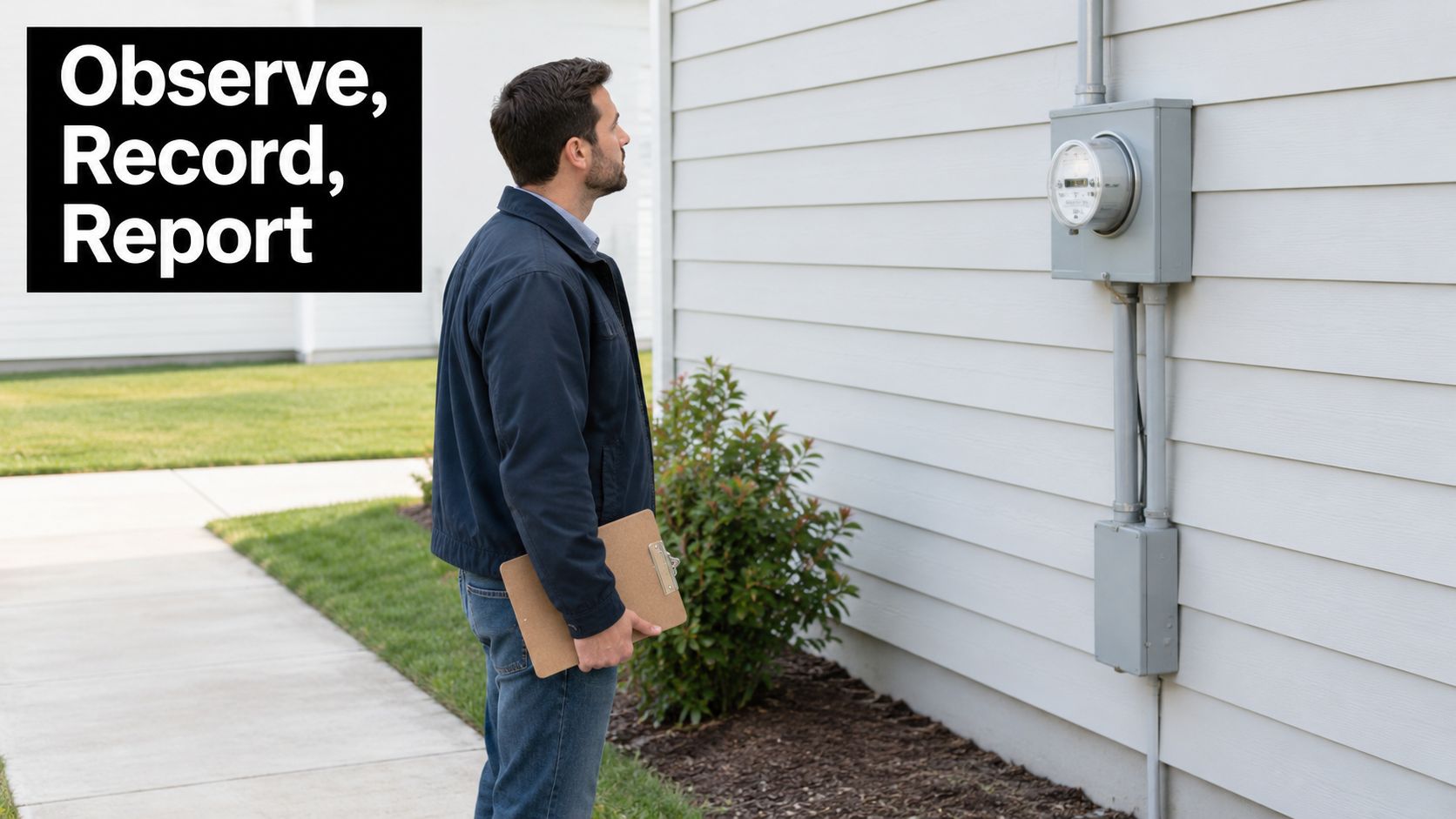
The Electrical Safety Foundation home electrical system guide notes that a homeowner can safely observe obvious damage, scorching, corrosion, loose covers, or buzzing, but shouldn't remove a meter or panel cover. Utility-owned equipment may remain energized even when a home's main breaker is off, and meter tampering is extremely dangerous and illegal.
Observations that can be made from outside the equipment
- Meter base exterior: Cracks, rust, water staining, a damaged seal, or impact damage
- Panel exterior: Scorch marks, discoloration, a loose cover, buzzing, crackling, or a hot smell
- Breaker behavior: Repeated trips on the same circuit, especially under a normal load
Equipment comparisons can create false confidence during planning. Resources describing home wallboxes rated at 22 kW show charger output, but output alone doesn't prove an existing Utah service can support that load. Service capacity still controls the installation decision.
Stop-and-call conditions
- Heat, odor, or visible damage: Burning smell, scorching, sparking, or a warm panel cover
- Water or impact: Water inside a meter enclosure or a meter base that has been struck
- Sound: Persistent buzzing or crackling from service equipment
People should stay away from affected equipment while the condition, time, and location are recorded. Panel-side symptoms belong with electrical troubleshooting by a licensed electrician. Meter-side damage belongs with the serving utility, coordinated with an electrician when customer-owned equipment is involved.
Decision Tree for Damage, Capacity and Upgrades
Work backward from the symptom. Choosing a component first leads homeowners to pay for the wrong job, and each scenario below routes to a different authorizer: the utility for meter-side work, a licensed electrician for panel-side work, and both when the service rating goes up.
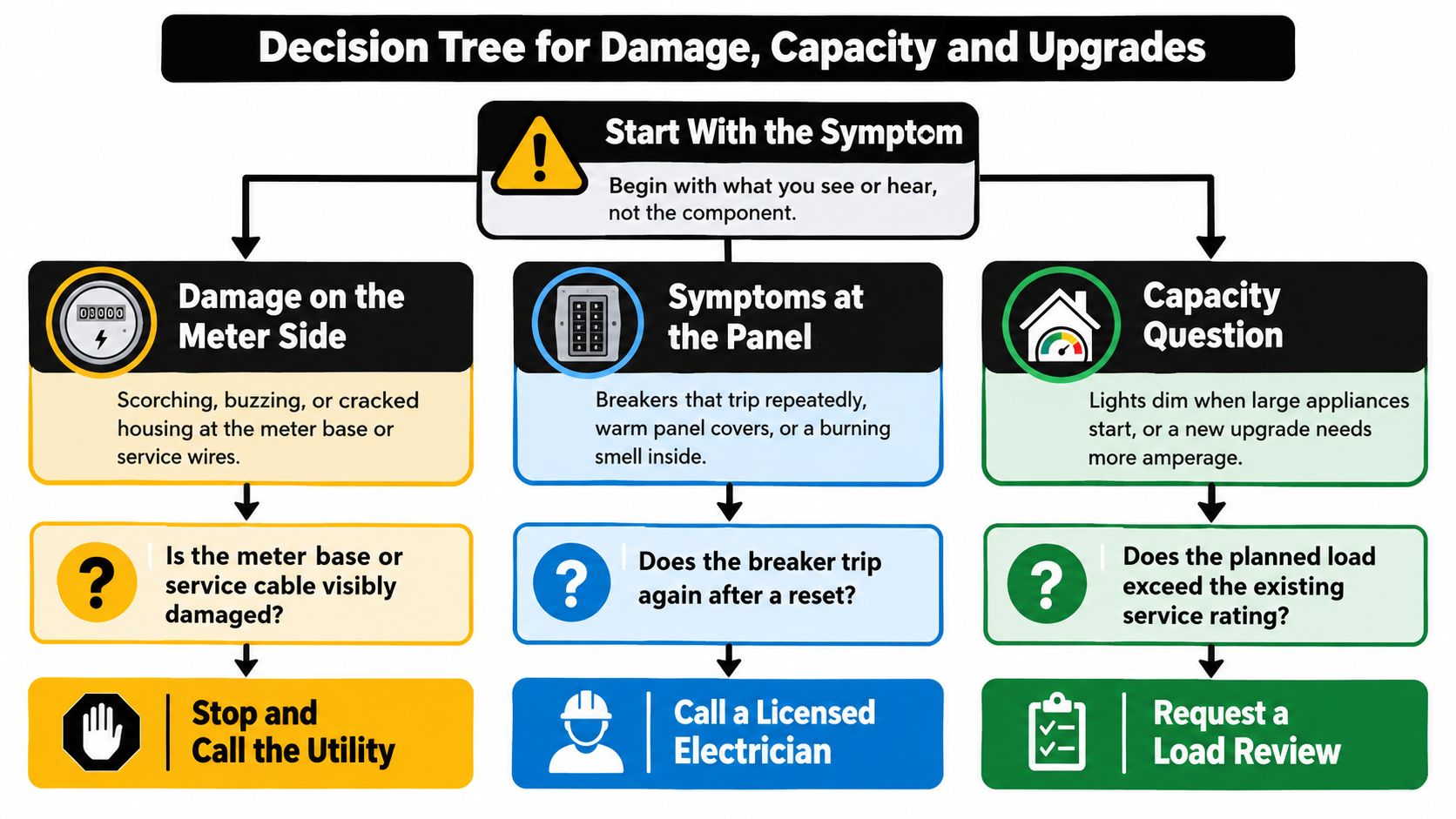
| Scenario | First question | Likely scope | Call a licensed electrician when |
|---|---|---|---|
| Corroded, cracked, or water-stained meter base | Is the damage in the meter itself or the customer-owned base? | Meter base replacement coordinated with a utility disconnect and reconnect | Right away; only the utility opens or removes a meter |
| One breaker trips repeatedly under load | Does only one circuit trip? | Breaker or circuit repair; the panel may still be adequate | Any repeated trip or a breaker that feels hot |
| More circuits needed, no major new load | Are there open breaker spaces? | Subpanel or panel work; the service rating stays the same | Before adding any circuit |
| EV charger, hot tub, heat pump, or electric range | Does the service rating support the load? | Load calculation, then panel, subpanel, meter base, or service work | Before buying equipment or scheduling installation |
| Panel relocation | Can the new location be reached and meet code clearances? | Panel relocation and rewiring | Before the move; confirm the permit with the local building office |
| Service-rating increase | Must the utility upgrade the service or transformer? | Meter base, service conductors, and utility-side work | Early, so the utility schedule is planned |
A full panel and an undersized service are different problems. The Lawrence Berkeley National Laboratory panel and service upgrade study explains that the meter socket is sized to the main breaker while the service panel holds the main and branch breakers. A new panel can add breaker spaces and safer hardware without raising the service rating.
The bottleneck on a service upgrade often sits on the utility's side of the meter. A heat pump plus an EV charger can push the load calculation past the existing rating, which puts the meter base, service conductors, and sometimes the utility's transformer in scope. The panel swap happens last.
For a large new load, the order is fixed: load calculation, service and meter-base compatibility review, utility requirements, permit planning, and panel selection.
Repair or Replace Each Component
Repair fits when damage stays confined to one component and the surrounding equipment passes rating and condition checks. A failed single breaker, a cracked cover, or a worn meter-base seal may stay a limited repair after a licensed electrician verifies listing and compatibility.
Replacement becomes more likely when heat has damaged an enclosure or bus, labeling doesn't support the intended service, corrosion or water has compromised the meter base, or planned load exceeds existing ratings. A new breaker in a heat-damaged panel doesn't correct the cause of the damage.
Four checks that frame the decision
- Location of damage: Meter side or panel side?
- Scope of damage: Isolated to one component or spread across connected equipment?
- Rating fit: Does existing equipment support the planned load?
- Utility involvement: Must the serving utility disconnect, approve, or reconnect service?
A negative answer on rating fit changes the conversation from repair to replacement or upgrade. Breaker compatibility also needs confirmation against panel manufacturer documentation, because a breaker must be listed for the specific panel where it's installed.
For panel-side heat damage, failed breakers, or an enclosure that no longer supports safe operation, electrical panel repair starts with diagnosis of the cause, not a parts swap based on appearance.
Permits, Utility Coordination and Cost Factors
A panel replacement, a service change, and a meter-base replacement are separate scopes with separate authorities. Combining them into one vague upgrade makes timelines and prices hard to compare.
The city or county building department where the home sits sets permit requirements. Homeowners in Weber, Davis, and Salt Lake counties should confirm the applicable process with the local office, including which electrical code edition it enforces and whether a meter-base or service change needs a separate permit. General background on electrical submeter installation permits and licensing doesn't replace that local confirmation, since metering and permitting authority isn't uniform.
Utility coordination adds another schedule. A meter-base change or service-capacity increase may require disconnect and reconnect work, a scheduled utility visit, or equipment approval before inspection can close. Those steps belong in the written scope from the start, along with utility coordination and service upgrade expenses.
Cost factors that change the scope
- Panel capacity: Main rating, bus rating, breaker spaces, and compatible breakers
- Meter base condition: Replacement need, utility-approved socket type, and enclosure suitability
- Service conductors: Size, condition, lug compatibility, and routing
- Utility-side work: Service or transformer capacity beyond the property equipment
- Circuits and access: Number of affected circuits and working access at both locations
The 2026 ENERGY STAR Home Upgrade guidance lists $1,000 to $2,500 as the sample cost for upgrading a residential electrical panel to standard higher capacity. That sample covers a panel upgrade, not a quote for meter-base replacement, service conductors, or utility-side work. A site-specific written scope remains the basis for comparing actual numbers.
Confirm the Scope Before Scheduling Electrical Work
Meter sockets sit on the utility side of the service, so a homeowner should not open one. NFPA NEC style guidance requires service equipment rated at 1,000 volts or less to be marked as suitable for service equipment and be listed or field labeled. Meter-socket enclosures sit outside that service-equipment category, and the NEC still requires each one to be listed and rated for the service voltage and ampacity.
Swapping a meter base involves more than matching physical size. Socket type, enclosure, conductors, lugs, grounding and bonding, and the utility interface all have to fit the service rating and the local jurisdictional requirements. Because the socket sits ahead of the main disconnect, the utility authorizes work on that side of the metering point, and the service typically has to be de-energized before a licensed electrician touches it.
Questions to settle before scheduling
- Load: Is a load calculation included for planned equipment?
- Ratings: What are the panel, socket, conductor, and fault-current findings?
- Written scope: Are panel, meter-base, and utility-side tasks listed separately?
A service visit normally covers an exterior meter-base check, panel labels and breaker layout, planned loads, visible safety concerns, and the written scope itself. Each question above gets settled on site: the electrician reads the socket and panel ratings, confirms whether the planned load fits the existing service, and splits the scope so utility-side work is priced and scheduled apart from the in-home work. Homeowners ready for that review can call 385-396-7048 or request a free electrical quote.
For meter work, breaker and panel work, panel upgrades, and capacity reviews before an EV charger or a remodel in Northern Utah, Black Rhino Electric can inspect the service equipment and define the correct scope.