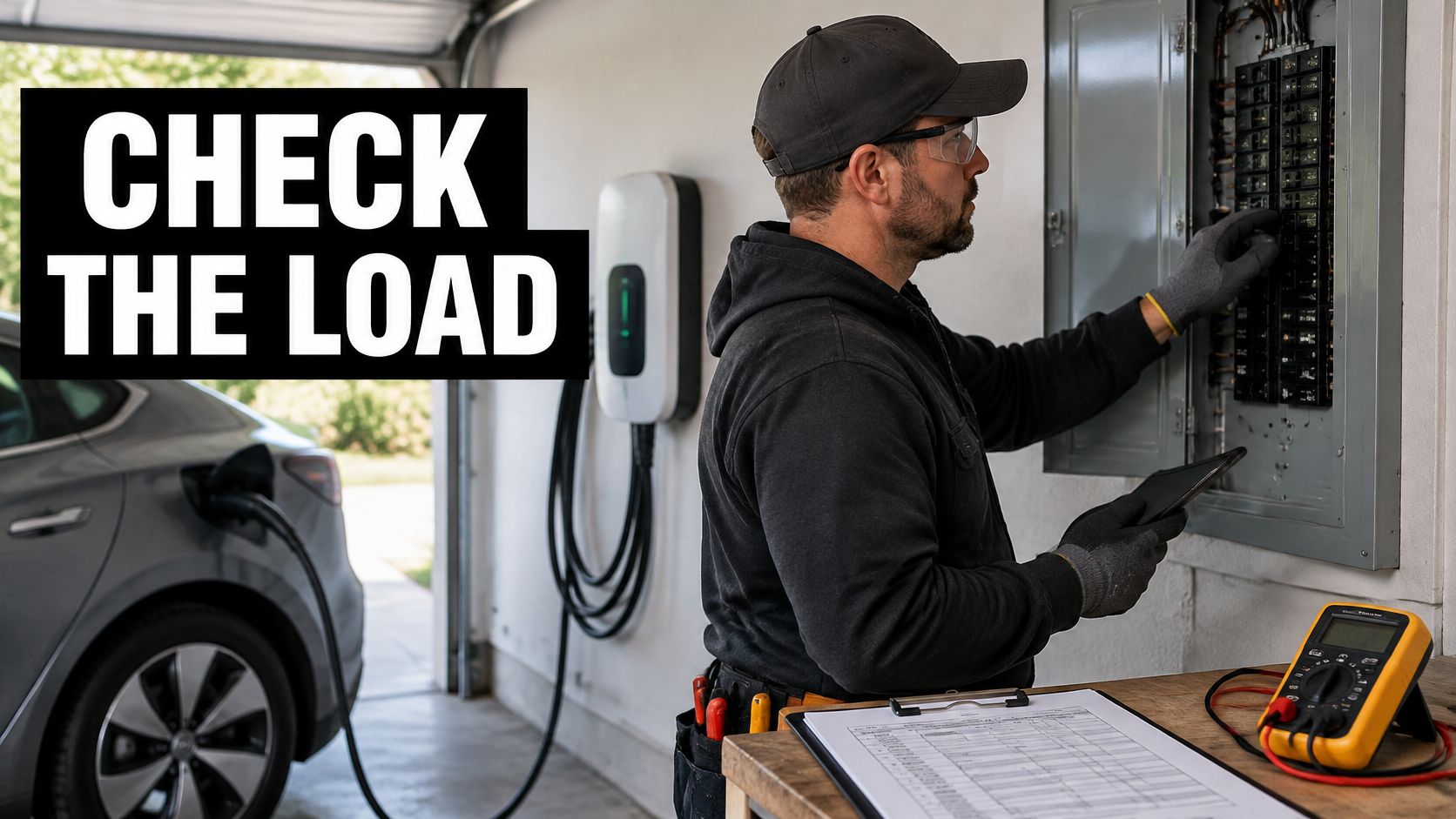
A dwelling load calculation determines whether Level 2 charging fits the home's electrical capacity. The charger's advertised amps describe charging output, while the branch circuit must be sized separately: a 40-amp charger generally requires a 50-amp circuit under the 125 percent sizing rule. Even a correctly sized circuit does not establish that the electrical service can support the added load. Check all three numbers before buying equipment.
What the Load Calculation Must Answer
The calculation must establish whether the existing electrical service can support household demand plus the proposed charging load. It also has to identify whether the obstacle is service capacity, panel condition, breaker space, or the dedicated circuit.
The U.S. Department of Energy's Alternative Fuels Data Center describes residential Level 2 charging at 240 volts, including equipment drawing up to 30 amps and delivering approximately 7.2 kilowatts, with a dedicated 40-amp circuit. That's a meaningful addition to an older Northern Utah home, especially when electric heating, cooking, water heating, or spa equipment already uses much of the available capacity.
A worksheet that separates observations from verification
Homeowners can gather accessible labels, appliance information, and utility records. They shouldn't remove panel covers to complete a worksheet. A blank field is safer than an assumed rating.
Dwelling load-calculation inputs before a Level 2 charger
| Input | What to record | Who gathers it | Why it matters |
|---|---|---|---|
| Service size | Main-breaker or service-disconnect amps, commonly labeled 100, 125, 150, or 200 | Homeowner records a label visible with the cover closed; electrician confirms | Sets the ceiling the calculated load must stay under |
| Panel bus rating | Bus amps printed on the panel label | Electrician only when access requires opening equipment | The bus rating can differ from the main breaker |
| General lighting load | Finished living area in square feet | Homeowner supplies area; electrician checks calculation inputs | Feeds the standard dwelling calculation under NEC Article 220 |
| Fixed appliances | Nameplate watts or amps for heat, air conditioning, range, dryer, water heater, and hot tub or spa | Homeowner lists accessible equipment; electrician verifies | Identifies major loads and applicable demand factors |
| EVSE nameplate and setting | Voltage, maximum current, and configurable output | Owner's manual plus electrician | Establishes the starting point for Article 625 branch-circuit design |
| Measured peak | Highest demand in the prior 12 months, in kW, if available | Homeowner requests utility records; electrician interprets them | An accepted existing-dwelling method can use 125 percent of that peak plus the EV load |
| Breaker positions | Whether a two-pole space appears open | Homeowner checks the directory; electrician confirms | Open space isn't unused service capacity |
What each input changes
Service size establishes the supply limit, while the bus label establishes what the panel itself can carry. Neither can be inferred reliably from the enclosure's appearance or age.
The appliance list lets the electrician apply the dwelling calculation rather than assume every appliance runs at full output simultaneously. The charging equipment's installation manual establishes which maximum-current settings are available and how they must be secured.
Utility demand records are useful only when they represent the measurement the calculation requires. Monthly energy consumption isn't interchangeable with peak demand.
Practical rule: A completed worksheet supports the calculation. It doesn't replace verification of the electrical equipment or the permit reviewer's requirements.
The electrician compares the completed calculation with the verified service rating. No particular Northern Utah home should be approved from guessed appliance ratings or a photograph of spare breaker spaces.
Why the Charger Uses Three Different Numbers
Charging output, branch-circuit capacity, and whole-service load answer different questions. Confusing them can produce either an unnecessary upgrade recommendation or an undersized installation.
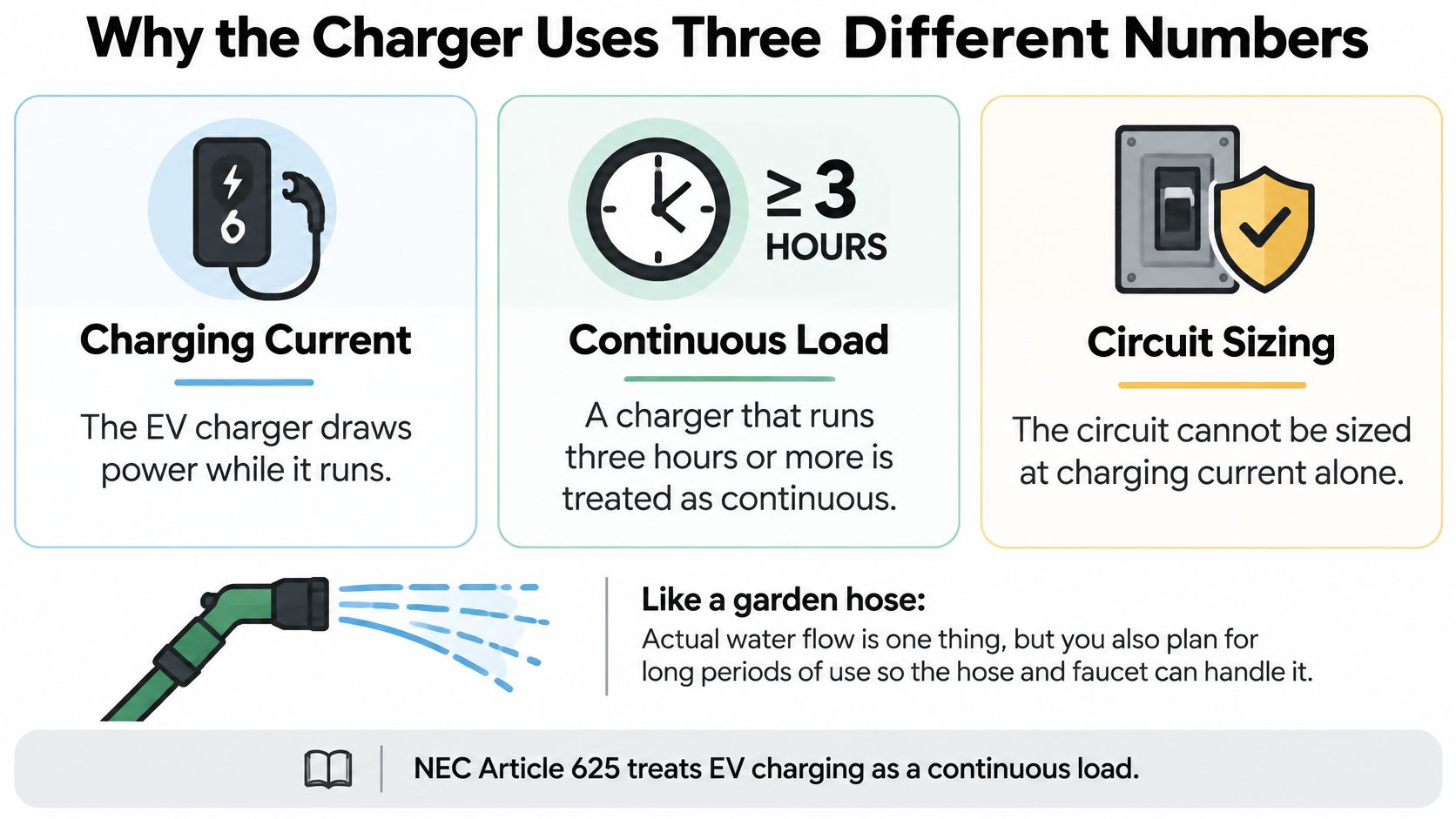
The Schneider Electric electrical distribution design guide explains that NEC Article 625 treats EV charging as continuous because it commonly operates for three hours or more, requiring circuit conductors and overcurrent protection sized for at least 125 percent of maximum charging current. Its examples pair 40-amp charging with a 50-amp design value and 48-amp charging with 60-amp branch-circuit capacity, representing 9.6 kVA and 11.52 kVA respectively at 240 volts.
Think of a hose supplying water steadily rather than delivering a brief burst. The electrical circuit must be suitable for sustained operation, not merely capable of supplying the charger for a moment.
Charging current versus circuit design
Department of Energy fleet training gives the additional example of a 32-amp charger requiring a 40-amp double-pole breaker and delivering about 7.7 kilowatts at 240 volts; the table applies the same continuous-load arithmetic to the other charging currents.
Charging current versus branch-circuit design value
| Charger maximum | 125 percent branch value | Approximate demand at 240 V | What this number does not decide |
|---|---|---|---|
| 30 amps | 37.5 amps, before selecting the appropriate standard circuit rating | 7.2 kVA | Whether the whole service has room |
| 32 amps | 40 amps | About 7.7 kW | Panel bus rating or utility service size |
| 40 amps | 50 amps | 9.6 kVA | Spare breaker spaces |
| 48 amps | 60 amps | 11.52 kVA | Whether the whole-service calculation passes |
Volt-amperes describe the electrical load used in capacity calculations. Kilowatts describe real power; the terms shouldn't be substituted indiscriminately throughout a worksheet.
The service-calculation floor is separate
The Department of Energy's multifamily EV charging guide describes the 2023 NEC service-calculation rule using 7,200 volt-amperes or the EVSE nameplate rating, whichever is larger. Consequently, reducing charging output can solve a circuit-sizing problem without reducing the service-calculation contribution below the applicable minimum.
A permitted installer-configured limit must be established through the equipment's installation instructions, not merely selected in a driver-facing app. The electrician must document the setting recognized by the accepted calculation method.
Connection type is another design choice, but choosing an EV charger connection doesn't establish service capacity. A suitable breaker and connection can coexist with a failed dwelling load calculation.
How to Read a Sample Calculation
A published illustration in the U.S. Department of Energy's EV charging technical brief starts with a 200-amp, 240-volt service rated at 48 kVA: a highest recorded demand of 9.6 kW becomes 12 kVA after applying 125 percent, and adding a 9.6-kVA charger produces 21.6 kVA. This is an illustration of an accepted demand-based approach, not a calculation for a Northern Utah address.
The result suggests substantial calculated capacity for that measured usage profile and proposed charger. It doesn't establish the condition of the panel, suitability of the wiring route, or compliance of the selected equipment.
How a different house changes the result
For a hypothetical 100-amp service at the same voltage, nominal capacity computes to 24 kVA. That smaller supply can leave little margin when the actual dwelling calculation includes substantial electric heating, water heating, cooking, or spa loads.
Another charger or a higher charging setting changes the proposed load again. The correct conclusion comes from substituting verified household values, not transplanting the favorable published example.
- Compare compatible values: The final calculated load must be compared with the verified service capacity in consistent units.
- Keep circuit sizing separate: The branch-circuit design still needs its own conductor and overcurrent-protection review.
- Use the accepted method: The applicable EV minimum or approved management allowance must remain in the service calculation.
- Reject invented peaks: Missing utility demand records require another accepted method, not a peak estimated from monthly electricity consumption.
An online calculator can help organize questions. Its result remains preliminary until the electrician verifies the inputs and the authority having jurisdiction accepts the submitted calculation.
Lower Current, Load Management, or an Upgrade
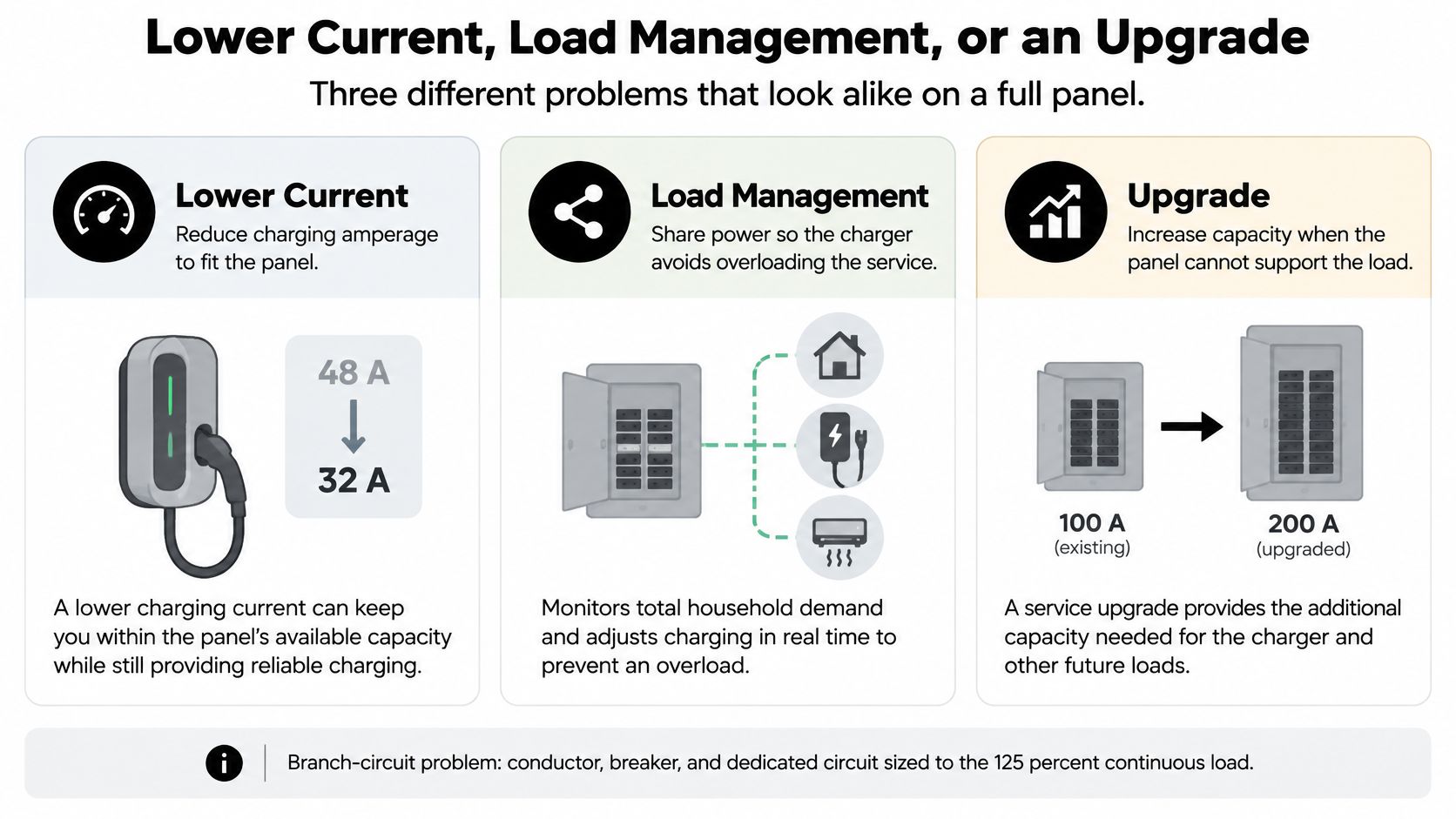
Choose the remedy based on which limit the calculation and equipment inspection identify. A panel can have no usable breaker spaces while the service still has capacity, or it can have open spaces with insufficient service capacity.
Charging options compared with a service or panel upgrade
| Option | Fits when | Effect on the calculation | Does not fix |
|---|---|---|---|
| Lower configured charging current | Available margin is short and slower charging meets daily driving | Can reduce circuit requirements; an applicable service minimum may still control | Worn bus, missing spaces, or excessive existing demand |
| Listed energy management | Other large loads peak while charging can wait | Approved controls limit the EV contribution to the maximum their design permits | Charger-circuit conductor and breaker sizing |
| Panel upgrade or rearrangement | Bus rating, spaces, or condition fail while service capacity passes | Provides suitable equipment and space for the dedicated circuit | Utility supply capacity or undersized service conductors |
| Service upgrade | The accepted calculation still exceeds available capacity | Increases service capacity to accommodate the calculated demand | Charger configuration, permits, or separate circuit defects |
| Remain on Level 1 | Level 2 isn't feasible and an upgrade is declined | Avoids the proposed higher-power charging addition | Existing receptacle defects or future faster-charging requirements |
Choose the remedy before pricing construction
Listed energy management limits charging through approved controls. Asking household members to wait before running other appliances does not meet the requirement. For example, if the dryer and range are both running during a 6 p.m. peak, a listed system can constrain EV charging according to its approved design. Lowering the configured charging current can also reduce the charger's demand, but a service-calculation minimum may prevent that setting from reducing the calculated load.
An electrical panel upgrade addresses panel limitations. Increasing service capacity can also involve the meter, service conductors, and utility coordination. Circuit length, trenching or difficult routing, equipment condition, and the extent of service work affect the construction scope.
Backup power is a separate project to assess. The discussion of Ford Fathom home backup power provides context for that planning conversation, not evidence that ordinary EV charging equipment can supply a home.
What Happens During the Site Assessment
A panel with open breaker spaces can still lack enough service capacity for an EV charger. The assessment checks the supply, panel, proposed equipment, and installation route so the design reflects actual limits before work begins.
The Department of Energy's electrical-contractor guidance describes Level 2 equipment requiring dedicated circuits ranging from 20 to 80 amps and calls for a site assessment and load calculation. Those figures concern circuit requirements, not a guarantee that a home can support any charger at its maximum output. The assessment must identify the proposed equipment's configurable current and distinguish its charging output from the branch-circuit rating and whole-service calculation.
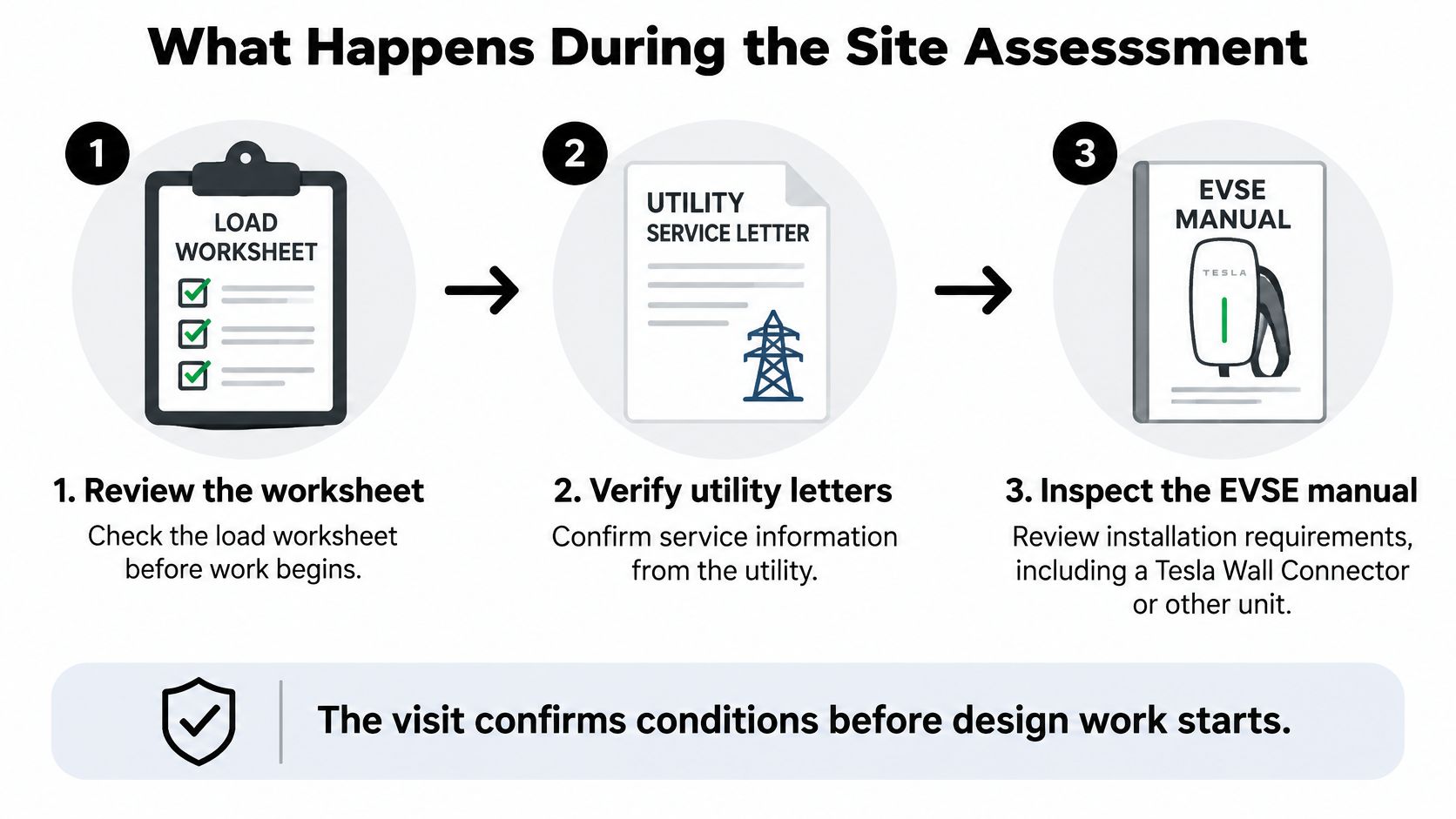
The electrician's inspection sequence
- Review the documents. Check the load calculation, available utility correspondence, and equipment manual for the proposed Tesla Wall Connector or other charger. Confirm its maximum configurable output.
- Verify the supply. Review the service conductors, meter equipment, and main disconnect. A past panel replacement does not establish that the service was upgraded.
- Inspect the panel safely. The electrician checks the bus rating, compatible breaker arrangement, signs of damage, and space for the dedicated breaker, de-energizing equipment as required.
- Plan the route. Assess the parking location, cable reach, mounting surface, wiring path, outdoor exposure, and any protective or disconnect provisions required by the adopted code and equipment manual.
- Complete the accepted calculation. Use verified dwelling inputs or an accepted existing-demand method supported by adequate records.
- Set the project scope. The result determines whether the installation needs a dedicated circuit alone, reduced charger output, approved load management, panel work, or service changes. A lower charger setting does not always reduce the calculated service load below its required floor.
- Prepare the installation details. Confirm equipment specifications, calculation information, and any utility coordination needed for the project.
What homeowners can safely prepare
For an EV charger installation, have the charger model available and identify the preferred parking location. A photo of the closed panel directory and accessible appliance nameplates can help the electrician review the home's loads. Leave panel covers, conductors, and electrical testing to the electrician.
Permits, Homeowner Prep, and Stop Conditions
The permit path should be confirmed with the responsible building department before construction begins. The adopted code edition, local amendments, equipment instructions, and accepted calculation method must agree; a generic online worksheet isn't jurisdictional approval.
The usual project sequence includes permit submittal, the required electrical information, installation, and final inspection. Black Rhino Electric's overview of Utah EV charger permit requirements provides context for that discussion, but the local authority determines the required submission.
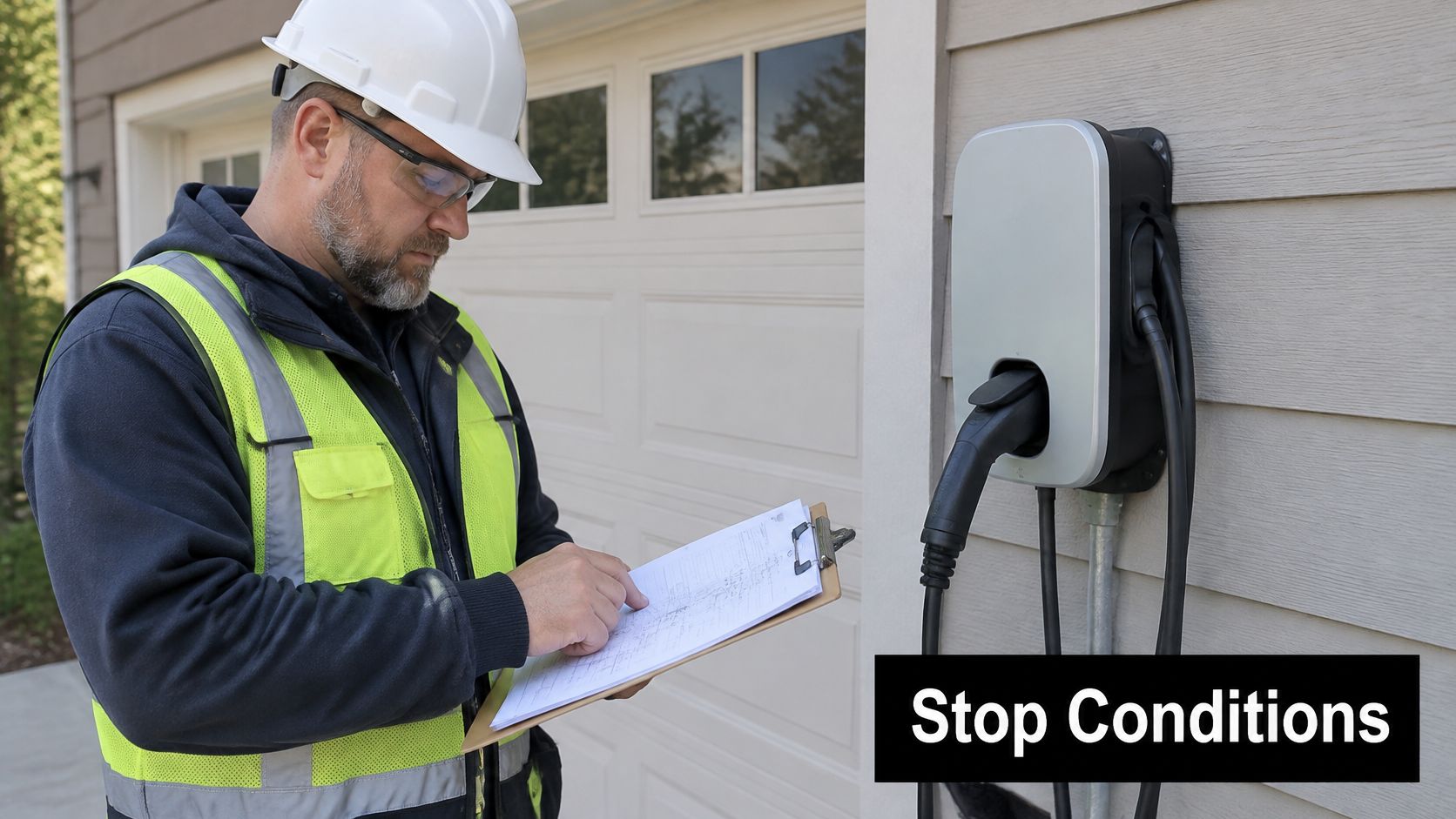
Conditions that stop homeowner preparation
- Heat or damage: Burning smells, unusual buzzing, discoloration, cracking, or a warm panel cover warrant professional evaluation.
- Repeated trips: A repeatedly tripping breaker shouldn't be reset continually or replaced with a larger breaker.
- Water or exposed parts: Water near equipment, a missing cover, or accessible conductors means keeping clear and calling a licensed electrician.
- Improvised space-making: Tandem breakers, added enclosures, or relocated circuits require a compatibility and capacity review, not an assumption that the charger now fits.
A passed calculation doesn't replace inspection. A failed calculation requires a revised design, not installation followed by a trial run.
Request a Load Review Before You Buy the Charger
Choose the charger only after the home's service rating, household demand, and proposed equipment have been reviewed together. Bring the charger's installation manual and a completed load worksheet so the review can address its specified charging output and circuit requirements.
Before approving the work, confirm what the quote covers:
- Written scope: Whether it includes a documented load calculation.
- Code basis: Which adopted code edition and local amendments apply.
- Equipment setup: How the charger's maximum current will be configured and recorded.
- Decision points: How the proposed work changes if the calculation passes or identifies a capacity limit.
Black Rhino Electric is fully licensed and insured in Utah for residential and commercial electrical work, serving Northern Utah's Weber, Davis, and Salt Lake counties. To discuss the worksheet, charger manual, and possible circuit or capacity solutions, request a free electrical quote. You can also call 385-462-0397.