
A lot of Northern Utah homeowners reach this point during a kitchen update. The cabinets are picked, the cooktop is selected, and then the electrical question shows up late in the process.
Induction cooktop electrical requirements are straightforward once the panel, circuit, and appliance specs are looked at together. The part that causes trouble is assuming the new cooktop can use whatever wiring is already there.
Why Your New Induction Cooktop Needs Special Wiring
An induction cooktop needs more than a standard kitchen outlet can deliver. The easiest way to think about it is like water service. A lamp or phone charger runs on a small pipe. A cooktop needs a much larger pipe and more pressure so it can deliver a lot of power, fast, without overheating the wiring.
That surprises people because induction is efficient. It wastes less energy in the cooking process, but it still needs strong electrical supply at the appliance.
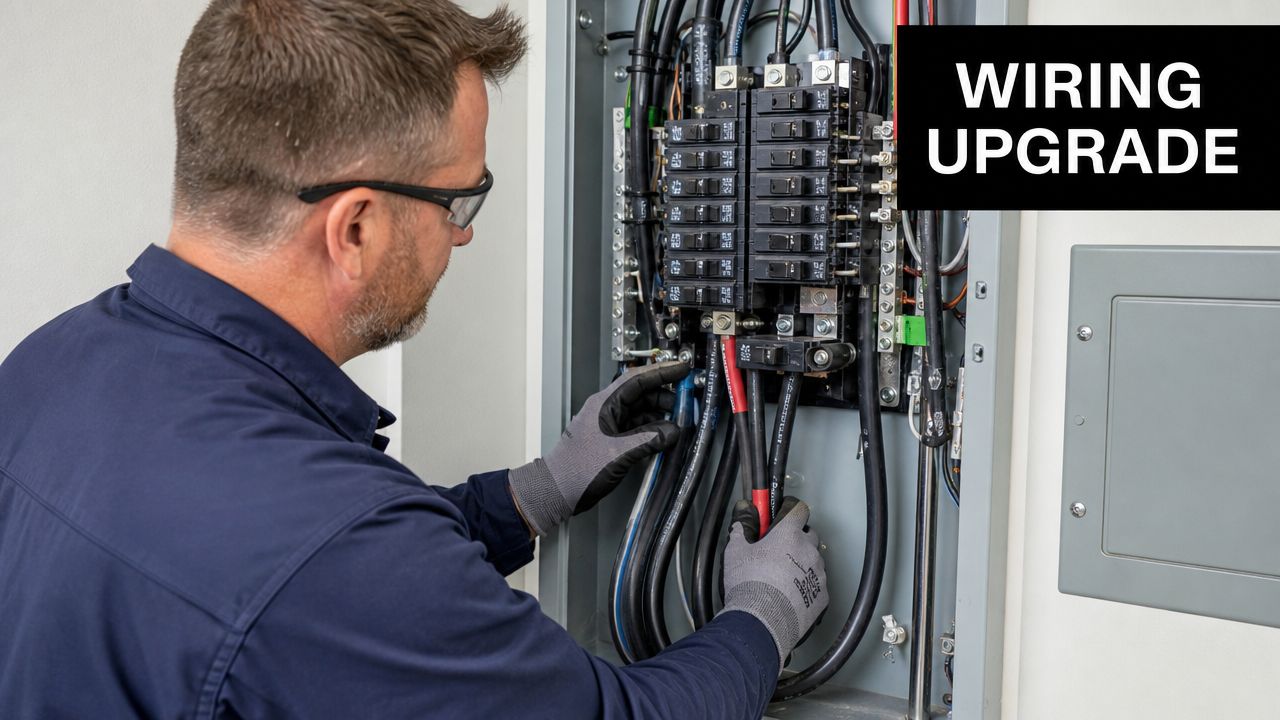
Efficiency doesn't mean low electrical demand
Induction cooktops achieve over 90% energy transfer efficiency and can draw up to 9,000W of power, which is why proper wiring matters and why larger circuits often use 6-gauge copper for 50A circuits according to induction cooktop power requirements.
A homeowner may hear “efficient” and assume “small electrical load.” That's not how cooking appliances work. Efficiency describes how well the cooktop moves energy into the pan. It doesn't mean the appliance can run safely on a basic 120V kitchen receptacle.
Practical rule: If the appliance is expected to boil quickly, hold steady heat, and run multiple elements at once, it usually needs wiring sized for that demand, not just an open outlet nearby.
Why kitchen remodel plans go sideways
A common problem in remodels is that the cabinet layout and countertop cutout get finalized before anyone checks the panel or existing branch circuit. Then the appliance arrives and the electrical scope changes.
That's one reason early kitchen electrical planning tips matter. The cooktop choice affects breaker size, wire size, shutoff location, and sometimes panel capacity.
Design also plays a role. Homeowners looking at flush, minimalist layouts sometimes explore seamless kitchen design cooktops because the visual style changes how the kitchen is built around the appliance. From the electrical side, the clean look doesn't reduce the need for a properly sized dedicated circuit.
What works and what doesn't
What works:
- Matching the circuit to the appliance spec. The nameplate and installation instructions drive the electrical work.
- Checking the panel before countertops go in. That avoids expensive changes later.
- Treating induction like a major appliance. It belongs in the same planning category as ovens, dryers, EV chargers, and hot tubs.
What doesn't:
- Assuming any old range wire is good enough. Existing wiring may be undersized, outdated, or incompatible.
- Planning around a standard outlet. Most full-size induction units don't work that way.
- Letting the countertop installer discover the electrical issue last. By then, the schedule gets tighter and the options get worse.
Decoding the Numbers Voltage Amps and Watts
When homeowners read appliance specs, the three numbers that matter are voltage, amperage, and wattage. Those numbers tell an electrician what kind of circuit the cooktop needs and whether the existing wiring can stay.
What the numbers mean in plain language
Voltage is electrical pressure. For most residential induction cooktops, that means 240V single-phase rather than the 120V used by ordinary small-appliance outlets.
Amperage is how much current the circuit can safely carry. Most residential induction cooktops require a dedicated 240V single-phase circuit drawing between 20 and 50 amps, and a standard 60cm four-zone cooktop typically requires a 32-amp dedicated circuit with its own breaker and permanent hardwiring by a licensed electrician according to these induction cooktop power requirements.
Wattage reflects total power demand. A higher-wattage cooktop may need a larger breaker or a different wire size, depending on the manufacturer's instructions.
Typical induction cooktop electrical requirements
| Cooktop Size | Typical Power (kW) | Required Circuit Breaker |
|---|---|---|
| Compact portable countertop unit | Qualifies by model | Standard 120V 15–20A outlet on qualifying portable units |
| Approx. 24-inch / 60cm four-zone cooktop | 3.7kW to 7.4kW on many single-phase units | 32A dedicated circuit is typical for a standard 60cm four-zone unit |
| Larger residential induction cooktop | Varies by model | Commonly 40A dedicated circuit |
| Premium or larger cooktop / range | Can exceed 7.4kW depending on model | Often 50A dedicated circuit |
This table is a planning tool, not a substitute for the appliance spec sheet. The manufacturer's listing always controls the final breaker and wiring requirements.
Why 240V matters
A full-size induction cooktop is designed to perform on a 240V supply. If a homeowner is comparing models during a remodel, the electrical spec matters just as much as the cutout dimensions.
That's also why electrical planning for a cooktop has some overlap with load calculations for EV chargers. They're different appliances, but both require looking at the home's available capacity instead of guessing from the panel door.
The most expensive kitchen wiring mistake is buying the appliance first and checking the electrical second.
Hardwired versus plug-in
Many homeowners ask whether an induction cooktop plugs in. In many installations, the answer is no. A lot of units are hardwired, meaning the circuit conductors terminate directly in the appliance connection area instead of plugging into a standard receptacle.
That matters for two reasons:
- Safety and code compliance. Permanent connections reduce the chance of loose, overheated connections on high-load appliances.
- Appliance compatibility. Some models are listed only for hardwired installation, and that requirement isn't optional.
If the listing calls for hardwiring, the electrician follows that method. If the listing allows a cord-and-plug configuration, the circuit still has to match the appliance requirements.
The Importance of a Dedicated Circuit
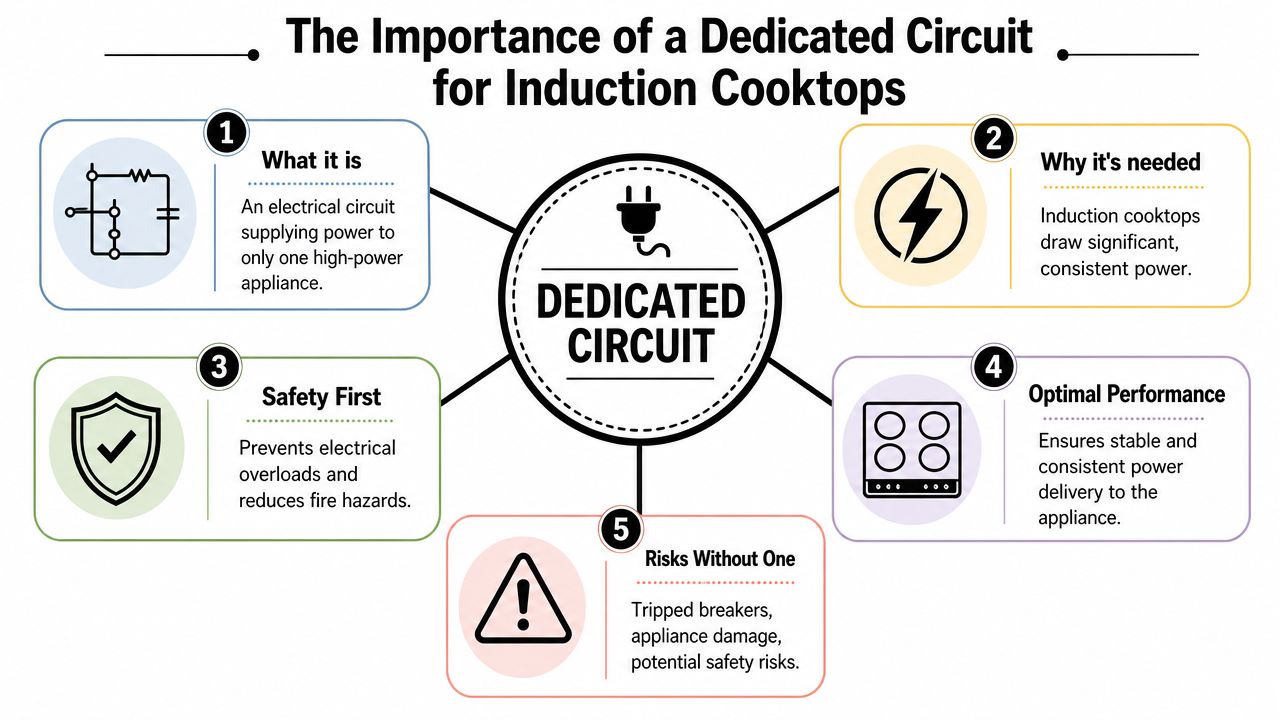
A dedicated circuit is exactly what it sounds like. One circuit. One appliance. No shared countertop receptacles, no microwave tied in, no “it seems to work fine” shortcuts.
That matters because induction cooktops draw sustained, high power. Shared circuits create nuisance tripping at best and overheating risk at worst.
What a dedicated circuit actually does
A proper dedicated circuit gives the cooktop its own path back to the panel. That lets the appliance receive stable power without competing with other loads in the kitchen.
Homeowners who want a deeper primer on this topic can review protecting appliances with dedicated circuits. The same logic applies here, just at a higher load level than a dishwasher or disposal.
Why the four-wire setup matters
Modern installations require a four-wire setup. That means two hot wires, a neutral, and a ground because the 120/240V specification indicates both voltages are required: 208/240V powers the heating elements, while 120V operates fans, lights, and electronics according to Rewiring America's cooking project guidance.
That detail gets overlooked in older homes. A homeowner may see an older range connection and assume it can be reused without changes. Sometimes it can't. If the existing setup is older or doesn't match current appliance requirements, the electrician may need to replace the cable, breaker, receptacle, or all three.
A dedicated circuit isn't an upgrade option. It's part of a safe installation.
Here's what tends to happen when a high-demand appliance doesn't have the right dedicated supply:
- Breakers trip under normal cooking use. This usually shows up when multiple burners run together.
- Wiring runs hotter than it should. Heat at connections is one of the early warning signs electricians look for.
- Controls behave poorly. Sensitive electronics don't like unstable power.
- Future service gets harder. Mixed or improvised wiring makes troubleshooting slower and more expensive.
What a homeowner can safely check
Without removing covers or touching live parts, a homeowner can safely observe a few things:
- Whether an existing double-pole breaker is labeled for the cooktop or range
- Whether the cooktop appears to be hardwired or connected by a range receptacle
- Whether the panel directory is clear or full of vague labels
- Whether there are signs of past alterations, such as mismatched breakers or abandoned wiring
Those observations help an electrician assess the job faster, but they don't replace an inspection.
Will Your Current Electrical Panel Handle It
Many kitchen projects often stall at this stage. A homeowner sees a new 40A or 50A appliance requirement and assumes the house must need a full service upgrade.
Sometimes that's true. Often it isn't.
What to check before worrying
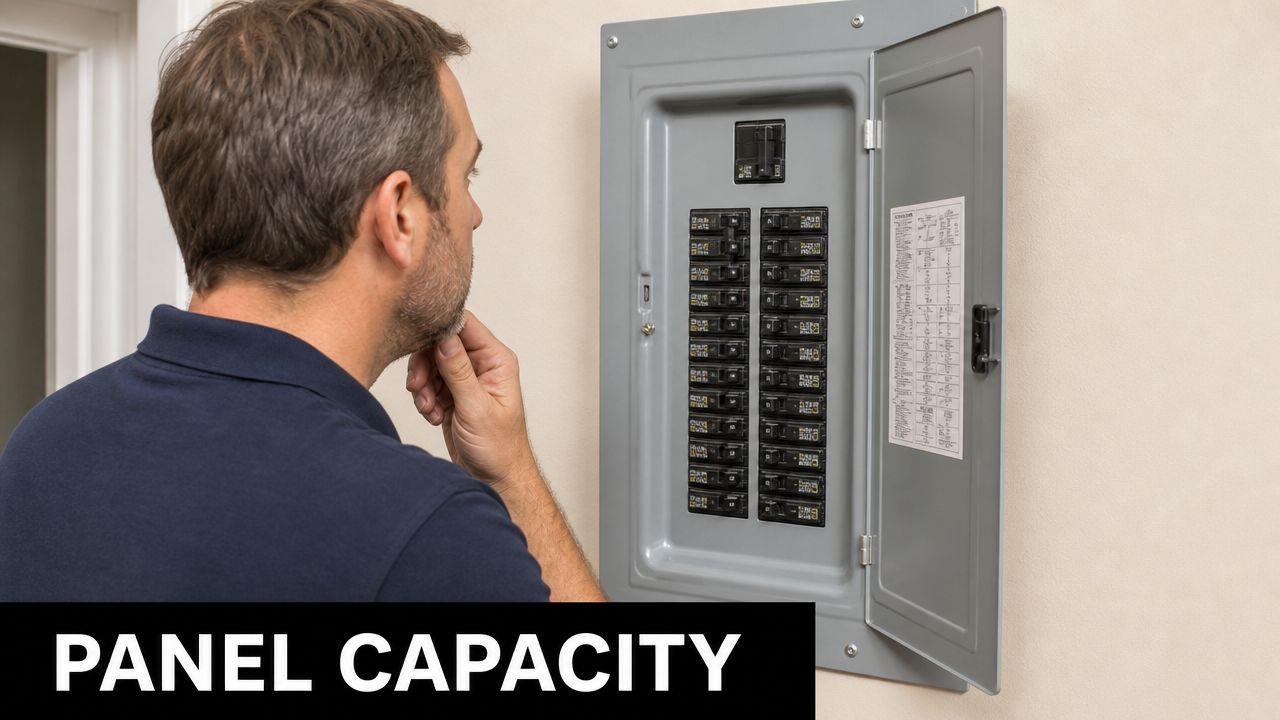
A homeowner can safely look at the front of the panel and note a few basics:
- Main breaker size. Is the service labeled 100A, 150A, or 200A?
- Available breaker spaces. Is there room for a new two-pole breaker?
- General panel condition. Is the panel orderly, or does it look crowded and heavily modified?
- Age clues. Older homes in places like Ogden or South Ogden may have earlier remodel work layered over original wiring.
None of that confirms capacity by itself, but it frames the conversation.
Why breaker size and service load aren't the same thing
A frequently missed nuance is that service load calculations use demand factors, not just the full appliance nameplate. A 12kW unit may count as only a 6kW load on the home's electrical system per code, while still requiring a 40–50A 240V circuit for the branch circuit, as explained in this discussion of electrical service load calculations for induction stoves.
That's why adding up all the breaker handles in a panel tells a homeowner almost nothing useful. Electricians calculate likely demand under code rules. That process often shows a panel has more usable capacity than the homeowner expected.
Signs a professional assessment should happen early
Some situations deserve a panel review before the cooktop is ordered:
- The panel is full. No room for a two-pole breaker usually means another decision has to be made.
- There's a fuse box or very old service equipment. That changes the scope quickly.
- Other big loads are already planned. EV charging, hot tubs, basement finishing, or electric dryer additions all affect available capacity.
- The home has a history of tripping breakers. Existing load issues shouldn't be ignored during a kitchen remodel.
For homeowners who do need more capacity or panel work, an electrical panel upgrade can become part of the project.
The panel question shouldn't be answered by guesswork, and it shouldn't be answered by fear either.
What an electrician is actually evaluating
During an assessment, the electrician isn't just checking whether there's an open breaker space. The core questions are:
- Can the service support the added cooking load under code calculation rules?
- Can a compliant circuit path be run from the panel to the kitchen?
- Is the existing wire, if any, the correct size and type for the new appliance?
- Will the remodel sequence allow the work to happen cleanly before cabinets, counters, and finish materials block access?
That's the difference between “maybe it fits” and a proper plan.
Common Scenarios for Utah Homeowners
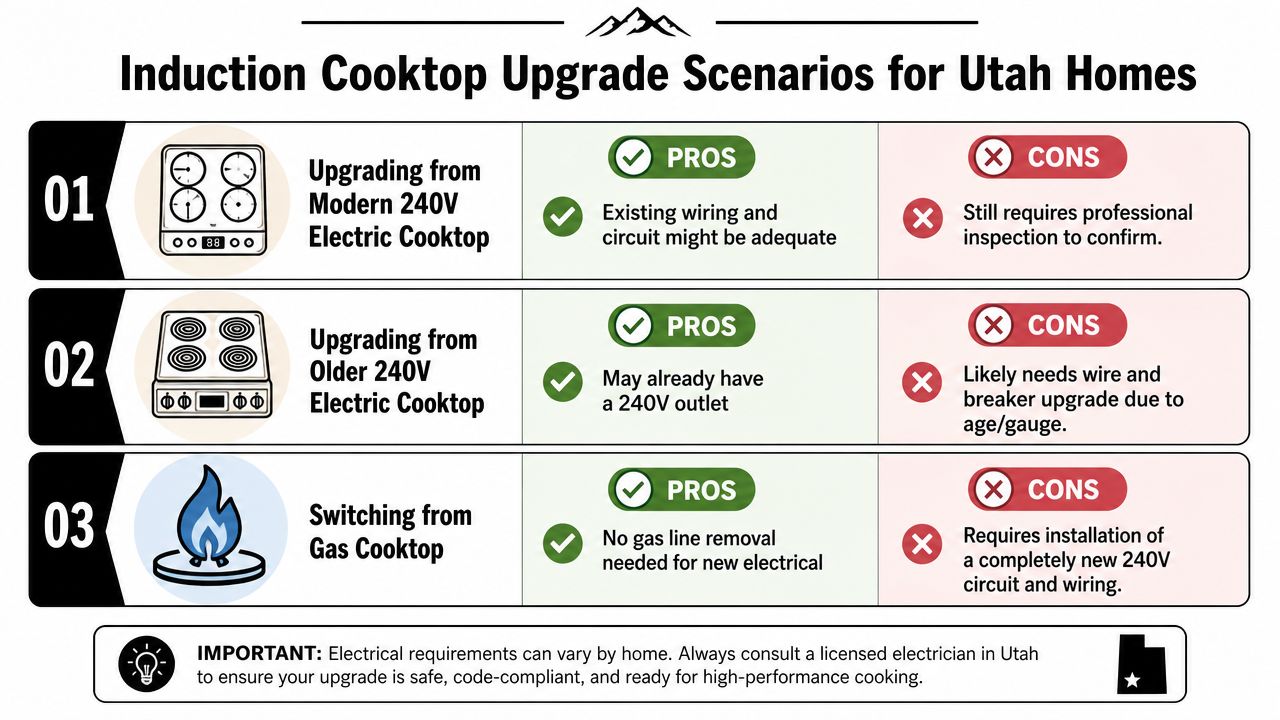
Most induction projects in Northern Utah fall into a few predictable categories. The electrical work changes a lot depending on what's in the kitchen now and how accessible the home is for new wiring.
Replacing a newer electric cooktop
This is usually the cleanest scenario. If the home already has a modern 240V electric cooktop circuit, the existing wiring may be close to what the new unit needs.
The key word is “may.” The breaker size, conductor size, connection method, and manufacturer instructions still have to match. A newer electric appliance circuit can shorten the job, but it doesn't eliminate the need for verification.
Replacing an older electric unit
This one is less predictable. Older homes in Weber County, especially houses that have seen multiple remodels, often have circuits that were acceptable for a past appliance but don't fit the new one.
Typical issues include:
- Older wire that's the wrong gauge for the new load
- A 3-wire setup where the new appliance requires 4-wire
- Breaker sizing that matched the old appliance but not the replacement
- Cabinet and countertop changes that force a new connection location
In a brick home or a house with finished walls and limited attic or crawl access, running replacement cable can take more planning than homeowners expect.
Switching from gas to induction
This is the scenario that changes the job most. Gas cooking locations usually don't have the high-capacity 240V branch circuit an induction cooktop needs.
Transitioning from gas to induction often requires significant electrical work because gas stoves generally use standard 120V outlets while induction needs 240V wiring on a 40–50 amp circuit. Surveys cited here place the average electrical upgrade cost around $987, though it can be higher in complex cases, according to this induction stove upgrade overview.
That cost range changes with access. A newer home in Layton, Farmington, or Kaysville may allow a more direct cable route from the panel to the kitchen. An older home in Ogden with plaster, masonry, or limited chases can take more labor even when the panel itself is adequate.
The hardest part of a gas-to-induction conversion usually isn't the cooktop. It's getting a clean, code-compliant 240V circuit to the right location.
Full kitchen remodels and temporary solutions
A full remodel offers the best timing for this work because walls, cabinets, and finishes may already be open. That gives the electrician more routing options and usually leads to a cleaner result.
For homeowners who aren't ready for a full branch-circuit project, there is another path. Some portable or countertop induction units operate on standard 120V 15–20A outlets, as noted in NYSERDA's buyer guidance on induction cooktops. They aren't the same as a built-in full-size cooktop, but they can be a useful temporary or renter-friendly option.
Your Pre-Installation Checklist When to Call an Electrician
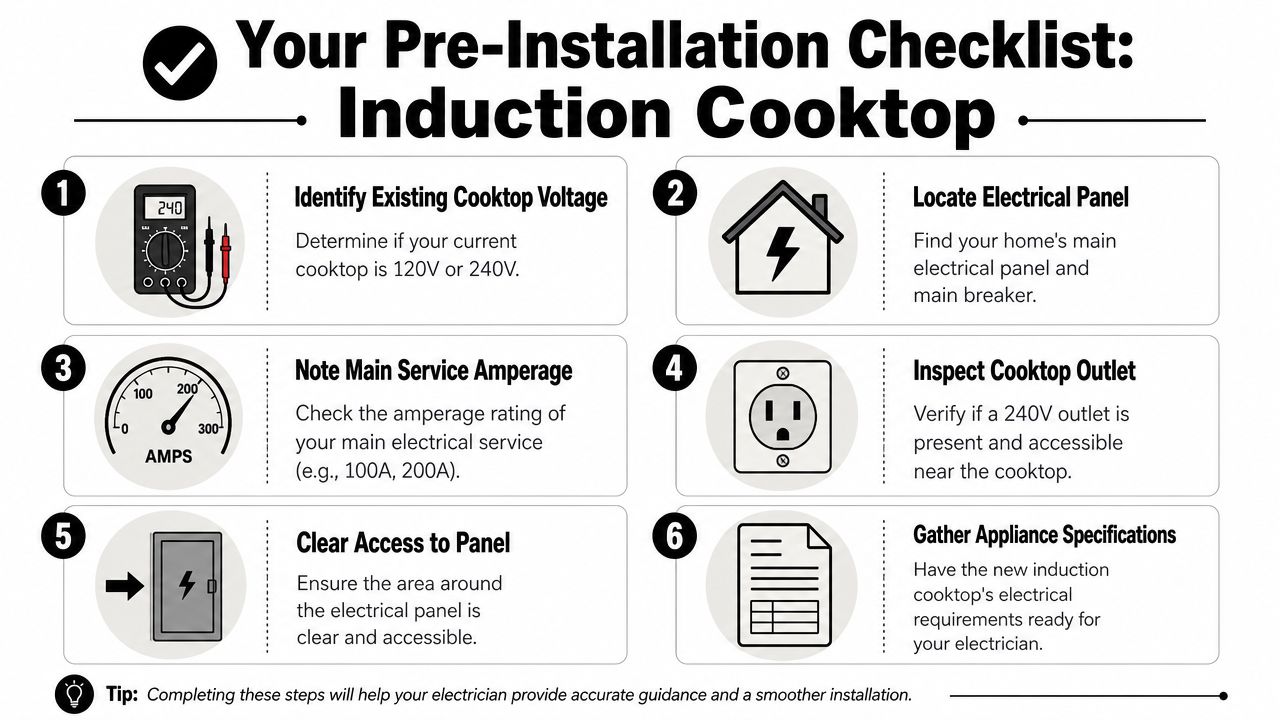
A little prep makes the service visit more productive. It also helps the electrician tell the difference between a simple appliance swap and a project that needs panel, breaker, or wiring changes.
What a homeowner can gather safely
Before calling, it helps to have these details ready:
- Appliance specifications. Have the model number and electrical requirements from the installation sheet.
- Panel photos. A clear photo of the panel with the door open helps identify breaker space and labeling.
- Kitchen layout notes. Note where the cooktop will sit and whether this is a replacement or a fuel switch.
- Distance clues. A rough idea of how far the panel is from the kitchen helps frame wiring complexity.
This is also a good time to look for obvious access issues. Stored items in front of the panel, finished basements, or tight crawlspaces don't make the job impossible, but they do affect planning.
What shouldn't be DIY
Homeowners can observe and document. They shouldn't run new cable, replace breakers, alter panel wiring, or make final appliance terminations unless they are properly licensed and qualified to do that work.
The line between “simple” and “hazardous” gets crossed fast with cooktop circuits. High-amperage branch circuits, panel work, grounding, and appliance connections need to be correct the first time.
Good questions to ask during the visit
A useful service call usually answers these points:
- Can the existing circuit be reused, or does it need replacement?
- Is the panel capacity adequate after a code-based load review?
- Will the cooktop be hardwired or connected by receptacle, based on listing and manufacturer instructions?
- Will permit and inspection requirements apply for this scope of work?
- At what stage of the remodel should electrical rough-in and final connection happen?
Homeowners outside Utah sometimes use articles like reliable electricians for your South Jersey project to understand what a professional electrical scope should look like in a kitchen remodel. The regional details differ, but the same principle holds. Appliance specs, code compliance, and access conditions drive the work.
For local scheduling, the simplest next step is to schedule an electrician. A proper site visit can usually answer whether the project is a straightforward cooktop circuit, a gas-to-induction conversion, or part of a larger service upgrade.
When to make the call
Call before the countertop template is finalized if any of these apply:
- The home is older and the wiring history is unclear
- The project switches from gas to induction
- The panel looks full
- Other large electrical additions are happening around the same time
- The appliance spec sheet lists requirements the current setup clearly doesn't match
That timing gives the project the best chance of staying on schedule and passing inspection cleanly.
For homeowners in Weber County, Davis County, Salt Lake County, and nearby communities, Black Rhino Electric handles kitchen wiring, breaker and panel work, remodel electrical, troubleshooting, and dedicated circuits for appliance upgrades. To talk through an induction cooktop installation, call 385-396-7048 or request a quote through the Black Rhino Electric quote form.