What Is a Hot Tub Disconnect and Why Does It Matter?
Planning a backyard oasis requires more than just picking out the perfect spa; you also need to ensure your electrical system is completely safe and up to code. Installing a dedicated hot tub disconnect is a critical safety requirement that allows you to quickly cut power to your spa in an emergency. Let’s explore everything you need to know about setting up this essential safety switch correctly.
A hot tub disconnect is one of the most important — and most overlooked — parts of any spa installation. It’s the dedicated shutoff switch that lets you (or a first responder) cut power to your hot tub instantly, without running inside to find the main panel. Get it wrong, and you’re looking at failed inspections, voided warranties, and serious safety risks.
Here’s the quick answer if you need it fast:
| Question | Quick Answer |
|---|---|
| What is it? | A dedicated manual shutoff switch for your hot tub’s electrical circuit |
| Is it required? | Yes — by NEC code (US) and CEC Section 68 (Canada) |
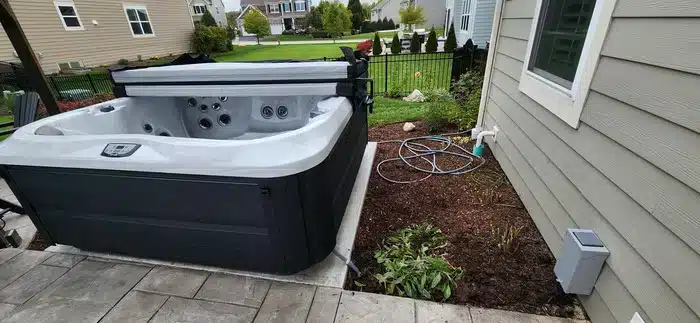
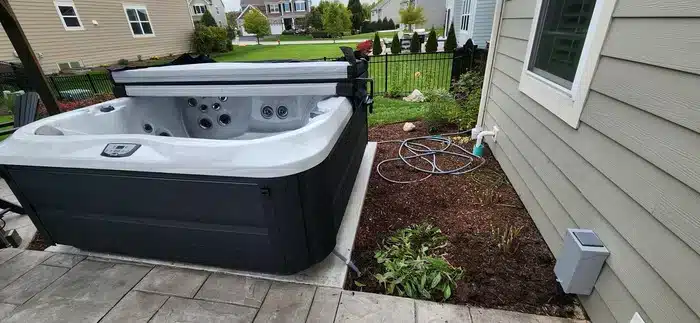
| Where does it go? | At least 5 ft from the water’s edge, within sight of the tub |
| What size? | Typically 50A or 60A, 240V, with GFCI protection |
| Can I DIY it? | Only for simple 120V plug-in tubs — 240V hardwired installs need a licensed electrician |
| What does it cost? | $50–$150 in materials + $200–$500 in professional labor |
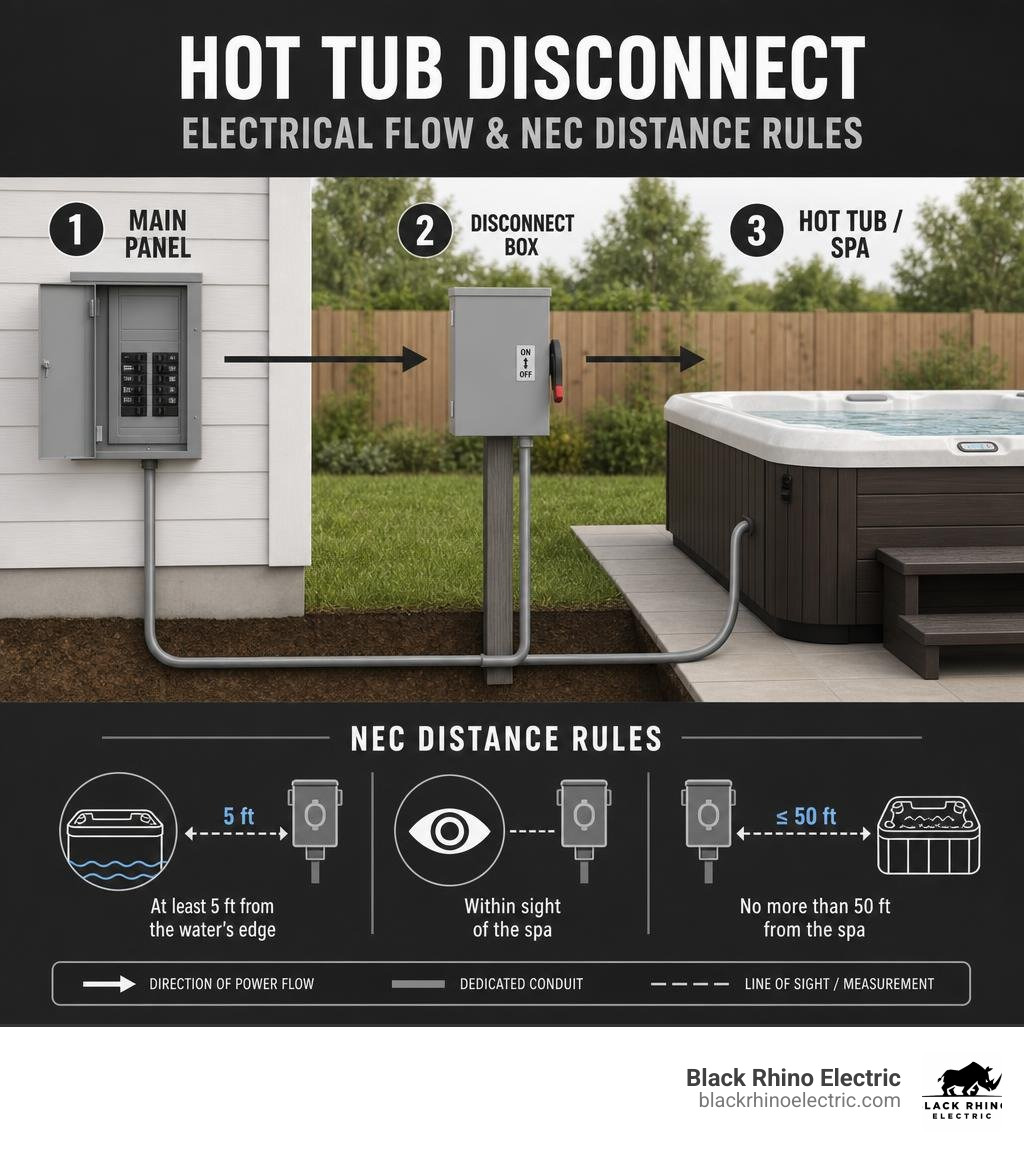
Most residential hot tubs run on a dedicated 240-volt circuit with a 50- to 60-amp breaker. The disconnect box sits between your main panel and the spa itself. It gives anyone nearby the ability to shut off power immediately — no hunting through the house for the right breaker.
Here’s the thing: it’s not optional. The National Electrical Code (NEC Section 680.13) requires a disconnect for every hot tub installation. In Canada, CEC Section 68 applies the same principle, with the disconnect placed at least 1.5 metres from the water and no more than 3 metres away.
This guide covers everything — code requirements, disconnect types, sizing, installation steps, common mistakes, and what safe decommissioning looks like — so you can move forward with confidence.
Essential Code Requirements for a Hot Tub Disconnect
When dealing with water and electricity, there is absolutely zero room for cutting corners. That is why national standards like the National Electrical Code (NEC) in the United States and the Canadian Electrical Code (CEC) in Canada have strict guidelines. If you live in Ogden, Roy, or anywhere in Weber County, local inspectors enforce these rules to keep your household safe.
Let’s look at the absolute non-negotiables:
- The 5-Foot Rule (NEC): The hot tub disconnect must be installed at least 5 feet (1.5 meters) from the inside wall of the hot tub. Why? Because we want to make sure you cannot sit in the water, reach out, and touch the electrical switch at the same time.
- The 50-Foot Rule (NEC): While it has to be at least 5 feet away, it also cannot be more than 50 feet away from the spa.
- Line of Sight: The switch must be fully visible and accessible from the hot tub. You cannot hide it behind a decorative privacy screen, around the corner of the house, or inside a locked shed. If there is an emergency, someone needs to see the switch immediately.
- GFCI Protection: All outdoor 240V hot tubs require Ground Fault Circuit Interrupter (GFCI) protection. This can be achieved either by having a GFCI breaker in your main electrical panel or by using a GFCI-integrated spa panel as your disconnect.
| Electrical Code | Minimum Distance | Maximum Distance | Visibility Rule |
|---|---|---|---|
| NEC (United States) | 5 feet | 50 feet | Must be within direct line of sight |
| CEC (Canada) | 1.5 meters (approx. 5 ft) | 3.0 meters (approx. 10 ft) | Must be within direct line of sight |
For a complete breakdown of local regulations, take a look at our guide on Hot Tub Electrical Requirements for Utah Homeowners. To understand how these rules fit into the broader context of your backyard project, you can also read Hot Tub AC Disconnect: Installation Guide & Safety (2025).

Choosing Your Hot Tub Disconnect: Fused vs. Non-Fused Panels
Honestly, walking down the electrical aisle of your local home improvement store in Layton or Bountiful can be a bit overwhelming. You will see several types of disconnect boxes. Which one is right for your home? Let’s explain the differences:
- Non-Fused Disconnect Switches: These are simple manual switches (often pullout style or lever-style). They do not contain fuses. Their only job is to break the circuit. Because they do not provide overcurrent protection, you must have a dedicated breaker at the main panel. Lever-style switches generally outlast pullout models because plastic handles on pullout units can degrade and melt under heat over time.
- Fused Disconnects: These use physical cartridges containing fuses to protect the circuit. While reliable, replacing blown fuses is an extra hassle you probably do not want.
- GFCI-Integrated Spa Panels: This is the gold standard for residential hot tubs. These panels function like a mini-subpanel, containing a built-in 50A or 60A GFCI breaker. This means you can run a standard, cheaper breaker from your main panel to the spa panel, and have the safety-critical GFCI protection right at the disconnect box.
Products like the SPA & HOT TUB DISCONNECT 2 POLE 50/60 AMP PART 5-10-0023 are specifically designed to handle these exact setups. For a side-by-side comparison of the top models we recommend to our customers, check out our guide on how to Stay Grounded with These Top Hot Tub Disconnect Switches.
Sizing Your Hot Tub Disconnect: Amperage and Wire Selection
Sizing your electrical system correctly is the difference between a relaxing soak and a tripped breaker. Most modern residential hot tubs require a dedicated 240V circuit rated for either 50 amps or 60 amps.
Here is the general rule of thumb for wire sizing:
- 50-Amp Circuits: Typically require #6 AWG copper wire for the hot and neutral lines.
- 60-Amp Circuits: Also require #6 AWG copper wire (or sometimes larger depending on the run length and manufacturer specifications).
- Conduit Requirements: You must run individual THWN/THHN conductors inside a compliant, weatherproof conduit (such as PVC or liquid-tight flexible metal conduit) when routing wires outdoors.
You know what? Many homeowners assume they can use standard Romex (NM-B) wire outdoors. That is a massive code violation! NM-B cable is not rated for wet locations, even if it is pulled inside a conduit. Moisture will eventually seep in and cause a short.
Always consult your specific spa’s documentation. As discussed in this Hot tub installation manual. | Information by Electrical Professionals for Electrical Professionals, manufacturers sometimes specify larger Equipment Grounding Conductors (EGC) than the NEC minimums to prevent warranty denials. To learn how to wire these components without any nasty surprises, read The Ultimate Hot Tub GFCI Wiring Handbook from Breaker to Bliss.
Step-by-Step Installation, Costs, and Safe Decommissioning
Installing a hot tub disconnect requires careful planning, routing conduit, mounting weatherproof enclosures, and making secure terminations. The system must stand up to heavy winter snow in Bountiful and hot summer sun in Roy.
Here is an overview of how our professional team handles a standard installation:
- Panel Capacity Assessment: We verify that your home’s main panel has the physical space and electrical capacity to support a new 50A or 60A load.
- Mounting the Enclosure: We mount a NEMA 3R weatherproof disconnect box at a code-compliant location (at least 5 feet from the water).
- Running the Conduit: We run rigid PVC conduit from the main panel to the disconnect box, and liquid-tight flexible conduit from the disconnect box to the hot tub’s control pack.
- Pulling and Connecting Wires: We pull the appropriate THWN copper wires. We connect the hot leads to the breaker, the neutral to the isolated neutral bar, and the ground to the grounding bus.
- Bonding: We ensure the hot tub’s metal frame is properly bonded to prevent dangerous voltage differences.
To see a visual walk-through of the process, you can watch this helpful video: Hot Tub 220V 50 AMP GFCI Breaker Installation – ALL WIRING!. For further reading, check out our article on How to Wire a 220V or 240V Hot Tub Without the Sparky Surprises.
Common DIY Mistakes to Avoid
Unless you are a licensed electrician, wiring a 240V circuit near water is highly risky. Here are the most common blunders we see when fixing amateur installations:
- The Neutral-Ground Bond: In a main service panel, neutral and ground wires connect to the same bus bar. However, in an outdoor subpanel or disconnect box, neutrals and grounds must be kept completely separate. Bonding them at the disconnect will cause ground-fault currents to loop, which prevents your GFCI breaker from working and can energize the metal frame of your spa!
- Incorrect Placement: Mounting the box too close to the tub (violating the 5-foot safety margin) or hiding it behind privacy panels where it cannot be seen in an emergency.
- Undersized Conductors: Using #8 AWG wire on a 50A circuit over a long distance, which causes voltage drops, overheating, and fire risks.
- Poor Weatherproofing: Failing to use outdoor-rated fittings, leaving open knockouts in the bottom of the box, or omitting silicone sealant where the conduit enters the house.
Don’t let these simple errors turn your relaxing retreat into a safety hazard. Read our guide on Don’t Get Zapped During Your Hot Tub Power Installation to learn more.
How to Safely Decommission or Remove an Existing Spa Setup
What if you are moving, upgrading, or reclaiming your backyard space? Safely decommissioning a high-voltage circuit is just as important as installing one.
Here’s how to handle it safely:
- Shut Off Power: Turn off the dedicated hot tub breaker at your main electrical panel. Use a lockout-tagout device to make sure nobody accidentally flips it back on while you are working.
- Verify Zero Voltage: Open the disconnect box and use a reliable multimeter to test all terminals. Make absolutely sure there is no voltage remaining.
- Disconnect and Cap: Disconnect the wires from the hot tub’s control pack.
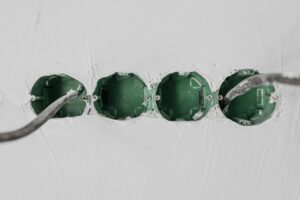
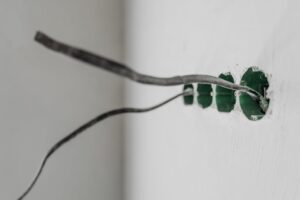
- Terminate Safely: You have two options here. You can completely remove the wiring and the breaker from your main panel. Alternatively, you can terminate the wires inside a weatherproof junction box, capping each wire individually with wire nuts and leaving the main breaker turned off and clearly labeled.
If you want to read a community discussion about this process, check out this thread on disconnecting wires to hot tub. You can also read our step-by-step guide on Pulling the Plug Safely Disconnecting Your Hot Tub.
Professional Installation Costs vs. DIY Safety
Let’s talk numbers. What should you expect to pay for a professional installation in the Weber County area?
- Materials: A high-quality weatherproof GFCI spa panel, conduit, and heavy-gauge copper wiring typically cost between $50 and $150.
- Labor: Professional labor for installing a new disconnect and running the circuit ranges from $200 to $500 for standard installations.
- Permit and Inspection Fees: These vary by city (such as Ogden, Roy, or Layton) but usually cost between $50 and $100.
While DIY might seem like a way to save a few bucks, working with 240V electricity next to water is incredibly dangerous. A single loose terminal can heat up and cause an electrical fire, and an unpermitted installation can void your homeowner’s insurance policy. Hiring a licensed Residential Hot Tub Electrician ensures the job is done safely, legally, and up to local codes.
Ready to ensure your backyard spa is completely safe and code-compliant? Contact the experts at Black Rhino Electric by calling 801-810-4292 or Request a Free Quote online today to schedule your professional installation.