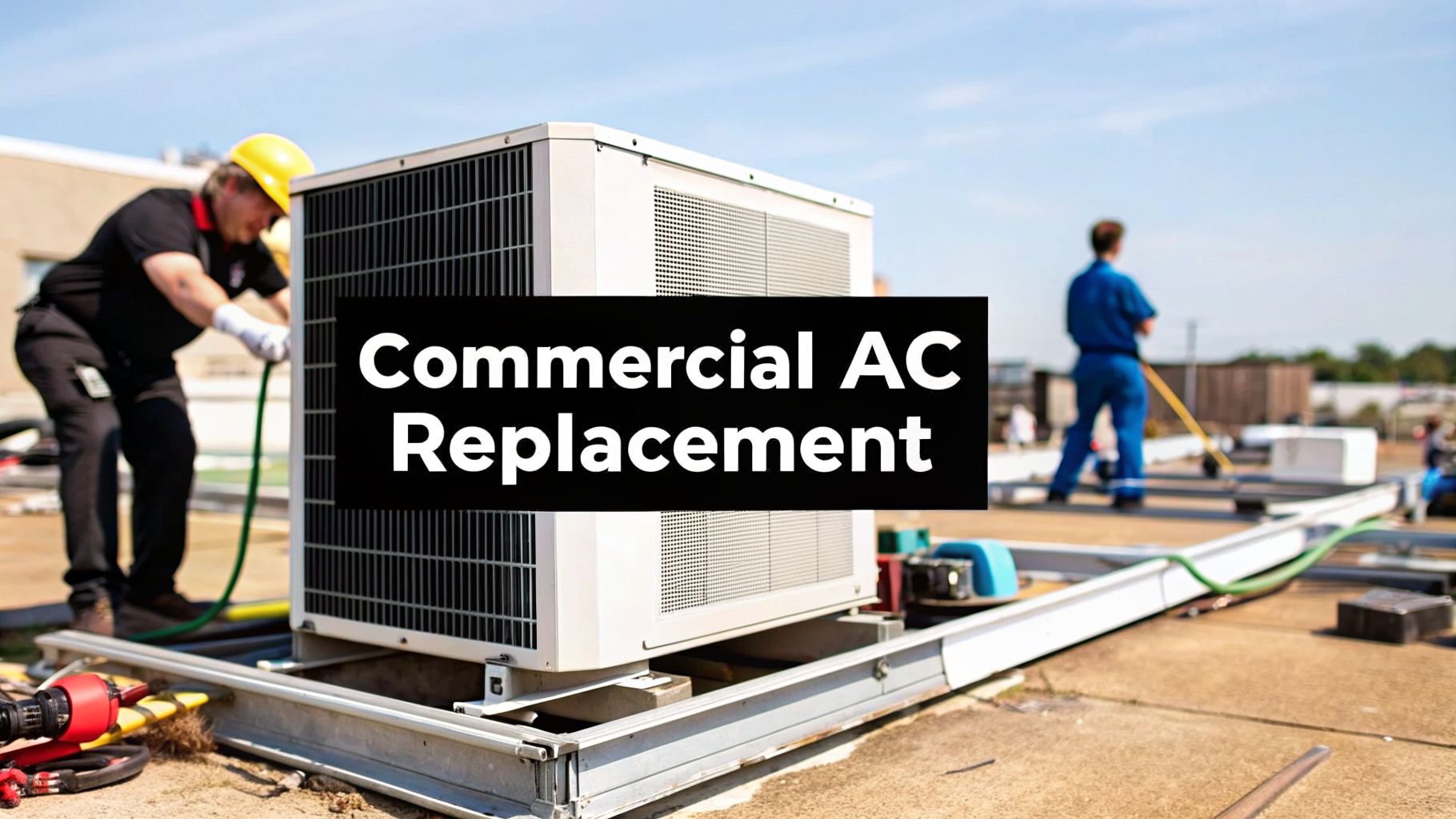
Planning a commercial air conditioner replacement can feel overwhelming, but it's a critical investment in your property's value and your tenants' comfort. When your old system starts showing its age, a planned replacement is far better than a frantic emergency call. With the right information and a solid plan, you can navigate this process smoothly and make a choice that benefits your business for years to come.
When to Repair vs. Replace Your Commercial AC
Are you constantly calling in an HVAC tech for your commercial AC? Honestly, there's a financial tipping point where patching up an old, inefficient rooftop unit just doesn't make sense anymore. It feels like you’re throwing good money after bad, doesn't it?
Deciding between another repair and a full commercial air conditioner replacement can feel like a gamble, but a few clear signs usually make the choice for you.
Telltale Signs It's Time for a Change
If your system is getting close to its 15-20 year average lifespan, that’s the first major flag. Age isn't just a number; it means worn-out compressors, corroded coils, and outdated technology.
You'll also notice it in your building's comfort and your utility bills.
- Are tenants in one office sweating while others are freezing?
- Are your Rocky Mountain Power bills creeping up for no obvious reason?
That’s your old unit working way too hard for way too little cooling.
This isn't just a local issue. Across the continent, businesses are upgrading old systems for better efficiency and to meet new codes. In fact, this replacement segment recently made up a staggering 46.2% of the entire North American HVAC market, a trend you can read more about on Grandview Research.
The Repair vs. Replacement Decision Matrix
To make it even simpler, here’s a quick-reference table. Use this to help gauge whether a repair is a smart stopgap or if a full replacement is the better long-term investment for your property.
| Factor / Symptom | Consider Repair If… | Consider Replacement If… |
|---|---|---|
| Unit Age | The unit is less than 10-12 years old. | The unit is over 15 years old. |
| Repair Cost | The repair is less than 30% of replacement cost. | A single repair is 50% or more of a new unit's cost. |
| Energy Bills | Bills are stable or have seen only a minor increase. | There's a sudden or steady, unexplained spike in costs. |
| Repair Frequency | This is the first or second major repair in a few years. | You're on a first-name basis with your HVAC technician. |
| Refrigerant Type | The unit uses a modern refrigerant (like R-410A). | The unit uses phased-out R-22 (Freon). |
| Performance | The issue is minor (e.g., a faulty thermostat, single fan). | There's a major component failure (compressor, coil). |
| Tenant Comfort | Inconsistent cooling is isolated to one small area. | Multiple zones have poor airflow or temperature control. |
This matrix isn't a substitute for a professional diagnosis, but it gives you a solid framework for making a sound financial decision. As an experienced team, we've seen this play out many times. If you find yourself ticking multiple boxes in the "Consider Replacement" column, it's time to start planning for an upgrade.
The 50% Rule: Here's a simple rule of thumb we use in the field. If any single repair costs 50% or more of what a brand-new, efficient system would cost, it's almost always smarter to replace it. Anything else is just buying you a little time on a sinking ship.
Your Guide to Commercial AC Replacement

Let's be honest, a full commercial air conditioner replacement is a big lift. But with the right game plan, it's a project you can absolutely get a handle on. We're going to walk through the entire process, starting with the one step you can't afford to skip: a professional load calculation.
From there, it’s all about logistics—from picking the right system to getting qualified HVAC and electrical contractors on the same page. You know what? It’s a coordinated dance.
This flowchart lays out the common triggers we see that push a business toward a full replacement. It almost always comes down to a mix of old age, soaring repair bills, and a unit that just can’t keep up anymore.

When those problems start stacking up, sticking with the old system stops making financial sense. That's why retrofits and replacements are expected to grab 60.3% of the commercial market. It’s a clear shift toward more efficient, reliable equipment.
As you map out your budget, remember to look at all your options for covering the investment, including specialized financing for HVAC contractors. A solid plan also means scheduling the work to cause the least amount of disruption to your business and pulling all the necessary permits upfront.
And here's a key piece of advice based on our experience: a new system will have new electrical demands. This is the perfect time to review your building's power and see if any commercial electrical repairs are needed before the new unit gets craned into place.
Finally, we’ll get into the nitty-gritty with an installation checklist, the system commissioning process, and how to set up a maintenance schedule that protects your new investment for years to come.
Sizing Up Your Options: System Types and Efficiency
Picking a new commercial AC isn't like buying a home window unit. It’s less about brand loyalty and more about matching the right machine to your building's real-world demands right here in Northern Utah. Getting the size right is absolutely critical, and it’s something we see botched all the time.
Here's the thing:
- An undersized unit will flat-out fail on a hot July afternoon, leaving you with unhappy tenants and customers.
- An oversized unit sounds powerful, but it's just as bad—it short-cycles, blasting cold air and shutting off before it can pull any real humidity out of the space. You get that clammy, humid feeling and shockingly high energy bills for your trouble.
Here’s a quick rundown of the main systems you’ll be looking at.
Rooftop Units (RTUs)
These are the workhorses you see on top of most single-story retail spots, warehouses, and strip malls. They’re all-in-one, self-contained boxes that handle both heating and cooling, which makes installation and maintenance fairly straightforward.
Split Systems
If you’ve got a multi-story office or a building where a single rooftop unit won't work, a split system is your go-to. Just like in a house, an outdoor condenser/compressor unit is paired with one or more indoor air handlers. This gives you flexibility in where you place the equipment, which is perfect for buildings with complex layouts.
Variable Refrigerant Flow (VRF)
VRF is the high-tech solution for buildings with diverse needs—think of a medical clinic with cool waiting rooms and warm patient areas, or an office that needs to heat one side while cooling the other. These systems can simultaneously heat and cool different zones, offering incredible efficiency and occupant comfort. They’re more complex, but the energy savings can be substantial.
The push for better performance is driving huge growth in this market. Valued at $75.88 billion in 2026, it’s expected to climb to $119.76 billion by 2034, a trend you can read more about in a detailed market analysis by Fortune Business Insights.
Choosing the right equipment is just one piece of the puzzle. Thinking about the project as a complete energy efficiency retrofit can unlock even bigger savings and add serious long-term value to your property.
Commercial AC System Comparison
To make things clearer, here’s a quick comparison of how these systems stack up for a typical commercial property in our area.
| System Type | Best For | Pros | Cons |
|---|---|---|---|
| Rooftop Unit (RTU) | Single-story buildings (retail, warehouses) with open layouts and easy roof access. | All-in-one packaged system, easier to install and service, saves interior space. | Less efficient for zoned control, requires roof space and structural support. |
| Split System | Multi-story offices, smaller buildings, or properties with limited roof access. | Flexible installation, good for zoning specific areas, quieter operation indoors. | More complex installation with refrigerant lines, multiple components to maintain. |
| Variable Refrigerant Flow (VRF) | Buildings with diverse, simultaneous heating and cooling needs (offices, medical facilities, hotels). | Superior energy efficiency, precise zone control, can heat and cool at the same time. | Higher upfront cost, more complex to design and install, requires specialized technicians. |
Ultimately, the best system depends entirely on your building's use, layout, and your long-term goals. An old, single-story warehouse has very different needs than a modern, multi-tenant office building, and the right HVAC choice reflects that reality.

Here’s something many business owners miss: a commercial air conditioner replacement isn't just an HVAC job. It’s a major electrical project, plain and simple.
Let me explain. Modern, high-efficiency units often have completely different power requirements than the decades-old system you’re pulling out. Ignoring this can lead to a whole host of problems—chronically tripped breakers, poor performance, or even a serious fire hazard.
Your building’s existing electrical system might not be up to the task. We see it all the time. This often means your project will require:
- A new, dedicated circuit to handle the specific load.
- New wiring with the correct wire gauge for safety and efficiency.
- An NEC-compliant disconnect located near the unit for service and safety.
A new AC unit connected to an old, undersized electrical system is a recipe for failure. We frequently see new installations that require an immediate (and expensive) electrical upgrade because the initial plan overlooked the building's capacity.
As electrical experts, we know that getting a handle on your building’s electrical panels and meters is the first real step toward a safe, code-compliant installation that won't give you headaches down the road.
Choosing Your HVAC and Electrical Partners
A commercial air conditioner replacement is only as good as the team you put in charge. You need qualified, licensed, and insured contractors who have real, boots-on-the-ground experience with commercial projects right here in Northern Utah. Don’t be shy about asking the hard questions, right?
Here are some tips from our years of experience:
- Get Detailed Quotes: You have to get detailed, itemized quotes from a few different contractors to see what you’re really comparing. Vague proposals are where surprise costs hide.
- Verify Experience and Licensing: Make sure any potential partner can walk you through their process for pulling permits, managing the project timeline, and what kind of warranties they stand behind after the job is done.
- Look for Teamwork: The best-kept secret to a smooth project? Hire an HVAC technician and an electrician who already have a history of working together. When your team has that built-in chemistry, the blame game disappears. It cuts down on costly miscommunications and makes for a safe, clean installation from day one.
As experienced electricians, we’ve seen firsthand how critical that coordination is for Northern Utah commercial electrical projects. When your partners are in sync, the project stays on schedule and, just as importantly, on budget. This is the trustworthiness you should look for.
Frequently Asked Questions About Commercial AC Replacement
It's natural to have questions. It's a significant project, and frankly, you deserve clear answers to help you budget and plan.
Here are the straight-talk answers to the questions we hear most often from business owners across Northern Utah.
How Much Does a Commercial AC Replacement Cost?
This is always the first question, and the honest answer is: it depends. The final price tag is a mix of a few key things. The system’s tonnage (its cooling capacity), its SEER2 efficiency rating, and the sheer complexity of your building all play a part. For example, a straightforward rooftop unit (RTU) swap on a flat-roof warehouse is a much different job—and price—than installing a modern VRF system in a multi-story office that also needs serious electrical panel upgrades.
The bottom line: Expect a wide range, from several thousand for a small, simple unit to tens of thousands for larger, more complex systems. The best way to know for sure is to get a detailed quote that breaks down equipment, labor, and any necessary electrical work.
How Long Does the Replacement Take?
A typical replacement can take anywhere from a few days to over a week. The timeline really hinges on a few moving parts: equipment availability, the scope of the project, and how quickly the city can process the permits. Good planning is everything here. Coordinating closely with your HVAC and electrical contractors from the start is the best way to build a schedule that keeps disruption to your business at an absolute minimum.
What Maintenance Does a New Commercial AC Need?
You've made a big investment, and you want it to last. Consistent, simple maintenance is the key to protecting that investment and keeping the system running at peak performance for years.
Here’s what you should plan for:
- Regular Filter Changes: This is non-negotiable. It’s essential for good air quality and keeps the system from working harder than it has to.
- Coil Cleaning: Clean coils help the system transfer heat efficiently. Dirty coils make it overwork, driving up your energy bills.
- Annual Professional Inspections: Once a year, have a pro come out. A technician will check refrigerant levels, inspect all the electrical connections, and give the whole system a thorough health check to catch small issues before they become big problems.
Replacing your commercial air conditioner is a big decision, and yes, it's a significant expense. But thinking of it as just another cost is a mistake. It’s a chance to improve your building’s efficiency, keep your tenants or employees comfortable, and add real long-term value to your property.
Waiting for a total system failure on a hot July afternoon is a crisis you can’t afford. It means emergency pricing, unhappy tenants, and a major disruption to your business. A planned replacement turns that potential headache into a strategic upgrade.
A successful commercial air conditioner replacement isn't just about the rooftop unit itself. It’s about the quality of the entire electrical system that supports it—from the breakers and conduit right back to the panel. Getting that part right is non-negotiable for safety and performance.
If you're planning an AC replacement for your commercial property in Northern Utah, you need an electrical partner who understands the complete scope of the project. Contact Black Rhino Electric today at 385-396-7048 or request a free quote online. We’ll make sure the power side of your project is handled right, from start to finish.