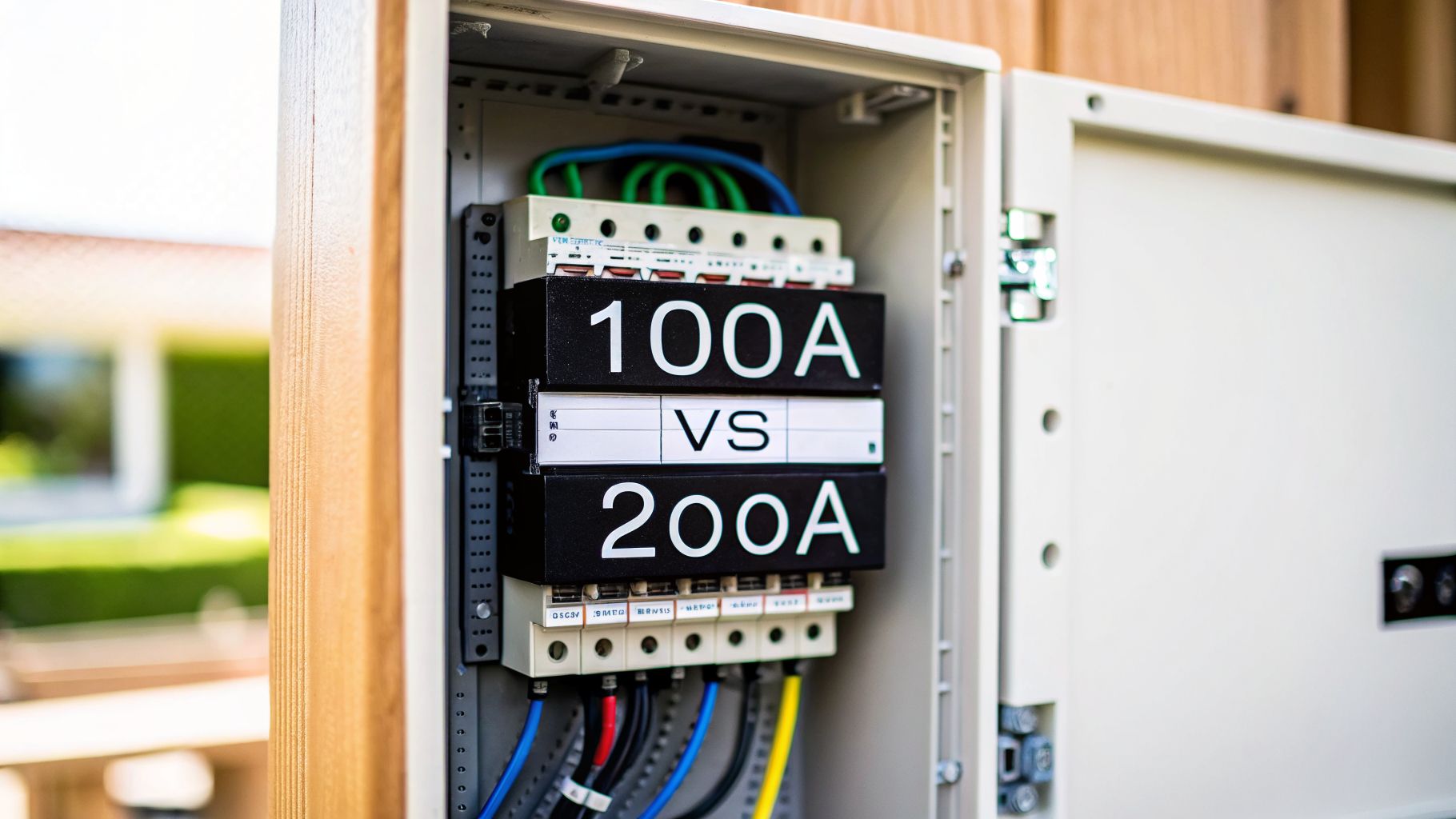
Deciding on your home's electrical service can feel complicated, but understanding the difference between 100 amp and 200 amp service boils down to one word: capacity. It’s simply about how much power your home can safely pull from the grid all at once. A 200-amp service provides double the electrical muscle of a 100-amp service, a critical upgrade for modern homes juggling big appliances, EV chargers, and a house full of gadgets.
Contents
Understanding Electrical Capacity in Your Home
Have you ever wondered what "amps" even means for your house? Think of your home’s electrical service like the main water line. Amperage (amps) is the volume of electricity that can flow through, while voltage is the pressure pushing it along. The total power you have on tap is wattage, which is just amps multiplied by volts.
A 100-amp service, still common in many older homes across Northern Utah, delivers a maximum of 24,000 watts of power (100 amps x 240 volts). A 200-amp service doubles that to 48,000 watts. Here’s the thing: while that sounds like a huge jump, our modern lifestyles gobble up that extra power faster than you’d think.
To really get it, you have to understand what is a panelboard is and what it does. Your electrical panel is the heart of the system, taking that main feed and safely distributing power to all the different circuits in your home.
An undersized service is like trying to run a whole sports team off a single water bottle. It just can’t keep up, leading to tripped breakers and, more seriously, potential fire hazards.
Key Power Concepts Simplified
Getting these terms straight makes it clear why a 200-amp service has become the new standard for so many homeowners.
| Concept | What It Means | Simple Analogy |
|---|---|---|
| Amperage (Amps) | The volume of electrical current available to your home. | The width of a highway. More amps mean a wider road, letting more cars (electricity) travel at once without a traffic jam. |
| Voltage (Volts) | The electrical pressure or "force" of the current. | The speed limit. Homes in the U.S. have a standard "speed limit" of 240 volts coming in. This is fixed. |
| Wattage (Watts) | The total usable power you have (Amps x Volts). | The total number of cars that can get down the highway. More watts mean more appliances can run simultaneously. |
A Real-World Power Comparison
Understanding the difference between 100-amp and 200-amp service feels a lot clearer when you see what it means for your daily routine. Let’s talk about what that power actually looks like when you’re running your household. What does 24,000 watts versus 48,000 watts really get you?
Think of it this way: amperage is the flow of electricity, and wattage is the total power available. When you double the amps, you double the power. Simple as that.

As you can see, doubling your amperage from 100 to 200 amps instantly doubles the total wattage your home can handle. It’s the difference between juggling your appliances and living without a second thought.
How Much Power Do Your Appliances Really Use?
You’d be surprised how quickly everyday appliances eat up your power budget. Let me explain. A 100-amp panel, which gives you a total of 24,000 watts, can be pushed to its limit fast.
On a hot Utah summer day, just running your central air conditioner (around 4,000 watts) and an electric dryer (5,000 watts) at the same time demands 9,000 watts. That's already 37.5% of your total capacity. Now, what happens if someone decides to use the microwave (1,200 watts) or the electric range (2,500 watts)? You’re looking at constant tripped breakers.
A 100-amp service forces you to juggle your power usage. A 200-amp service lets you live your life without worrying if turning on the oven will plunge the house into darkness.
This table gives a clear picture of how much power your devices demand and their impact on both types of electrical services.
Typical Appliance Power Demands: 100 Amp vs. 200 Amp Service
The numbers below show why so many homeowners are making the switch. High-draw appliances that cripple a 100-amp system are easily managed by a 200-amp service.
| Appliance | Average Wattage | Impact on 100-Amp Service (24,000W Max) | Impact on 200-Amp Service (48,000W Max) |
|---|---|---|---|
| Central Air Conditioner | 4,000 W | Consumes 17% of total capacity | Consumes 8% of total capacity |
| Electric Dryer | 5,000 W | Consumes 21% of total capacity | Consumes 10% of total capacity |
| Electric Range (Oven) | 2,500 W | Consumes 10% of total capacity | Consumes 5% of total capacity |
| Level 2 EV Charger | 7,200 W | Consumes 30% of total capacity | Consumes 15% of total capacity |
| Hot Tub | 6,000 W | Consumes 25% of total capacity | Consumes 12.5% of total capacity |
| Refrigerator | 700 W | Consumes 3% of total capacity | Consumes 1.5% of total capacity |
As you can see, a Level 2 EV charger alone uses a significant portion of a 100-amp service's capacity. With a 200-amp panel, that same charger leaves plenty of power for the rest of your home.
The Shift Toward Higher Power Demands
Honestly, the world has changed. Back in the day, most homes in the U.S., including those here in Northern Utah's Weber and Davis counties, were built with 100-amp services. That was plenty.
Fast forward to today, and our power needs have exploded. We’re seeing firsthand how modern life, with its array of electronics and high-power appliances, consistently pushes older systems past their limits. Our experience shows that nearly every major home renovation or appliance upgrade now points toward a 200-amp service as the new baseline for safe, reliable power.
With a 200-amp panel, that A/C and dryer scenario from earlier is no big deal. You still have plenty of power for your home office, entertainment system, and all the other devices that make a modern house a home. It's about having the capacity to live comfortably and safely, without compromise.
When Is It Time to Upgrade Your Electrical Panel?
Knowing when to finally ditch that old 100-amp service can feel tricky, but your house usually gives you some pretty clear hints. The whole conversation about the difference between 100 amp and 200 amp service gets real when your home starts acting up. So, how do you know if your panel is holding you back?

Here are a few of the red flags we see all the time in the field:
- Frequent Breaker Trips: If you’re constantly heading to the basement to reset breakers, your panel is screaming for help. It's doing its job—shutting down before a wire overheats—but it’s a clear warning that you’re asking for more power than it can safely provide.
- Flickering or Dimming Lights: Notice the lights dip when the A/C or microwave kicks on? That means a big appliance is pulling so hard it’s causing a voltage drop across the entire system.
- Buzzing or Humming from the Panel: Any strange noises from your electrical panel could point to a loose connection or a failing breaker. This isn’t just an annoyance; it’s a serious safety hazard that needs immediate attention.
Life Events That Demand More Power
Beyond those daily frustrations, some big life changes and home projects almost guarantee you’ll need more power than a 100-amp service can provide. These aren't just small tweaks; they’re modern demands that put a serious strain on your home's electrical load.
Here are a few common situations where an upgrade becomes a necessity:
- Major Home Remodels or Additions: Tack on a new room, finish the basement, or do a full kitchen gut, and you’re adding a ton of new circuits for lights, outlets, and hungry appliances. An older panel gets overwhelmed fast.
- Installing a Hot Tub: A typical hot tub needs its own dedicated 50-60 amp circuit. On a 100-amp panel, that one luxury can eat up more than half your total available power before you even turn on a light.
- Switching to All-Electric Appliances: If you're swapping that old gas stove for a new induction range or installing an electric tankless water heater, your power needs are going to jump. Big time.
A 100-amp service was fine for the 1970s, but it was never designed to power a modern, all-electric home with smart devices, high-efficiency HVAC, and personal luxuries. An upgrade isn't just about convenience; it's about enabling the lifestyle you want.
The EV Charger Tipping Point
Maybe the single biggest reason for an upgrade today is bringing home an electric vehicle. As EVs become a common sight in Northern Utah, homeowners are discovering that installing one of the EV chargers is a major electrical project. A standard Level 2 charger, like a Tesla Wall Connector, needs its own 40-60 amp circuit.
That one device puts a massive, sustained load on your panel. For a 100-amp service that’s already running the rest of your house, adding that kind of draw is often a non-starter—you’d be tripping breakers every time you plugged in. It’s the number one reason homeowners finally see the limits of their current system and realize a 200-amp upgrade isn’t a luxury, but a practical necessity.
Safety Risks of an Outdated Electrical Panel
Look, the whole conversation about 100 amp vs. 200 amp service is about a lot more than just convenience—it’s about safety. An overloaded electrical panel isn’t just an annoyance that trips breakers; it’s a real fire hazard hiding behind a metal door. Sticking with an old 100-amp system in a modern, power-hungry home is like trying to force a river through a garden hose. Eventually, something’s going to give.
The constant strain on that 100-amp panel causes wires to overheat, insulation to melt, and breakers to fail completely. These are the exact conditions that lead to dangerous arc faults, where electricity jumps between connections and creates sparks hot enough to ignite nearby wood or insulation. You know what? It’s these hidden dangers that keep electricians like us up at night.
An electrical panel upgrade isn't just about making room for new gadgets. It’s a fundamental safety measure to protect your home and family from the very real risk of an electrical fire.
Based on our extensive experience performing service upgrades, we've seen firsthand how easily an outdated panel can become a critical failure point. Homes with older 100-amp service are simply not equipped for today's electrical loads, which significantly elevates the risk of malfunctions that can lead to fires. This isn't just statistical data; it's a reality we confront in the field.
Adhering to Modern Safety Codes
Here’s the thing: a professional panel upgrade isn’t just about swapping out a box. It’s about bringing your entire electrical service entrance up to current National Electrical Code (NEC) standards. This is a critical point for homeowners here in Northern Utah, where local city inspectors have specific requirements you have to meet to pass.
A 200-amp upgrade from a licensed team like ours at Black Rhino Electric ensures everything is done right:
- Proper Grounding and Bonding: This is your number one defense against power surges and electric shock. It gives stray electricity a safe path home.
- Arc-Fault Protection: Modern codes demand Arc-Fault Circuit Interrupters (AFCIs) in most living areas. These devices are designed specifically to prevent fires caused by arcing wires.
- Correct Wire Sizing: A 200-amp service needs a much thicker main service cable to handle the increased load without dangerous overheating.
This isn’t a weekend DIY job. You can check out our guide on breakers and panels to see exactly why this work demands an expert. An improperly installed panel can be even more dangerous than an old one. For the safety of your family and the integrity of your home, always trust a licensed and insured professional to handle it.
The Panel Upgrade Process Cost and Timeline
So, you’ve decided an upgrade is probably in the cards. What actually happens next? A full panel and service upgrade is a big job, but it’s a project we handle routinely for homeowners across Northern Utah. It’s a coordinated effort involving careful planning, city permits, and working directly with the utility company.
We’ve turned what seems like a complex process into a smooth, transparent experience by managing all the moving parts for you.

A successful upgrade is all about getting the details right to ensure everything is safe, up to code, and ready for decades of reliable power.
What to Expect: The Upgrade Step-by-Step
We have a clear, battle-tested process. From the first phone call to the final thumbs-up from the inspector, we handle every detail so you’re never left guessing.
- Initial Consultation & Load Calculation: It starts with a visit to your home. We'll assess your current system, but more importantly, we'll talk about your future plans. We run a detailed load calculation to confirm a 200-amp service is the right move for your needs.
- Permits and Utility Coordination: This part is crucial. We pull all the necessary permits with your local municipality, whether that's Ogden, Layton, or anywhere in Weber, Davis, or Salt Lake counties. We also coordinate directly with Rocky Mountain Power to schedule the service disconnection and reconnection. You don’t have to make a single phone call.
- Installation Day: Our licensed electricians get to work. This involves pulling out the old 100-amp panel, installing the new, larger 200-amp panel, and replacing the main service entrance cable and the meter base outside. It's a full replacement of the core components.
- Final Inspection & Power-Up: Once our work is done, a city inspector comes out to review it, making sure it meets all NEC and local code requirements. After we get the green light, Rocky Mountain Power reconnects your service. Your home is now officially running on a powerful, modern 200-amp system.
The entire on-site process is surprisingly fast. For most standard upgrades, we can complete the work and have your power restored in just one to two days, minimizing the disruption to your family.
Understanding the Costs
So, what does it cost? For a standard panel upgrade in the Northern Utah market, homeowners can typically expect the price to fall between $2,500 and $4,500. The location of your panel is a big one. If it’s tough to access or needs to be relocated to meet modern codes (they can’t be in closets or bathrooms anymore), that adds labor. Other factors include the condition of your existing wiring and whether we need to do any trenching for the new service line.
We provide a detailed, upfront quote before any work begins, so you see every line item. No surprises, no runaround.
Future-Proof Your Home with a 200 Amp Service
Choosing between a 100 amp and a 200 amp service isn't just about what you need right now. It's about planning for the “future you” and making a practical investment in your home's long-term value and usability. A 200-amp panel is one of the smartest moves you can make to keep your home from feeling outdated.
It’s also a big deal when it comes time to sell. Homebuyers, especially in tech-forward areas like Salt Lake County, expect an electrical system that can keep up. An updated panel is a clear sign of a well-maintained home, and it can make your property stand out.
A 200-amp upgrade is your ticket to being ready for what's next. It’s the electrical backbone your home needs to handle new technology without forcing another big, expensive overhaul in a few years.
Preparing for a Smarter, More Electric Future
The real advantage of a 200-amp service is the flexibility it gives you. It means you have the capacity to adopt new tech without worrying if you’re about to max out your panel.
- Smart Home Integration: As our homes get smarter with automated lighting, security systems, and connected appliances, their baseline power draw creeps up. A 200-amp panel handles that extra load without breaking a sweat.
- Electric Vehicle (EV) Adoption: EVs are here to stay. A 200-amp service gives you the breathing room to install a powerful Level 2 charger and still run the rest of your house. You can learn more about what’s involved with our professional EV charger installation.
- Future Additions: Thinking about adding solar panels, a backup generator, or finally setting up that workshop in the garage? A 200-amp panel provides the space and power to make those projects happen.
Ultimately, this upgrade buys you peace of mind. It’s the foundational work that ensures your home stays functional, safe, and valuable for decades to come.
Ready to power your home for the future and stop worrying about electrical limits? Give us a call at 385-396-7048 to talk to a licensed electrician, or request a free quote online to get a detailed estimate from the trusted experts at Black Rhino Electric.