If you are looking for a 50 amp gfci breaker for hot tub wiring diagram, you already know that water and electricity require a healthy dose of respect and precision. Honestly, there is nothing better than a soak after a long day, but getting the power right is non-negotiable. Let’s walk through how to get your spa bubbling safely without any “shocking” surprises.
Understanding Your 50 Amp GFCI Breaker for Hot Tub Wiring Diagram
When we talk about a 50 amp gfci breaker for hot tub wiring diagram, we are looking at a specialized safety system. A standard breaker protects your wires from overheating, but a Ground Fault Circuit Interrupter (GFCI) protects you. It does this by constantly monitoring the current flowing through the hot wires and returning through the neutral. If it detects an imbalance as tiny as 5 milliamperes—which could mean electricity is “leaking” into the water—it snaps the power off in a fraction of a second (milliseconds).
For most modern spas in Weber County, you’ll be looking at a 4-wire, 240V system. This includes two “hot” legs, a neutral, and a ground. This setup is essential because many hot tubs use 240V for the heavy lifting (like the heater and large pumps) but rely on 120V for the “brains” of the operation, such as the digital control panel, ozonators, and LED lighting.

NEC Requirements and Spa Disconnect Placement
The National Electrical Code (NEC) isn’t just a book of suggestions; it’s the law designed to keep your family safe. When installing a spa in places like Ogden or North Ogden, there are three “golden rules” for placement:
- The 5-Foot Rule: Your GFCI disconnect panel must be at least 5 feet away from the inside wall of the hot tub. Why? So you can’t reach out of the water and touch the electrical box.
- Line of Sight: The disconnect must be within sight of the hot tub. If a technician is working on the motor, they need to know no one is flipping the power back on from around a corner.
- Maximum Distance: While the code focuses on the minimum 5 feet, most pros recommend keeping it within 15 feet to avoid significant voltage drop and to keep the “emergency shut-off” accessible.
Don’t forget burial depths! If you’re running PVC conduit through your yard in Roy, it needs to be at least 18 inches deep. If you’re using rigid metal conduit, you can go as shallow as 6 inches, though PVC is the standard choice for most Utah homeowners.
Essential Components for a 50 Amp GFCI Breaker for Hot Tub Wiring Diagram
Before you start digging or pulling wire, you need the right gear. Using the wrong wire gauge is one of the most dangerous mistakes you can make. For a 50 amp circuit, #6 AWG copper wire is the industry standard.
| Component | Specification | Why it matters |
|---|---|---|
| Wire Gauge | #6 AWG Copper | Handles 50 amps without overheating |
| Wire Type | THHN / THWN | Heat and moisture resistant for conduit |
| Conduit | Schedule 40 PVC | Protects wires from rocks and shovels |
| Flex Conduit | Liquid-tight (Max 6ft) | Allows for vibration and easy spa connection |
| Breaker | 50A 2-Pole GFCI | Provides the critical life-saving trip mechanism |
Honestly, we always tell our neighbors in West Haven that you should never use aluminum or copper-clad aluminum wire for hot tubs. Stick to pure copper to ensure the best conductivity and longevity. For more details, check out our guide on hot tub electrical requirements for Utah homeowners.
Step-by-Step Installation: Wiring Your Spa Panel Like a Pro
Wiring a spa panel involves two main stages: the “Line Side” (power coming from your house) and the “Load Side” (power going to the tub). You’ll start by installing a standard 50A 2-pole breaker in your main electrical panel. This acts as the feeder for your outdoor spa panel.

Connecting the Line Side and Load Side
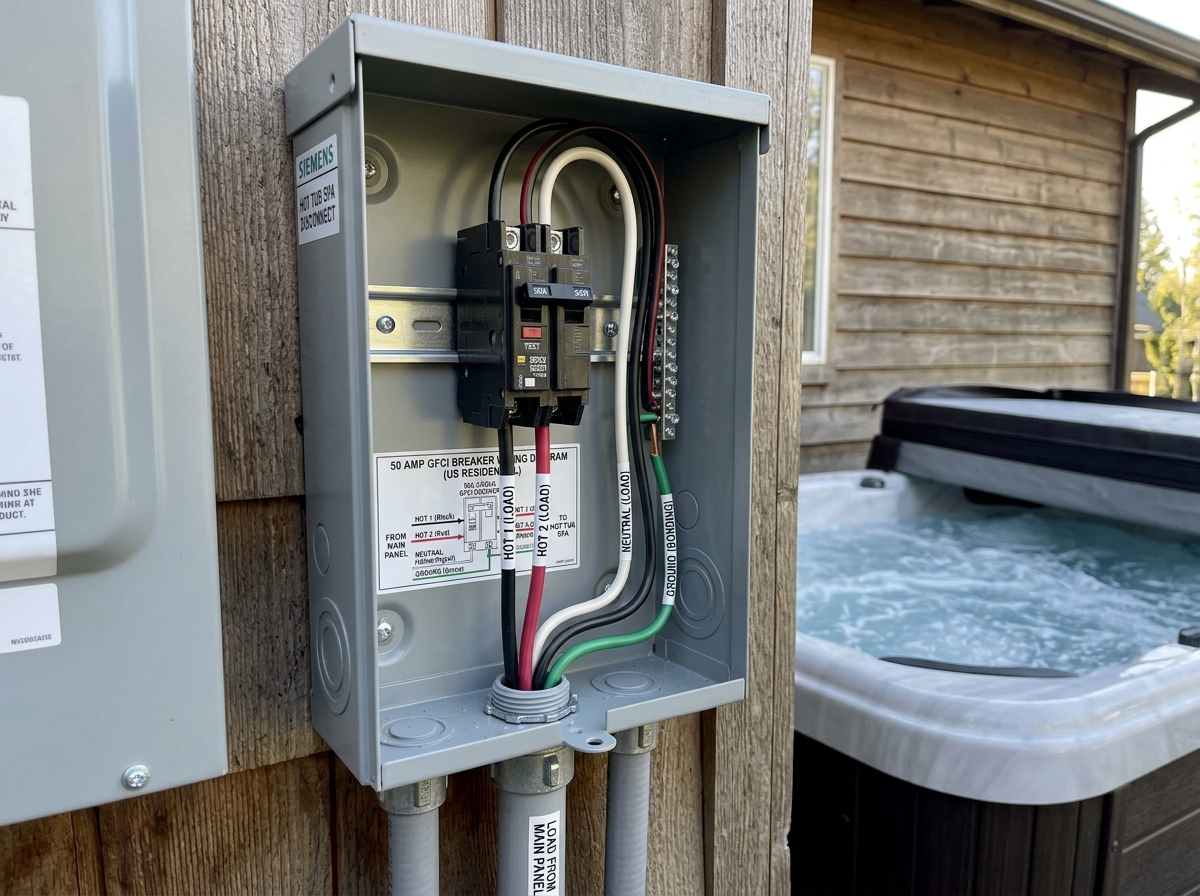
This is where many DIY attempts go south. Let’s look at the GFCI breaker itself. It usually has three terminals on the bottom and a white “curly” pigtail wire.
- The Line Side (From Main Panel): The two hot wires (Black and Red) connect to the main lugs of the spa panel. The White neutral from the house connects to the neutral bus bar.
- The GFCI Pigtail: This is critical! The white curly wire attached to the breaker must be connected to the neutral bus bar in the spa panel.
- The Load Side (To the Hot Tub): The hot tub’s Black and Red wires connect to the breaker terminals. The hot tub’s White Neutral wire connects directly to the “Load Neutral” terminal on the breaker itself—not the bus bar.
If you connect the hot tub’s neutral to the bus bar instead of the breaker, the GFCI will trip the moment you turn it on. It’s a classic “newbie” mistake that we see all the time. For a deeper dive, read more about how to wire a GFCI breaker for a hot tub like a pro.
The Critical Role of the Neutral Wire in a 4-Wire System
You might wonder, “If it’s a 240V tub, why do I even need a neutral?” Here’s the thing: while the heater uses the full 240V (pulling from both hot legs), the smaller components like your ozonator, stereo, and control logic often run on 120V. These components need the neutral wire to complete the circuit.
The GFCI breaker is smart—it monitors the current going out on the hots and coming back on the neutral. If the “math” doesn’t add up perfectly, it assumes electricity is escaping somewhere it shouldn’t be and cuts the power. This is why keeping your neutral and ground wires separate in the subpanel is so important. If they touch, the breaker sees a path for electricity that bypasses its sensors, leading to instant tripping. If you’re seeing issues with your home’s general outlets, you might also want to look at our tips on essential electrical wiring repair.
Troubleshooting a 50 Amp GFCI Breaker for Hot Tub Wiring Diagram
Is your breaker tripping the second you flip the switch? Don’t panic. Here are the most common culprits:
- The Neutral-to-Ground Bond: In your main house panel, neutral and ground are bonded together. In your spa disconnect (subpanel), they must be separate. Make sure the bonding screw is removed from the neutral bar in the spa panel.
- Moisture in the Box: South Ogden winters can be tough. If moisture gets into the conduit or the spa pack, it can cause a ground fault.
- Heater Element Failure: If the spa has been sitting empty or is older, the heater element might have a tiny crack. When it gets hot, it leaks current into the water, triggering the GFCI.
- Miswired Load Neutral: Re-check that the white wire from the hot tub is on the breaker, not the bar!
Honestly, troubleshooting can be a headache. If you’re struggling, it’s often safer to call a pro. You can learn more about GFCI power outlets and how they function to better understand the technology.
Conclusion: Why Professional Installation Ensures Peace of Mind
At the end of the day, a hot tub is supposed to be about relaxation, not worrying if your wiring is a fire hazard. While a 50 amp gfci breaker for hot tub wiring diagram provides the map, the actual “trek” through your electrical system requires precision tools and experience.
| Feature | DIY Installation | Black Rhino Electric |
|---|---|---|
| Code Compliance | Risk of failing inspection | Guaranteed to meet NEC 2023 |
| Safety | High risk of shock/fire | Fully insured & safety-tested |
| Warranty | May void spa warranty | Protects manufacturer warranty |
| Permits | Homeowner must navigate city hall | We handle all paperwork/permits |
| Longevity | Potential for loose connections | Torque-tested, professional finish |
We’ve seen plenty of “handyman” jobs in Bountiful and Layton that ended up costing the homeowner twice as much to fix. Let me explain: an improperly torqued terminal can vibrate loose over time, causing “arcing” that can melt your expensive spa controller. Our team at Black Rhino Electric ensures every connection is tight, every conduit is deep enough, and every breaker is the perfect match for your panel brand.
Testing and Maintaining Your Hot Tub Circuit
Once we’ve got you up and running, the work isn’t quite over. You should hit that “Test” button on your GFCI breaker once a month. It’s a simple “click-off, click-on” process that ensures the internal spring mechanism hasn’t seized up. Also, keep an eye out for corrosion. Utah’s climate can be dry, but the area around a hot tub is always humid. If you see green “crust” on your wires or terminals, it’s time for a professional check-up.
For more information on why these steps are vital, see our post on why you need a hot tub electrician for safe installations.
A 50 Amp GFCI Breaker for Hot Tub Wiring Diagram Summary
To wrap it up, your hot tub electrical project needs:
- A dedicated 50A circuit with #6 copper wire.
- A GFCI disconnect within sight but at least 5 feet away.
- Separation of neutral and ground in the subpanel.
- A permit and a final inspection from your local Weber or Davis County building department.
You know what? Honestly, while a diagram is a great start, the stakes are incredibly high when mixing high-voltage electricity with water. Here’s the thing: a single loose neutral or an incorrect burial depth can lead to equipment damage or worse. Let me explain why our team at Black Rhino Electric is the preferred choice for families in Ogden and Weber County—we handle the permits, the trenching, and the technical wiring so you can just focus on relaxing. If you’re ready to get your hot tub running safely, call us at 801-810-4292 or Request a Free Quote today.