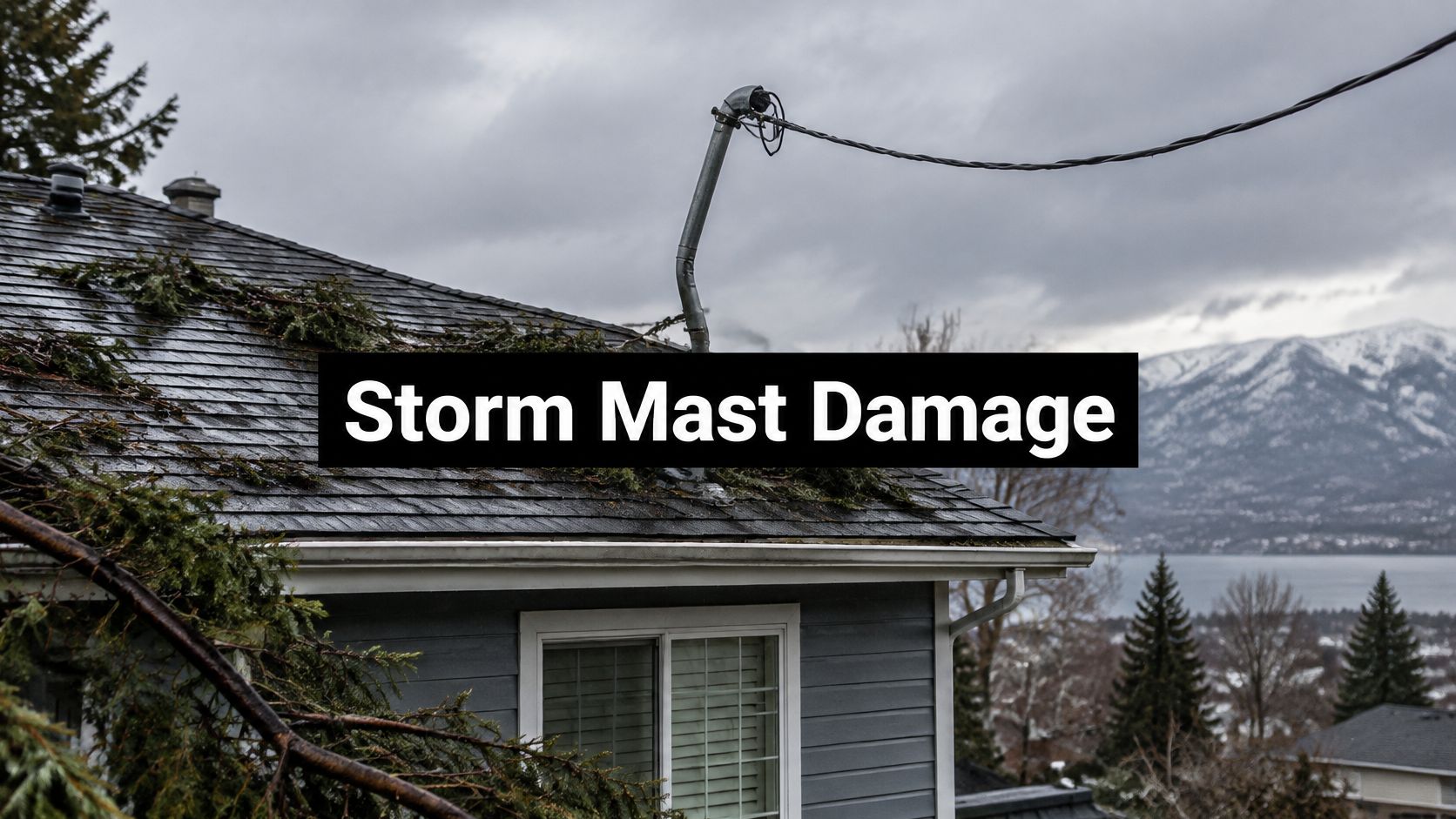
A leaning pipe beside the meter is easy to ignore when the lights still work. Service mast damage after a storm is an electrical safety problem, not a cosmetic bend, and power being on does not prove the installation is safe. Stay clear, report the hazard, and have a licensed electrician assess the customer-side equipment before anyone puts the service back.
What to Do First After Service Mast Damage
Treat the mast, the overhead conductors, and every loose wire as live until the serving utility says otherwise. FEMA instructs people to treat all loose or downed power lines as energized, report them immediately to the power company, police, or fire department, and warn others to stay away. The same guidance says to look outside for damaged power lines and other structural damage before entering a residence.
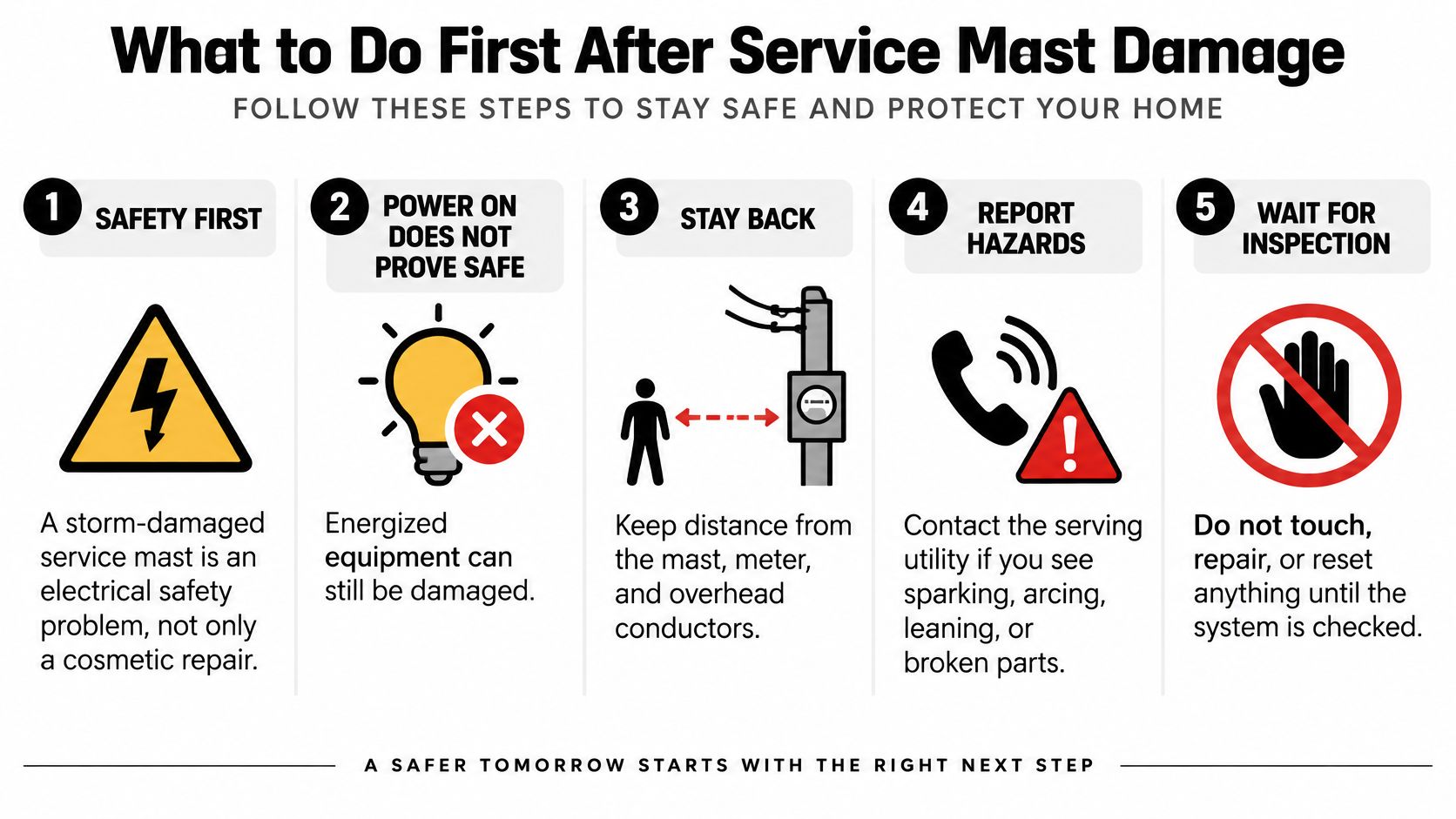
Work from a distance. Do not climb, brace the pipe, or open equipment.
- Keep everyone clear. Keep people, pets, and vehicles well away from the mast, the service drop, and any sagging wire. A conductor on the ground or in a tree can still be at full voltage.
- Treat the line as hot. Treat every overhead line and conductor as energized, including when the house has lost power. An outage inside does not mean the utility conductors are dead.
- Do not touch the hardware. Do not touch, brace, straighten, tape, or cut the mast, weatherhead, or conductors. Moving a bent mast can tear insulation or pull a live conductor toward the building.
- Look only from outside. Note a leaning mast, a bracket pulled from the wall, a cracked meter enclosure, or water in the meter area. From a safe distance you can also see whether conductors are sagging or whether branches are on the service. Do not touch the mast, meter, conductors, ladder, or debris.
- Leave covers closed. Do not open the meter, panel, or service equipment. Rain in a cracked fitting can reach terminals you cannot see.
- Report the hazard. Call the serving utility. Call 911 if a line is arcing or touching a structure, tree, or vehicle. Property managers taking tenant calls overnight can use an after-hours answering service so a downed-line report is written down instead of sitting in a full voicemail.
- Photograph from where you stand. Pictures help your records and your insurer. A bend can hide nicked insulation and loose terminals that a photo of the pipe will not show.
Practical rule: Lights on, with a pulled bracket or water at the meter, is still a stop-and-call condition.
The utility addresses hazardous incoming lines. A licensed electrician evaluates and repairs customer-owned service equipment. More on that handoff is in after-hours electrician services. Your job now is to keep the site safe and get that assessment before anyone reconnects the service.
Service Mast Parts and Who Owns Each One
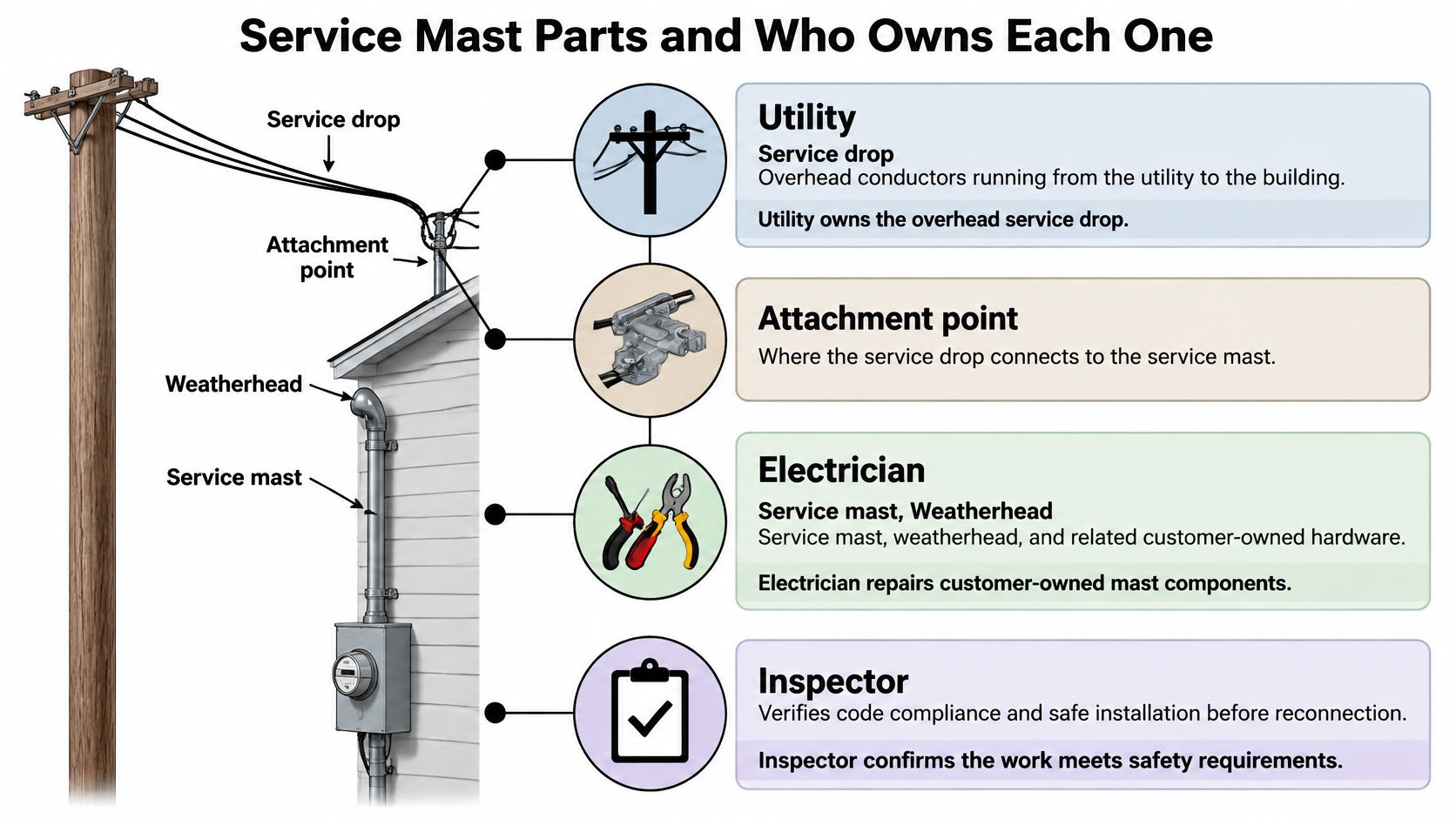
These are the names you will hear from the utility and from the electrician. The table is a typical split, not a substitute for the serving utility's written boundary.
| Component | What It Does | Usually Handled By |
|---|---|---|
| Service drop | Overhead conductors from the utility to the building | Utility |
| Attachment point | Bracket or hardware anchoring the mast to the structure | Licensed electrician, with building trades if framing or roof work is needed |
| Weatherhead | Fitting at the top of the mast that seals the conductor entry | Licensed electrician |
| Service mast | Conduit carrying conductors from the attachment to the meter | Licensed electrician, after utility disconnection |
| Meter base | Socket that holds the utility meter and connects customer-side conductors | Licensed electrician for repair; utility for meter removal and reinstallation |
| Service conductors (customer side) | Conductors from the meter base into the home | Licensed electrician |
| Inspector | Verifies the repair before power is restored | Local permit authority, when a permit is required |
The service drop is the overhead run from the utility to the building. The attachment point is the bracket or hardware that anchors the mast. The weatherhead is the fitting at the top that seals the conductor entry. The service mast is the conduit that carries those conductors down to the meter. The meter base is the socket that holds the meter and connects to the customer-side service conductors.
The utility side usually ends at a defined point of connection. Where that point sits follows the serving utility's rules and where the conductors attach, so confirm the boundary with the utility before anyone starts work. A mast torn at the attachment can also need framing or flashing. Roofing is a separate trade from the electrical repair. How a damaged socket shows up is covered in meter base damage warning signs.
Write down the utility's stated boundary and the name of the party who will do each repair. That note is what keeps the later handoff from stalling.
Sorting Downed Lines, Leaning Masts and Meter Damage
Start with what you can see without walking under the wire. A downed or sagging service line is the first call, to the utility and to 911 if it is arcing or touching something. A leaning mast with the lights still on is next. It still needs the utility to make the service safe, then a licensed electrician, before any repair.
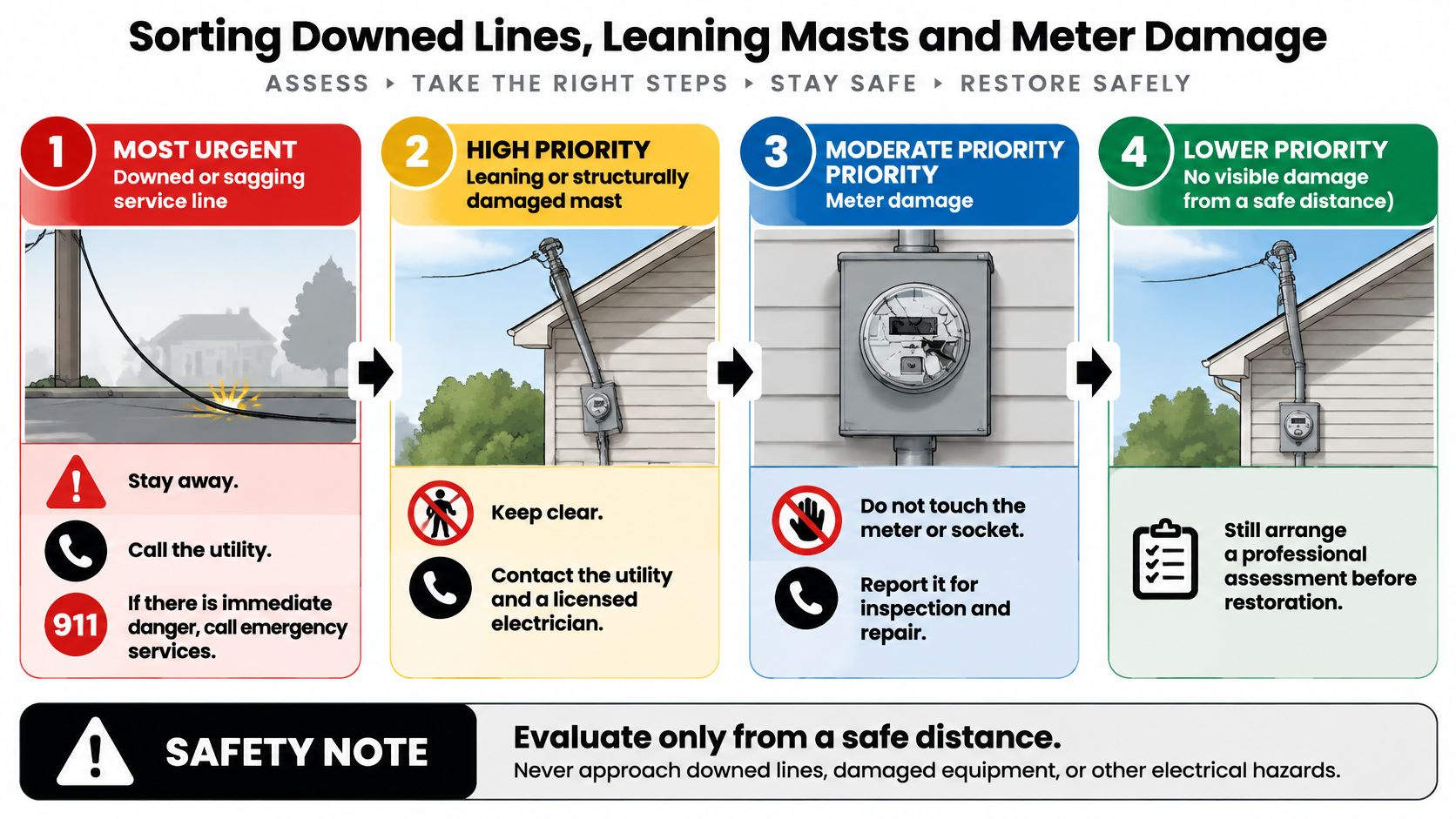
| Scenario | Safe to Observe From Outside | Action | Who to Call |
|---|---|---|---|
| Downed or sagging service line | Line on the ground or low across a path or tree | Keep everyone clear and do not touch the line | Utility and 911 if arcing or contact |
| Leaning or pulled-away mast, power on | Visible lean or gap at the attachment | Do not touch, brace, or straighten; keep clear | Utility, then licensed electrician |
| Displaced weatherhead, exposed conductor | Visible damage to the top of the mast or wire insulation | Keep clear; do not tape or cover | Licensed electrician before power returns |
| Cracked meter base or loose meter | Cracks or water in the meter area | Do not open the meter or reset breakers | Utility and licensed electrician |
| Power on, mast visibly damaged | Lights work but the mast is bent or detached | Treat as energized; avoid contact | Licensed electrician for assessment |
A displaced weatherhead with bare or nicked insulation needs that assessment before power returns. A cracked or loose meter base with water in the socket involves both the utility, for the meter, and an electrician, for the customer equipment. If the lights work and the mast is still bent or pulled, treat the system as energized and arrange an assessment. Black Rhino Electric's residential services include troubleshooting and repairs for this kind of electrical issue.
Stop and call
- Sparking or buzzing: Leave the area and call the utility, and 911 if a line is in contact.
- Burning smell or scorch marks: Do not reset breakers or open covers.
- Water in the meter or panel area: Keep the equipment closed.
- A line on a tree, fence, vehicle, or the house: Stay back and report it.
Once the utility and electrician roles are clear, residential diagnosis continues at the electrical troubleshooting page.
Utility, Permit and Electrician Sequence Before Power Returns
Neighborhood power can return while one house stays off. The utility will not treat a damaged mast as ready just because the street is back. Confirm the serving utility for that address, whether that is Rocky Mountain Power or another provider, before you assume who takes the first call.
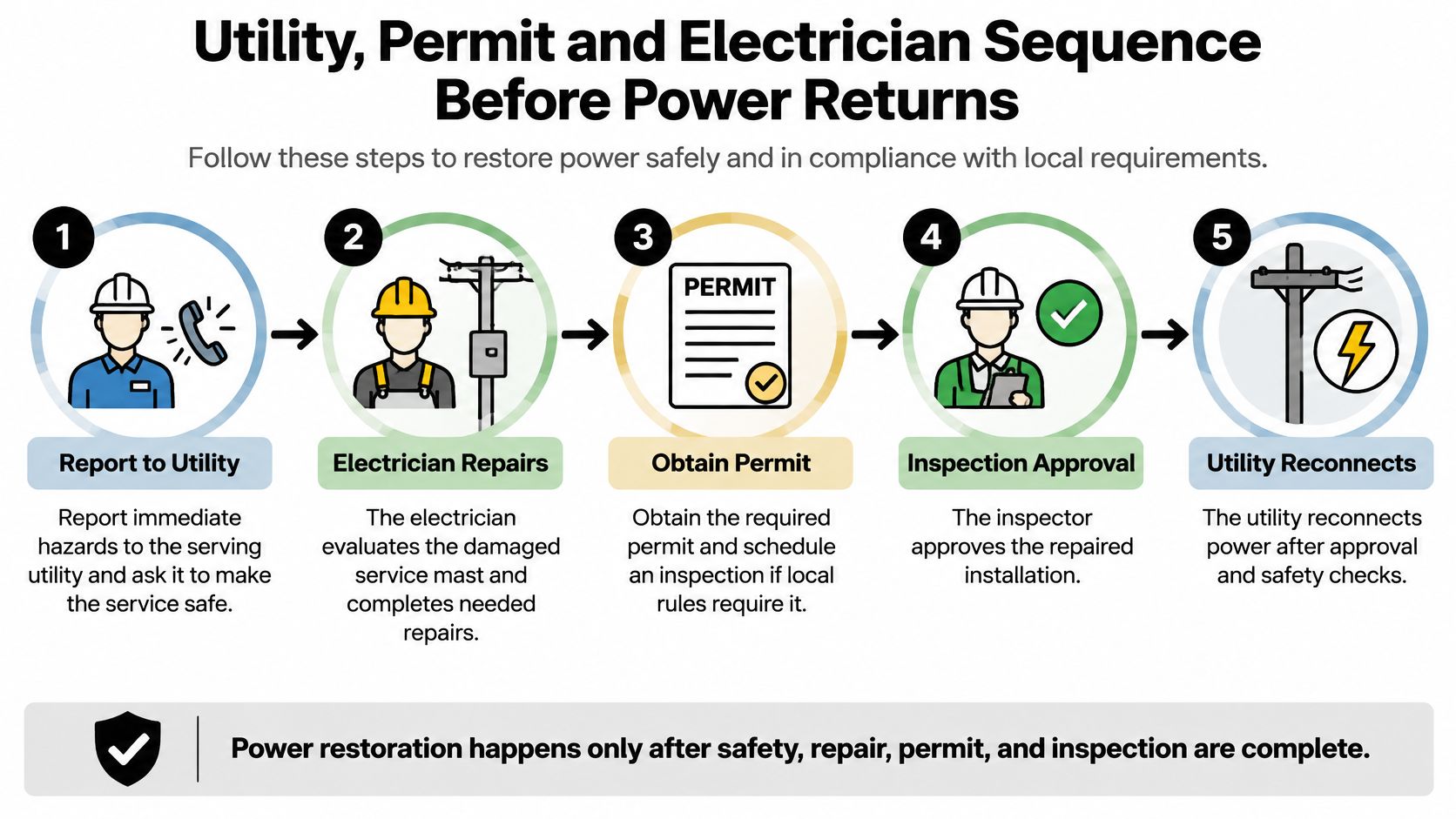
- Make it safe. Report immediate hazards to the serving utility and ask it to make the service safe and disconnect where needed.
- Scope the customer side. Have a licensed electrical contractor inspect the customer-side equipment and write a repair scope.
- Sort the paperwork. Confirm whether a permit is required, who pulls it, and which inspection the adopted Utah electrical code requires for that address. You can find electrical permit requirements for 2026 as a starting point, then match them to the local authority.
- Repair, then document. Complete the repair and keep the inspection or approval.
- Wait for the utility. Notify the utility that the work is ready, and wait for its reconnection confirmation before expecting power.
What gets checked together
The electrician's review is one pass, not a glance at the bend. It covers mast plumbness and mechanical stability, attachment hardware and whether the building anchorage can carry the load, conduit cracking or crushing, weatherhead position and sealing, roof flashing at any penetration, service conductor insulation and terminals, meter base condition, grounding and bonding, and clearance of the service drop.
FEMA's design guide identifies storm-related electrical service-mast failure as a recurring vulnerability where overhead service is used. When wind, ice, vegetation, or debris collapses or loads an overhead line, that line can pull the mast and rupture the roof membrane where the mast penetrates the roof. The same guide recommends avoiding that roof penetration where overhead service is used, and notes that underground service can eliminate this overhead-line pull hazard. Equipment exposed to flooding may suffer total loss or need substantial cleaning, so the mast is not an isolated cosmetic repair.
FEMA wind guidance treats inadequate mast strength or attachment as a key inspection concern and says to check whether attached equipment adds wind load that was never counted. A leaning mast or damaged attachment should not be straightened while energized. The utility makes the service safe and coordinates disconnection first. Exposed or uncapped conduit should be repaired or temporarily capped, because it can admit water onto energized parts.
A neighborhood restoration notice is not permission to re-energize a damaged mast.
Black Rhino Electric's commercial services include code violation repairs, electrical panels and meters, and electrical repairs when the property is commercial rather than a house. Get each party's step in writing before work begins. This sequence does not include a typical timeline.
Cost Factors and Questions to Ask Before You Hire
Repair cost depends on the damage and the work needed to make the service safe and complete. Ask for an itemized written scope, and check with your insurer about coverage. Utility-side charges may be billed separately, so ask whether any part of the work will be your responsibility.
| Factor | Why It Changes the Scope |
|---|---|
| Mast height and conduit length | More material and labor may be needed to replace or reroute the run |
| Attachment condition at roof, wall, or fascia | Damage may require framing, roofing, or flashing work by another trade |
| Meter base condition | Damage may add meter-base replacement to the electrical work |
| Extent of conductor damage | Repairs may extend beyond the mast to service conductors and terminals |
| Work included in the written scope | Separate utility-side charges or work by another trade can change the total |
| Site access and safe working area | Crew setup, equipment needs, and time on site can vary |
Before hiring, ask how the contractor prices the work: by task, labor and materials, or a fixed scope. Confirm what is included and what could be billed separately if hidden damage is found. Also ask whether utility-side work is billed to the property owner, whether another trade is needed for roof or framing repairs, and whether the written scope includes photographs for your insurer.
If the repair discussion includes a larger service, budgeting for a 200-amp service upgrade can help you consider that work separately from storm-damage repairs.
Get the Mast Inspected Before Power Is Restored
Lights next door do not clear your mast. I would leave the main off. Power being on does not mean the mast is safe. A lean, a pulled weatherhead, or water in the meter area still has to be repaired on the customer side and accepted by an inspector before the utility restores your service.
The sequence is fixed. The utility disconnects or holds the drop. A licensed electrician repairs the customer-owned damage. An inspector checks that repair. Only then does the utility reconnect. Skip a step, or call the wrong party first, and the outage waits on a reschedule.
Stay clear until you know the lines are safe and which parts you own. Gather the service address, utility account, any utility notice, photos taken from the ground, and the written repair scope.
Black Rhino Electric explains inspection failures in plain terms if you want to know what an inspector is looking for.
Black Rhino Electric, headquartered in Marriott-Slaterville, serves Weber, Davis, and Salt Lake counties. The reason to call them here is a customer-side inspection of storm-damaged mast, meter, and panel equipment before power returns. Request a quote at the quote form, or start at Black Rhino Electric.