
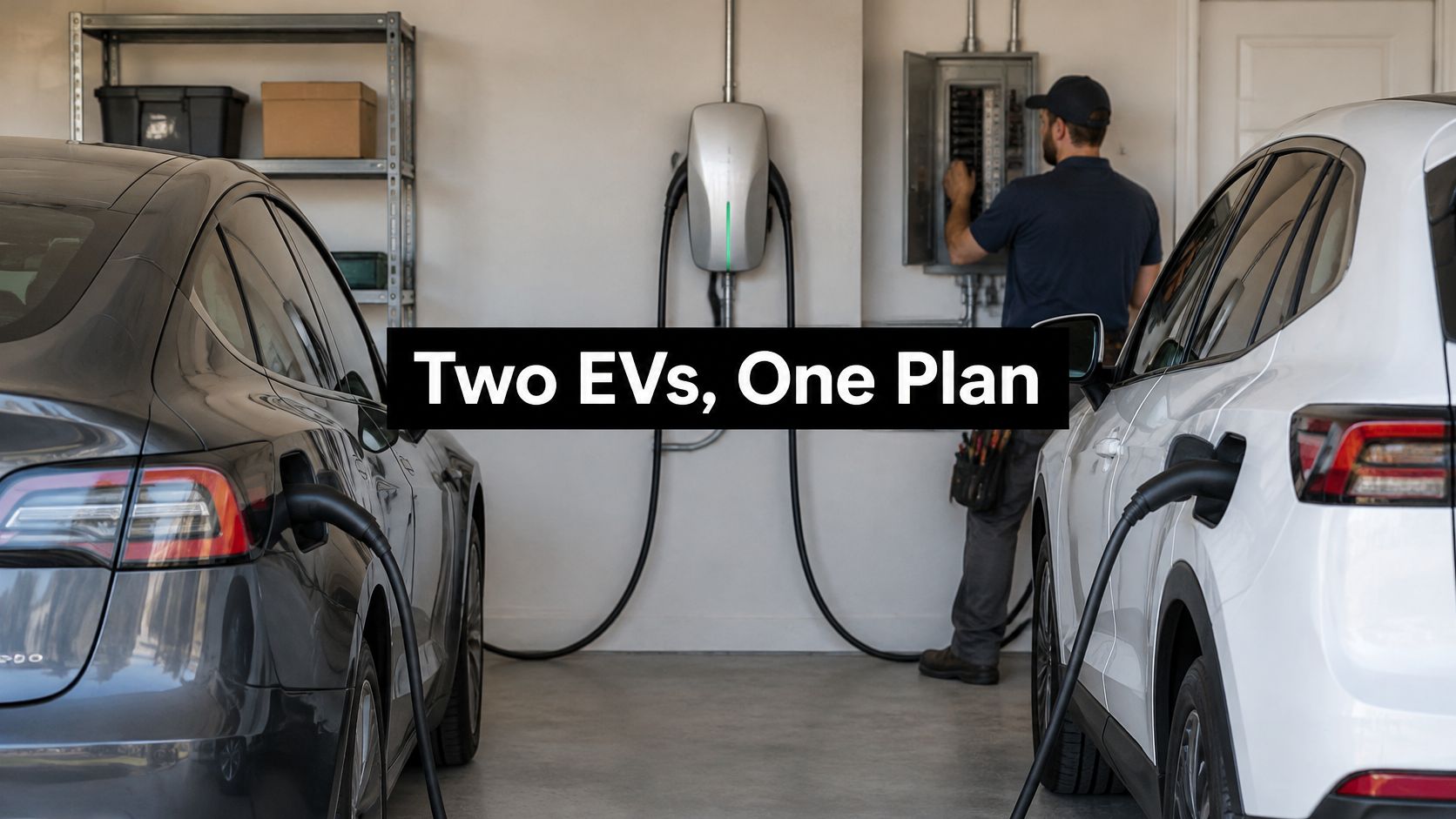
Two cars don't automatically need two full-power chargers. Charging two electric cars at home can work with one shared charger, mixed Level 1 and Level 2 charging, or listed load-sharing equipment when both drivers' departure times fit the home's verified electrical capacity.
Pick the Plan From Both Departure Times
Two-driver schedule and the setup that fits
| Household pattern | Parking window | Setup to consider | Why it fits |
|---|---|---|---|
| Cars rarely overlap | Different shifts | One listed charger, drivers alternate | A second circuit adds little if only one car is plugged in |
| Both home overnight, moderate miles | For example, about 8–12 hours | One Level 2, or Level 2 plus Level 1 | The available window may cover modest daily driving |
| One early departure, one later | Short window for one car | Faster circuit for the early car; slower or later charging for the other | Priority follows the first departure, not equal hardware |
| Both need a large morning recharge | Same short window | Two circuits only if the load calculation passes; otherwise listed sharing or service work | Unmanaged full power may exceed available service capacity |
| One short commute, one long commute | Overnight overlap | Level 2 for the high-mile car and dedicated Level 1 for the other | The low-mile car may not need another high-power circuit |
The Department of Energy's home-charging guidance gives typical charging ranges of about 2–5 miles per hour for Level 1 and about 10–30 miles per hour for Level 2, and calls for an available dedicated circuit near the parking location for Level 1. These are planning ranges, not promises for either vehicle.
Start with the driver who has less time
Different shifts make alternating straightforward, provided the arriving driver can reach the charger and nobody forgets the handoff. Installing another charging point solely because another car enters the household can add equipment without solving a real scheduling problem.
For the hypothetical overnight household in the table, modest replenishment may fit comfortably. However, a long parking window doesn't help if somebody must get out of bed to move the cable and regularly forgets. Convenience is a legitimate reason for another connection, even when additional electrical power isn't necessary.
An early-departure driver should receive the faster charging opportunity when that driver also needs substantial replenishment. Equal charging equipment isn't automatically a fair allocation if the other car can remain parked until later.
Planning rule: The useful target is enough range by departure, not matching charger ratings on the garage wall.
Separate vehicle needs from home-energy plans
When both cars need substantial energy before the same early departure, the electrician must assess whether independent charging loads fit. A low-mileage second car presents a different decision: dedicated Level 1 may meet its needs without another high-output installation.
For households also considering storage, HighFlow Energy's explanation of how to coordinate EV charging and home batteries provides broader planning context, not Northern Utah code or utility guidance.
Before choosing equipment, each driver should record arrival time, departure time, and miles needed the next day. Those observations are more useful than a request for the fastest charger available.
Compare One Port Two Circuits and Listed Sharing
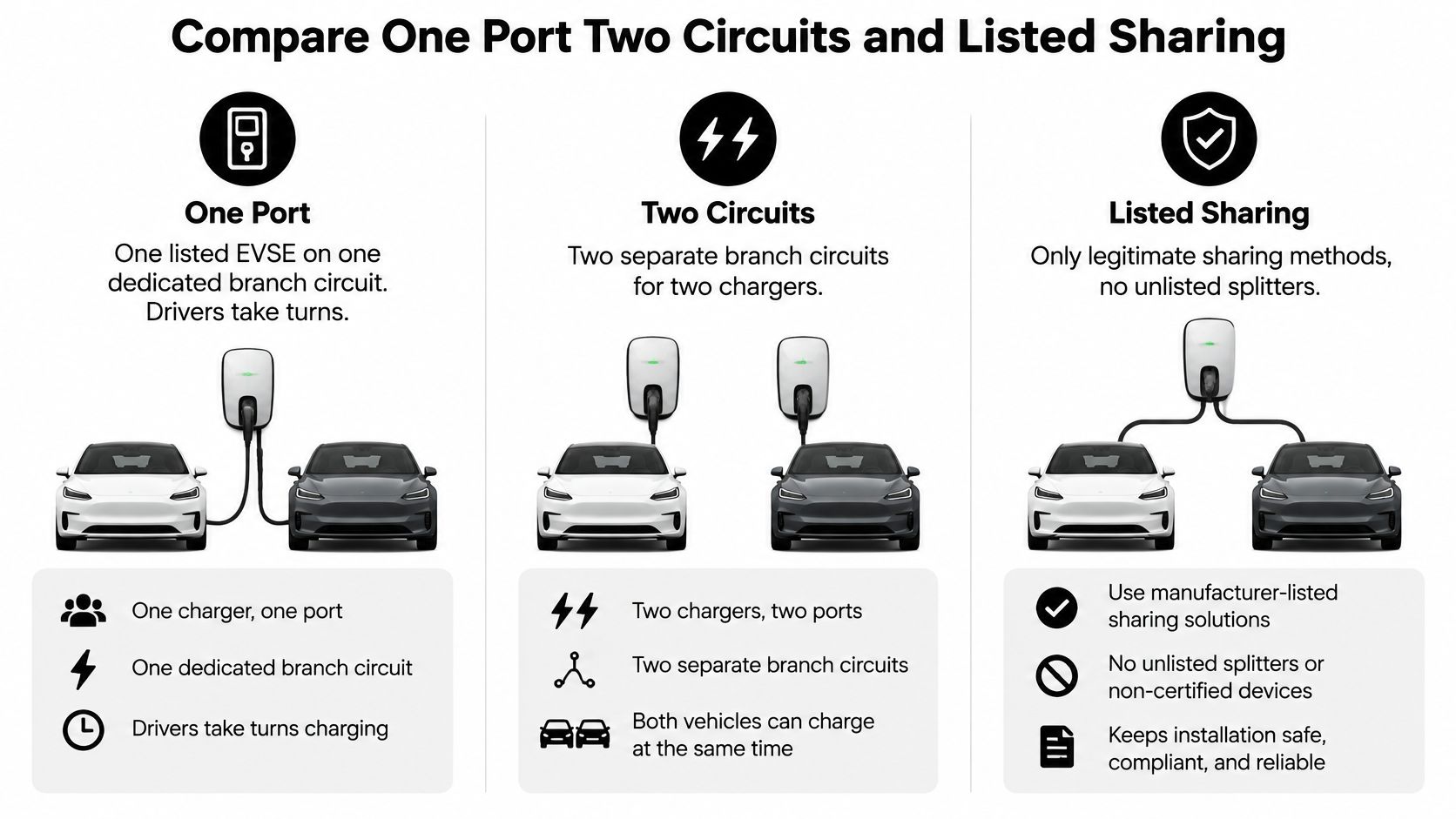
A charging connection and a charging circuit aren't the same thing. EVSE, the equipment commonly called a charger, must be selected together with its approved electrical arrangement.
One port, two circuits, or listed load management
| Setup | Branch circuits | Full power at once | Best when | Hard limit |
|---|---|---|---|---|
| One listed port, drivers alternate | One dedicated branch circuit | No | Cars aren't parked together or miles are modest | Only one vehicle charges at a time |
| Level 2 plus dedicated Level 1 | Two circuits at different voltages | Yes, at very different rates | One car has a short commute | Level 1 is slow and still needs its own circuit |
| Two separate Level 2 circuits | Two dedicated branch circuits | Only if the load calculation passes | Both need fast charging in a short window | Combined continuous load may require panel or service work |
| Listed dual-port or paired load sharing | As the listing specifies, with coordinated limits | Not two unrestricted maximums; output is shared or reduced | Both cars park long enough for sequenced or reduced-rate charging | Equipment must support the proposed arrangement; replenishment takes longer |
Compare the approved arrangement, not just the ports
The Alternative Fuels Data Center's charging-equipment guidance describes a residential example operating at 30 amperes and approximately 7.2 kilowatts, requiring a dedicated 40-ampere circuit under National Electrical Code Article 625. That's an example, not a universal circuit specification for every Level 2 product.
With an alternating port, drivers exchange the connector rather than dividing electrical output. With independent circuits, each charging installation has its own protection and wiring requirements. The explanation of dedicated circuits for home EV chargers helps distinguish that arrangement from finding another garage outlet.
A dual-port enclosure doesn't, by itself, prove that its internal controls can enforce the limit the house needs. Likewise, paired chargers must have manufacturer documentation supporting their particular sharing configuration. Product selection should remain open until the electrician has reviewed the exact installation instructions and listing.
Reject improvised sharing
An unlisted splitter, cheater cord, or pair of chargers attached to an ordinary garage receptacle isn't an approved load-management system. None belongs in the acceptable scenarios above.
The proposal should identify:
- Circuit arrangement: Which equipment connects to which branch circuit.
- Enforced limit: How the equipment prevents combined charging from exceeding the approved allocation.
- Failure behavior: What happens if communication or a monitoring component stops working.
- Vehicle compatibility: Whether connectors and supported controls suit both cars.
No universal amperage recommendation can replace that review. The electrician's load assessment determines which arrangements are candidates before equipment is purchased.
Check Service Capacity and Equipment Limits
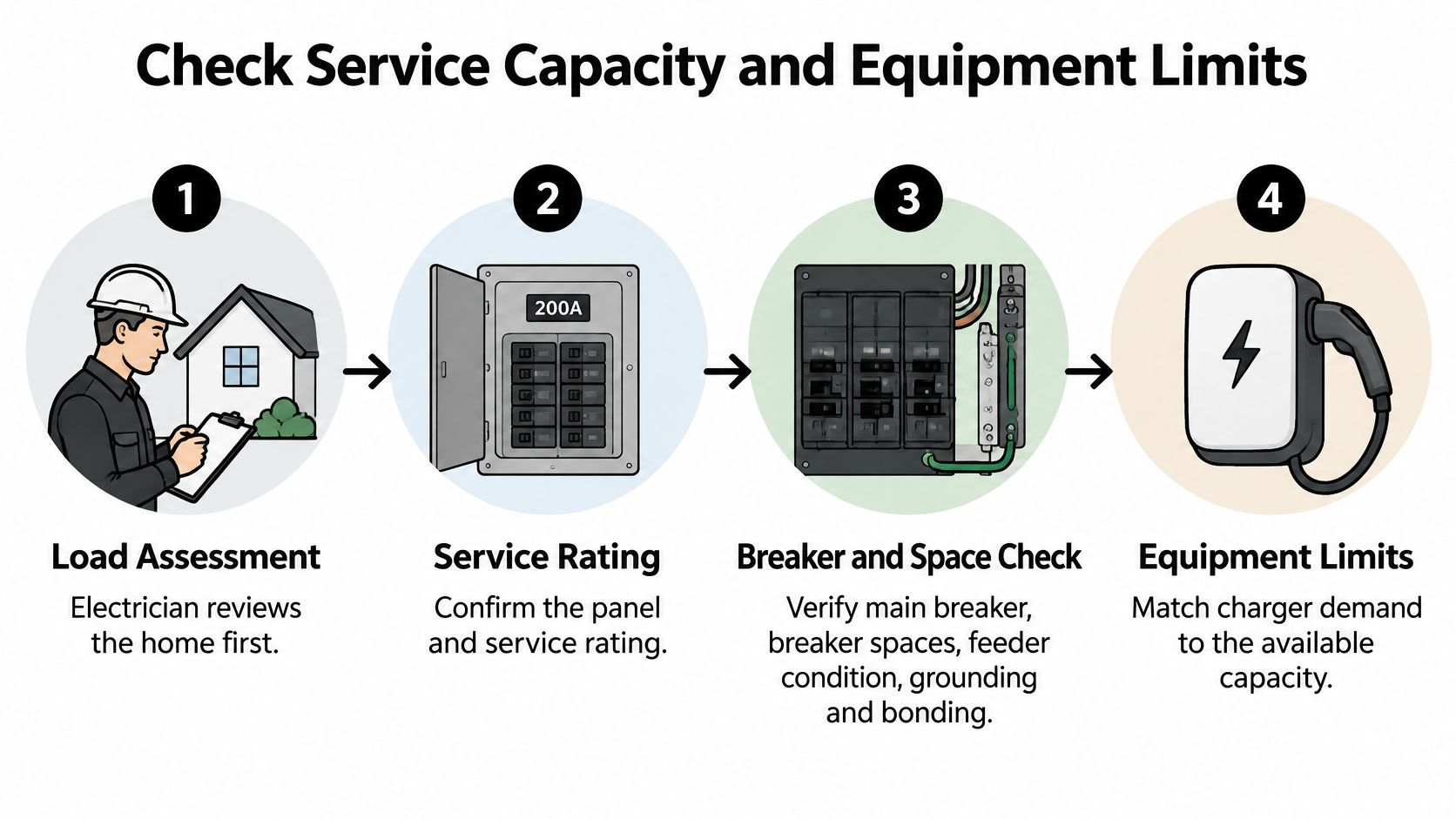
Start with the home's load calculation and the drivers' departure priorities. A two-car setup may need coordinated charging, rather than a second full-power charger. The right arrangement depends on the home's electrical service and the load it must support.
A licensed electrician assesses the service rating, main breaker, panel capacity, feeder condition, grounding and bonding, and existing major electrical loads. Include equipment such as a range, dryer, heat pump, air conditioner, electric water heater, or hot tub. The calculation needs to account for the household's actual electrical demands.
Understand the scale of the additional load
The U.S. Department of Transportation's charging-speed guidance describes residential Level 2 charging as 208–240-volt AC, typically 7–19 kilowatts. At 7 kilowatts each, two vehicles charging simultaneously add roughly 14 kilowatts beyond the home's other loads. Use those figures to understand the scale, not as a universal recommendation for a particular house.
The electrician also checks conductor sizing, overcurrent protection, any required disconnecting means, and the proposed installation location. GFCI protection, wiring method, and equipment placement must fit the adopted electrical code and the selected equipment's listing.
The Department of Energy's multifamily EV charging guide describes automated load management that monitors building demand and reduces or pauses charging as needed. Fixed sharing keeps chargers within an established combined allocation. Dynamic management adjusts charging in response to changing demand. Ask how the monitoring function is verified and what controls charging if monitoring stops. A schedule alone does not establish that the system responds to the home's electrical demand.
Gather observations without opening equipment
Homeowners can note visible panel labeling, approximate age, parking positions, and the likely route from the panel to the stalls. Take photos of accessible exterior views only; leave covers in place.
Available breaker space is a physical observation. Available electrical capacity is a calculation.
The guide to assessing electrical service before charger installation explains why a load assessment informs the installation plan. Panel interiors, conductors, meter equipment, and utility-side connections should be handled by qualified professionals, with utility coordination where needed.
The assessment should establish whether to add a circuit, use listed load-managed equipment, or plan panel or service work. That calculation sets the equipment limits for the two-car plan.
Match Overnight Windows to Real Miles
Consider these hypothetical schedules, not customer projects. Each tests whether the household can receive enough energy before departure rather than whether both cars can display a high charging rate.
Staggered shifts and unequal commutes
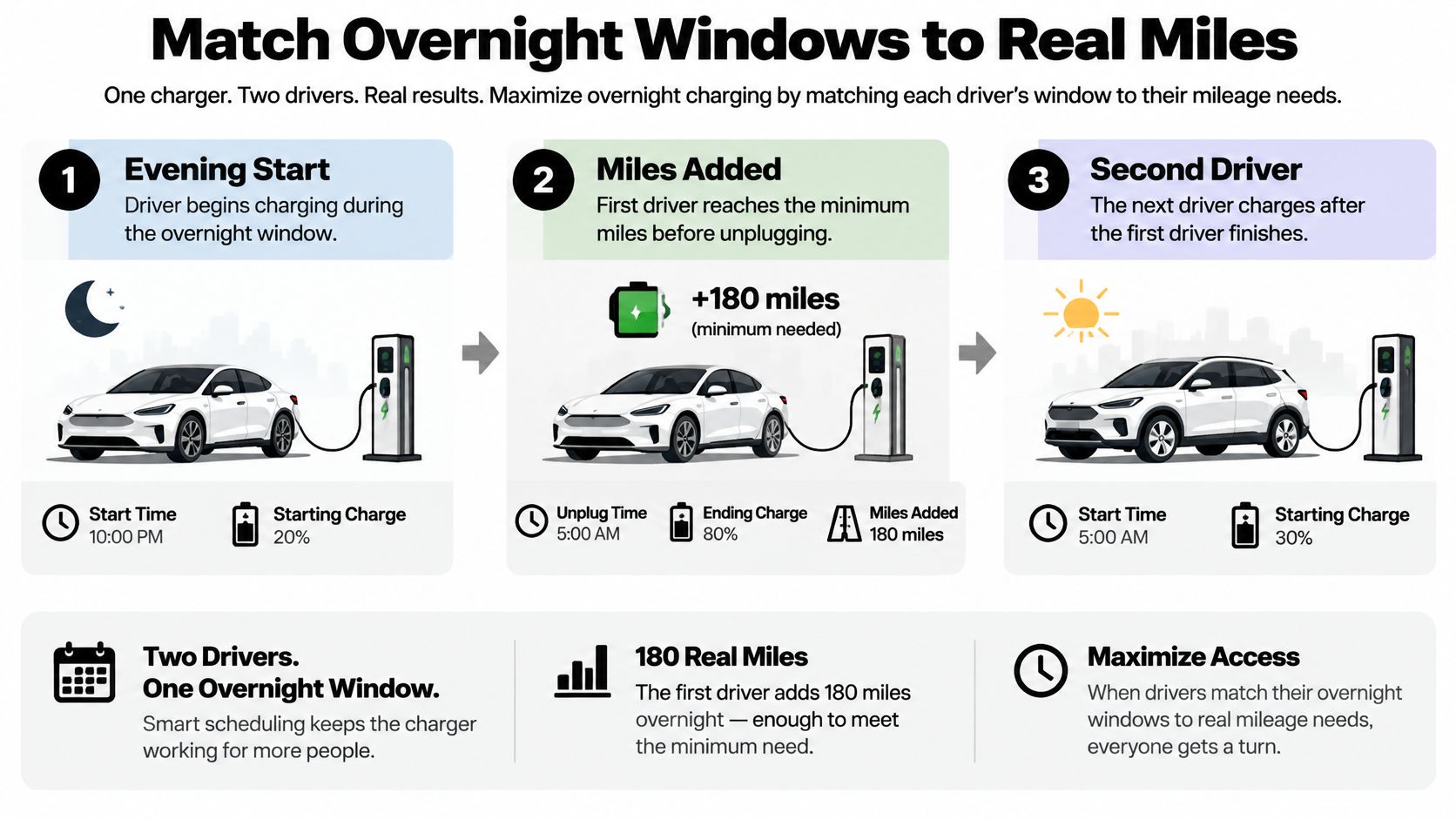
With staggered shifts, the first driver charges to the required morning range before unplugging. The arriving driver then connects the other car. This works only if the cable handoff is practical and the vehicle positions don't block access.
For overlapping overnight parking with unequal commutes, a supported priority arrangement can favor the longer-distance driver before allocating more power to the other car. Departure time comes first, followed by state of charge and minimum morning range. A permanently equal split may be less useful than an approved system that matches the actual need.
Simultaneous departures need an energy check
For a hypothetical pair needing 30 kWh each, the energy calculation below uses 60 kWh total and the combined-power scenarios accompanying NREL's utility-impact analysis; the analysis also found a modeled peak-to-off-peak price ratio of at least 2:1 effective in shifting charging in its scenarios.
Charging time for two cars needing 60 kWh total
| Combined charging power | Total energy | Approximate time before losses |
|---|---|---|
| 9.6 kW | 60 kWh | About 6.25 hours |
| 7.2 kW | 60 kWh | About 8.3 hours |
These are energy-divided-by-power calculations, not guaranteed completion times. Losses, vehicle limitations, and household-driven charging reductions can lengthen the window.
Sharing can distribute available energy more usefully. It can't create additional energy within a shortened parking window.
The household should ask its utility which tariff applies and whether any cheaper charging period accommodates both vehicles. No particular Northern Utah rate or eligibility should be assumed.
After the energy requirement is clear, homeowners can compare hardwired and plug-in EV chargers with the electrician. For a separate vehicle-purchase decision, Brill Motors' guide to buying a used hybrid in Nairobi is market-specific reading, not evidence for Utah electrical requirements or home-charging capacity.
Plan the Stall and Any Association Approval
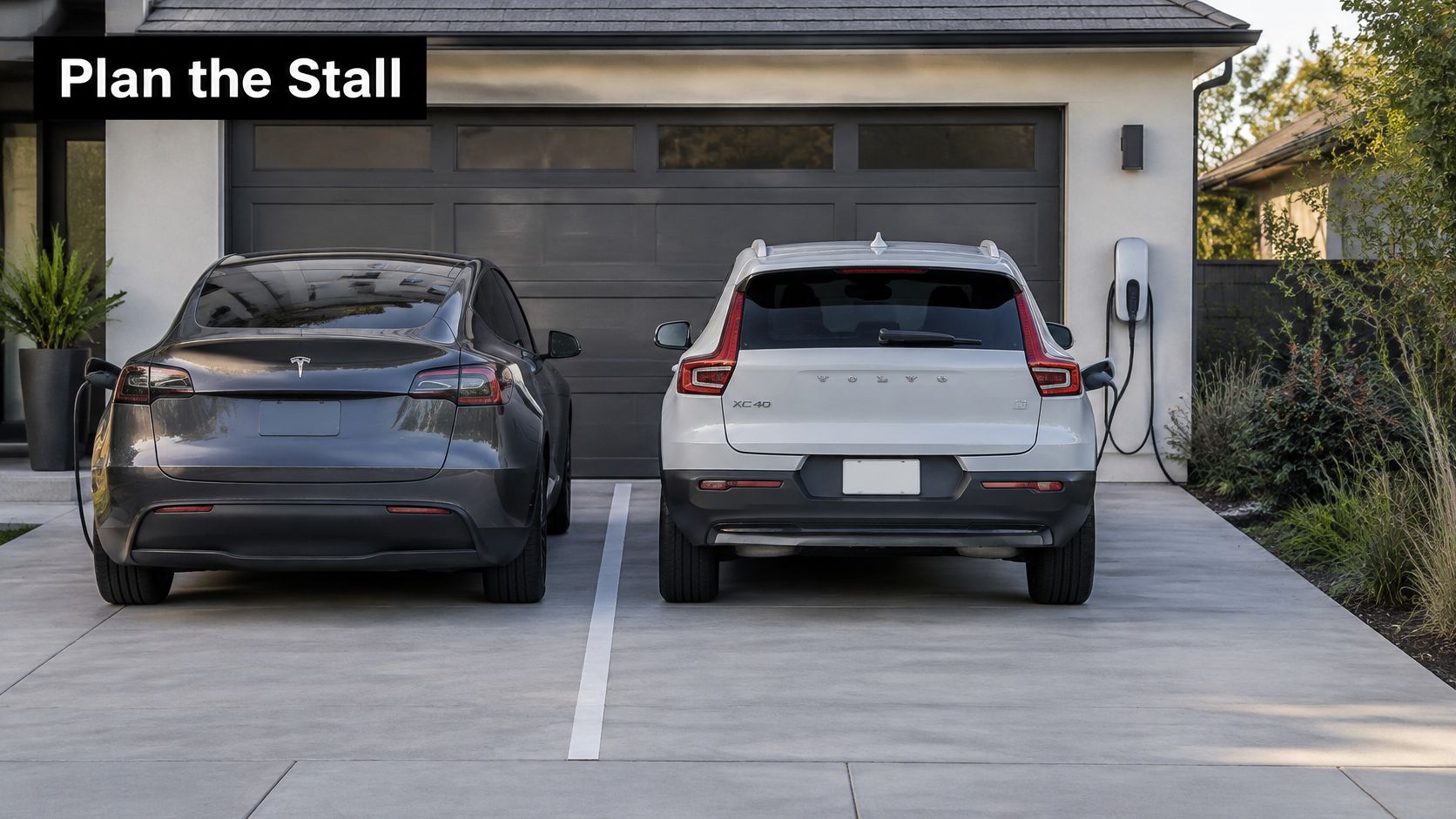
For a typical private garage, placement starts with both vehicles parked where they'll remain. A well-positioned charger may reach either stall during alternating use without routing its cable across a walkway.
Finished walls, outdoor exposure, and the route from the panel affect installation planning. Homeowners can identify those conditions without opening walls or pulling conductors.
Association-controlled stalls need separate permission
Under Utah Code Section 57-8-8.2, a condominium association may require an application, a general or residential electrical contractor, code and reasonable design compliance, reasonable review or permitting charges, and owner payment of installation, metering, and electricity costs. Comparable provisions apply to some planned communities under Section 57-8a-802.
- Owner responsibility: Obtain required written association approval and clarify electricity-cost allocation.
- Electrical coordination: Have the electrician address the installation scope and required permit with the authority having jurisdiction.
For properties in Weber, Davis, and Salt Lake counties, electrical permit guidance for Northern Utah homeowners helps frame the permitting conversation. Access Management Group's project planning guide offers broader property-management context, but the applicable Utah statute and association documents govern the approval process.
Service Visit, Warning Signs, and Questions to Ask
Bring both drivers' typical arrival and departure times, daily mileage, vehicle and charger details, and clear photos of the parking area and electrical panel. These help the electrician discuss the actual routine and installation conditions during the visit.
What to bring and discuss
Have a list of major electrical loads ready, along with any charger equipment you are considering. Point out where each car parks and whether the cable route would cross a finished wall, outdoor area, or other hard-to-access space.
Ask what work is included in the estimate. A longer circuit run through a finished wall can cost more in labor than a cheaper charger body saves on equipment. The same charger can involve different installation work depending on the route, circuit count, existing capacity, and any association requirements.
Questions that clarify the proposal
- Permit and inspection: Which approvals apply, and who will coordinate them?
- Utility coordination: Would service changes require utility involvement, and who handles that contact?
- Work scope: Which equipment, wiring, and any panel work are included in the estimate?
- Written terms: What equipment and workmanship warranties apply, and where are they documented?
- Scheduling: What needs to be accessible on the day of the visit, and when will power be unavailable during the work?
Watch for warm outlets or plugs, burning smells, buzzing, repeated breaker trips, or lights dimming when charging begins. Stop charging and have a licensed electrician evaluate the issue. Do not keep resetting a breaker or use an improvised workaround.
Homeowners should not open the panel, handle conductors, or bypass electrical protection. If there is active smoke or fire, call emergency services rather than attempting another charging session.
Choose the Setup and Request the Load Check
Two-car charging is a scheduling and load-management decision, not an automatic call for a second full-power charger. The best setup meets both drivers' departure needs within the home's electrical limits. Buy for those requirements, not the largest advertised output.
Before requesting a proposal, gather the details that shape the recommendation:
- Both vehicle models and each driver's typical daily mileage.
- Arrival and departure times, including days when both cars need charging.
- Preferred parking positions and any limits on moving cars.
- Charger locations and accessible photos of the parking layout and panel.
These details help distinguish a schedule that can work with shared charging from one that needs separate equipment or a different arrangement. They also give the electrician a practical starting point for assessing circuit placement and available capacity.
Black Rhino Electric serves residential customers in Weber, Davis, and Salt Lake counties, with EV charger installations, including Tesla installations, and related panel work. Learn about home EV charger installation and provide both drivers' schedules when requesting an assessment.
Black Rhino Electric offers EV charger installations for Northern Utah homes. Call 385-462-0397 or request a free quote with your vehicle details, schedules, and proposed charger locations.