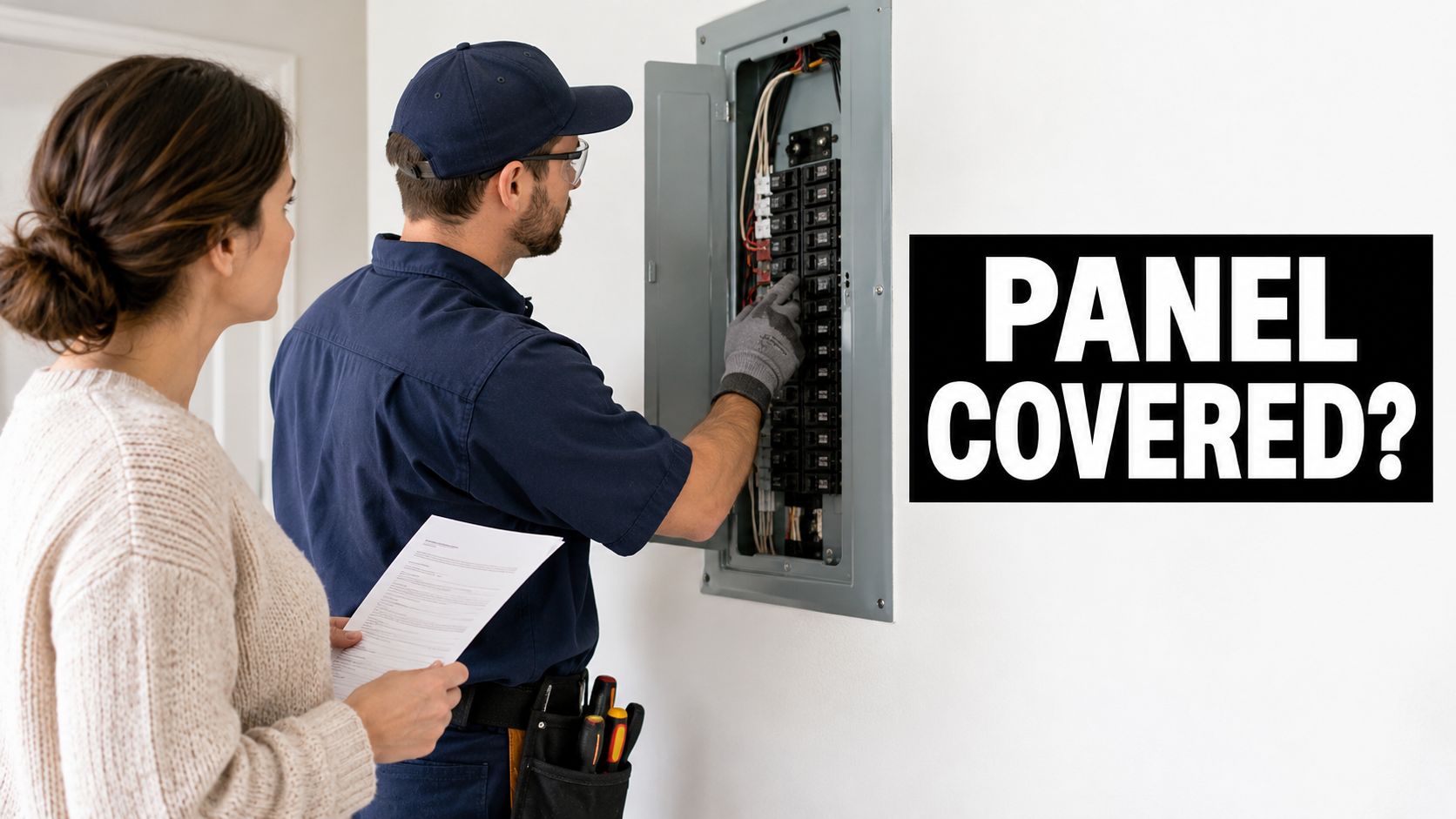
Homeowners insurance generally pays for an electrical panel damaged by a sudden covered peril, but not for age, wear, routine maintenance, inadequate capacity, or elective modernization unless an endorsement applies. Does homeowners insurance cover electrical panel replacement when an electrician says an old panel is unsafe? Usually the cause of loss, not the recommendation alone, drives the answer.
Understand the Coverage Answer
A standard policy generally responds after sudden damage from a covered peril, such as fire or lightning, and not after ordinary aging or failure. The individual policy controls, including its deductible, limits, exclusions, and conditions.
Insurance works more like protection against a qualifying event than a maintenance plan. Planned upkeep and improvements stay with the homeowner unless specific policy language says otherwise.
Separate Event Damage From Condition
- Fire or lightning damage: A listed event may trigger a claim review for the affected panel and wiring.
- Corrosion or deterioration: Long term decline usually falls under maintenance exclusions.
- Nuisance tripping: Repeated trips signal a safety or load question, but they don't prove an insured event occurred.
- Undersized service: A panel that can't support current demand usually needs an elective capacity upgrade.
- Obsolete design: An aging Federal Pacific or Zinsco panel may warrant replacement for safety, yet age alone doesn't create coverage.
That distinction follows guidance explaining that standard HO-3 policies typically exclude wear and tear, deterioration, inadequate maintenance, and mechanical or electrical breakdown. An endorsement for equipment breakdown can change part of that analysis, so the declarations page matters.
Black Rhino Electric can evaluate the panel, identify visible damage, and document electrical conditions. The contractor can't decide coverage, interpret a policy as legal advice, or promise payment. Those decisions belong to the insurer under the signed policy.
Compare the Main Coverage Scenarios
Similar looking panels can fail for very different reasons. A melted breaker after a house fire presents a different claim question than corrosion found during a routine inspection, even when replacement is recommended in both cases.
| Situation | What Usually Drives the Decision | Questions to Confirm |
|---|---|---|
| Sudden fire or lightning damage | Whether the event is a covered peril and directly damaged the panel | Has the cause been documented before removal? |
| Age, corrosion, or loose connections | Wear, deterioration, and maintenance exclusions | Is there an equipment breakdown endorsement? |
| Recalled or high risk panel model | Safety findings and underwriting requirements, not a sudden loss | Is replacement required for renewal? |
| Code correction after damage | Whether ordinance or law coverage applies and its limit | Does the estimate separate damaged work from code work? |
| More capacity for a remodel or EV charger | Elective improvement rather than insured damage | Is any portion tied to a covered loss? |
The governing principle is that standard homeowners coverage generally addresses damage from a covered peril rather than ordinary wear or an obsolete component. Planned replacement and capacity work usually remain the owner's expense unless the policy provides otherwise.
Coverage Versus Underwriting
An insurer may require replacement of a high risk panel as a condition of issuing or renewing a policy. That underwriting demand doesn't mean the insurer will pay for the work. Homeowners should request the written reason, deadline, and acceptable proof of completion, then separate a mandatory safety correction from optional capacity additions.
Older Northern Utah homes sometimes combine panel concerns with early wiring methods. Readers reviewing both issues can compare the panel question with Black Rhino Electric's K&T safety guide before deciding scope.
An unsafe panel deserves prompt electrical evaluation even when replacement is not reimbursable. Safety and claim eligibility are separate decisions.
Fire data explain insurer scrutiny without converting prevention into coverage. The U.S. Fire Administration estimated an annual average of 25,900 residential building electrical fires during 2009 to 2011, causing approximately 280 deaths, 1,125 injuries, and $1.1 billion in property loss, according to the U.S. Fire Administration residential electrical fire report.
Read Policy Language and Valuation Terms
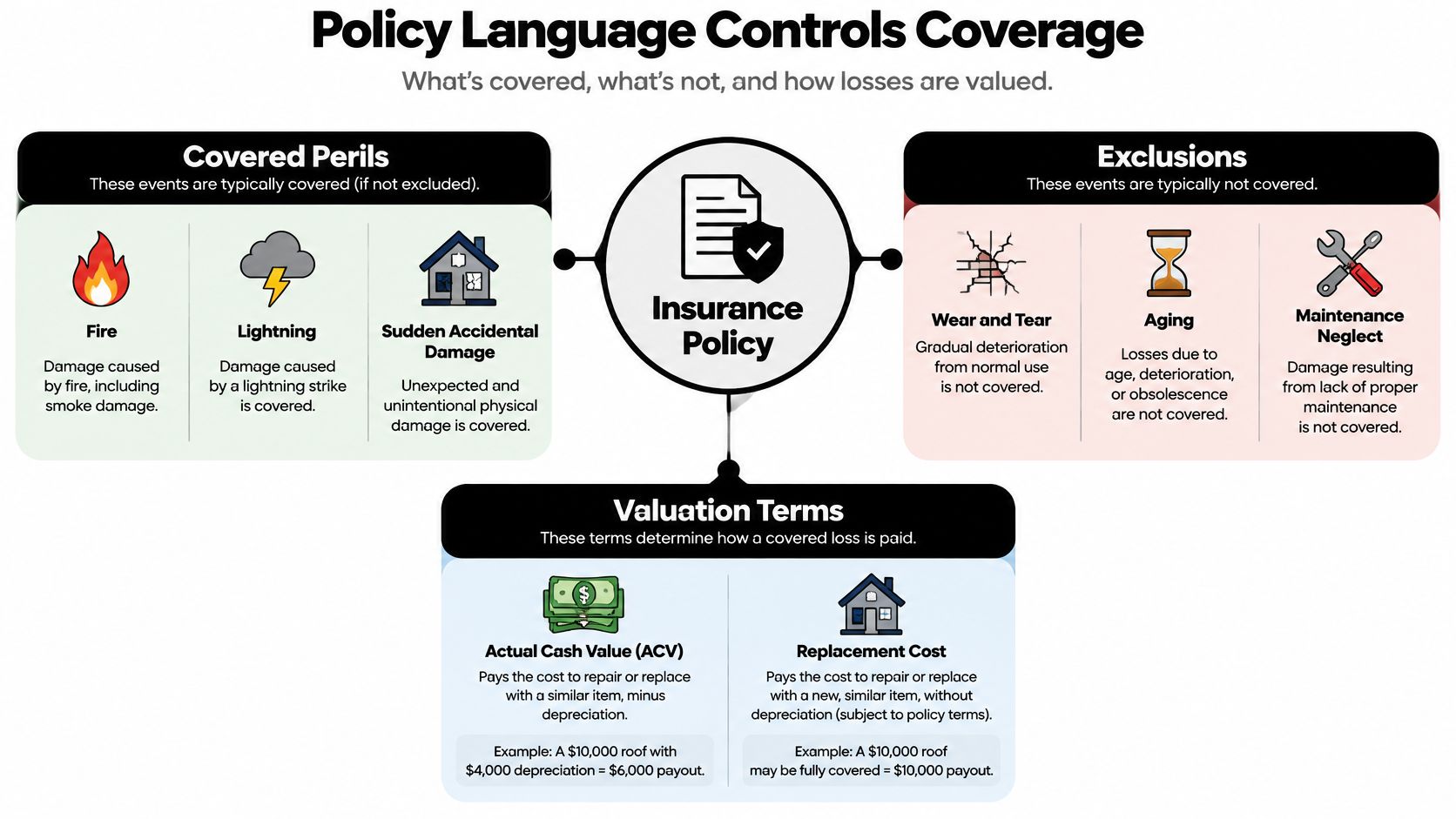
Two panels can fail in the same week and get opposite answers from the same carrier. The difference is rarely the equipment itself. It is what caused the failure and how the policy values the loss. The first review should locate the covered perils, dwelling terms, deductible, and every exclusion that mentions wear, deterioration, faulty maintenance, or electrical breakdown.
Three Clauses That Change the Outcome
Equipment breakdown coverage may respond to a sudden and accidental failure when it's included or endorsed. Definitions still matter. The policy may specify covered equipment, excluded causes, a separate deductible, and a payment limit, so a tripped main breaker doesn't automatically qualify. From the contractor side, I can document that a bus bar failed suddenly or that a breaker fused to the stab. Whether that evidence satisfies the endorsement is the adjuster's call, and no electrician can promise it will.
Ordinance or law coverage addresses a narrower problem. After covered damage, current code may require work beyond restoring the damaged component, such as relocating a panel or adding surge protection. Guidance from the National Association of Insurance Commissioners explains that a policy may restore the damaged portion, while unaffected areas generally aren't brought to current code without ordinance or law coverage.
Loss settlement terms determine how an approved amount is calculated. Actual Cash Value, or ACV, generally reflects value after depreciation. Replacement Cost Value, or RCV, generally concerns the cost to replace covered property under the policy's stated terms and conditions. Neither label promises a brand specific match or an upgraded panel at no added cost. On an older panel, an ACV settlement can leave a real gap between the check and the invoice, and RCV policies frequently pay recoverable depreciation only after the work is finished and invoiced.
Homeowners comparing the broader claims process can also review this guide for NC homeowners on claims as general background on how carriers document cause of loss, while treating the Utah policy in hand as controlling. State rules and insurer forms vary, so a general explainer can't replace the declarations page and endorsements.
Useful written questions for the carrier include:
- Cause standard: What evidence does the carrier require to connect damage to a covered peril, and who makes that determination?
- Endorsement check: Does the policy include equipment breakdown or ordinance or law benefits?
- Settlement basis: Will any approved loss be calculated as ACV or RCV, and is depreciation recoverable once repairs are complete?
Build Documentation Before Filing a Claim
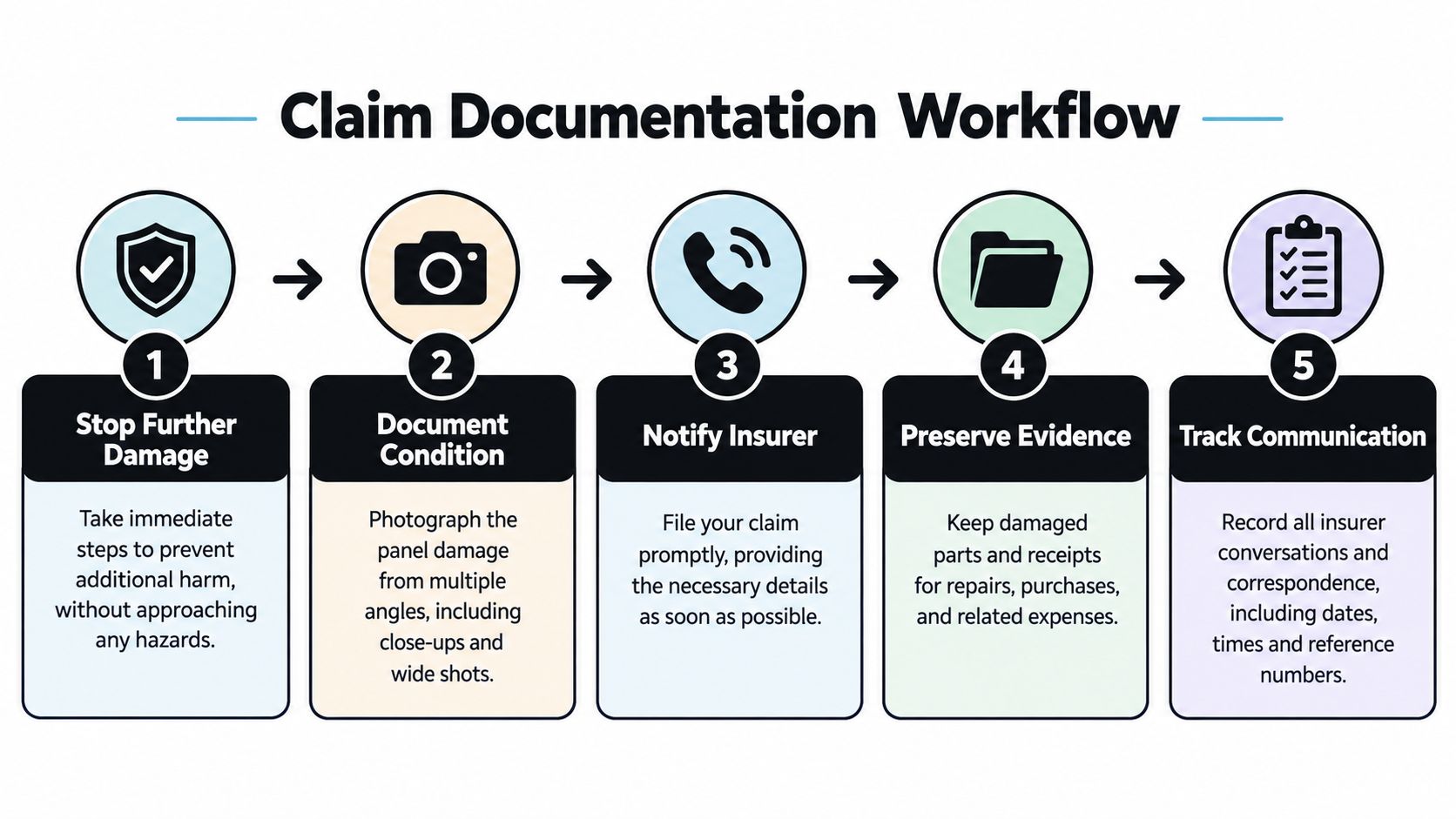
Safety comes before evidence collection. Homeowners can note smoke, burning odor, heat, buzzing, visible scorching, or a sudden loss of power from a safe distance. Nobody should open a damaged panel, touch conductors, or approach an active hazard to take a better photograph.
Documentation Checklist
- Dated exterior photos: Capture the closed panel, surrounding wall, visible labels, and any damage that can be photographed safely.
- Event timeline: Record when the fire, storm, outage, odor, or breaker failure was first noticed.
- Model information: Save manufacturer, model, serial, breaker labels, and any prior inspection report.
- Prior symptoms: Note earlier tripping, flickering, heat, corrosion findings, or recent electrical work.
- Written electrician scope: Request itemized separation between direct damage, required access, code triggered work, and optional upgrades.
- Insurer correspondence: Keep claim numbers, names, dates, and written instructions about inspection or disposal.
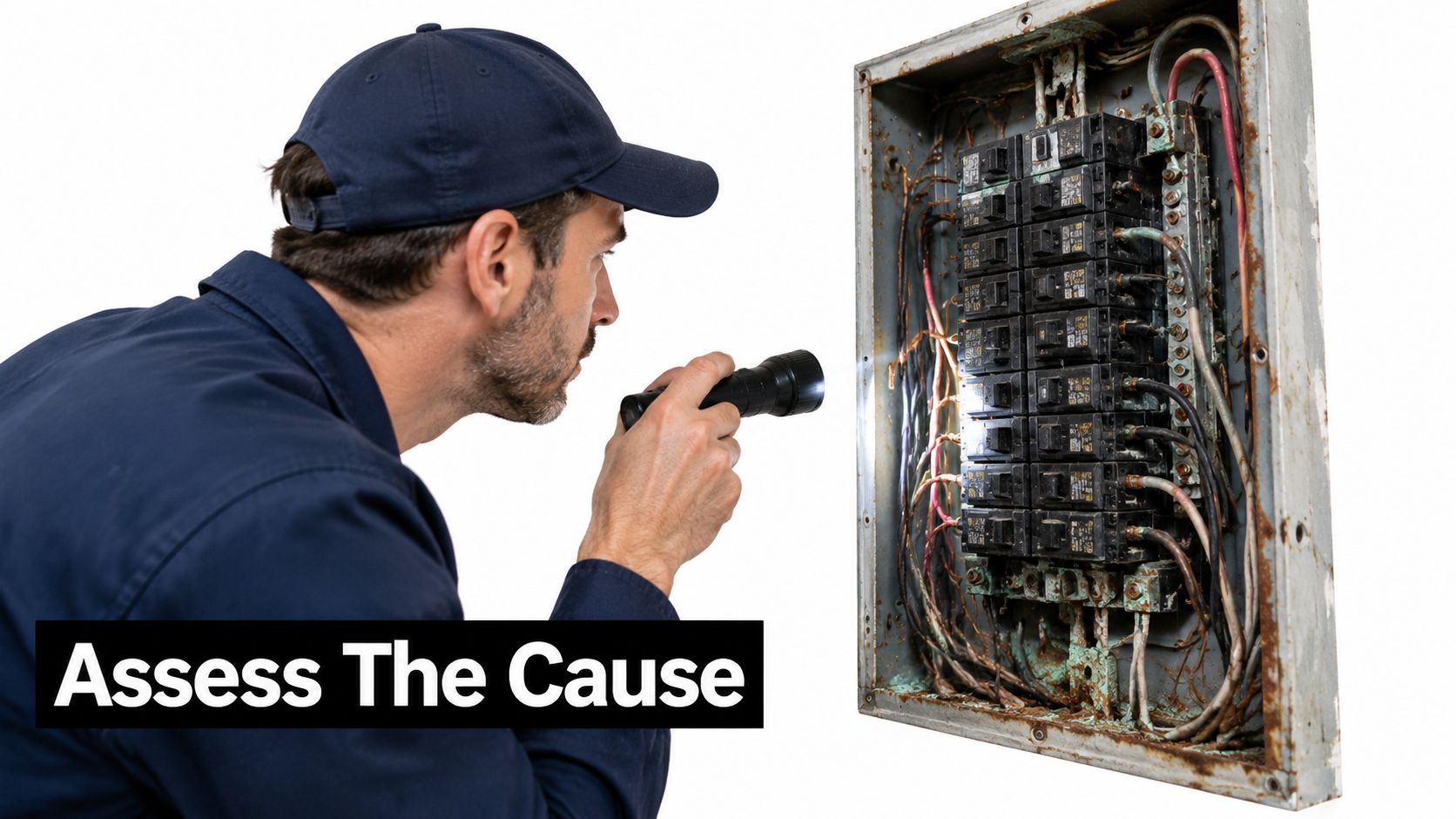
A licensed electrician can evaluate burn patterns, damaged breakers, bus condition, conductor insulation, moisture, overheating, and signs of overloading. The written cause of failure assessment should describe observed facts and avoid claiming certainty where testing can't establish the origin.
Evidence preservation is critical. Homeowners should preserve the damaged panel, obtain a written cause of failure assessment, photograph visible damage, and report the event promptly rather than discard parts before adjuster review. Authorizing unrelated modernization at the same time can blur the boundary between loss and improvement.
Permit and inspection findings also help define necessary scope. The homeowner guide to inspection failures offers context for code issues an electrician may identify during documentation.
Preservation rule: Emergency stabilization may be necessary, but permanent replacement should not erase evidence before the insurer has had a reasonable chance to inspect it.
Work Through Unsafe Panels and Repair Scenarios
Representative scenarios show why causation controls the financial path. None guarantees approval or denial, because each result still depends on documented facts and policy language.
Five Common Fact Patterns
Panel damaged during a covered house fire. Photos, fire reports, preserved components, and an itemized scope help the insurer separate burned equipment from unaffected circuits. Code upgrades remain a separate coverage question.
Corrosion or loose terminations found during service. Those findings point toward deterioration or maintenance unless evidence links them to a sudden covered event. Repair may still be urgent because heat and arcing risks don't wait for a coverage decision. Guidance for owners of older houses in another market, including options to find NC coverage for aging houses, illustrates why carriers scrutinize age related systems, although Utah homeowners must confirm terms with their own insurer.
Obsolete panel identified by an inspector. The safety finding may affect purchase, renewal, or insurability, but it doesn't by itself establish an insured loss. Homeowners deciding on proactive work can review when to upgrade your electrical panel for condition based warning signs.
Recall related concern. Model and serial documentation matter, along with any manufacturer notice presented to the electrician. A recall or safety concern shouldn't be treated as automatic insurance payment.
Undersized service ahead of an EV charger or remodel. Added load creates a capacity project. Unless covered damage overlaps the scope, the expansion is ordinarily an improvement paid by the homeowner.
Stop and call conditions include smoke, burning odor, panel heat, buzzing, sparks, exposed conductors, scorch marks, or repeated unexplained trips. Consumer guidance notes that homeowners can safely observe burning odor, heat, smoke, or visible damage but should contact the insurer and a licensed electrician rather than handle energized components.
Compare Repair, Warranty, and Financing Options
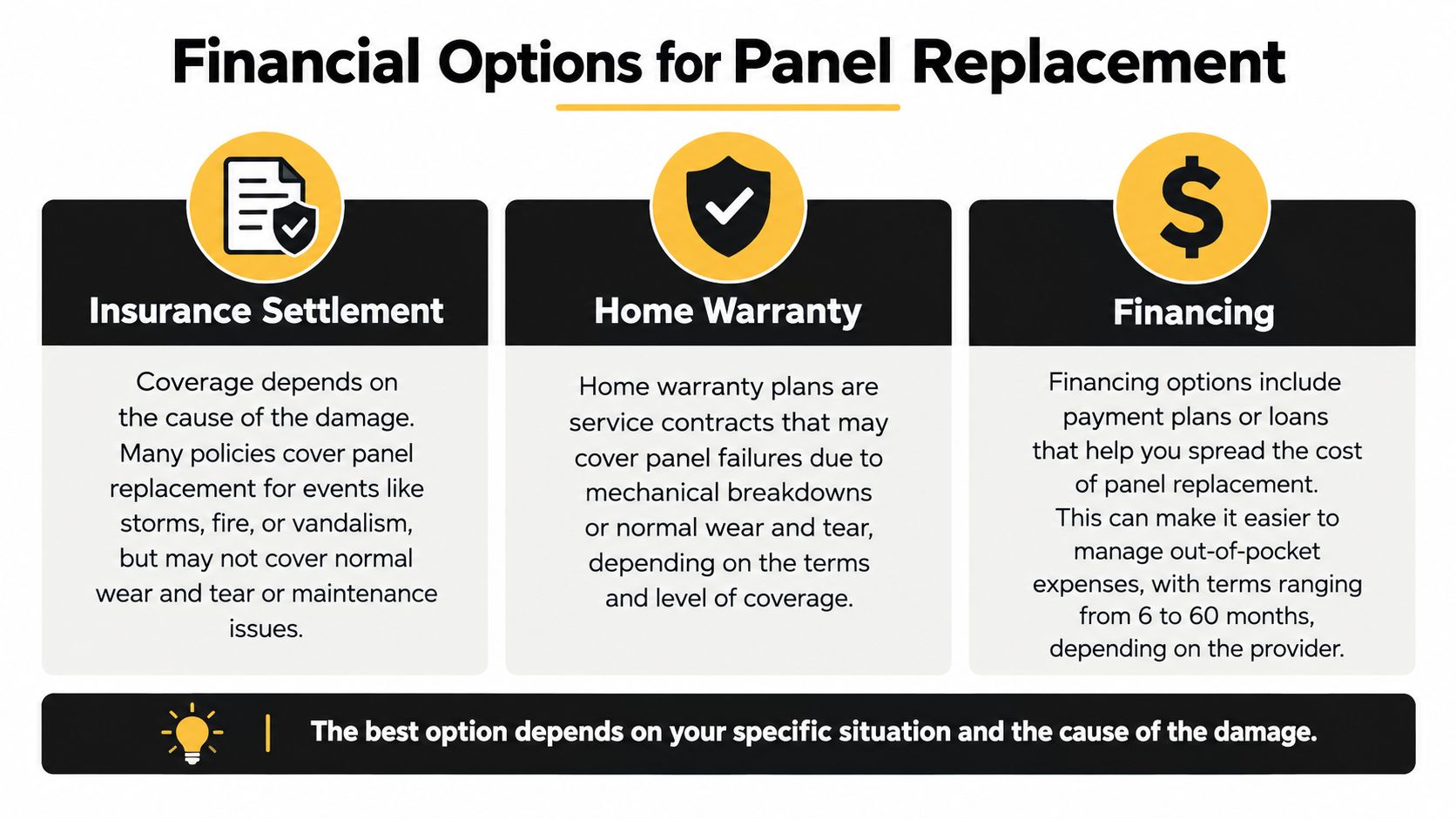
Insurance, a home warranty, a recall program, and financing solve different problems. Treating them as interchangeable often sends the claim or service request to the wrong place first.
Match the Mechanism to the Cause
Homeowners insurance starts with a covered event and policy terms. Payment, if approved, may restore the damaged portion subject to deductibles, exclusions, limits, and settlement method.
A home warranty is a service contract, not homeowners insurance. It may have service fees, eligibility rules, preexisting condition terms, and category limits. Those provisions should be read before authorizing work, especially when the panel still operates but has been identified as obsolete or undersized.
A manufacturer or recall program depends on the equipment and the terms of that program. Model documentation is essential, and labor, permits, access work, or code corrections shouldn't be assumed included.
Financing or direct payment can fund an uncovered replacement, but neither option makes the job reimbursable. Homeowners evaluating budget categories can use the electrical panel upgrade cost guide to organize scope questions before requesting an itemized estimate.
The clearest proposal separates five buckets: emergency stabilization, direct damage repair, required access, unrelated corrections, and elective capacity improvements. That separation helps an insurer review only the loss portion, helps a warranty administrator apply contract terms, and prevents a safety correction from being confused with a remodel upgrade.
Prepare for a Safe Electrical Service Visit
Before a visit, homeowners should write down visible symptoms, recent events, breaker behavior, and questions about capacity or code. Observations should stay outside the panel. A licensed electrician handles internal inspection, testing, conductor evaluation, grounding and bonding checks, and repair recommendations.
For homes in Weber County, Davis County, and Salt Lake County, permit and inspection expectations should be confirmed for the specific project. A useful written scope names the panel model, observed cause related damage, separate code items, access needs, and work beyond the claimed loss.
Homeowners needing panel evaluation can review service details from a breaker panel electrician, call 385-396-7048, or submit the request a quote form. The insurer decides coverage, while the electrician evaluates electrical condition and safety.
For panel damage, repeated breaker problems, or an unsafe panel finding in Northern Utah, Black Rhino Electric can inspect the electrical condition, document visible findings, and provide a written scope that separates repairs from optional upgrades. Contact the team to schedule an evaluation, then share the documentation with the insurer for its independent coverage decision.