
A homeowner plugs in a three-light tester, sees the outlet still power a lamp, and then notices the display says “open ground.” The practical answer to what does open ground mean on outlet tester is that the tester detects a hot-to-neutral voltage pattern but can't find a functioning equipment-grounding path at the receptacle.
Opening Answer to Open Ground Meanings
An open-ground reading doesn't necessarily mean the outlet is dead. It means the receptacle appears to have power between the hot and neutral conductors, while the tester can't verify the safety path connected to the grounding contact.
That path is the equipment-grounding conductor, or EGC. During ordinary operation, it normally carries no current. If an energized wire touches the metal case of an appliance, tool, or other equipment, the EGC is intended to provide a low-resistance route for fault current so protective devices can disconnect power. Without that route, the appliance may continue to operate while exposed metal parts present a greater shock risk. A detailed explanation of open-ground tester results describes the same distinction between normal operation and fault protection.
A three-slot receptacle doesn't prove that grounding protection exists. Someone may have installed a modern-looking receptacle on an older two-wire circuit, or a grounding conductor may be disconnected at the receptacle, an upstream box, the panel, or another point in the circuit. The tester checks a limited set of electrical relationships. It can't trace the entire circuit or prove that the grounding path can safely carry fault current.
Practical rule: Treat open ground as a warning, not as proof that the outlet is safe or that replacing the cover device will solve the problem.
Homeowners can record which outlets show the reading and unplug equipment when practical. They shouldn't remove the receptacle or panel cover to investigate. For background on making electrical service information easier for local homeowners to find, local SEO for electricians is a useful resource, while testing your home's GFCI outlets can help explain a related protection device.
Understanding Outlet Tester Readings and Comparisons
Plug-in testers are useful screening devices, but their light patterns can be misunderstood. “Open ground” is different from “open neutral,” “open hot,” and “reversed polarity,” even though all of them may appear on the same small display.
| Reading | Likely meaning | Urgency |
|---|---|---|
| Open ground | Hot-to-neutral voltage is detected, but the tester can't verify a continuous equipment-grounding path | Stop relying on the outlet for grounded equipment and arrange evaluation |
| Open neutral | The neutral connection appears interrupted or missing, so the circuit may not complete normally | Stop using the outlet and seek professional troubleshooting |
| Open hot | The tester doesn't detect the expected energized hot connection | Don't assume the receptacle is safe to use or that the circuit is fully de-energized |
| Reversed polarity | The tester detects an abnormal relationship between the hot and neutral conductors | Stop using the outlet until the wiring is checked |
| Correct wiring indication | The tester sees the limited relationships it's designed to check | Not proof of full code compliance, ground quality, or safe fault-current capacity |
An open ground is unusual because the receptacle can appear to work normally. A lamp may turn on, a charger may power up, and the tester may still display a warning. That normal operation only shows that some part of the hot-to-neutral circuit is functioning. It doesn't establish that metal cases, surge-protection components, or fault-current paths are properly connected.
Other readings can also be misleading. Manufacturer instructions for plug-in testers warn that these devices don't measure ground quality, can miss certain combinations of defects, and may not identify every hazardous wiring condition. A false or improper neutral-to-ground connection at the receptacle can make a basic tester appear satisfied even though the circuit isn't correctly grounded.
A qualified electrician performing electrical troubleshooting uses the tester result as a starting point, not a final diagnosis. The evaluation may involve tracing the circuit, checking terminations, confirming conductor continuity, inspecting the panel and accessible junction points, and determining whether the protective arrangement matches the applicable electrical code.
Why Older Northern Utah Homes Have Open Grounds
In older homes around Weber, Davis, and Salt Lake counties, an open-ground reading often reflects the age or alteration history of the wiring rather than a failure of the tester. Many earlier residential circuits used two conductors, an ungrounded hot and a grounded neutral, without a separate equipment-grounding conductor.
The transition to grounding-type receptacles happened gradually. The 1947 National Electrical Code introduced grounding-type three-prong receptacles in limited higher-risk locations, the 1956 NEC expanded grounding requirements to areas such as basements, garages, and outdoors, and the 1962 NEC required new 120-volt branch circuits to include an equipment-grounding conductor. The 1971 NEC then required grounded outlets in new homes. These milestones are summarized in the historical code discussion from Electrical Contractor Magazine.
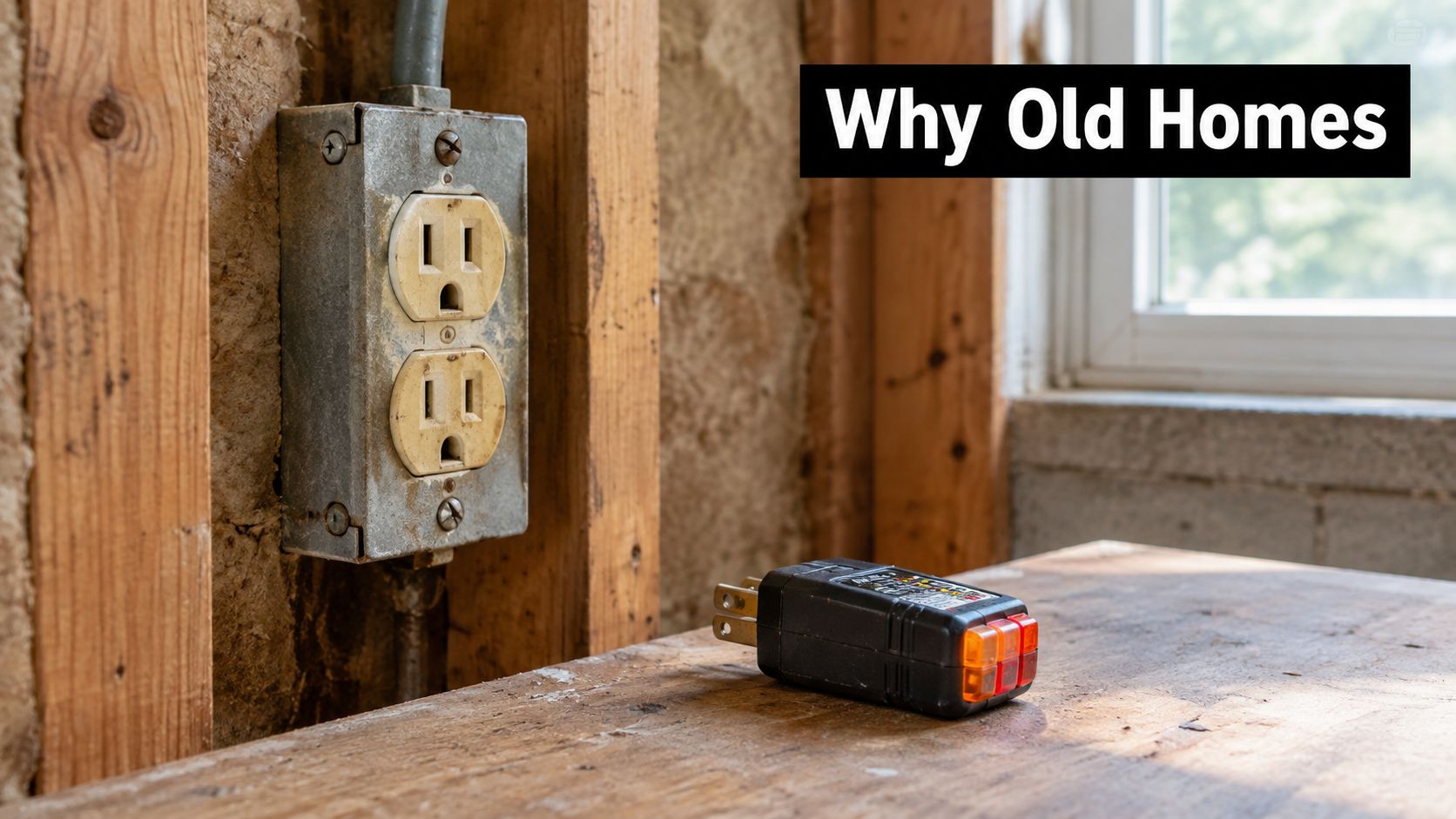
Why a three-slot outlet can still be ungrounded
A three-slot receptacle added to an older two-wire circuit creates a particularly confusing situation. The plug fits, the connected device may operate, and the face of the receptacle looks modern. But if no EGC reaches that box, the grounding contact has no verified fault-current path.
The same result can occur after remodeling, partial rewiring, or an outlet replacement where a grounding connection was left disconnected. A loose termination or interruption farther upstream may affect several outlets, while a problem at one receptacle may affect only that location.
The right repair depends on what the electrician finds and what local requirements allow. Options may include adding a genuine EGC, installing an approved GFCI arrangement with required labeling where permitted, or evaluating broader rewiring. A three-prong replacement alone isn't a grounding repair, and a ground rod or improvised connection isn't an automatic solution.
For homeowners considering a purchase, the distinction matters when negotiating with seller after inspection. An inspection finding should lead to a defined electrical evaluation, not an assumption that every older outlet needs the same correction.
Safety Risks and Testing Limitations
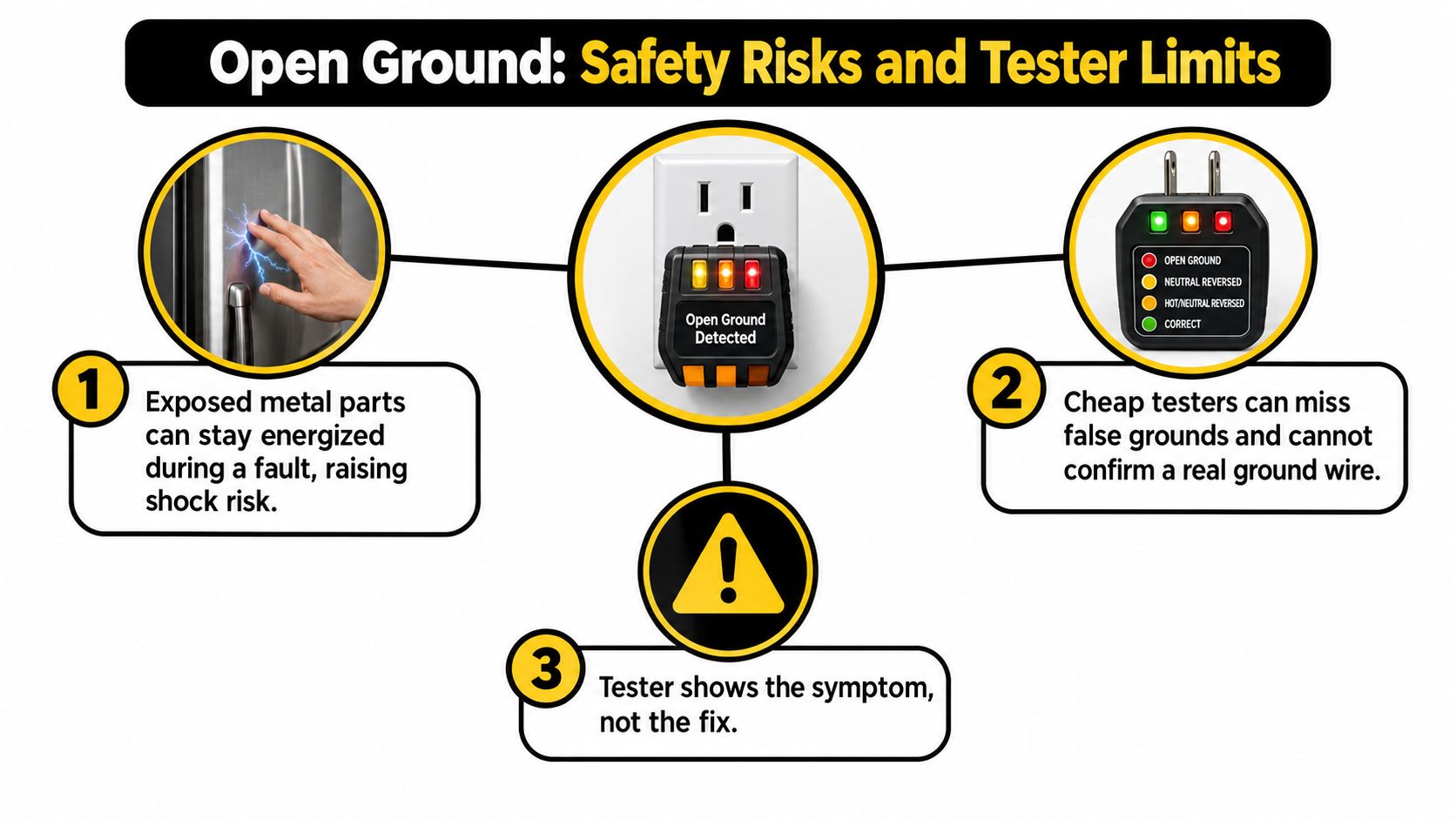
The dangerous misconception is simple: a working plug isn't necessarily a safe plug. A receptacle can deliver power while lacking the equipment-grounding path intended to protect a person if an internal appliance fault energizes exposed metal.
A metal-cased appliance with an internal fault may leave its enclosure energized until another conductive path is available. A person touching the appliance and a grounded surface could become part of that path. The grounding conductor is intended to carry fault current back toward the source through a low-impedance route, helping the protective device disconnect power.
What the tester cannot establish
The tester doesn't measure the complete grounding system. It can't confirm the condition of the grounding electrode system, locate the break, measure the grounding path's ability to carry fault current, or identify every combined wiring defect. It also can't turn a three-slot face into a properly grounded circuit.
Grounding and GFCI protection serve different purposes. OSHA distinguishes system grounding from equipment grounding, with equipment grounding intended to provide a low-resistance fault path from energized metal parts. A GFCI can reduce shock risk in some situations by detecting an imbalance and disconnecting power, but it doesn't create an equipment-grounding conductor. OSHA's electrical grounding guidance explains that distinction.
A GFCI may be allowed on a two-wire circuit under applicable code provisions, with the receptacle and downstream outlets labeled appropriately. A standard plug-in tester may not reliably verify that protection on an ungrounded circuit because its test current can depend on the very grounding path that's missing.
The tester shows a symptom. It doesn't identify the repair.
Open ground deserves faster attention when the receptacle serves a metal-cased appliance, computer equipment, tools, a hot tub, outdoor equipment, or another device that relies on grounding. Stop using the affected outlet if there's a shock, burning odor, scorch mark, heat, buzzing, or repeated breaker activity, and arrange professional troubleshooting.
Homeowner Options for Grounding Correction
Older wiring doesn't have one universal fix. The appropriate choice depends on the existing cable, accessible pathways, panel and service conditions, the location of the receptacle, the equipment being used, and applicable code requirements.
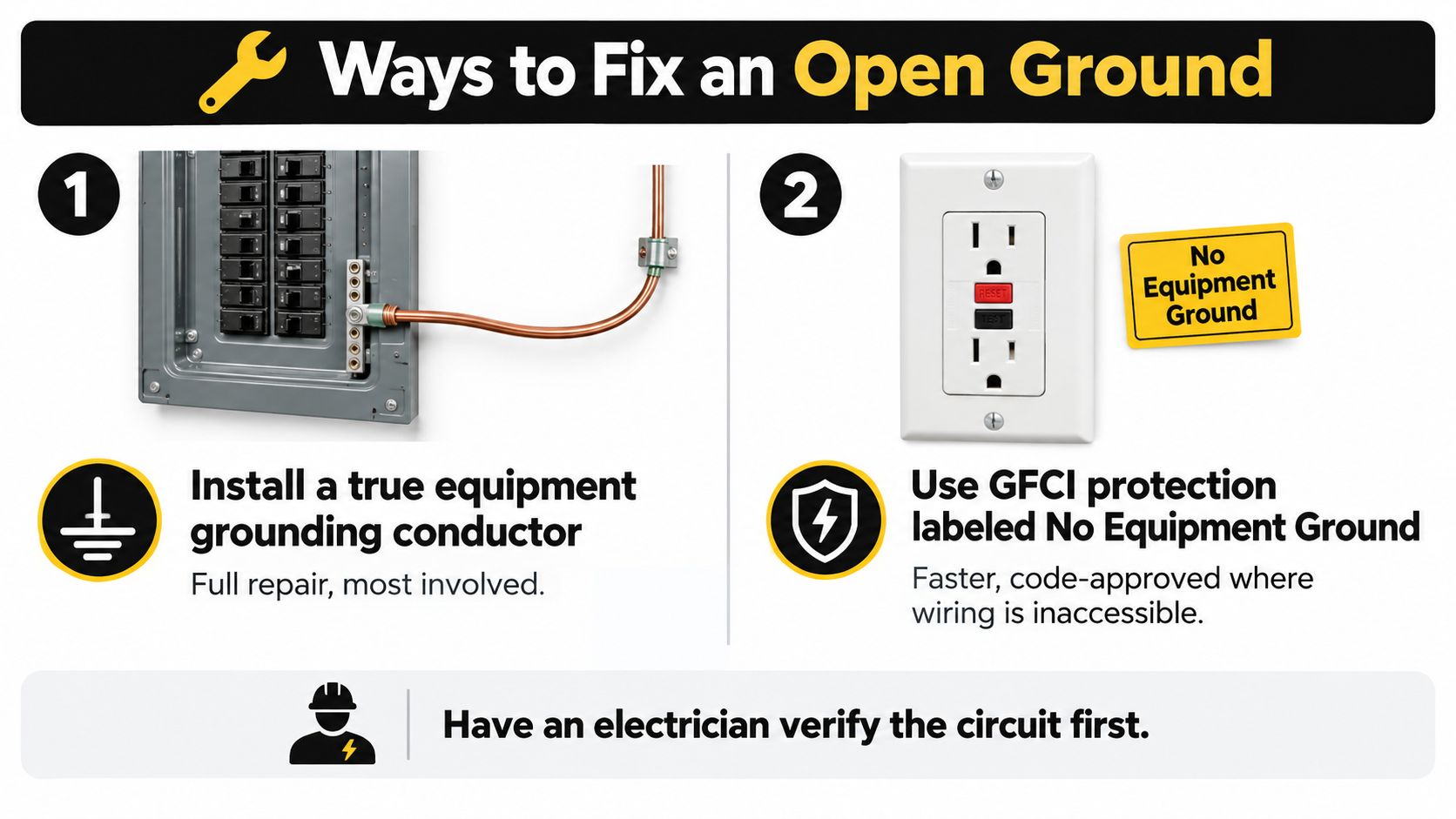
| Correction path | What it accomplishes | Main trade-off |
|---|---|---|
| Install a genuine equipment-grounding conductor | Provides the intended grounding path when properly connected back through the circuit and service equipment | May require access to boxes, cable routes, or other parts of the building |
| Use approved GFCI protection and labeling | Adds shock protection where permitted, even when an EGC isn't available | It doesn't create a ground and doesn't provide the same function as equipment grounding |
| Evaluate rewiring | Replaces outdated or extensively altered wiring and can address broader circuit concerns | The scope depends on how much wiring needs access and correction |
Choosing between the options
An EGC repair is often the most direct answer when the existing circuit can accept a proper conductor and the route is practical. The electrician must verify where that conductor connects and whether the grounding and bonding arrangement is correct. Attaching a wire to a nearby pipe, rod, receptacle box, or neutral terminal without proper evaluation can create a different hazard.
GFCI protection may be a useful code-compliant approach in specific circumstances. The receptacle or protected outlets need the required “No Equipment Ground” or related labeling, and the electrician must confirm that the arrangement is permitted for that location and installation. It improves shock protection, but sensitive equipment may still lack the grounding connection it expects.
Rewiring makes more sense when open grounds appear throughout the home, when circuits have been altered repeatedly, or when the property is already undergoing a remodel. Kitchens, basements, garages, wet areas, hot tub wiring, EV charger circuits, and other dedicated loads deserve individual evaluation rather than a one-size-fits-all outlet swap.
The Black Rhino Electric GFCI guide can help homeowners understand the purpose of GFCI devices. Any actual replacement, rewiring, grounding-conductor work, or panel connection should be handled by a qualified electrician.
Safe Checks and When to Call an Electrician
Homeowners can gather useful information without opening an outlet or panel. The safest approach is observation, documentation, and removing equipment from a questionable receptacle when practical.
Safe observations at home
- Map the readings: Use the plug-in tester only as directed, note which outlets show open ground, and record whether the pattern appears in one room or across several areas.
- Check wet-area protection: Look for GFCI receptacles or other GFCI protection in applicable kitchens, bathrooms, garages, outdoor areas, and other locations where protection may be required. Don't assume that a nearby device protects every outlet unless the circuit has been verified.
- Unplug sensitive equipment: Disconnect computers, tools, surge-protection devices, hot-tub equipment, and other grounding-dependent devices from the warning receptacle when practical.
- Record warning signs: Write down any shock, tingling, heat, discoloration, buzzing, burning odor, loose receptacle, or breaker activity and tell the electrician exactly where it occurred.
- Leave the wiring alone: Don't remove the cover plate, pull out the receptacle, open the panel, bond neutral to ground at the outlet, or install a makeshift wire.
A general Northpoint Construction's safety checklist can provide additional context for household electrical observations, but a checklist can't replace circuit testing and code evaluation.
Stop and call conditions
Professional help is appropriate when the open-ground reading remains, affects multiple outlets, or appears on a circuit serving a high-load or permanently connected device. It's especially important before installing an EV charger, Tesla Wall Connector, hot tub, spa, new appliance circuit, or other equipment that requires a verified electrical connection.
During a service visit, the electrician typically identifies the affected outlets, checks accessible wiring and terminations, traces the circuit toward the panel, verifies grounding and bonding, and determines whether the issue is local or part of an older branch-circuit design. The recommended correction should explain what the circuit currently has, what the proposed work changes, and what labeling or inspection considerations apply.
Call promptly rather than repeatedly resetting a breaker or relying on a “correct wiring” light. Homeowners in Northern Utah can schedule an electrician for a professional evaluation without attempting energized testing or receptacle rewiring.
For open-ground readings, Black Rhino Electric provides residential and commercial troubleshooting, outlet and GFCI work, wiring repairs, panel and meter services, rewiring, EV charger and hot tub wiring, and code-violation corrections across Northern Utah. Visit Black Rhino Electric, call 385-396-7048, or submit the quote request form to arrange an evaluation of the affected circuit.