
If you're looking into air conditioning Park City solutions, you're probably feeling the same tension most homeowners do. You want a house that stays comfortable in summer, but you also don't want to buy the wrong system, overload your electrical panel, or end up with an installation that never performs the way it should.
Your Air Conditioning Options for a Park City Home
A common Park City call goes like this: one room stays hot every afternoon, the guest wing is empty most of the month, and the homeowner is not sure the existing panel can handle another major load. The right AC choice starts there. Layout, occupancy pattern, duct condition, and electrical capacity all matter before anyone picks equipment.
Central air for full-home cooling
A traditional central air system usually fits homes that already have good ductwork or new construction where ducts can be planned properly from the start. For a full-time residence with a conventional floor plan, central air can keep the whole house on one system and one control strategy.
The catch is the duct system. If the ducts are undersized, leaking, poorly balanced, or routed through very hot attic areas, the equipment will never perform as well as the brochure suggests. I see this often in remodels where homeowners replace the condenser but leave old duct problems in place. They buy new equipment and keep the same comfort complaints.
Central air also has a bigger electrical planning step than many homeowners expect. The outdoor unit, air handler or furnace interface, disconnect, breaker size, and available panel space all need to line up before installation day.
Ductless mini-splits for zoning and hard-to-duct spaces
Ductless mini-splits are a strong option for additions, older homes, guest suites, garages, and rooms that heat up differently from the rest of the house. They let you cool occupied areas without forcing one thermostat to guess what the whole house needs.
That zoning advantage matters in Park City, where part-time occupancy is common. If two bedrooms sit empty most weekdays, there is no reason to cool them the same way as a home office or main living area.
Mini-splits also avoid expensive wall and ceiling work when ducts are not practical. For homeowners comparing upkeep and service needs, Black Rhino Electric has a useful guide on mini-split AC servicing.
One caution from the field: multi-zone systems solve a lot of problems, but they need careful design. Too many indoor heads on a poorly matched outdoor unit can create control and performance issues that show up later, not at the sales appointment.
Heat pumps for cooling plus future electrical planning
A modern heat pump makes sense for homeowners who want cooling now and may want to reduce fuel use later. It can cover heating and cooling in one piece of equipment, which is appealing in remodels and equipment replacement projects.
That decision should never be made in isolation. Heat pumps can change circuit requirements, breaker sizing, load calculations, and in some homes, panel upgrade plans. Older houses are where this gets missed. The equipment may fit the space, but the electrical system may need new capacity, a dedicated circuit, or updated controls before the installation is safe and code-compliant.
This is one of the biggest mistakes in generic AC advice. It treats the condenser or heat pump as the main decision and leaves the electrical work as an afterthought. In practice, they need to be planned together.
AC system comparison for Park City homes
| System Type | Best For | Typical Upfront Cost | Pros | Cons |
|---|---|---|---|---|
| Central Air | Larger homes with existing ductwork | Varies by home and scope | Whole-home cooling, single-system operation, familiar setup | Requires ductwork, duct issues can limit performance, less flexible room-by-room control |
| Ductless Mini-Split | Additions, cabins, older homes, guest spaces, zoning needs | Varies by number of indoor units and installation scope | Zoning, no ductwork required, good fit for remodels | Visible indoor heads, multi-zone design can get complex |
| Heat Pump | Homeowners replacing AC and evaluating heating and electrical upgrades at the same time | Varies by equipment and electrical readiness | Heating and cooling in one system, strong fit for long-term planning | May require electrical upgrades, equipment selection must match home conditions carefully |
A few quick filters help narrow the field:
- Choose central air if the house already has sound ductwork and you want one system serving the whole home.
- Choose mini-splits if you need room-by-room control or want to cool areas where ducts would be expensive or disruptive.
- Choose a heat pump if you're replacing equipment and want the cooling decision to line up with future electrical and heating plans.
Why Park City's Climate and Altitude Matter for AC
Park City isn't a copy-and-paste cooling market. A house here can feel hot for reasons that don't show up clearly when someone looks only at outdoor temperature.

Sun load changes the cooling problem
At altitude, sunlight can drive indoor heat gain hard through windows, roofs, and upper-floor spaces. That's why two homes on the same street can need very different cooling strategies. One may stay stable because of shading, orientation, and better insulation. The other may overheat every afternoon because of western exposure and large glass areas.
A simple analogy helps. Cooling a mountain home isn't like cooling a humid coastal house. It's closer to dressing for a dry hike under intense sun. The air may not feel oppressive, but direct exposure changes everything.
Dry air doesn't remove the need for moisture control
Many homeowners assume dehumidification doesn't matter much in a mountain market. That assumption causes a lot of bad system choices. One of the biggest content gaps around Park City is the lack of location-specific guidance on sizing and dehumidification. Building research in the U.S. has long recognized indoor humidity control as a design issue in energy-efficient homes, especially when oversized or short-cycling systems don't remove moisture properly, and ASHRAE guidance emphasizes sensible and latent load calculations instead of rule-of-thumb sizing (Park City sizing and dehumidification discussion).
That point matters even more in tighter homes. If a system cools too fast and shuts off too soon, comfort can still feel off even when the thermostat says the temperature is right.
A thermostat can show the target number while the house still feels uncomfortable. That usually points to load, airflow, or runtime problems, not just a “bad AC.”
What local load calculations should include
A proper Park City cooling design should account for more than square footage.
- Window exposure: South- and west-facing glass can change afternoon cooling needs dramatically.
- Building envelope: A newer, tighter home behaves differently from an older home with air leakage.
- Occupancy pattern: A vacation property used intermittently may need a different control strategy than a full-time residence.
- Zoning reality: Bonus rooms, upper floors, and guest wings often need separate treatment.
- Shoulder-season swings: Mild outdoor conditions can still produce strong indoor solar gain.
Generic contractor math proves unreliable. If someone sizes your system by rough estimate alone, you're taking a risk with comfort, efficiency, and equipment life.
Sizing Your System for Peak Efficiency and Comfort
A high-efficiency air conditioner only performs like a high-efficiency air conditioner when the system is matched to the house and installed correctly. Equipment labels don't save a bad design.
What SEER2 actually tells you
For modern residential split-system air conditioners, federal regional efficiency rules now use SEER2 instead of the older SEER rating. Under current AHRI regional standards, the minimum for split-system ACs below 4.5 tons is 14.3 SEER2 (15 SEER), while systems above 4.5 tons must meet 13.8 SEER2 (14.5 SEER). Higher SEER2 ratings mean lower seasonal electricity use for the same cooling load, but only when the installation supports that performance (AHRI regional SEER2 requirements).
That last part is where many projects go sideways. SEER2 is not a magic shield against poor sizing, weak airflow, or sloppy setup.
What happens when sizing is wrong
An undersized system usually runs too long and struggles to pull the house down to setpoint during the hottest parts of the day. An oversized system has a different problem. It satisfies the thermostat quickly, cycles on and off too often, and never runs long enough to manage comfort the way it should.
For homeowners trying to understand the logic behind load calculations, these professional HVAC sizing insights from Cobre Valley Air LLC are a solid companion read because they explain why surface assumptions rarely produce reliable results.
Field note: The system that “sounds powerful” on paper is often the one that delivers the weakest real-world comfort if it wasn't sized to the actual load.
What to insist on before installation
Before anyone installs equipment, ask for the sizing method. If the answer is based mostly on square footage or what was there before, that isn't enough.
Use this checklist when reviewing a proposal:
- Load calculation first: Ask whether the contractor performed a room-by-room or whole-home load calculation rather than a rule-of-thumb estimate.
- Airflow planning: Make sure duct capacity, filter pressure, and return air paths are part of the discussion.
- Equipment match: The outdoor unit, indoor coil, and controls should be selected as a matched system.
- Installation details: Proper line set routing, condensate management, and startup testing affect real efficiency.
- Electrical coordination: Cooling performance and electrical readiness should be reviewed together. Black Rhino Electric's HVAC installation checklist is useful for catching scope items that often get missed.
The best-performing system is rarely the biggest one. It's the one sized for the house you have.
Understanding AC Installation Costs and Permitting
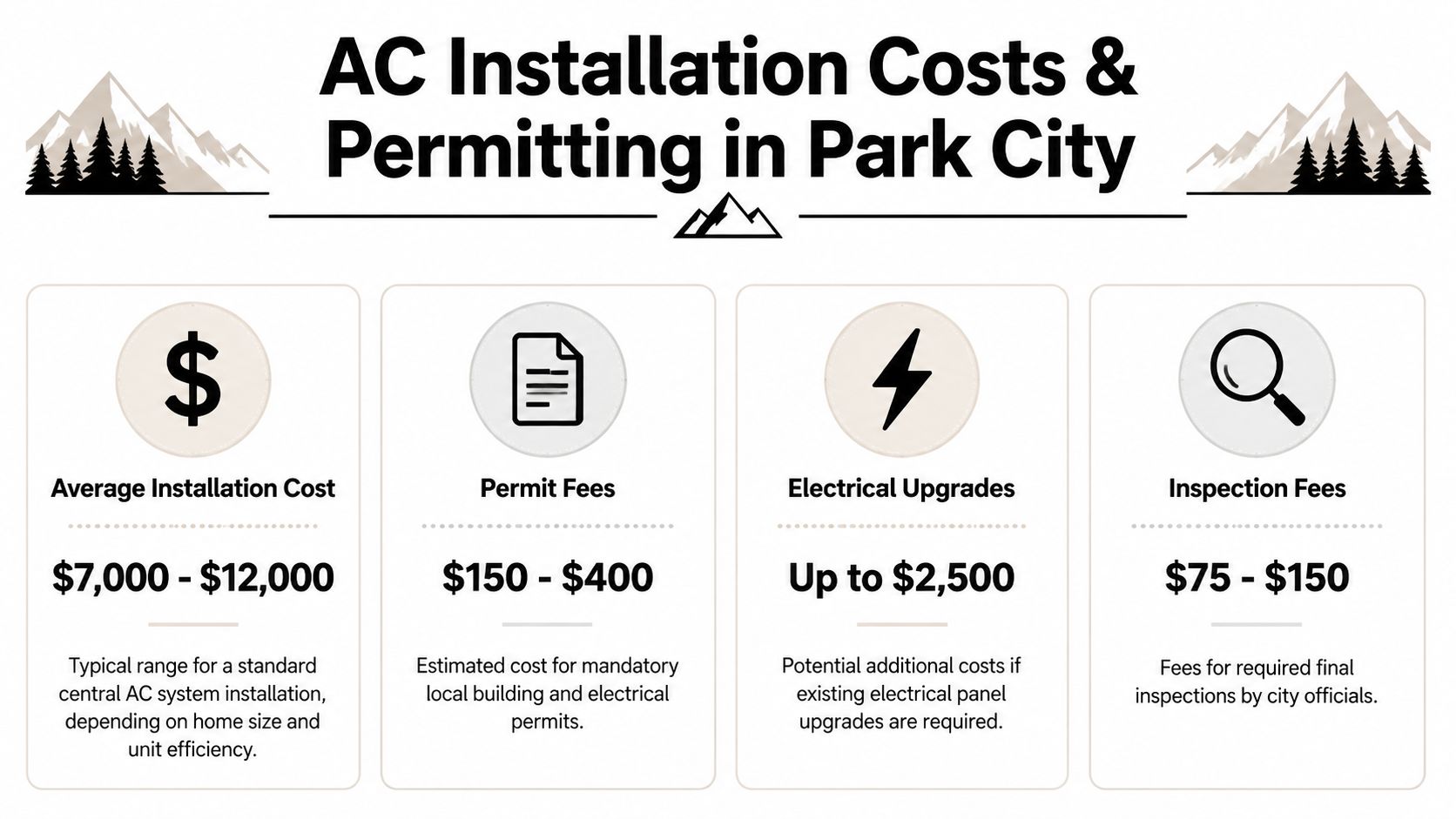
The price of a new AC system is never just the equipment. Homeowners get into trouble when they compare quotes as if every contractor is pricing the same scope.
What a proposal should actually include
A real installation quote should spell out the full job, not just the condenser and indoor unit. That usually means looking at line sets, disconnects, circuit work, thermostat compatibility, pad or mounting details, condensate disposal, startup labor, and any duct modifications needed for proper airflow.
Cheap quotes often leave those pieces vague. Then the change orders start.
Why permits matter
Permitting isn't paperwork for paperwork's sake. It creates a paper trail, requires code review, and helps make sure the electrical and mechanical work gets inspected. That's protection for the homeowner, especially if you remodel, sell, or file an insurance claim later.
If you want a plain-English explanation of why permit compliance matters beyond HVAC, this overview from Aureli Construction on building codes is worth reading because the same logic applies to cooling projects tied into your home's electrical system.
Questions to ask before signing
Use these questions to pressure-test any estimate:
- What's excluded: Ask specifically whether electrical upgrades, permit fees, control wiring, or duct changes are outside the quoted price.
- Who pulls permits: The answer should be clear. If nobody wants responsibility, that's a warning sign.
- Who handles inspections: Someone should coordinate final approval, not leave you guessing.
- What triggers extra charges: Panel issues, inaccessible routing paths, and structural obstacles should be discussed early.
- Is replacement like-for-like: A simple swap is different from converting to a heat pump or adding zoning.
If a quote looks dramatically lower than the others, assume something is missing until someone proves otherwise in writing.
Cost conversations are easier when the scope is complete. That's what keeps a cooling project from turning into a series of surprises.
The Critical Electrical Needs for Your New Air Conditioner
A Park City homeowner replaces an old AC condenser, the crew sets the new unit, and everything looks fine until the first hot afternoon. The breaker trips, lights dip when the compressor starts, and the install stalls because the electrical side was never checked closely enough. I see that problem more often than I should.
A new AC needs more than breaker space
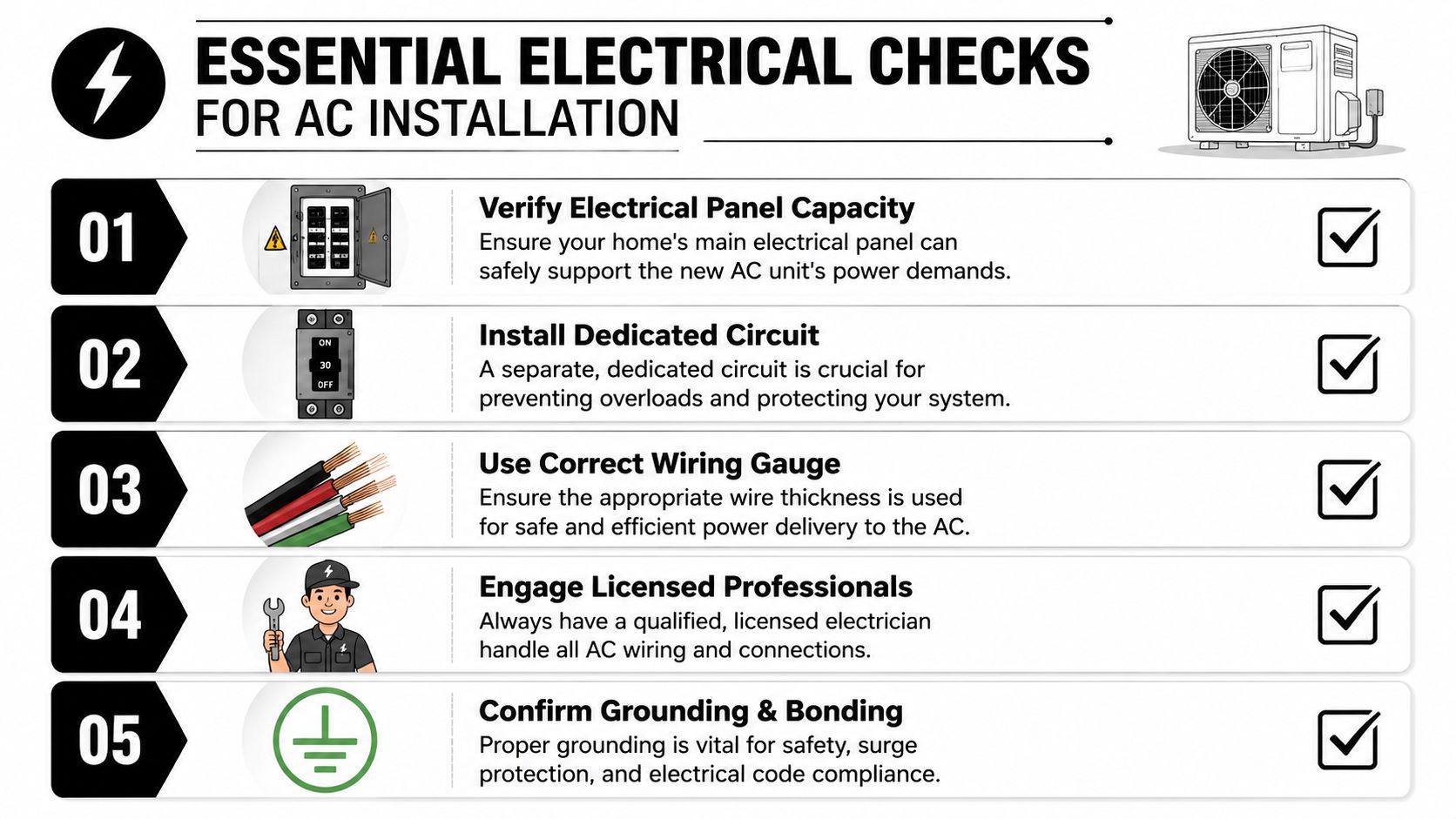
Most central AC systems and many heat pumps need a dedicated 240-volt circuit sized to the equipment. That means the breaker, wire size, disconnect, grounding, bonding, and terminations all have to match the manufacturer instructions and code requirements.
An open slot in the panel does not answer the real questions. The important checks are whether the service can carry the added load, whether the panel is in good enough condition to accept a new circuit, and whether the layout leaves room for the correct breaker and conductor routing. In Park City, that review matters even more because homeowners often add electric upgrades over time, including heat pumps, hot tubs, garage heaters, or EV charging. Each one competes for capacity.
Signs the electrical system needs a closer look
Some houses tell you early that the panel may not be ready for new cooling equipment.
- Breakers trip during summer use: That can point to an overloaded panel, a weak breaker, or another circuit issue that needs testing.
- Lights dim when large appliances start: Voltage drop or poor connections should be checked before adding compressor load.
- The home still has fuses or an older panel: Replacement may be straightforward, but planning gets tighter and code corrections are common.
- Circuit labels are missing or confusing: That slows load calculations and raises the risk of mistakes during installation.
- Past remodels added patchwork wiring: Mixed wiring methods deserve inspection before new equipment is tied in.
Poor AC electrical work creates real problems. I am not talking about minor inconvenience. I mean overheated conductors, nuisance trips, failed inspections, damaged equipment, and service calls that could have been avoided with proper load planning.
HVAC and electrical work have to line up
The HVAC side and the electrical side affect each other. The equipment nameplate tells you what the circuit must support. The panel capacity determines whether that circuit can be added safely. The disconnect has to be placed where service can be performed safely and legally. Thermostat and control wiring also need to be protected and installed correctly, especially on higher-efficiency systems with more complex controls.
If you want a plain-English explanation of why your air conditioner should be on its own circuit, this guide on what a dedicated circuit is for major appliances covers the basics.
What good electrical prep looks like
Before the system is energized, the electrical work should be checked point by point.
| Electrical Check | Why It Matters | What Can Go Wrong If Ignored |
|---|---|---|
| Panel capacity review | Confirms the home can support the added cooling load | Overloaded service, nuisance tripping, failed inspection |
| Dedicated circuit design | Protects the equipment and isolates a major load | Shared circuits, voltage issues, breaker problems |
| Correct wire sizing | Keeps conductors within safe temperature limits | Heat buildup, insulation damage, unsafe operation |
| Disconnect placement | Gives technicians a safe shutoff point near the unit | Unsafe servicing conditions |
| Grounding and bonding verification | Helps the system clear faults properly and meet code | Shock hazards and unreliable fault clearing |
A good AC quote should mention this work clearly. If it barely addresses the electrical side, ask direct questions before anyone starts. In Park City, a cooling system is only as dependable as the circuit feeding it.
A Simple Maintenance Schedule for AC Longevity
Once the system is installed right, maintenance keeps it that way. This doesn't need to be complicated, but it does need to be consistent.
Monthly and seasonal homeowner tasks
Most homeowners can handle the basic upkeep safely.
- Check the filter: Replace or clean it on the schedule recommended for your system and living conditions. A loaded filter hurts airflow fast.
- Keep the outdoor unit clear: Remove leaves, cottonwood, and windblown debris. Trim vegetation so the unit can breathe.
- Watch the thermostat behavior: If the system starts running longer than usual or comfort becomes uneven, don't ignore it.
- Check supply and return vents: Make sure furniture, rugs, and drapes aren't blocking airflow.
What a technician should inspect
An annual professional tune-up is still worth scheduling, especially before heavy cooling use. A technician can inspect electrical connections, test components, clean coils, verify drainage, and evaluate whether the system is operating the way it was designed to operate.
That visit also catches small issues before they turn into compressor strain, water damage, or mid-season breakdowns.
Maintenance is cheaper than emergency replacement, and it's a lot less stressful than losing cooling when you need it most.
A practical rhythm to follow
A simple routine works well:
- At the start of cooling season: Change the filter and clear the condenser area.
- During active use: Keep an eye on runtime, noise, and airflow.
- At season's end: Inspect the outdoor area again and note any issues to address before next year.
- Once a year: Schedule professional service.
Think of maintenance as protection for a major home investment, not a chore on a checklist.
Ready for a Cool and Comfortable Park City Summer?
Good air conditioning in Park City depends on more than choosing a brand or tonnage. Optimal performance stems from matching the system to the home, accounting for mountain conditions, and making sure the electrical side is ready for safe, code-compliant operation. If you're planning a new AC or heat pump installation and want the electrical work handled correctly, call 385-396-7048 or request a free quote.
For homeowners who want safe, practical guidance on cooling upgrades, Black Rhino Electric handles the electrical side of AC, heat pump, panel, circuit, and permitting-related work with a safety-first approach.