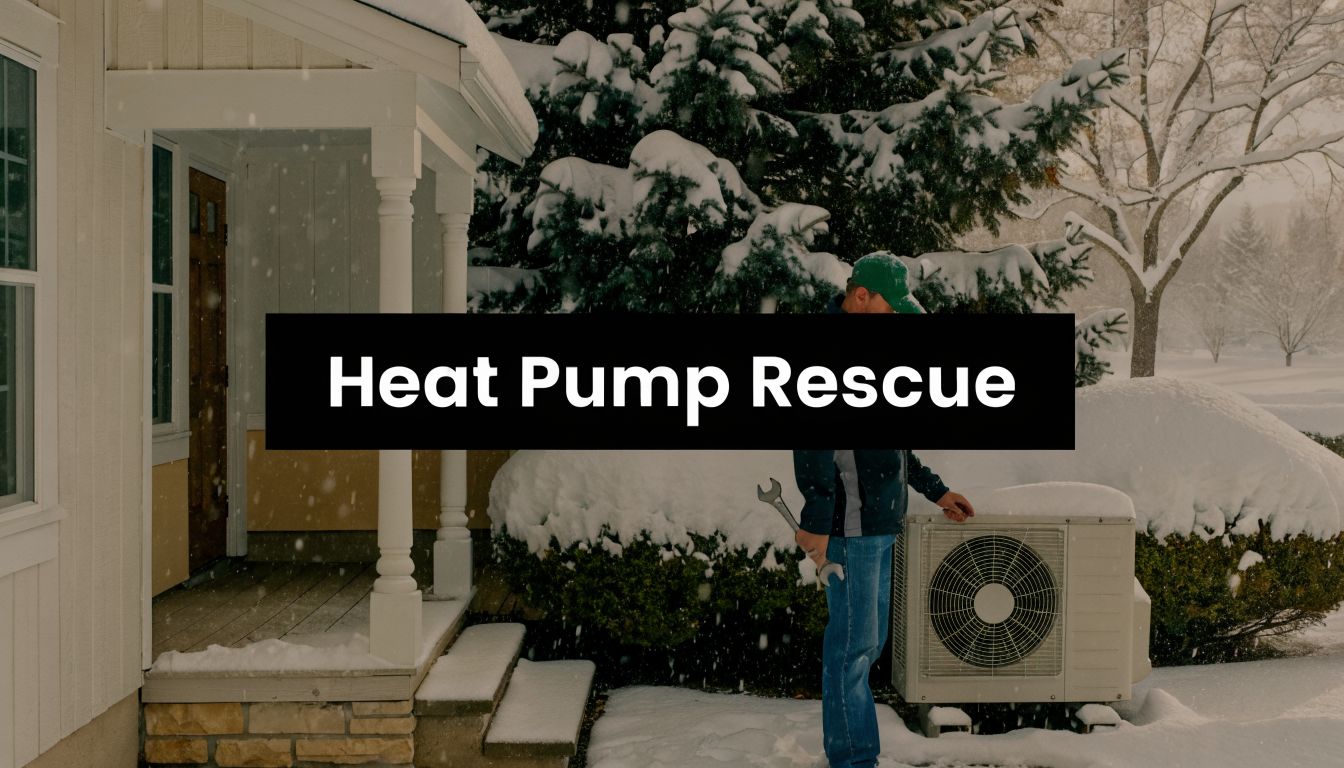
A Northern Utah winter night gets serious fast when the house turns cold and the vents start blowing weak air, or nothing at all. If you're dealing with **emergency heat pump repair, the priority is simple: protect your family, avoid making the problem worse, and figure out whether this is a safe homeowner check or a stop-and-call-a-pro situation.
Introduction
A failing heat pump can put you on edge in a hurry. One room feels cold, the thermostat says heat is on, and then you hear a strange hum, catch a burning smell, or notice the outdoor unit frosting over. That’s the moment most homeowners start searching for answers while also worrying about frozen pipes, pets, kids, and what the repair bill might look like.
In Northern Utah, cold weather exposes weak points quickly. A heat pump problem isn't always just an HVAC problem. It can also be an electrical problem involving breakers, wiring, controls, panel capacity, or emergency heat strips. That distinction matters because the wrong response can increase damage, create a fire risk, or leave you paying for expensive backup heat longer than necessary.
Practical rule: If you smell burning insulation, see smoke, hear hard grinding, or the breaker keeps tripping, stop troubleshooting and shut the system down if you can do so safely.
Is This a Real Emergency Red Flags You Can't Ignore
Some heat pump problems are inconvenient. Others are urgent. The difference usually shows up in what you hear, smell, and see.

Signs that mean call now
If any of the symptoms below show up, treat it like a real emergency and stop trying random fixes.
- Burning or ozone smell: An electrical smell points to overheating components, damaged wiring, or a failing contactor or motor. That’s not a “wait until morning” issue.
- Smoke from the unit or panel: Shut the system off if you can do it safely. Smoke means something is actively failing.
- Loud banging, grinding, or screaming noise: Mechanical parts don’t make those sounds unless something is loose, seized, or breaking apart.
- No heat with a hard lockout or no power at all: If the thermostat calls for heat and the system is dead, there may be a control, breaker, wiring, or panel issue.
- Heavy ice buildup or water where it shouldn’t be: Thick icing on the outdoor unit or indoor water around the air handler can point to airflow, defrost, or drain problems.
- Breaker trips again after one reset: One trip can happen. Repeated trips usually mean a fault, not a fluke.
Hear that loud banging? That’s your system telling you to stop and take it seriously.
What may be happening behind the scenes
When a heat pump fails, many systems switch to emergency heat, which uses auxiliary electric resistance strips. That backup mode keeps some homes from going completely cold, but it can also hide the underlying problem while driving up power use. Service data cited by Phil’s Heating and Air notes that 36% of service calls involve capacitor faults and 25% involve refrigerant leaks, and defrost board or reversing valve problems can force the system into that costly backup mode.
That matters because a homeowner may think, “At least it’s still heating a little.” In reality, the main system may be down, and the house is being carried by the least efficient part of the setup.
Safe triage before you touch anything
You can make a few observations without tools.
- Look at the thermostat: Is it calling for heat, or has someone switched modes by mistake?
- Check airflow at vents: Weak airflow can point to filter restriction, blower trouble, icing, or control problems.
- Listen near the indoor and outdoor units: Humming without startup often points toward an electrical issue.
- Check for obvious icing or snow blockage: Northern Utah storms can choke airflow fast.
If the system is making electrical smells or tripping protection devices, don't keep “testing” it. Repeated attempts can turn a repairable fault into a damaged motor, board, or compressor.
Your First 15 Minutes Safety Checks and Quick Fixes
If the system isn't smoking, sparking, or making violent noise, you can do a short, disciplined check. The goal is not to repair the heat pump yourself. The goal is to rule out simple issues and avoid causing new ones.

The safe reset sequence
A structured triage protocol described by MEM Solutions reports an 80% success rate for preventing catastrophic failure, and its basic reset starts with powering the unit off for 30 seconds, cleaning or replacing the air filter, and checking for a clogged drain line. The same guidance warns you to never repeatedly reset a tripped breaker, because that points to a serious electrical fault.
Follow this order.
Set the thermostat correctly
Make sure it’s on Heat, not Cool or Fan. Raise the setpoint enough that the system should clearly call for heat.Power the system off briefly
Turn it off at the thermostat. Give it about 30 seconds before restoring the call for heat.Inspect the filter
A clogged filter can choke airflow, contribute to icing, and make the system act worse than it is. If it’s dirty, replace it.Check the drain area if accessible
If the indoor unit has a visible condensate setup and it’s clearly clogged, note it for the technician. Don’t start disassembling anything.Look at the outdoor unit
Clear loose snow and debris around the cabinet so it can breathe. Don’t chip ice off coils with tools.
The breaker test that homeowners misuse
Many emergencies turn into electrical hazards.
You may check the breaker once. If it’s tripped, reset it a single time. If it trips again, stop there. That repeated trip is a warning, not an inconvenience. It can indicate a short, locked motor, failing compressor, damaged heat strip, or overloaded circuit.
Older homes are where this gets messy. A heat pump may be tied into an aging panel with little spare capacity, weak connections, or past “creative” breaker work. If you're seeing odd power behavior, a qualified electrical diagnosis matters more than another thermostat adjustment. For homeowners who want help separating safe checks from risky ones, this guide to residential electrical troubleshooting is useful.
What not to do
It's these mistakes that cost people the most.
- Don’t keep flipping the breaker
- Don’t open electrical compartments
- Don’t force the unit to run if it smells hot
- Don’t thaw coils with sharp tools or open flame
- Don’t assume “some heat” means the heat pump is fine
A heat pump can still warm the house a little while the main system is down and backup heat is carrying the load. That’s exactly why people miss the real failure.
The Hidden Electrical Dangers in Heat Pump Failures
A winter heat pump failure in Northern Utah often looks like an HVAC problem first. In older homes, it often starts as an electrical problem. I see that gap all the time. The outdoor unit stops, the backup heat masks the failure for a while, and the underlying issue sits in the panel, disconnect, breaker connection, or control wiring.

Why older Northern Utah homes get caught off guard
Homes built before 2000 need extra caution, especially if the heat pump was added after the house was built or replaced without a full electrical review. A system can run for years with marginal wiring, weak breaker terminations, corrosion in the disconnect, or a panel that was already close to its limit. Then a cold snap hits, the load goes up, and the weak point shows itself fast.
Generic HVAC articles usually stop at “check the breaker.” That advice misses the harder part. A breaker can be only the symptom. The actual fault may be a failing compressor drawing hard on startup, a loose lug heating up under load, undersized branch wiring, a damaged whip at the outdoor unit, or an older panel that no longer makes a clean, reliable connection.
Electrical symptoms that call for an electrician
Some signs point past basic HVAC troubleshooting and into electrical diagnosis.
- Breaker trips again after one reset
- Lights dip or flicker when the outdoor unit tries to start
- Buzzing or arcing sounds at the panel, disconnect, or air handler
- A hot electrical smell near the indoor unit, outdoor disconnect, or breaker panel
- Scorch marks, melted insulation, or discoloration around wiring
- A newer heat pump connected to an older panel with little spare capacity
- Repeated winter faults after a remodel, EV charger install, hot tub, or panel changes
At that point, stop opening covers and stop testing your luck with another reset. Fault current, overheated conductors, and failing connections do not give much warning before they get expensive or dangerous.
Why emergency heat can hide the real failure
A house can still feel partly heated while the main heat pump side is down. That happens because the system may switch over to electric resistance heat. Homeowners assume the unit is still “working enough,” but the expensive heat strips may be carrying the whole load while the outdoor unit sits offline.
That matters in older Utah homes because resistance heat puts heavy demand on the electrical system. If the panel is already crowded or the feeder and branch circuits are aging, that added load can expose loose terminations and weak breaker connections quickly. Homeowners planning repairs or upgrades should review panel and breaker service information so they know what an electrician is checking and why it matters.
Thermostat settings can add confusion too. Smart controls help when they are set up correctly, and poor setup can cause unnecessary backup-heat use. For contractors trying to explain services clearly online, this article on how local HVAC services are found online shows why good local education matters before a homeowner is stuck making decisions in the middle of a cold night.
The trade-off homeowners need to understand
A fast repair is not always the first repair. If the heat pump failure traces back to power delivery, the safe fix may involve the breaker, disconnect, wiring, or panel capacity before anyone replaces HVAC parts. That can feel frustrating in an emergency, but it prevents the common mistake of changing components while the electrical fault that damaged them is still in place.
In plain terms, if there is burning odor, visible wire damage, repeated breaker tripping, or power instability when the system starts, electrical diagnosis comes first. That is the point where a licensed electrician is required, not optional.
Calling a Pro What to Expect from Your Service Call
The service call goes smoother when you’re ready with a few details. That doesn’t just save time. It helps the technician decide whether to prepare for a control issue, airflow issue, refrigerant issue, or an electrical fault that may involve the panel, disconnect, or heat strips.
What to have ready before the technician arrives
Write these down or take photos on your phone.
- Model and serial information: Usually found on the indoor air handler and the outdoor unit.
- Age of the system: Even an estimate helps.
- Symptoms in order: What happened first, what changed, and whether the breaker tripped.
- Any smells or noises: Burning, buzzing, grinding, clicking, humming.
- Thermostat behavior: Blank screen, error message, calling for heat with no response.
- Recent work on the home: Panel changes, remodels, thermostat swaps, generator work, EV charger installs, or previous HVAC service.
That last item matters more than people expect. Heat pump issues sometimes show up right after another electrical load or wiring change in the house.
What the visit usually includes
A solid emergency call is methodical. The technician should verify the call for heat, inspect the indoor and outdoor equipment, and work through controls, electrical connections, airflow conditions, and safety devices. If the fault has an electrical component, they may need to inspect the disconnect, breaker, wiring terminations, or service panel condition.
You should also expect a service call fee. Emergency heat pump repairs typically run from $150 to over $4,000, and the service call fee alone is usually $100-$250, according to Honest Fix’s emergency repair cost breakdown. The same source notes that after-hours service commonly carries a 20-50% premium, capacitor failures appear in 36% of emergency calls and average $120-$250 to fix, and a compressor swap can cost up to $3,500.
Here’s a practical cost snapshot.
| Repair Type | Common Cost Range | Notes |
|---|---|---|
| Minor electrical fix | $150-$500 | Often includes smaller electrical faults and basic component repairs |
| Service call fee | $100-$250 | Usually diagnostic arrival cost before major repair work |
| Capacitor replacement | $120-$250 | Common emergency issue |
| Thermostat replacement | $150-$400 | Depends on control type and compatibility |
| Defrost control board | $300-$650 | A common cold-weather fault |
| Refrigerant leak repair and recharge | $300-$1,200 | Varies by leak location and recharge need |
| Blower motor or medium repair | $500-$1,500 | Includes labor and parts for mid-level failures |
| Reversing valve | $650-$1,500 | Can disable proper heating mode |
| Coil replacement | $900-$2,500 | Severity depends on coil and access |
| Compressor replacement | $1,500-$4,000 | Highest-cost major repair category, with some swaps up to $3,500 |
| Auxiliary heat strip replacement | $300-$900 | Backup heat component, not the main heat pump cycle |
| Panel-related work tied to major repair | $1,500-$5,000 | Applies when electrical capacity or panel condition delays the job |
Auxiliary heat and emergency heat are not the same thing in practice
This confuses a lot of homeowners during a breakdown. Auxiliary heat may engage automatically in cold weather or during defrost, while Emergency Heat is the manual setting people flip on when they think the system has failed. If someone leaves Emergency Heat on longer than necessary, the utility bill can get ugly fast.
The smarter move is to confirm the failure first, then use backup mode only when it’s needed and only for as long as needed.
When a homeowner can clearly describe whether the system lost power, iced over, ran on backup heat, or tripped a breaker, the technician gets to the fault faster.
If you’re trying to choose a company in a hurry, it helps to understand how local HVAC services are found online, especially when you're comparing maps listings, reviews, and service-area results during a winter emergency.
After the Repair Preventing Future Heat Pump Emergencies
A successful repair is only half the job. If the original failure started with weak wiring, a marginal breaker, a loose disconnect, or an older panel that is already carrying too much load, the same heat pump can fail again under the next cold snap.

In Northern Utah, I would pay close attention to homes built decades ago and later updated with added circuits, space heaters, basement finishes, hot tubs, or EV charging. Those houses often have enough electrical history to hide a repeat problem. The heat pump gets repaired, but the feeder, breaker termination, disconnect, or thermostat wiring never got a hard look.
What to do in the first week after repair
Once the house is warm again, ask better questions than “Is it fixed?”
- Ask what failed: Get a clear answer on whether the cause was electrical, mechanical, control-related, airflow-related, or a combination.
- Confirm the electrical path was checked: That includes the breaker, disconnect, wire terminations, and any signs of heat damage or corrosion.
- Verify thermostat programming: As noted earlier, Emergency Heat costs much more to run, so the setup needs to be correct and the mode should not be used as a convenience setting.
- Replace the filter and keep an extra on hand: Restricted airflow can turn a small problem into a service call.
- Ask whether the panel is still a good fit for the load: In older homes, that answer matters more than homeowners expect.
If the technician repaired the unit but did not inspect the electrical side, schedule that separately. A licensed electrician should check any system that had repeated breaker trips, scorched wires, melted insulation, a buzzing disconnect, or signs that the circuit is running hotter than it should.
Build a seasonal routine that fits Utah weather
Northern Utah weather is hard on outdoor equipment. Snow drift, wind, ice, and freeze-thaw cycles can interfere with airflow, sensors, defrost operation, and electrical connections at the unit.
A prevention routine should stay simple enough that it gets done:
- Fall service: Test operation before the first real cold stretch.
- Spring service: Catch wear from winter before cooling season starts.
- Keep the outdoor unit clear: Remove packed snow, leaves, and debris around the cabinet.
- Watch for billing changes: A sudden jump can mean the system is relying on backup heat or short-cycling.
- Look at the disconnect and visible wiring: Rust, loose fittings, and water intrusion do not fix themselves.
Use smarter controls and safer electrical follow-up
The thermostat should match the equipment and the way the home is used. Fancy controls are not the point. Correct setup is the point.
That matters even more in older Northern Utah homes, where the heat pump problem may be tied to aging electrical infrastructure instead of the outdoor unit alone. If you want to know who handles that kind of troubleshooting, read about our licensed electrical team and how we approach residential service work.
Heat pumps last longer after a repair when the controls are set correctly, the filter gets changed on schedule, the outdoor unit stays clear, and the electrical system feeding the equipment is in good condition.
Your Trusted Partner in Any Electrical Emergency
A heat pump failure feels personal because it affects comfort, safety, and your sense of control in your own home. You can do a few safe checks at the start, but once the symptoms point toward wiring, breakers, control failures, panel capacity, smoke, or repeated trips, a licensed electrical contractor should be involved.
For homeowners in Northern Utah, that matters even more in older homes where the heating problem may really be an electrical infrastructure problem. If you want to know more about the team behind that kind of work, you can read about Black Rhino Electric's background and approach.
When you need fast, safe help with a heat pump emergency or the electrical issue behind it, contact Black Rhino Electric. Call 385-396-7048 or request a free quote to get your home warm and safe again.