
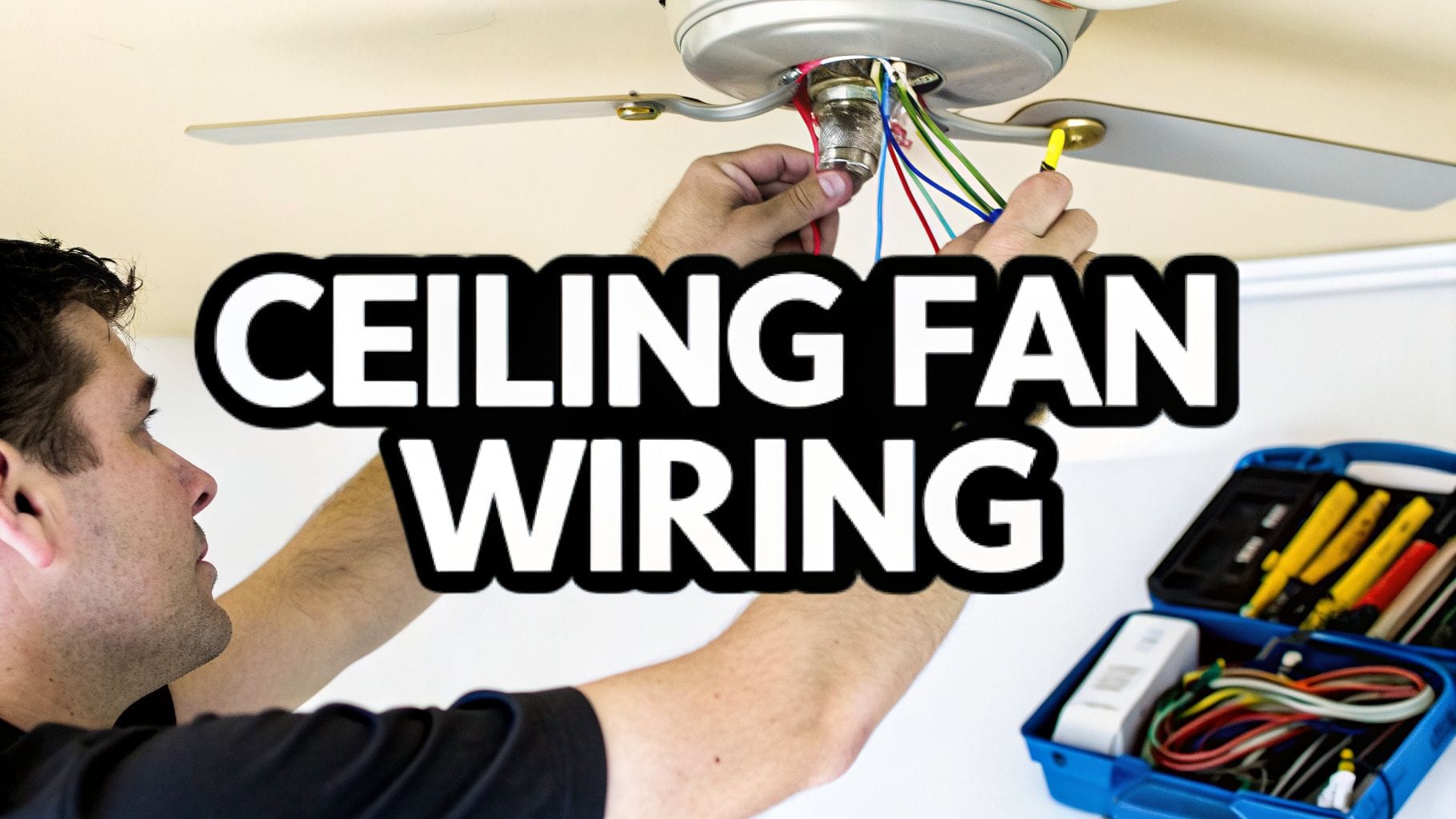
Installing a ceiling fan is a fantastic way to boost your home's comfort and energy efficiency, but getting the wiring right is crucial for safety. This guide will teach you how to wire a ceiling fan, cutting through the confusion of different colored wires and setups. We’ll give you the confidence to tackle this project safely and correctly.
Your Essential Guide to Ceiling Fan Wiring
We’ll cover the common scenarios, from swapping out an old light fixture to installing a fan where there's never been one before. You know what? Understanding your home's existing electrical setup is half the battle. We're here to walk you through it, making sure your fan is installed safely and securely for total peace of mind.

This job is about more than just matching up colored wires. It's about stability, preventing electrical hazards, and protecting your investment. A correctly wired ceiling fan runs quietly and efficiently—without that dreaded wobble that plagues so many DIY jobs.
Here’s the thing: you’re creating a secure electrical circuit to power the fan motor and, usually, a light kit. The real goal is to do this while following the safety codes that protect your house and your family.
Key Considerations Before You Start
Before you even touch that old light fixture, it's critical to take a step back and assess the situation. Thinking through these key factors first will make the entire project go a whole lot smoother.
- Existing Infrastructure: Are you replacing a simple light or an older fan? What you find in the ceiling box will dictate how you can wire your new fan.
- Ceiling Support: A standard plastic electrical box made for a lightweight fixture is not strong enough to handle a fan’s weight and motion. You absolutely need a fan-rated brace and box, which is designed to hold up to 70 pounds.
- Wiring Configuration: Take a look at your wall switch. Is it a single switch, or do you have separate switches for a light and fan? This determines how you’ll connect the wires from the ceiling to your new unit.
A common mistake we see in older Northern Utah homes is assuming the existing ceiling box can handle a fan. Verifying it's fan-rated isn't just a best practice—it's a critical safety requirement to prevent the fan from falling.
Nailing down these details upfront will save you from last-minute trips to the hardware store and headaches down the road.
Gathering Your Tools and Materials for the Job
Before you even think about touching a wire, let's talk about getting set up. A smooth, safe ceiling fan installation starts with having everything you need before you start. Think of it as your pre-flight checklist; laying out your tools and materials now prevents frustrating trips to the hardware store and keeps you from taking risky shortcuts later.
Honestly, the difference between a successful DIY project and a frustrated call to an electrician often comes down to being prepared from the get-go.
The Right Tools Make All the Difference
Using the right tool for the job isn't just about making things easier—it's about safety. Trying to strip a wire with a pair of pliers, for example, can nick the copper inside. A damaged wire is a fire hazard, plain and simple. Every tool here has a specific purpose that contributes to a solid, professional-quality installation.
Here’s a look at the absolute must-haves:
- Non-Contact Voltage Tester: This is your most important safety tool, bar none. It's how you'll confirm with 100% certainty that the power is off before you touch a single wire.
- Wire Strippers/Cutters: You need these to cleanly remove the outer plastic from the wires without damaging the copper conductor.
- Screwdrivers: A good multi-bit driver with both Phillips and flathead bits is perfect. You'll need them for the mounting bracket, canopy, and various fan parts.
- Sturdy Ladder or Step Stool: Get a ladder that lets you work comfortably at ceiling height without stretching or standing on your tiptoes. Stability is key.
Let me explain: The non-contact voltage tester is non-negotiable. Even after you've flipped the breaker, you must test the wires in the junction box to ensure the circuit is dead. It's the single most important safety check you will perform.
Essential Materials for a Secure Installation
Beyond the tools, you need the right parts to mount the fan securely and wire it correctly. The most common—and dangerous—mistake we see in Northern Utah homes is using a standard plastic light fixture box. Those boxes simply can't handle the weight and constant vibration of a running fan.
It's a fact: residential ceiling fans are incredibly popular, powering 75.77% of global demand. Here in the U.S., the market was valued at $1.38 billion in 2023 as people look for ways to offset rising energy costs, which have jumped 12% since 2022. Unfortunately, wiring mistakes are behind about 10% of all service calls we get at Black Rhino Electric, often from simple, avoidable errors.
A fan-rated electrical box, designed to hold over 35 pounds, has been a code requirement since 1996, and it's a non-negotiable part of every installation we do. You can find more insights into the ceiling fan market and its growth on Mordor Intelligence.
Here’s a quick checklist of everything you'll want to have on hand.
Essential Tools and Materials Checklist
| Item Category | Specific Tool or Material | Why It's Essential |
|---|---|---|
| Safety Equipment | Non-Contact Voltage Tester | Verifies that electricity is completely off before you begin work, preventing electrical shock. |
| Wiring Tools | Wire Strippers & Cutters | Allows for clean, precise stripping of wire insulation without damaging the copper conductor. |
| Fastening Tools | Phillips & Flathead Screwdrivers | Needed for attaching the mounting bracket, securing the canopy, and assembling the fan components. |
| Support & Access | Sturdy Ladder or Step Stool | Provides safe and stable access to the ceiling, preventing falls and injuries from overreaching. |
| Electrical Box | Fan-Rated Electrical Box | Specifically designed to support the weight and vibrations of a running fan, unlike a standard light fixture box. |
| Connectors | Assorted Wire Nuts | Used to create secure connections between the house wiring and the fan wiring. Ensure you have the correct size. |
| Securing | Electrical Tape | Provides an extra layer of security and insulation over wire nut connections. |
Having these items ready to go will make the entire process smoother and safer from start to finish. Now, let's get into the wiring itself.
A Practical Guide to Common Wiring Scenarios
Now we get to the heart of the project. Knowing how to wire a ceiling fan correctly makes all the difference between a frustrating afternoon and a perfectly spinning fan. This is where we connect the dots—or rather, the wires—to bring your new fan to life safely. We'll demystify the process by breaking down the three most common wiring configurations you're likely to find in your home.
This quick visual guide outlines the essential prep work before you touch a single wire. Don't skip these steps.

The flow is simple but non-negotiable: confirm the power is off, secure the fan-rated box, and strip the wires to the proper length. Only then are you ready to make connections.
Scenario 1: Wiring for a Single Wall Switch
This is the most straightforward setup, the one you’ll usually find when you're replacing a basic light fixture with a fan. In this layout, one switch on the wall controls both the fan and its light kit at the same time. Flip the switch, everything turns on; flip it again, everything’s off.
The wiring here is simple because you’re working with one "hot" wire from the switch. Typically, the ceiling box will have one black (hot), one white (neutral), and one bare copper or green (ground) wire coming from the house.
Your new fan will have its own set of wires: a black wire for the fan motor, a blue wire for the light kit, a white neutral wire, and a green ground wire. The goal is to connect the single power source from your house to both the fan and light functions.
Here’s the standard hookup:
- House Black to Fan Black and Blue: Twist the single black wire from your ceiling box together with both the black motor wire and the blue light wire from the fan. A single wire nut should securely join all three wires. This sends power to both components when the switch is flipped on.
- House White to Fan White: Connect the white neutral wire from the ceiling to the white neutral wire from the fan. This completes the circuit.
- House Ground to Fan Ground: Connect the bare copper or green ground wire from the ceiling to the green ground wire from the fan’s mounting bracket and the fan motor itself.
By connecting the house's single hot wire to both the fan's motor and light wires, you're creating a parallel circuit. When power is supplied, it flows to both devices at the same time, allowing the single switch to act as a master control.
Scenario 2: Wiring for Separate Fan and Light Switches
What if you want to control the fan and light independently right from the wall? It’s a popular and convenient setup, but it requires different wiring coming from the ceiling. For this to work, you need what's called a 3-wire cable (plus a ground) running from the wall switches to the ceiling box.
This cable contains a black wire, a red wire, a white wire, and a ground wire. The black and red wires each act as a separate "hot" lead—one for the fan motor and one for the light kit, each controlled by its own switch.
Here’s how the connections change:
- Connect the black house wire to the black fan motor wire. This dedicates one switch to controlling just the fan's power.
- Connect the red house wire to the blue fan light wire. This dedicates the second switch to controlling only the light kit.
- Connect the white house wire to the white fan neutral wire. Just like before, this completes the circuit for both functions.
- Connect all ground wires (from the house, fan bracket, and fan motor) together.
This setup offers maximum control and is a fantastic upgrade for bedrooms or living rooms where you might want a gentle breeze without the lights on. If your home isn't wired for this and you want to make the switch, a qualified lighting electrician can run the new wiring to code.
Scenario 3: Wiring a Fan with a Remote Control
Adding a remote control introduces another component into the mix: the receiver. This small black box is the brain of the operation. It catches signals from the remote and tells the fan and light what to do. The receiver physically sits inside the fan's mounting bracket or canopy and gets wired between the house wiring and the fan wiring.
Here’s a critical tip: before you tuck away the wires, set the fan’s pull chains to their highest speed and turn the light on. From now on, the remote will be the primary controller. Using the pull chains can confuse the receiver and make it seem like it's not working.
The wiring flow changes slightly. First, you connect your house wiring to the receiver.
| From House Wiring To… | …Receiver Input Wires |
|---|---|
| Black (Hot) from Ceiling Box | Black "AC in L" on Receiver |
| White (Neutral) from Ceiling Box | White "AC in N" on Receiver |
| Ground from Ceiling Box | Ground from Fan Bracket/Motor |
Next, you connect the receiver's output wires to the fan itself.
| From Receiver Output Wires To… | …Fan and Light Wires |
|---|---|
| Black "To Motor L" from Receiver | Black Motor Wire on Fan |
| Blue "For Light" from Receiver | Blue Light Wire on Fan |
| White "To Motor N" from Receiver | White Neutral Wire on Fan |
Essentially, power flows from your house to the receiver, and then the receiver distributes that power to the fan and light based on what the remote tells it to do. It’s a simple but crucial distinction. Always make sure the receiver fits neatly into the canopy without pinching any wires before you secure it to the ceiling.
This is the most important section in the entire guide. A fan that spins is one thing, but a fan that's safe for your family is non-negotiable. Knowing how to wire a ceiling fan to code isn't just about following rules; it's about preventing fire and shock hazards from day one.

Here, we'll get into the critical safety protocols and electrical code requirements you absolutely must follow. These aren't just suggestions. They are the standards that keep your home and family safe.
Understanding the National Electrical Code
The National Electrical Code (NEC) is the benchmark for safe electrical design, installation, and inspection across the country. While local jurisdictions here in Utah might add their own amendments, the NEC provides the foundational rules for every single job, including wiring up a ceiling fan.
When it comes to ceiling fans, the NEC is crystal clear on several points. These rules are in place for very good reasons—to handle the unique weight, movement, and mechanical stress a fan places on your home's electrical system. Ignoring them isn't just a code violation; it's a serious gamble.
The two biggest NEC requirements for this job are:
- Fan-Rated Electrical Box: The ceiling box must be specifically listed and marked for fan support. A standard box for a light fixture is absolutely not designed to handle the weight and vibration and can fail, causing the fan to fall.
- Proper Grounding: All of the fan’s metal components must be correctly connected to the home’s grounding system. This is your primary defense against electrical shock if a malfunction ever happens.
Choosing the Right Wire Gauge
The wires inside your walls are like the veins of your electrical system, and they need to be the right size for the job. Wire size is measured in "gauge," where a smaller number means a thicker wire capable of carrying more current. For a standard residential lighting circuit, which is usually 15 amps, you will almost always use 14-gauge copper wire.
Using a wire that's too small for the circuit's amperage is a major fire hazard. The wire can overheat, melting its insulation and potentially igniting nearby building materials like wood or drywall. This is why checking your breaker panel is a crucial step. If your circuit is on a 20-amp breaker, you absolutely must use 12-gauge wire.
A common mistake, especially in older homes, is just assuming the existing wiring is correct for the job. Always verify the circuit amperage at the breaker panel and make sure your wire gauge matches. This is a non-negotiable part of safe electrical work. For more complex issues, it's wise to understand the basics of your home's electrical panels and breakers.
The Critical Role of Grounding
Let me explain why grounding is so important. Think of the ground wire—that bare copper or green-insulated one—as an emergency exit for electricity. If a "hot" wire ever comes loose inside the fan and touches a metal part, that electricity needs a safe and immediate path to travel.
Without a ground wire, the fan's metal housing becomes energized, just waiting to deliver a dangerous shock to anyone who touches it. With a proper ground connection, the fault current rushes safely back to the panel, instantly tripping the circuit breaker and shutting off the power. It is an essential, life-saving feature.
The global ceiling fan market is projected to hit an incredible $17.98 billion by 2034, driven by homeowners seeking comfort and energy efficiency. Here in North America, the market is expected to reach $5.55 billion by 2033. This massive growth means more DIY installations, but sadly, botched jobs from issues like ignored grounding contribute to 15-20% of home electrical fires annually. You can discover more insights about the booming ceiling fan market and its safety implications.
Troubleshooting Common Ceiling Fan Wiring Issues
Even when you follow the instructions perfectly, sometimes you flip the switch and… nothing. Or worse, you get a wobble that looks like it’s trying to shake the fan loose from the ceiling. It’s frustrating, but take a breath. Most post-installation glitches are surprisingly common and often simple to fix.
Before you start tearing everything apart, let's walk through the headaches we see all the time. A little patience and methodical checking can solve most of these issues without a full do-over.
My New Fan Is Wobbling Excessively
A tiny bit of movement is normal as a fan gets up to speed, but a significant, rhythmic shake is a problem that needs your immediate attention. It’s not just annoying; it’s a real safety issue.
Nine times out of ten, the cause is a simple imbalance in the fan blades. Even a tiny weight difference from one blade to the next can create a serious wobble at high speeds. Your fan almost certainly came with a blade balancing kit for this exact reason. Following the kit's instructions to add small, stick-on weights to the lighter blades will usually smooth things right out.
If balancing doesn’t fix it, the problem is likely with the installation itself.
- Loose Screws: Go back and check every single screw. That means the ones holding the blades to their brackets, the brackets to the motor, the downrod, and the mounting bracket to the ceiling box. Make sure they're all snug.
- Unsecured Electrical Box: That fan-rated box absolutely must be anchored securely to a ceiling joist or a fan-rated brace. Any give or flex in the box will translate into a major wobble when the fan is running.
A severe wobble that balancing can't fix points to a foundational problem. Re-check your mounting hardware immediately. A loose fan is a dangerous fan, period.
The Light Works but the Fan Motor Does Not
This one’s a classic head-scratcher. If the light kit turns on, you know the fixture is getting power. That’s good news! It means the problem isn't the breaker or the switch, but a specific wire connection for the fan motor.
The culprit is almost always a single loose wire. You'll need to turn the power back off and check the wire nut connecting the black motor wire from your fan to the house wiring. If you have a remote, this would be the connection between the receiver's "To Motor L" wire and the fan's own black wire. A poor connection here will power the light (via the blue wire) but leave the motor dead in the water.
My Fan Makes a Humming Noise
Is your fan making an annoying electrical hum? Before you blame the fan, look at your wall switch. This is the number one cause of humming, by a long shot.
A standard dimmer switch is designed for light bulbs, not for fan motors. When you try to control a fan's speed with a light dimmer, it can damage the motor and create that audible, aggravating hum. You have to use either a standard on/off toggle switch or a switch specifically rated for ceiling fan speed control.
If the switch is correct, check for loose wire nuts inside the canopy, as they can sometimes vibrate. Also, make sure the remote receiver (if you have one) is tucked in snug and not rattling against the mounting bracket. If the noise just won't quit, our team offers professional electrical troubleshooting services to hunt down the source of the problem.
Ceiling Fan Troubleshooting Guide
Here’s a quick-reference table to help you diagnose the most common issues you might run into after wiring up a new fan. Think of it as your first-aid checklist.
| Symptom | Potential Cause | Solution |
|---|---|---|
| Fan Wobbles | Unbalanced blades or loose mounting screws. | Use the included balancing kit; re-tighten all screws on the blades, downrod, and mounting bracket. |
| Light On, Fan Off | Loose connection to the fan motor wire. | Re-check the wire nut connecting the black motor wire (or receiver output for motor) to ensure it's secure. |
| Humming Noise | Incompatible dimmer switch or loose components. | Replace the dimmer with a fan-rated speed control switch; check for loose wire nuts or a vibrating remote receiver. |
| Remote Not Working | Receiver and remote are not paired correctly. | Cycle power to the fan at the breaker, then follow the manufacturer's instructions to re-pair the remote. |
Most of the time, working through these steps will get your fan running smoothly and quietly. If you’ve double-checked everything and are still stumped, it might be time to call in a professional.
When to Call a Professional Electrician
Knowing your limits is the hallmark of a smart homeowner. While this guide walks you through the common scenarios for how to wire a ceiling fan, some situations are clear signals to stop, put the tools down, and call for expert help.
This isn’t about giving up; it’s a wise investment in your home’s safety and your own peace of mind.
Here’s the thing: some jobs go far beyond a simple fixture swap. If you open that ceiling box and find something unexpected, or if the project scope is bigger than you thought, it’s time to bring in a pro.
Call an electrician if you run into any of these:
- You Need a New Circuit: If there’s no existing light or fan fixture, a licensed electrician has to run a new wire all the way from your breaker panel. This is non-negotiable and requires permits.
- You Find Outdated Wiring: Discovering old knob-and-tube or aluminum wiring is a game-changer. Both require specialized knowledge and specific materials to handle safely and bring up to modern code.
- You’re Dealing with High or Vaulted Ceilings: The safety risks alone make this a job for the pros. They have the right ladders, scaffolding, and experience to work at height without damaging your home or getting hurt.
- You Just Feel Uncertain: If at any point you feel unsure, confused, or overwhelmed, that’s the single best reason to call. A quick, professional installation is always better than a weekend of frustration and a potential safety hazard.
Got Questions About Ceiling Fan Wiring? We've Got Answers.
Even the best guides can leave you with a few "what ifs." As electricians working across Northern Utah, we get the same questions from homeowners all the time. You're not alone in wondering about these details.
Here are the real-world answers our crew at Black Rhino Electric gives every single day.
Can I Just Swap My Old Light Fixture for a Fan Using the Same Wires?
Most of the time, yes—but there are two huge "ifs" you absolutely can't ignore.
First, the electrical box in the ceiling must be fan-rated. That standard plastic box holding up a lightweight fixture won't cut it. It can't handle the weight and constant vibration of a spinning fan. You need a metal box, stamped "acceptable for fan support," that's anchored directly to a ceiling joist or a heavy-duty brace.
Second, the wiring itself has to be up to the job. For a typical 15-amp circuit, you'll usually find 14-gauge wire, which is perfectly fine. As long as those two things check out, you're generally good to go for a basic fan installation.
Do I Really Need a Special Switch for a Ceiling Fan?
Not always, but it all comes down to how you want to control it. If your fan has a light kit, you’ll probably want to control the fan and light from separate wall switches. That setup requires a 3-wire cable running from the switch to the ceiling box, which you might not have if it was only wired for a simple light.
If you remember one thing, make it this: never use a standard light dimmer switch to control the fan's motor. We see this all the time. It’s the number one cause of that annoying electrical hum, and it will absolutely cook the fan's motor over time.
How Can I Tell if My Ceiling Box Is Strong Enough for a Fan?
This is a critical safety check, so it pays to be certain. Here’s what to look for:
- It’s metal, not plastic. Plastic boxes will crack and fail under the stress of a fan. No exceptions.
- It has official markings. The box itself should be stamped with a phrase like "Acceptable for Fan Support" or show a weight rating, like 70 lbs.
- It’s rock-solid. Look at how it's mounted. It should be screwed directly into a ceiling joist with long, heavy-duty screws or attached to a metal brace that spans between two joists.
If you push on it and it wiggles, it's not ready for a fan.
What's the Most Common Mistake You See People Make?
It’s a tie between two dangerous-but-easy-to-avoid errors. The first is simply not getting the wire nuts tight enough. A loose connection can cause arcing—a tiny electrical spark that can easily start a fire inside your ceiling. Always give the wires a firm twist and make sure that wire nut grabs them securely.
The second mistake is messing up the ground wire. The ground is a non-negotiable safety feature that protects you from electric shock if something goes wrong. It needs to be connected securely to the ground wire from the house, the fan's mounting bracket, and the fan itself. Don't skip it.
If you’ve read through this and still feel like you're in over your head—or you opened up your ceiling to find a mess of confusing wires—the safest bet is always to call a pro. At Black Rhino Electric, our team is ready to make sure your fan is installed right, to code, and without any guesswork. For service in Weber, Davis, or Salt Lake counties, give our office a call at 385-396-7048 or request a free quote.