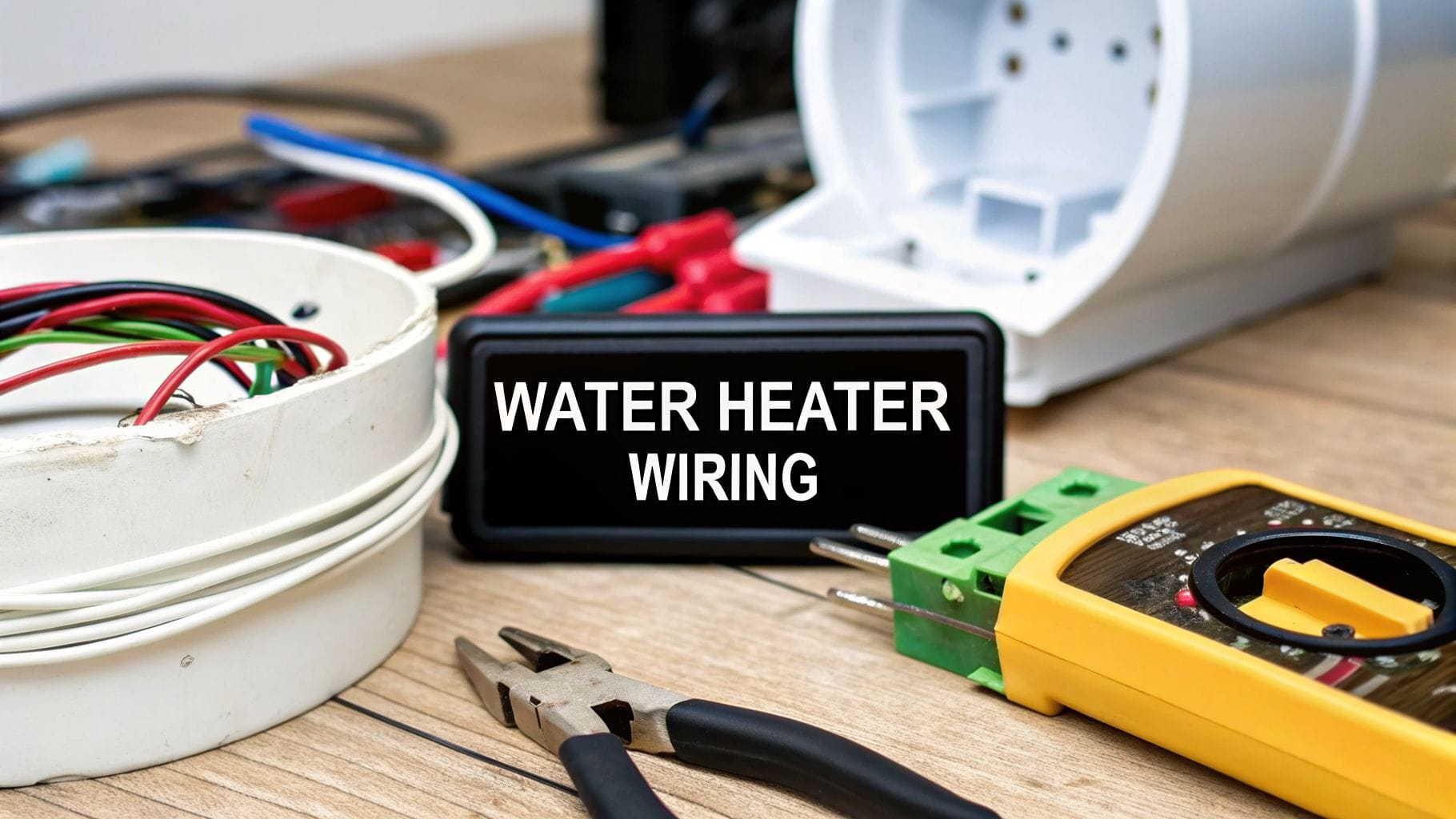
Taking on a project like learning how to wire electric water heater components is a serious job, not a casual weekend task. We're talking about a high-power, 240-volt circuit where there is absolutely no room for error. Honestly, having the right gear and a strict safety protocol is what separates a clean, successful installation from a genuinely hazardous mistake.
Your Essential Safety and Tool Checklist
Before you even think about touching a wire, you have to get your head in the game. A single misstep can lead to severe injury or fire. That means having a clear plan, the right personal protective equipment (PPE), and the proper tools for the job. No shortcuts.

Lockout/Tagout: The First—and Most Important—Step
The most critical part of this entire process is de-energizing the circuit you'll be working on. And I don’t just mean flipping the breaker off. You have to make sure it stays off.
- Find the Breaker: Go to your electrical panel and locate the circuit breaker for the water heater. It's a double-pole breaker, which means it’s twice as wide as a standard one.
- Switch It Off: Firmly move the breaker handle to the "OFF" position.
- Lock It Out: This is the pro step. Use a breaker lockout device and a padlock. This physically prevents anyone from accidentally flipping the power back on while you’re working. Slap a "Danger: Do Not Operate" tag on it for good measure.
Pro Tip: Never, ever assume a circuit is dead just because you flipped a switch. Always verify with a voltage tester right at the point of connection before your hands go anywhere near a wire. No exceptions.
Personal Protective Equipment (PPE)
Your safety is non-negotiable. The right gear protects you from unexpected shocks, flying debris, and other job site hazards. Don't even start without these basics:
- Safety Glasses: A non-negotiable for protecting your eyes, especially if you're drilling or cutting.
- Insulated Gloves: Get gloves specifically rated for electrical work. They provide a critical barrier against shock.
- Sturdy Footwear: Closed-toe shoes, preferably with rubber soles, give you better stability and an extra layer of protection.
Gathering the Right Tools for the Job
Using the correct tools makes the work easier, faster, and, most importantly, safer. Trying to make do with the wrong tool leads to stripped screws, damaged wires, and connections that are just waiting to fail. Before getting started, it's always a good idea to review your essential electrical safety tools.
A typical 50-gallon electric water heater pulls 4500 to 5500 watts at 240 volts. That demands 10-gauge wire and a dedicated double-pole 30-amp breaker to handle the load safely. Get this wrong, and you’re looking at a serious fire hazard or code violations that could cost a fortune to fix.
Here’s a quick rundown of the must-have tools for this project.
| Tool Category | Specific Tool | Why It's Necessary |
|---|---|---|
| Testing & Safety | Multimeter / Voltage Tester | To verify the circuit is de-energized before you start and check voltage after installation. |
| Wire Handling | Wire Strippers | To cleanly remove insulation without nicking the copper wire, which ensures a solid connection. |
| Cutting & Pliers | Lineman's Pliers | For cutting heavy-gauge wire and twisting conductors together firmly. |
| Connections | Screwdrivers (Phillips & Flathead) | To tighten terminal screws on the breaker, disconnect switch, and water heater. |
| General Tools | Fish Tape or Cable Puller | Essential for running the new electrical cable through walls or conduit from the panel. |
Calculating the Correct Circuit and Wire Size
Here’s the thing: when you're figuring out how to wire electric water heater components, you absolutely cannot guess which wire and breaker to use. Getting the circuit size right is the foundation of a safe, code-compliant installation. It’s what prevents overloaded circuits, melted wires, and potential fire hazards, ensuring your system runs smoothly for years to come.
Let me explain. Every electric water heater has a manufacturer's nameplate—that small metal plate or sticker on the side of the unit. Treat this as your source of truth. It lists the two critical specs you need: the wattage (W) and voltage (V) ratings.
Finding the Load Amperage
To figure out the amperage, you’ll use a simple formula: Watts ÷ Volts = Amps. For a very common 4500-watt water heater running on a typical 240-volt circuit, the math looks like this:
4500W ÷ 240V = 18.75 Amps
This number, 18.75A, is the actual electrical load the heater will draw when its heating element kicks on. But we're not done yet. Electrical code has a special rule for appliances that run for long stretches.
Applying the NEC 125% Rule
Because a water heater is what we call a "continuous load" (meaning it can run for three hours or more at a time), the National Electrical Code (NEC) requires the circuit to be sized to handle 125% of the appliance's actual load. This built-in safety margin prevents the breaker and wiring from overheating during those long cycles.
So, we take our calculated load and multiply it by 1.25:
18.75A x 1.25 = 23.44 Amps
This means your circuit must be rated for at least 23.44 amps. And since circuit breakers and wires only come in standard sizes, you have to round up to the next available size. You can never round down.
Key Takeaway: The 125% rule isn't optional—it's a critical safety requirement designed to protect your home. Overlooking this step is one of the most dangerous mistakes a DIYer can make, as it creates a circuit that is perpetually undersized for the job.
Matching the Wire and Breaker
With a required capacity of 23.44A, the next standard breaker size up is 30 amps. This will require a double-pole 30-amp circuit breaker in your panel. From there, you match the wire gauge to the breaker. A 30-amp circuit requires a minimum of 10-gauge (10 AWG) copper wire.
The electric water heater market, which includes these common models, is a massive global industry. Properly wiring these units with the right components is key to their performance. For most 40-80 gallon tanks, a dedicated 240V, 30A circuit using #10 AWG wire and a double-pole breaker is the standard, reliable setup.
For a quick reference, here’s a breakdown of common setups.
Wire and Breaker Sizing for Common Water Heaters
This table provides a handy cheat sheet for selecting the correct wire gauge and breaker size based on your water heater's power rating. Always double-check your unit's nameplate, but this covers the most frequent scenarios we see in the field.
| Water Heater Wattage (at 240V) | Required Amperage (Load x 125%) | Minimum Wire Gauge (Copper) | Required Breaker Size (2-Pole) |
|---|---|---|---|
| 3800W | 19.79A | 10 AWG | 20A or 30A |
| 4500W | 23.44A | 10 AWG | 30A |
| 5500W | 28.65A | 10 AWG | 30A |
| 6000W | 31.25A | 8 AWG | 40A |
Keep in mind that this table assumes you have adequate space in your panel. Occasionally, especially in older homes, the main electrical panel may not have the capacity for a new 30-amp circuit. If your panel is already full of breakers or seems undersized for your home's needs, it's crucial to consult a professional. If you are concerned about your home's electrical capacity, you can learn more about our professional services for breakers and panels.
Running Wire From the Panel to the Heater
With your circuit planned out, it’s time to get your hands dirty and connect the dots between the electrical panel and your new water heater. This is where the real work begins—installing the breaker, pulling the cable, and making the final connections that will bring your system to life.
Think of it as building a dedicated highway for electricity, straight from the source to where it's needed. This diagram breaks down the simple math that ensures that highway is built to the right specifications.

This flow—from wattage to amps to breaker size—is the critical calculation that keeps everything safe. It makes sure your wiring can handle the heater’s demand without breaking a sweat.
Installing the New Double-Pole Breaker
Before you even think about touching the inside of your panel, shut off the main breaker. I can't say this enough. This cuts power to the entire house. Then, double-check that the panel is completely dead with your voltage tester. No shortcuts here.
Once you’re sure it’s safe, look for two empty, side-by-side slots. A 240V double-pole breaker is twice as wide as a standard breaker because it needs to grab power from both "legs" of your panel's service.
- Seat the Breaker: Hook the back of the breaker onto the small retaining rail inside the panel.
- Press Firmly: Push the front of the breaker down until it clicks solidly onto the hot bus bars. You’re looking for a firm, satisfying snap that tells you it's locked in.
- Connect the Wires: This is where your new cable comes in. The two "hot" wires (usually black and red in a 10/3 cable, or black and white in a 10/2) attach to the two screws on the breaker. The bare copper ground wire goes to the panel's ground bus bar. If you have a neutral wire, it goes to the neutral bus bar.
Expert Insight: Every screw on a breaker has a specific torque value, listed right on the breaker or panel door. It’s not a suggestion. Too loose, and you get arcing—a serious fire hazard. Too tight, and you can damage the breaker. A torque screwdriver is the right tool for this job.
Routing the Electrical Cable
Now for the fun part: running your 10-gauge non-metallic (NM) cable, commonly known as Romex, from the panel to the water heater. The route you take will depend on your home. You might be fishing wire through finished walls, running it along joists in an unfinished basement, or protecting it inside conduit.
A few pro tips for the road:
- When drilling through studs or joists, keep your holes centered. This prevents a stray drywall screw from puncturing your cable later.
- Secure the wire with cable staples every 4.5 feet and within 12 inches of any electrical box. Don't hammer them down so hard that they pinch the cable's outer jacket.
- Always leave some slack. An extra 18-24 inches of cable at the panel and at the heater will give you plenty of room to work without fighting the wire.
Installing a Local Disconnect Switch
This is a step that many DIY guides miss, but it's a big deal. The 2023 NEC now requires an accessible disconnect switch within sight of the water heater. It’s a safety switch that lets a technician kill the power right at the unit, so there's zero chance of it being turned on accidentally from the main panel. Skipping this isn't just a code violation; it's dangerous.
Wiring it is simple. The cable coming from your panel (the "line" side) connects to one set of terminals in the disconnect box. A separate piece of cable runs from the other set of terminals (the "load" side) to the water heater itself.
Connecting Wires at the Water Heater
You're on the home stretch. Once the cable is run, you'll make the final connections inside the water heater's junction box, which is usually right on top.
- Prep the Wires: Carefully strip about 8 inches of the outer plastic sheathing off the NM cable. Then, use your wire strippers to remove about 3/4 inch of insulation from the individual black, red (or white), and bare copper wires.
- Make the Connections: Inside the junction box, you’ll see two terminals for power and a green screw for the ground. It’s pretty straightforward.
- The black wire connects to one of the power terminals.
- The red wire (or the white wire, which you should mark with black electrical tape to show it’s hot) connects to the other power terminal.
- The bare copper ground wire connects securely to the green ground screw.
- Secure Everything: Give each wire a gentle tug to make sure the connections are tight. Loose wires are a primary cause of electrical fires. Carefully tuck the wires into the junction box and put the cover back on.
Field reports show that improper DIY wiring contributes to a significant number of new appliance failures. Getting these final connections perfect is what ensures your water heater runs safely for its full lifespan. The takeaway is clear: attention to detail here pays off for years to come.
Testing and Commissioning Your New Water Heater
You’ve pulled the wire, tightened the last connection, and the new heater is sitting there, ready to go. This is the moment of truth. Following the right testing and startup sequence is what separates a safe, professional job from a costly, dangerous mistake. Let's walk through it—this is the last hurdle.

Before you even think about flipping that breaker, a couple of quick electrical checks with the power off can save you a world of trouble. This is all about catching a problem before it has a chance to cause real damage.
Pre-Power Safety Checks with a Multimeter
Grab your multimeter; it's your best friend for this part. With the breaker still firmly in the OFF position (and locked out!), you’ll run two simple tests right at the water heater’s junction box. Just set your meter to the continuity setting—it usually has a symbol that looks like a sound wave.
- Check for Short Circuits: Touch one multimeter probe to a hot terminal (where a black or red wire lands) and the other probe to the bare metal casing of the heater. You should get no reading, or "OL" for open loop. If that meter beeps, you have a hot wire touching the frame—a dangerous short. Stop and find it.
- Confirm the Ground: Now, touch one probe to the green ground screw and the other to a different bare metal spot on the heater's frame. This time, it should beep. That sound confirms your ground wire has a solid, continuous path, which is your number one safety against electric shock.
These checks take less than a minute. A short circuit could trip the breaker instantly, or worse, energize the entire metal body of the water heater. Don't skip this.
A Critical Reminder: Never, ever skip these continuity tests. They're the final guardrail that can catch a life-threatening wiring error before 240 volts enters the picture.
The Most Important Step: Fill the Tank!
You know what? This next part is the single most common and costly mistake people make. Before you send a single volt of power to that heater, you must fill the tank completely with water. If you energize an empty tank, the upper heating element will burn out in a matter of seconds. Poof. Gone.
Here’s the right way to do it:
- Open the main cold water supply valve that feeds the heater.
- Go inside and open a hot water faucet all the way. A bathtub or kitchen sink works great.
- Just listen. You'll hear the tank gurgling and filling up.
- Now, watch the faucet. You're waiting for a steady, solid stream of cold water to come out of the hot side. No more sputtering or air pockets. That steady stream is the signal that the tank is 100% full and the air has been pushed out.
Once you have that solid stream, you can turn the faucet off. Only now is it safe to power up the unit.
Powering Up and Final Voltage Check
Okay, the tank is full and your safety checks are done. Time to head back to the panel.
Remove your lockout/tagout device. As a matter of habit, always stand to the side of a panel, never directly in front of it, and firmly flip that double-pole breaker to the ON position.
One last check. Go back to the water heater's junction box one more time. Carefully set your multimeter to AC Volts and test the voltage between the two hot terminals. You should get a reading right around 240V. This confirms the heater is getting the correct, full power it needs.
Once you see that 240V reading, you can safely put the junction box cover back on. Congratulations—you’ve finished the job. Now you just have to wait for that first hot shower.
Common Mistakes and When to Call an Electrician
Even with the best instructions, things can go sideways. Learning how to wire electric water heater components is one thing, but figuring out why it's not working is a whole different ballgame. This is the exact moment a satisfying DIY project can morph into a frustrating, or even dangerous, ordeal.
Sometimes, the smartest tool in your bag is the phone. Knowing the difference between a simple hiccup and a serious red flag is what keeps your home and family safe. Let me walk you through some common snags and the absolute "stop-work" signs that mean it's time to call a pro.
Troubleshooting Common Installation Issues
Alright, you've finished the wiring, but something’s off. Before you get discouraged, let’s look at a few common scenarios I’ve seen countless times. These often point to a simple oversight, but they can also signal a bigger problem lurking beneath the surface.
- The Breaker Trips Immediately: You flip the new breaker on, and it instantly snaps back off. This is a classic symptom of a dead short. It means a hot wire is making contact with a ground wire or the metal casing of the heater. Shut everything down at the main, lock out that breaker again, and meticulously re-check every single one of your connections, from the panel all the way to the unit.
- The Water Fails to Get Hot: The breaker is holding steady, but after an hour or two, you've still got nothing but cold water. This could be an electrical issue or a mechanical one inside the heater. Grab your multimeter and confirm you’re getting 240V right at the heater's connection terminals. If the power is there, you're likely looking at a bad heating element or thermostat—a repair that's often best left to a professional to diagnose and replace safely.
- Humming or Buzzing Sounds: A quiet, low hum from the unit is usually normal operation. However, a loud, angry buzzing sound from either the breaker panel or the heater itself is a major warning. This almost always points to a loose wire connection that's arcing. Kill the power immediately. This is a serious fire hazard.
It’s completely normal to feel a bit out of your depth when things don't go according to plan. The key is to react with caution, not pride. An electrical fire doesn't care how much time you spent on the project.
Red Flags That Demand a Professional Electrician
Some situations are simply not worth the risk. At Black Rhino Electric, we've seen firsthand how a small moment of uncertainty can spiral into a major disaster. If you run into any of the following, it is absolutely time to call in a licensed professional.
These are the non-negotiable "put the tools down" signals:
| Red Flag Scenario | Why You Need to Call a Pro |
|---|---|
| Discovering Aluminum Wiring | Common in homes from the '60s and '70s, aluminum wiring needs special connectors and handling. Mating it directly to modern copper fixtures is a known fire hazard. |
| An Overloaded or Outdated Panel | If your panel is already packed, uses old fuses, or looks like a spaghetti mess, squeezing in a new 30-amp circuit isn't a DIY job. You might be a candidate for a panel upgrade. |
| Uncertainty About Local Codes | Electrical codes are complex and vary between cities and counties. If you're foggy on permit rules, disconnect requirements, or the inspection process, a pro guarantees it’s done right. |
| Any Sign of Scorching or Melting | If you see any evidence of heat damage, black marks, or melted plastic on old wiring or at the panel, stop. This points to a pre-existing, dangerous issue that has to be fixed. |
These aren't just helpful tips; they are critical safety boundaries. The peace of mind that comes from knowing the job was done correctly by an expert is priceless. For more detailed help, our guide on electrical troubleshooting can offer more insight into tracking down complex problems.
Frequently Asked Questions
When you're figuring out how to wire an electric water heater, asking questions is a good thing. It shows you're taking this seriously. Here are a few of the most common ones we get from homeowners.
If your question isn't on this list, that's often a sign your situation has a unique wrinkle. That's usually the best time to bring in a professional.
Can I Use the Old Wiring From My Gas Water Heater for a New Electric One?
The short answer is almost always a hard no. A gas water heater usually just sips power for its electronic controls—often from a standard 120V, 15-amp circuit with thin 14-gauge wire.
An electric water heater, on the other hand, is a power-hungry appliance. It needs its own dedicated 240V circuit, typically 30 amps, which requires much beefier 10-gauge copper wire and a double-pole breaker. Trying to repurpose that old gas heater wiring isn't just a bad idea; it's an immediate and serious fire hazard.
Do I Need a Permit to Wire My Own Electric Water Heater?
Great question, and the answer comes down to your local city or county rules. Here in Utah, for most jurisdictions, running a brand-new circuit for a major appliance like this absolutely requires an electrical permit.
Skipping the permit can cause real headaches. You could face fines, have issues with your homeowner's insurance if a problem arises, and run into trouble when you eventually sell your home.
Our Experience: We've seen homeowners forced to tear out perfectly good drywall for an inspection because they skipped the permit. Always check with your local building department first. It’s a five-minute call that can save you a week of frustration.
What Is a Disconnect Switch and Is It Required?
A disconnect switch is a small box, usually with a lever or pull-out block, mounted on the wall near your water heater. Its only job is safety—it lets you kill the power right at the appliance. The National Electrical Code (NEC) requires a means of disconnect to be located "within sight" of the unit.
This is a critical safety feature. It allows a technician to work on the heater without worrying that someone might unknowingly flip the breaker back on in another room. If your main panel is in the same room and you have a clear line of sight to it, that might count. But in most homes where the panel is in the basement, garage, or a closet, you'll need a separate disconnect switch installed near the heater to meet modern code.
My Water Heater Has Two Heating Elements. How Does That Change the Wiring?
This is a common point of confusion. It seems like two elements would mean double the electrical load, but that's not how they're designed to work. A standard residential 240V water heater with dual elements runs them one at a time, never simultaneously.
The internal thermostats manage everything, switching power from the upper element to the lower one as needed. Because only one element is ever active, the total electrical load is based on a single element's wattage. You'll still wire it to a single 240V, 30-amp circuit with 10-gauge wire, just like a single-element model. You can dive deeper into these kinds of specifics on our company's FAQ page.
When your project shifts from straightforward installation to complex problem-solving, it’s time for a new game plan. Your family's safety comes first. If you have even the slightest doubt about your work, give our team at Black Rhino Electric a call at 385-396-7048 or request a free quote online. We're here to make sure the job gets done safely and correctly, every single time.