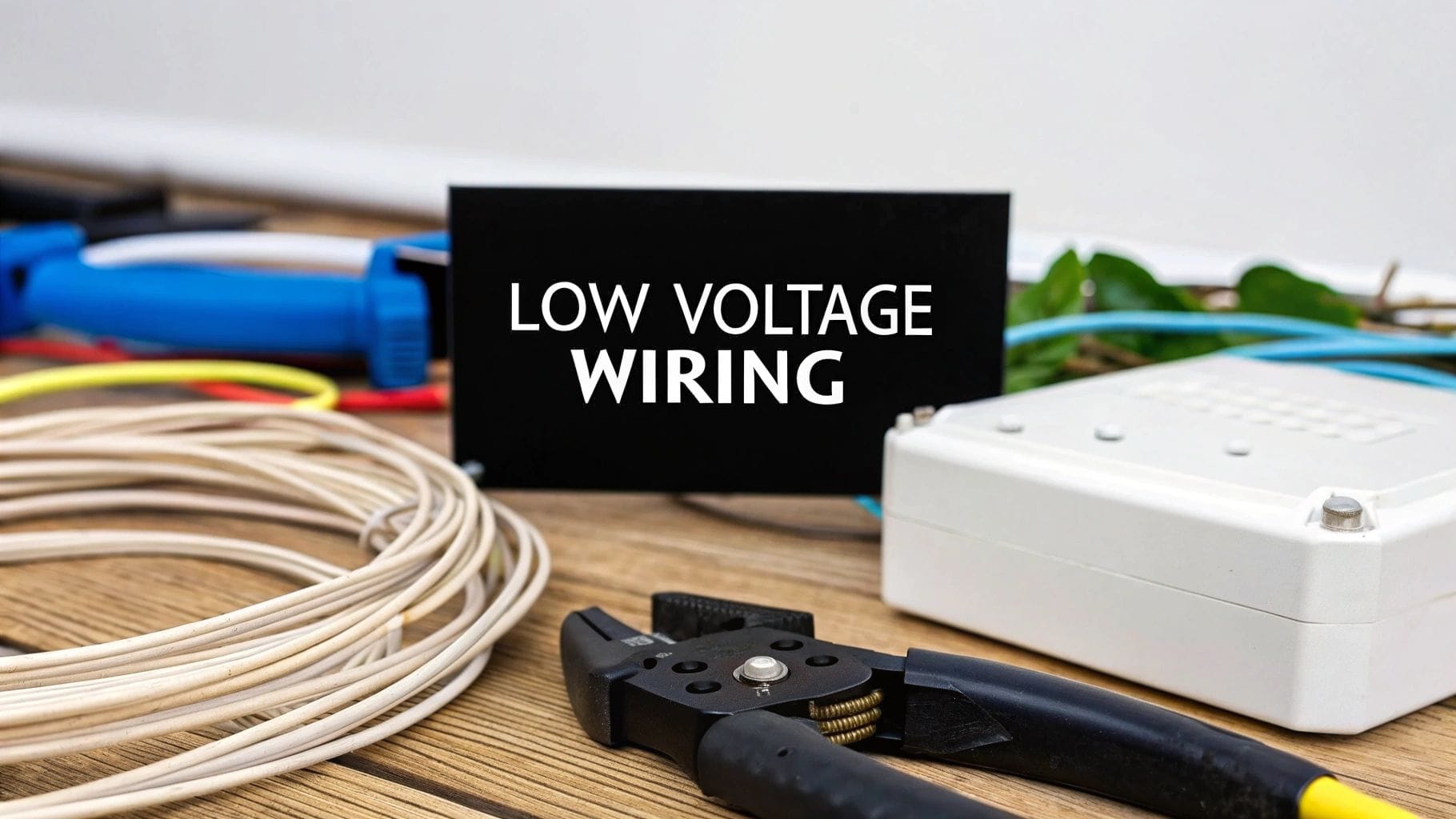
Ever wondered what powers your smart doorbell, Wi-Fi router, or even the landscape lights in your yard? It’s not the same heavy-duty current that runs your refrigerator or air conditioner. Let’s talk about what is low voltage wiring—think of it as the quiet, efficient nervous system for your home's modern technology, operating at 50 volts or less to safely power our connected world.
The Foundation of Your Connected Home
Let me explain. Low voltage wiring is a completely different animal than the standard electrical cabling in your walls. That standard wiring is the powerhouse, delivering 120 volts or more to your major appliances. Low voltage, on the other hand, handles the delicate, data-driven tasks. It’s the unsung hero that keeps your digital life humming along.
You know what? Most people don't realize just how much of their home depends on it. From the Ethernet cables that provide rock-solid internet for streaming your favorite shows to the speaker wires delivering immersive surround sound, these specialized systems are woven into the fabric of a modern home.
Key Characteristics
To really get a feel for its role, here are the core features that set it apart:
- Safety First: Operating at under 50 volts (and more commonly at 12V or 24V), the risk of a dangerous electrical shock is dramatically lower. This makes it much safer to have around sensitive electronics and in areas where cables are more accessible.
- Lean and Efficient: These systems are built to transmit data and signals with minimal power draw. That’s what makes them perfect for "always-on" devices like security cameras, smart thermostats, and network gear.
- Purpose-Built for the Job: Not all low voltage cables are the same. A Cat6 cable is optimized for high-speed internet, while a coaxial cable is designed for video signals. Each one is a specialist.
Low Voltage Wiring at a Glance
To put it all in perspective, this table gives you a quick, side-by-side comparison. It’s a simple way to see the fundamental differences between the low voltage network and the standard power lines in your home.
| Characteristic | Low Voltage Wiring | Line Voltage (Standard) Wiring |
|---|---|---|
| Voltage | Typically 50V or less | 120V or higher |
| Primary Use | Data, communication, audio/video | Powering appliances and lighting |
| Safety Risk | Low risk of electric shock | High risk of electric shock |
| Installation | Requires precision and knowledge of systems | Requires a licensed electrician for safety and code |
Ultimately, both systems are absolutely essential. They work together—not in competition—to create a fully functional, safe, and modern home. The high-voltage lines provide the raw muscle, while the low voltage network delivers all the intelligence and connectivity.
Low Voltage vs High Voltage: A Simple Analogy
To really get what low voltage wiring is all about, let’s use a simple analogy. Think of high-voltage wiring as a powerful fire hose—it’s built to deliver a massive, forceful blast of energy. That’s exactly what you need for the big jobs, like running your air conditioner, oven, or clothes dryer.
On the other hand, low-voltage wiring is more like a garden hose with a nice, adjustable spray nozzle. It provides a much gentler, more controlled stream of power, which is perfect for delicate and precise tasks. This is the wiring that handles the intricate communication and control systems that make a modern home functional and smart.
The Powerhouse and the Nervous System
Honestly, you need both systems for your home to work correctly. High voltage (typically 120V and above) is the raw muscle that handles all the heavy lifting. It’s what powers the outlets and major appliances that require a significant amount of electricity.
Low voltage (anything under 50V) acts as the home's central nervous system. It manages the sophisticated flow of information for devices like your router, security cameras, and smart thermostat. Without it, the "smart" in your smart home simply wouldn't exist.
This diagram shows how low-voltage wiring connects common smart home devices to a central hub.
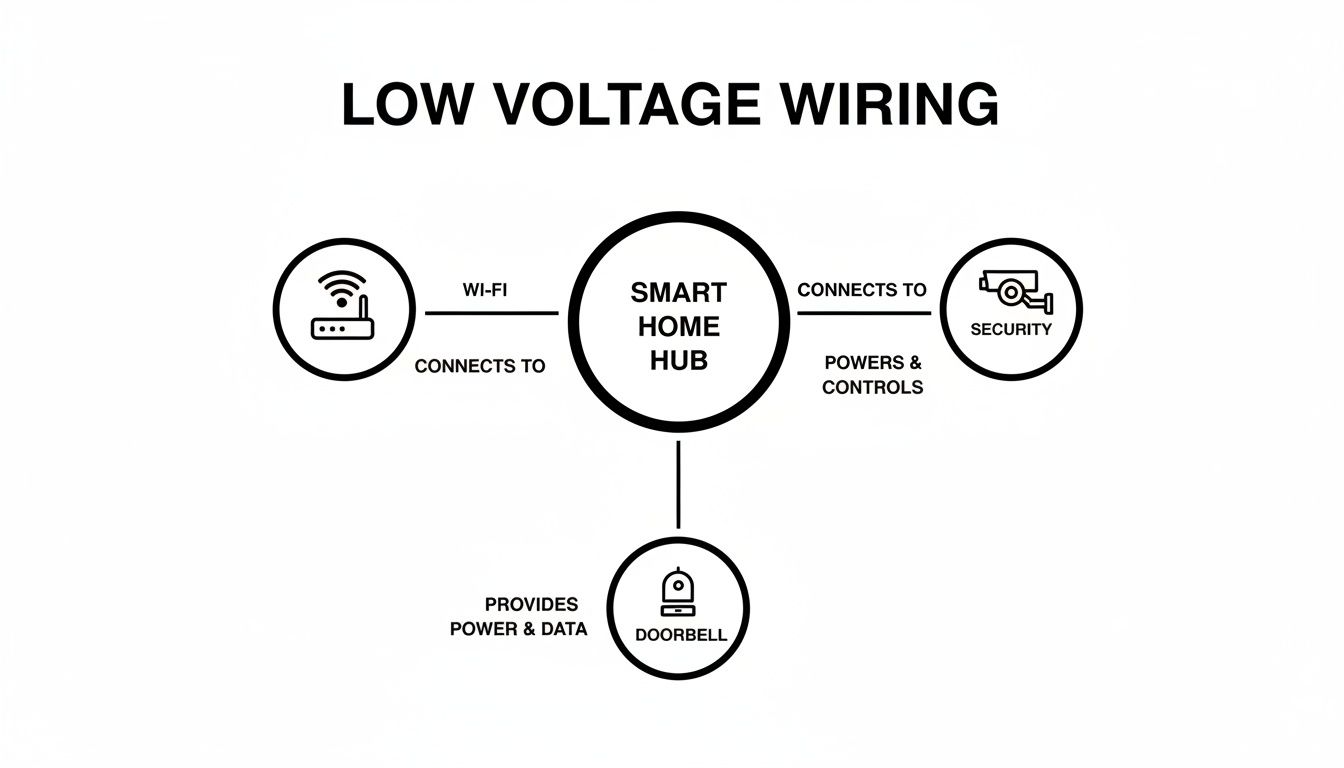
You can see how these essential technologies all rely on a dedicated, low-power network to communicate effectively. This separation is crucial—it ensures that high-power demands don’t interfere with sensitive data signals.
A Growing Demand for Connectivity
The importance of these specialized systems is growing every single day. Low-voltage wiring powers everyday essentials like security alarms, telecommunications, and data networks in homes and businesses all across Northern Utah. The global market for these cables was valued at over USD 145 billion and is projected to nearly double within the next decade. That reflects a massive worldwide push toward more connected infrastructure. You can explore more data on the low voltage wire market to see the full scope of this growth.
Here’s a quick breakdown to highlight the core differences:
| Feature | High Voltage Wiring | Low Voltage Wiring |
|---|---|---|
| Analogy | A powerful fire hose | A precise garden hose |
| Function | Powers heavy-duty appliances (e.g., ovens, dryers) | Manages data and signals (e.g., Wi-Fi, doorbells, speakers) |
| Voltage | 120V+ | Typically 12V, 24V, or under 50V |
| Primary Risk | Significant risk of electric shock and requires a pro | Low shock risk, but fire hazards exist with poor installs |
Ultimately, one system provides the brawn, while the other provides the brains. They work in tandem, but they are not interchangeable. Understanding this distinction is the first step toward building a safe, reliable, and future-ready home network.
Common Uses for Low Voltage Wiring in Your Home
So, where is all this hidden wiring, exactly? You'd be surprised how much of your daily life depends on it. Low voltage wiring is the quiet, unsung hero behind the modern tech you use every single day. Once you know where to look, you'll start seeing it everywhere.
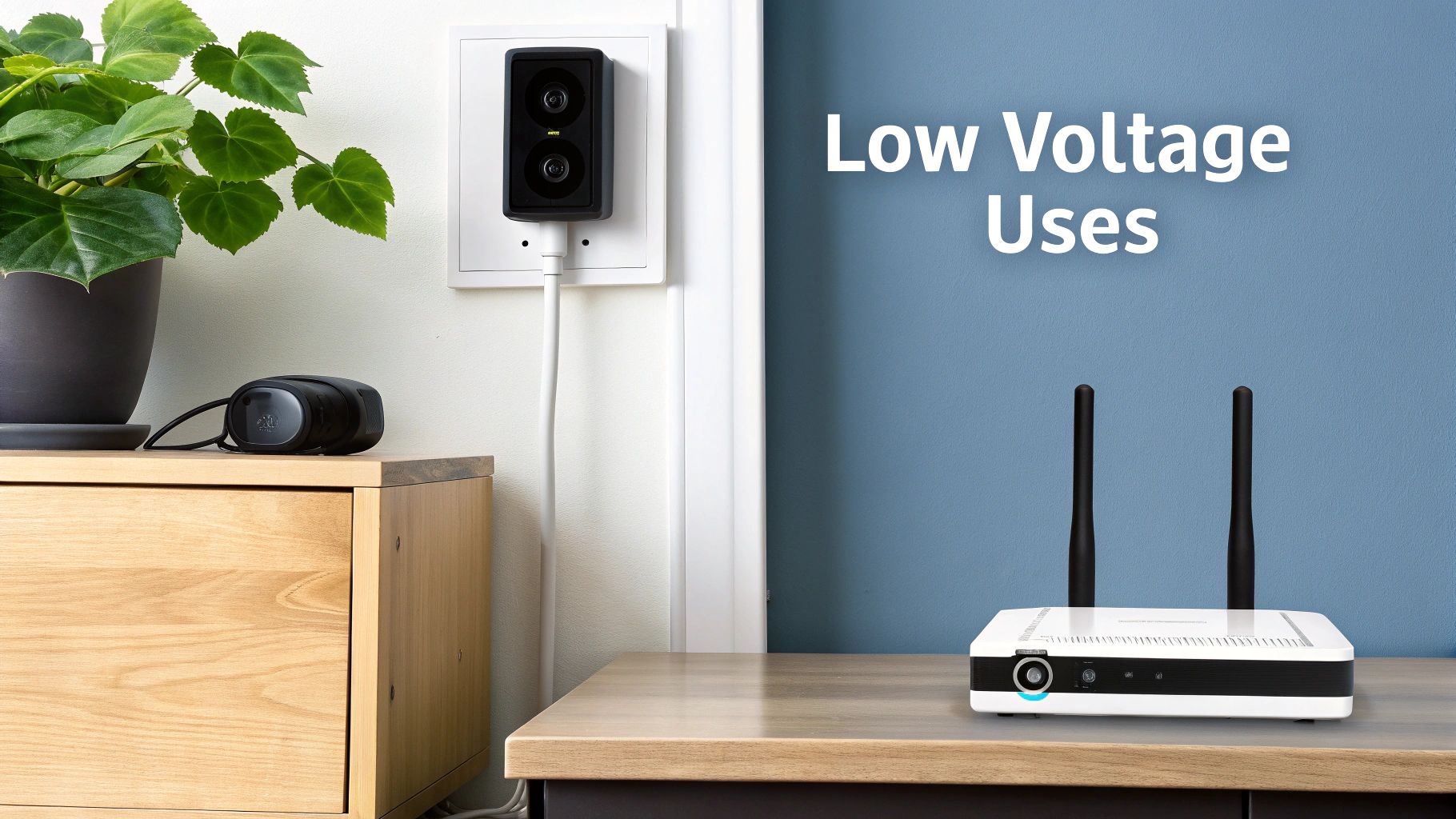
From your entertainment setup to the doorbell camera, these specialized circuits are humming along in the background. Think about the crisp audio from your surround sound speakers or the ethernet cables giving you that rock-solid internet connection for gaming. Every one of those devices relies on properly installed low voltage wiring to work safely and reliably.
Entertainment and Connectivity
One of the most common places to find low voltage wiring is right in your living room. The systems that create that immersive home theater experience are prime examples.
- Home Audio Systems: The speaker wires connecting your receiver to the surround sound speakers carry a low-voltage audio signal, not high-power electricity.
- Internet and Data Networks: That trusty Wi-Fi router, your modem, and the Cat6 Ethernet cables running through the walls are all part of a low voltage data network. It’s absolutely essential for a stable home office setup.
- Video and Cable TV: The coaxial cables that deliver your television signal are another classic example—a purpose-built, low-voltage application.
Security and Smart Home Automation
Beyond the fun stuff, low voltage wiring is the foundation for a secure and automated home. These systems need consistent, reliable power to protect your family and property, day in and day out.
A well-planned low voltage infrastructure isn’t just a luxury anymore; it’s essential for a modern, connected, and secure home. It’s the invisible framework that makes all that smart technology actually work.
The growth here is huge. As we add more smart devices and demand better connectivity, the need for this kind of wiring just keeps climbing. In fact, the global low voltage cable market is projected to hit nearly USD 200 billion by 2033, driven almost entirely by modern technology. You can read more about the low voltage cable market growth and its impact.
Just look at how many different systems rely on it.
Where You Will Find Low Voltage Wiring
This table breaks down some of the most common residential and commercial systems that run on low voltage wiring. You'll likely recognize a few.
| System Category | Examples of Applications |
|---|---|
| Security Systems | Doorbells, security cameras, motion sensors, and alarm panels. |
| Smart Home | Thermostats, automated blinds, and smart lighting control systems. |
| Communications | Landline phones and intercom systems. Our expertise in telephone and computer wiring ensures these systems are robust. |
| Outdoor Living | Landscape lighting, sprinkler systems, and pool controls. |
When you realize just how many of these systems depend on low voltage wiring, it becomes clear why professional installation matters so much. From your home network to your outdoor lighting, every component needs the right type of wiring to perform at its best.
Why Professional Low Voltage Installation Matters
Honestly, this is where expertise makes all the difference. While the voltage is low, the stakes for performance and safety are surprisingly high. Trusting a professional with your low voltage projects prevents a host of frustrating issues, ensuring your smart home technology works as intended from day one.
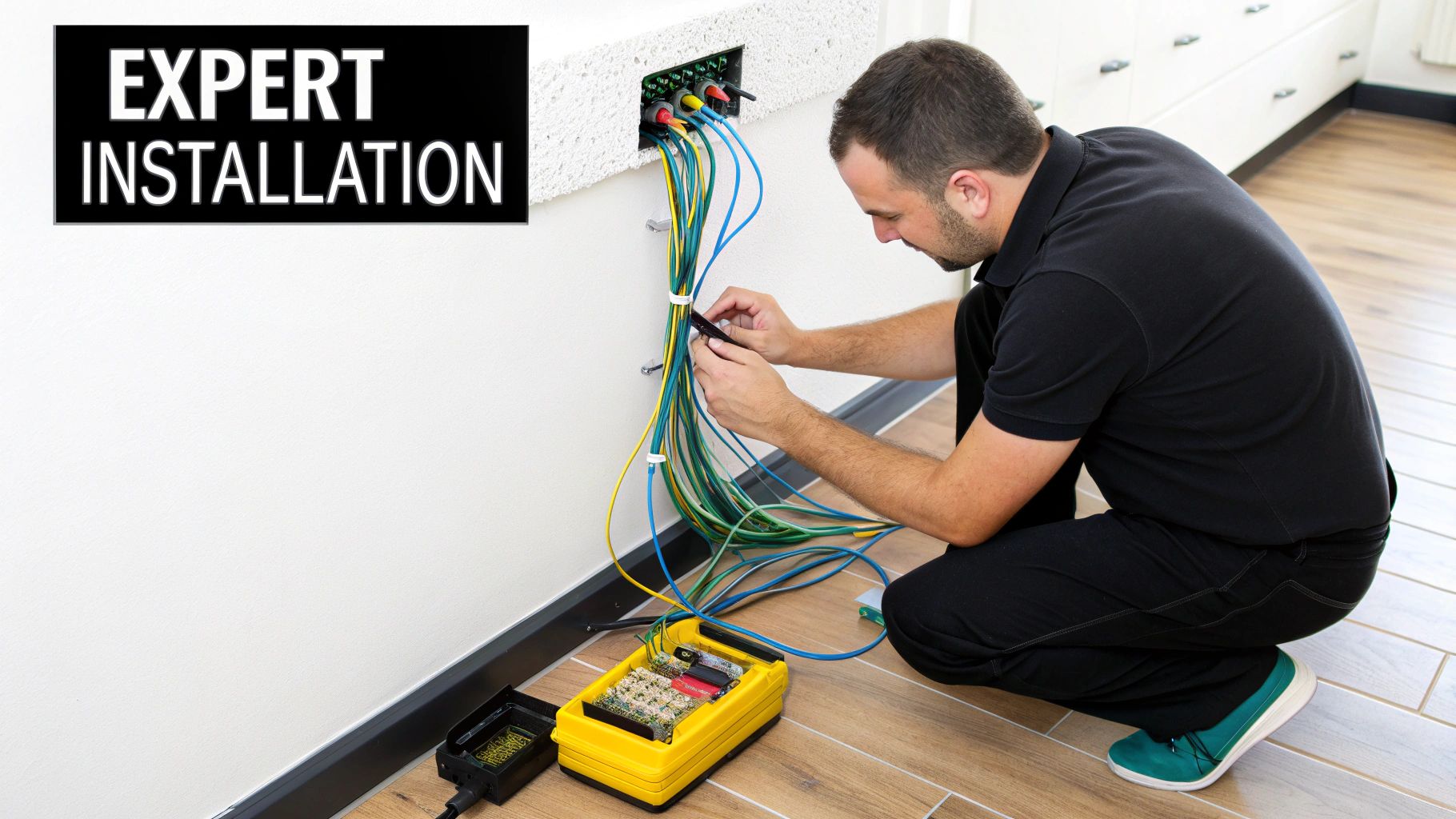
Improper installation can lead to nagging problems like spotty Wi-Fi due to signal interference or security cameras that cut out unexpectedly. A licensed professional ensures every connection is solid, every cable is the correct type for the job, and the entire system is optimized for reliability.
Performance and Future-Proofing
Think about it—what good is a state-of-the-art home network if the wiring behind the walls can't keep up? A professional installation is about more than just connecting wires; it's about building a robust foundation for all your current and future technology.
Here’s what that professional touch gets you:
- Reduced Signal Interference: Professionals know how to properly route low voltage cables away from high-voltage lines to prevent electromagnetic interference (EMI), which can degrade data signals. It's a small detail that makes a huge difference.
- Optimal Performance: Using the correct cable types (like Cat6a for high-speed data) and proper termination techniques ensures your devices get the bandwidth and power they need. No bottlenecks.
- Scalability for the Future: A structured cabling plan makes it easy to add new devices or upgrade systems later without having to tear open your walls again. We plan for the "what's next."
A professional low voltage installation isn't an expense; it's an investment in your home's functionality, safety, and long-term value. It ensures your technology works seamlessly today and is ready for whatever comes next.
Adherence to Safety and Codes
Here’s the thing: even though the shock risk is low, fire hazards are a real concern with poor low voltage work. Using the wrong type of cable in certain spaces or overloading circuits can create dangerous situations.
A licensed electrician from Black Rhino Electric understands the intricate details of the National Electrical Code (NEC) as well as local Northern Utah building codes. This is crucial for:
- Safety: Ensuring all installations meet strict safety standards to protect your home and family.
- Insurance Compliance: Your homeowner's insurance may not cover damage resulting from non-compliant electrical work.
- Property Value: Proper, code-compliant wiring is a significant asset when it comes time to sell your home.
This also applies to specialized systems. Our expertise in creating stunning and safe designs, like those required for custom lighting, showcases the difference professional knowledge can make. From planning to final inspection, we ensure every aspect of the job is done right.
Here’s the thing about "low voltage"—it can give you a false sense of security. Just because it’s called "low voltage" doesn't mean it comes with "no risk." The danger of a serious electric shock is much, much lower than with a standard outlet, but an improper installation can create a very real fire hazard.
That’s why understanding the safety rules and building codes for these systems is non-negotiable.
An improperly installed low-voltage wire can overheat if it's the wrong type for the job or gets damaged inside a wall. That heat can eventually ignite nearby insulation or wood framing. It's a hidden danger, and it's why professional experience matters. A licensed electrician makes sure every cable is chosen, routed, and secured correctly to prevent this from ever happening.
Understanding Cable Ratings and Placements
One of the most critical safety details—and one that's easy to miss on a DIY project—is using the right type of cable for a specific location. For example, any wiring you run through the air-handling spaces in your home, like inside ductwork or above a drop ceiling that circulates air, has to be plenum-rated.
Why does this matter so much?
- Plenum-Rated (CMP) Cable: This cable has a special fire-resistant jacket. It doesn't produce much smoke or toxic fumes when it burns. If you use the wrong wire and there’s a fire, your HVAC system could pump hazardous smoke throughout your entire home in minutes. That’s why using non-plenum wire in these spaces is a serious code violation.
- Riser-Rated (CMR) Cable: This one is designed for running wires vertically between floors (but not in plenum spaces). It's built to help prevent a fire from climbing the cables from one floor to the next.
Following the National Electrical Code (NEC) isn't just about passing an inspection. It's a fundamental part of protecting your property and your family from a fire that could have been prevented.
The Importance of NEC Classifications
The NEC gives us clear rules for low-voltage systems, mainly by sorting them into Class 2 or Class 3 circuits. The classification is all about the power limitations of the circuit, and it dictates exactly how things need to be installed.
Let me explain. Class 2 circuits are what you’ll find most often in homes—they power things like thermostats, doorbells, and security sensors. Their power supplies are designed with built-in safety limits.
These standards control everything from the type of wire you can use to how it’s supported and connected. This is where a professional firm like Black Rhino Electric really delivers peace of mind. We know these codes inside and out, ensuring your system isn't just working, but is completely and verifiably safe.
When to Call a Licensed Low Voltage Electrician
Knowing when a project is simple enough for a DIY afternoon versus when it’s time to call a pro is key. Honestly, it’s an investment in safety and reliability. While plugging in a smart speaker is one thing, any project that involves running wires through walls, integrating complex systems, or requires a permanent connection should be left to a licensed low voltage electrician.
Are you planning a new construction build or a major remodel here in Northern Utah? This is the perfect time to bring in an expert. Professionals can design and install a structured cabling system from the ground up, ensuring your home is ready for any tech you want to add now—or five years from now.
Troubleshooting and Complex Integrations
Another clear sign to call for help is when things go wrong. If you’re troubleshooting a dead ethernet port that’s crippling your home office, or if your landscape lights are flickering, an expert can diagnose and fix the problem quickly and safely. It saves you the immense frustration of trying to trace a faulty wire hidden somewhere in a wall.
And if you're integrating multiple smart home systems, a licensed professional is essential to get them all working together seamlessly. They have the experience to ensure your security cameras, smart thermostat, and audio system all communicate flawlessly without interference. This is especially true for more complex installations, like designing and installing commercial-grade alarm systems that need to be 100% reliable.
Investing in a professional electrician for your low voltage needs is about more than just convenience—it’s about ensuring the safety, performance, and long-term value of your home’s technological backbone.
Ultimately, a professional guarantees the job is done right, adhering to all safety codes and performance standards. For any low voltage wiring project in Northern Utah, from a simple repair to a full smart home setup, you can call Black Rhino Electric at 385-396-7048 or request a free quote to get the peace of mind you deserve.
Got Questions About Low Voltage Wiring? We've Got Answers.
We hear a lot of the same questions when we're out on jobs, and honestly, they're good ones. Understanding what low voltage wiring is means cutting through some common confusion. Let’s tackle a few of the big ones head-on so you can make smart calls for your home.
So, Can I Just Install This Stuff Myself?
While some of the simple, plug-and-play gadgets are definitely DIY-friendly, anything that involves running wires through your walls, making permanent connections, or tying complex systems together really ought to be handled by a licensed electrician.
You know what? It’s not just about getting it to work. It’s about doing it safely, making it reliable, and staying on the right side of local Northern Utah building codes. A pro install keeps you safe from fire hazards caused by bad wiring and makes sure all your systems talk to each other without interference.
What's This "Structured Cabling" I Keep Hearing About?
Think of structured cabling as the central nervous system for all your home’s data, phone, and video signals. Instead of a chaotic "spiderweb" of wires going every which way, it’s an organized system where every wire runs neatly back to one central hub or panel.
This methodical setup makes troubleshooting a breeze, simplifies future upgrades, and gives you a rock-solid, reliable network for every connected device you own. It’s the difference between a tangled mess behind the TV and a clean, high-performance system built to last.
Does Low Voltage Wiring Actually Add Value to My House?
Absolutely. In today's market, a professionally installed structured cabling system is a huge selling point. Homebuyers now expect seamless connectivity for everything—home offices, entertainment systems, smart security, you name it.
A home that's already wired and ready for today's technology (and tomorrow's) is way more attractive than one that needs a major wiring overhaul. It tells buyers the home is modern, well-maintained, and ready for a connected lifestyle from day one.
How Is Low Voltage Wiring Different for a Business?
The core ideas are the same, but commercial jobs are a whole different ballgame—usually more complex and on a much larger scale.
Business installations often require:
- Massive Data Networks: We're talking support for dozens or even hundreds of computers, phones, and servers.
- Access Control Systems: Wiring for key card readers or biometric scanners to manage employee entry.
- Complex Phone Systems: Sophisticated wiring is needed to handle multiple internal and external communication lines.
- Tougher Code Requirements: Commercial buildings have far more rigorous safety and installation codes to follow.
These systems demand a much higher level of planning to guarantee they are reliable, secure, and can grow right alongside the business.
For any low voltage project in Northern Utah, trust the experts at Black Rhino Electric to get it done right the first time. Give us a call at 385-396-7048 or request a free quote online for a safe, reliable, and future-ready installation.