Knowing when to upgrade your electrical panel isn't some big mystery, as your home usually gives you plenty of warning signs. That constant hum from the breaker box or the way your lights flicker when you start the microwave aren't just harmless quirks. Honestly, they're symptoms of an electrical system under stress, and ignoring them can lead to serious safety problems.
Contents
Is Your Electrical Panel Sending Out an SOS?
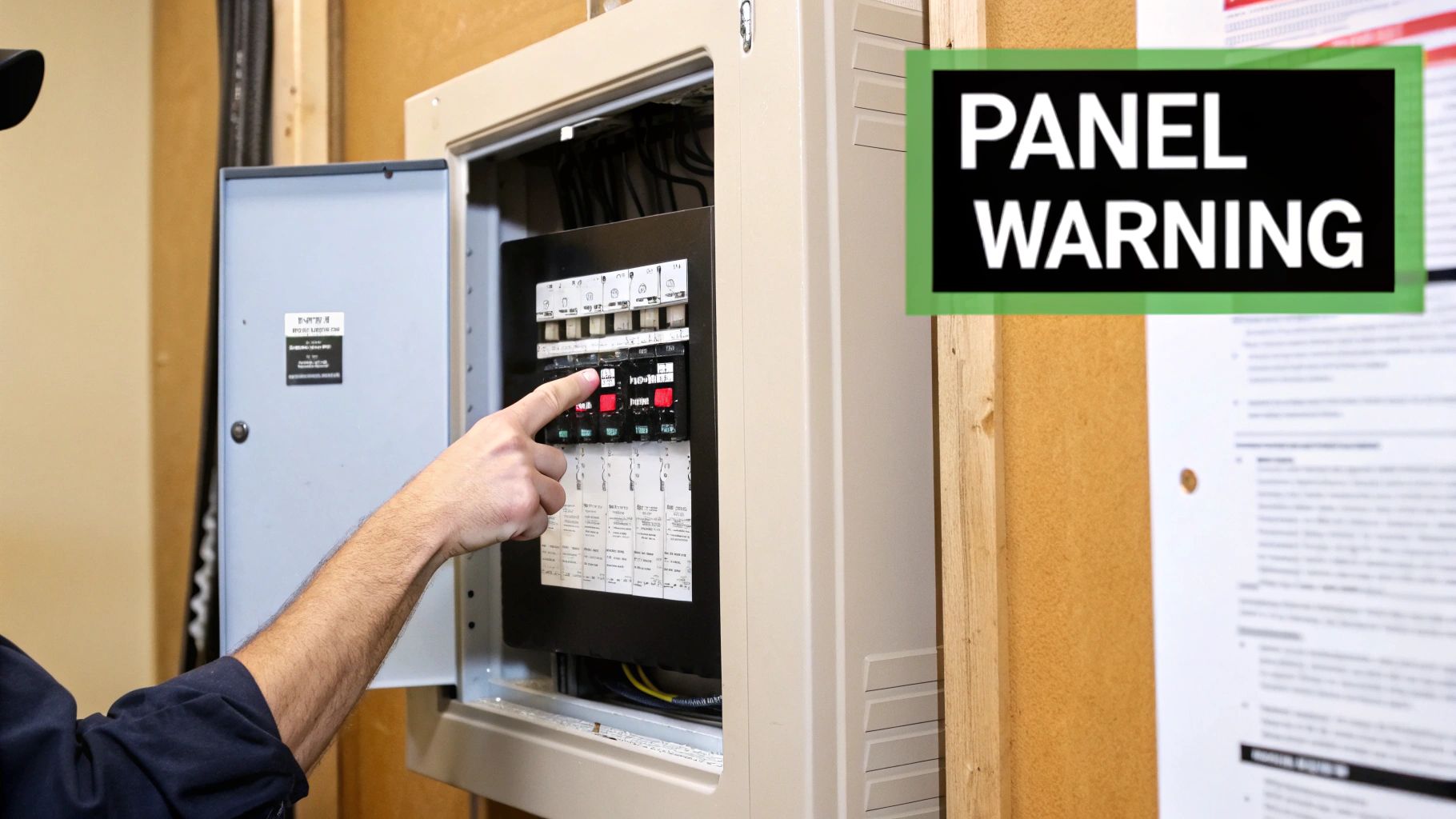
Think of your electrical panel as the heart of your home's power system. It’s supposed to pump electricity safely to every room and appliance. But when it starts struggling to keep up with modern life, it’ll show signs of strain. Ignoring these signals is like ignoring chest pain—it’s a risk you just shouldn't take, right?
A lot of homeowners get used to these little electrical hiccups, but they're often the first clue that a panel is overloaded or starting to fail. Recognizing these red flags is the first step toward keeping your home safe and functional. Let me explain a few of the most common signs we see in our experience as licensed electricians.
Frequent Breaker Trips
You know what? A circuit breaker that trips every once in a while is just doing its job—preventing an overload. But if you find yourself constantly walking to the panel to reset the same breaker, that's a clear signal the circuit is overloaded. This often happens when you’re running high-power appliances on a circuit that can't handle it. While it’s definitely a nuisance, it's also your panel’s way of crying out for help. If this sounds familiar, professional electrical troubleshooting services can pinpoint the real cause.
Flickering or Dimming Lights
Ever notice your lights dimming the moment the AC kicks on? Or maybe they flicker when you run the vacuum? This is a classic symptom of an overloaded system. Your panel is struggling to supply consistent power to everything at once, and those voltage drops are the result.
Odd Noises and Smells
Your electrical panel should be seen, not heard. If you hear buzzing, crackling, or humming sounds coming from the breaker box, it points to a serious problem like a faulty breaker or a loose wire. It's not normal. Even worse, a distinct burning smell or any sign of melted wires are immediate red flags that require a professional electrician, right away.
Your electrical panel is a silent guardian of your home's safety. When it starts making noise or showing signs of distress, it's not a suggestion—it's a critical warning that demands immediate action to prevent potential fire hazards.
Electrical fires are a real, silent threat in homes with outdated systems. The National Fire Protection Association (NFPA) reports that electrical problems cause about 44,000 home fires every year. That leads to an estimated $1.9 billion in property damage and, tragically, claims over 400 lives. Here in Salt Lake County, where many homes are 40-50 years old, panels often max out at 100 amps, which just isn't enough for today's electrical demands. Upgrading to a modern panel isn't just a convenience—it's one of the most important safety measures you can take.
Major Upgrades That Demand More Power
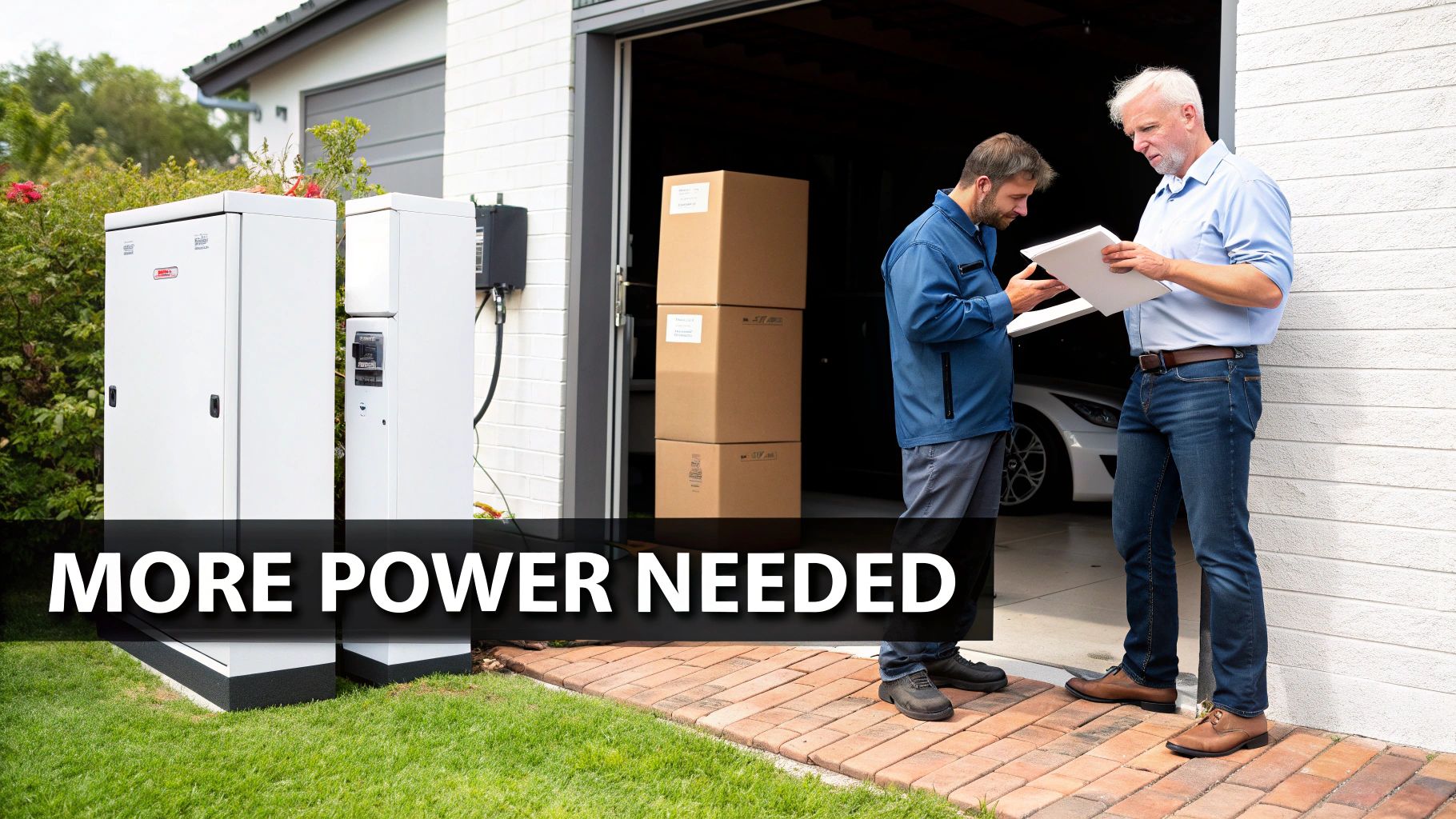
Your home is constantly evolving, and so are its power needs. You're planning that dream kitchen renovation, finally installing a hot tub, or getting ready for an electric vehicle. But have you considered if your electrical panel can handle the new load? Honestly, knowing when to upgrade your electrical panel is often the most overlooked part of any major home improvement, yet it's absolutely critical for safety and performance.
Think of your home's electrical capacity like a highway. A 100-amp panel, common in older homes, is like a two-lane road—perfectly fine for the traffic of a few decades ago. But when you start adding high-power "vehicles" like a new central air conditioner, a hot tub, or an EV charger, you create a major traffic jam.
Here’s the thing: these modern additions draw a significant amount of power, often requiring their own dedicated circuits. Piling them onto an old, undersized panel is a recipe for constant breaker trips, poor appliance performance, and even dangerous overloads. You simply can't add more lanes to the old highway; you need to build a new, wider one.
The Rise of the All-Electric Home
More and more, homeowners are moving away from gas appliances and embracing electrification. This includes things like:
- Induction cooktops
- Heat pump water heaters
- Electric vehicles (EVs)
While this is great for efficiency and the environment, it puts a massive strain on older electrical systems. The reality is stark: up to 48 million single-family homes in the U.S. have panels that just can't handle full electrification. One study found that in homes with 100-amp service or less, a staggering 83% would require an upgrade to go all-electric. For Northern Utah families, adding a new Level 2 EV charger to a pre-1980s panel will almost certainly demand an upgrade to a 200-amp service to stay safe and code-compliant.
Planning Your Power Needs in Advance
The smartest time to consider a panel upgrade is before you start a major project. You know what? It’s far easier and more cost-effective to include it in the initial renovation plan than to deal with electrical problems after the fact. Planning for an expert EV charger installation, for example, should always involve an assessment of your panel's capacity first.
This responsive table shows just how much demand popular home additions place on your system, especially an older 100-amp panel.
| Home Addition or Appliance | Typical Amperage Required | Impact on a 100-Amp Panel |
|---|---|---|
| Level 2 EV Charger | 30-50 Amps | Consumes a massive portion of the panel's total capacity, often making an upgrade mandatory. |
| Hot Tub or Spa | 50-60 Amps | Requires a dedicated circuit and can easily overload an older panel when other major appliances are running. |
| Central Air Conditioner | 30-50 Amps | A significant, continuous load that can cause flickering lights and breaker trips on an undersized system. |
| Major Kitchen Remodel | Varies (20-40+ Amps) | New appliances like induction stoves, double ovens, and high-power microwaves quickly exceed capacity. |
As you can see, a single one of these upgrades can claim half of an older panel's entire capacity. Add a couple of them together, and you're well past the safety margin and into upgrade territory.
The Hidden Dangers of Obsolete Panels
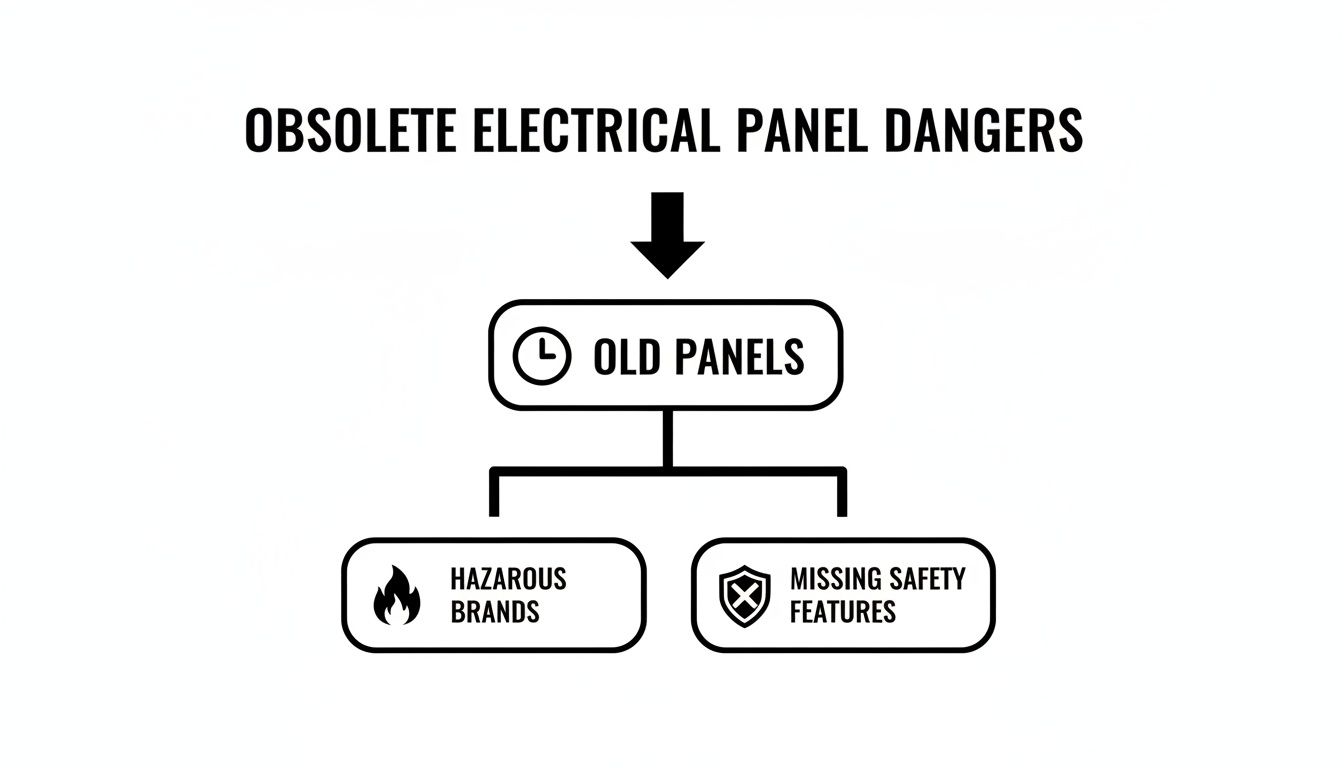
An outdated electrical panel isn't just an inconvenience; it's a ticking clock. Sure, your panel has a finite lifespan—usually 25 to 40 years—but the real danger isn't always age. It's the obsolete and hazardous technology lurking inside. Let me explain. Some electrical panels, widely installed for decades, are now known to be severe fire hazards because they can fail to do their one essential job: shutting off power during an overload or short circuit.
When a breaker fails to trip, electricity continues to surge through the wiring. This causes wires to overheat, melt their protective sheathing, and ignite surrounding materials like wood framing. It’s a silent but deadly failure that can happen without any warning.
The Notorious Brands You Need to Know
Two names stand out in the electrical world for all the wrong reasons: Federal Pacific Electric (FPE) and Zinsco. If your home was built between the 1950s and 1980s, there's a chance you might have one. Honestly, finding one in your home is an immediate cause for a professional inspection and replacement.
- Federal Pacific Electric (FPE) Panels: Often called "Stab-Lok" panels, these units have a documented failure rate that is alarmingly high. Studies have shown their breakers can fail to trip over 60% of the time, creating a massive fire risk.
- Zinsco Panels: These panels have a design flaw where the breakers can seem to be in the "off" position but are still conducting electricity. They are also known for breakers melting to the main bus bar, which prevents them from tripping at all.
Identifying these panels can be tricky, but look for the brand name "Federal Pacific," "Stab-Lok," or "Zinsco" on the panel door or inside cover. You might also notice brightly colored breaker switches, which are a classic sign of Zinsco panels.
A faulty breaker that fails to trip is like having a smoke detector with no batteries. It provides a false sense of security while leaving your family completely exposed to danger. If you suspect you have an FPE or Zinsco panel, it is not a matter of if it will fail, but when.
Missing Modern Safety Features
Even if your panel isn't one of the infamous brands, its age alone means it's missing critical safety technology required by modern electrical codes. One of the most important is the Arc Fault Circuit Interrupter (AFCI). So, what is an arc fault? It's a dangerous electrical spark created by damaged, overheated, or stressed wiring. These arcs can reach temperatures hot enough to ignite nearby materials in seconds.
Modern building codes now mandate AFCI protection in nearly every living space—bedrooms, living rooms, hallways, you name it. An older panel simply wasn't designed with this life-saving technology, leaving your home vulnerable to one of the leading causes of electrical fires. Upgrading isn’t just about adding capacity; it's about adding layers of protection that your old panel completely lacks.
Understanding Your Home's Electrical Capacity
When an electrician throws around terms like "capacity" or "amps," what does that actually mean for you?
Think of your home's electrical system like its plumbing. Amperage—or amps—is the electrical equivalent of water pressure and the size of the main pipe running into your house. An older home with a 100-amp panel is like having a narrow water main. It was perfectly fine decades ago, but it really struggles to supply enough "pressure" when you have a bunch of modern, high-demand faucets running all at once.
Every single appliance, from your fridge to that new EV charger you're eyeing, draws a certain amount of amperage. A 100-amp panel, which is still common in many older Utah homes, can only supply a total of 100 amps at any given time. A modern 200-amp panel, now the standard for new construction, is like having a much wider main pipe, giving you more than enough electrical "flow" for a house full of today's gadgets.
Honestly, figuring out if you have enough capacity isn't just guesswork; it comes down to some straightforward math.
How to Estimate Your Electrical Needs
While a precise electrical load calculation is a job for a licensed electrician, you can get a rough feel for it yourself. Just walk around and list your major electrical appliances—things like your central AC, electric range, water heater, and clothes dryer. Each one has a label showing the amps it uses. Once you add those up and factor in general lighting and outlet circuits, you'll see just how quickly the total can creep toward the limit of a 100-amp panel. This little exercise makes it crystal clear why adding a 50-amp hot tub might be the final straw for an older system.
An electrical panel upgrade isn't just about adding more circuits. It’s about increasing the total capacity of your home's entire electrical system to safely meet the demands of modern life without compromise.
Comparing Electrical Panel Capacities
To make it even clearer, here’s a simple breakdown of what different panel sizes can realistically handle in today's world.
| Panel Capacity | Best Suited For | Potential Limitations |
|---|---|---|
| 100 Amps | Smaller homes with mostly gas appliances. Can support basic electric needs, but little more. | Struggles with multiple high-power appliances (EV chargers, hot tubs, central AC). Not ideal for full home electrification. |
| 150 Amps | A good middle-ground for medium-sized homes that may have a mix of gas and electric appliances. | Can support one or two major electric additions, but may reach its limit with an all-electric setup. |
| 200 Amps | The modern standard. Perfect for larger homes or any home with significant electrical loads. | Easily handles EV chargers, electric heating, and other modern appliances simultaneously. Future-proofs your home. |
Seeing it laid out like this makes it obvious why a 200-amp panel has become the new benchmark. It gives you the robust capacity needed not just for what you have today, but for any electrical additions you might want down the road.
What to Expect During a Panel Upgrade
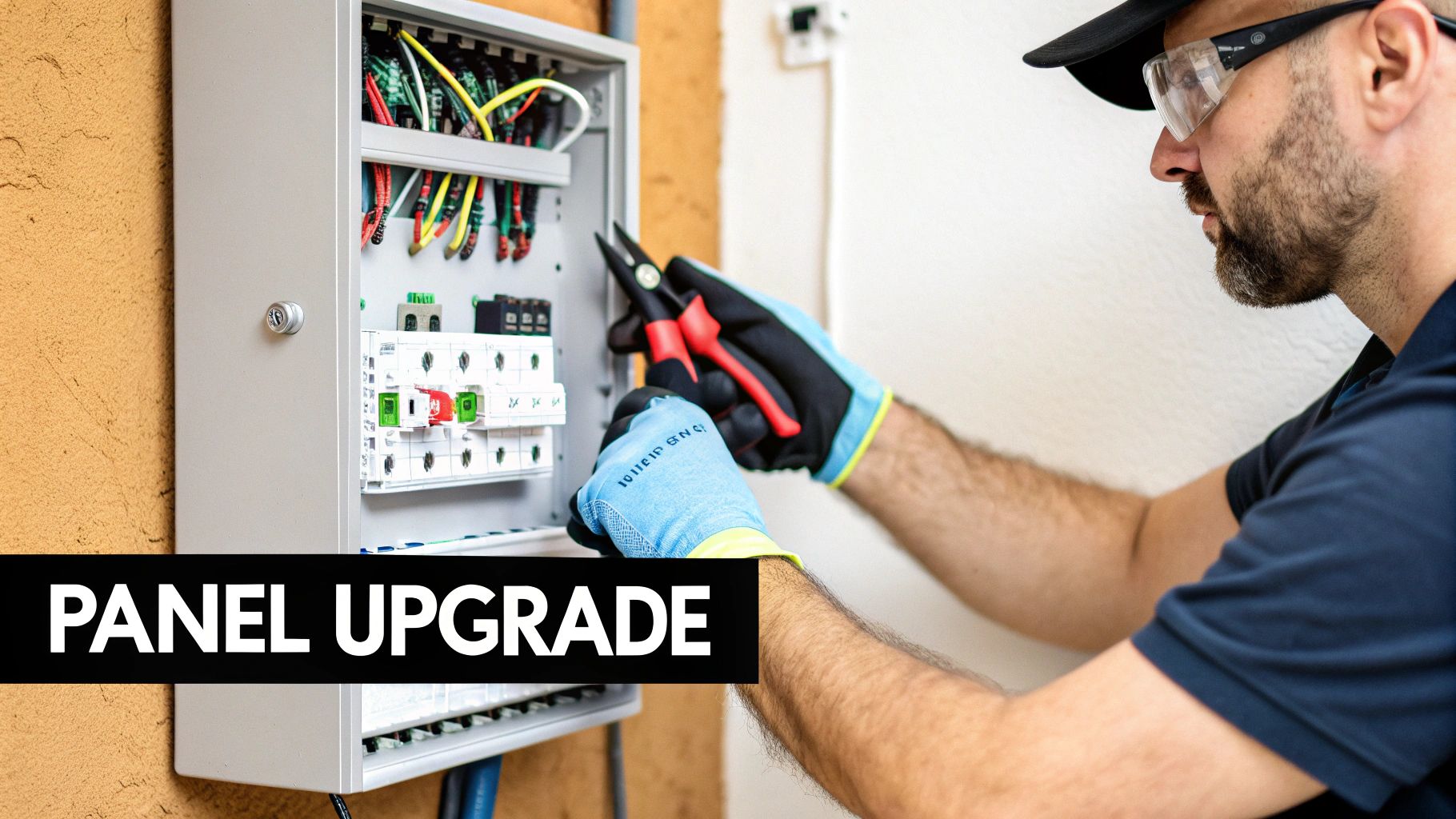
The thought of a big electrical project can feel a little intimidating, but a professional panel upgrade is a well-oiled machine. You know what? It’s far less disruptive than most homeowners think. Here's the thing: a panel upgrade isn’t just swapping a metal box. It’s a systematic overhaul of your home’s electrical core, making sure it’s safe, up to code, and ready for whatever you plug in next.
The Step-by-Step Upgrade Process
A professional upgrade follows a structured timeline to make sure everything goes off without a hitch. While every home has its own quirks, the core steps stay the same. Here's what you can expect when working with our team of certified electricians:
- Initial Consultation and Assessment: It all starts with a thorough evaluation. A licensed electrician will inspect your current panel, meter, and service wiring to figure out your home's electrical load and spot any existing issues.
- Permitting with Your Municipality: This is a crucial step that protects you. Your electrician handles pulling the necessary permits from your local Utah city or county. This ensures the work is documented and meets all local safety codes.
- The Day of the Upgrade: This is when the main event happens. The electrician will coordinate with the utility company to temporarily shut off power to your home. They’ll then remove the old panel and install the new one, connecting each circuit with precision.
- Inspection and Power Restoration: Once the new panel is installed, it has to be inspected by a city or county official. After it gets the green light, the utility company will restore power.
- Final Walk-Through: Your electrician will walk you through the new panel, explaining the layout of the new breakers and answering any questions you have.
The most common question we get is, "How long will my power be out?" For a standard panel replacement, the power is typically off for only 4 to 8 hours—usually less than a full workday.
Key Factors That Influence the Project
Honestly, not all upgrades are created equal. A few things can affect the timeline and final cost. For instance, if the main service line from the utility pole to your house (we call it the service mast) needs to be replaced, that will add to the scope of work. Similarly, sometimes older home wiring needs minor adjustments to be brought up to code. Our team at Black Rhino Electric provides a detailed quote that breaks down every single element. You can learn more about our process for handling breakers and panels on our residential services page. We believe in total transparency so there are no surprises.
Hiring the Right Electrician for the Job
Your electrical panel is the literal heart of your home’s power system. Let’s be blunt: working on it is absolutely not a DIY project. An upgrade requires a deep, practical knowledge of local codes, safety protocols, and utility company requirements. Hiring a qualified, licensed electrician isn’t just a good idea—it’s essential for protecting your property and your family.
A shoddy installation can lead to failed inspections, damage your expensive appliances, or even create a serious fire hazard. Let me walk you through what you should be looking for to make sure you hire a true professional.
Vetting Your Electrical Contractor
When you start looking for an electrician here in Utah, there are a few non-negotiables you should check off before making a decision. Think of it as a simple checklist to protect your investment and ensure the job gets done right the first time.
- Verify Licensing and Insurance: Always confirm that the contractor holds a current Utah state electrical license. Don't be afraid to ask for proof of liability insurance and workers' compensation.
- Check Reviews and References: A quick look at online reviews on platforms like Google will tell you a lot about past customer experiences. Any reputable company will also be happy to provide references you can actually speak with.
- Get a Detailed Written Quote: Never accept a vague verbal estimate. A professional quote should be itemized, clearly breaking down the costs of the panel, breakers, labor, and any potential extra work.
Red flags to watch out for? Electricians who push for cash-only payments, can't provide a license number when asked, or offer a price that seems drastically lower than everyone else's. An unusually cheap quote almost always means corners are being cut somewhere.
Answering Your Questions About Panel Upgrades
Thinking about a project this big naturally brings up a lot of questions. We get it. Knowing when to upgrade is the first step, but understanding the real-world details of cost, downtime, and home value is just as important. Here are some straightforward answers to the questions we hear most often from homeowners based on our extensive experience.
How Much Does an Electrical Panel Upgrade Cost in Utah?
Honestly, the cost can vary quite a bit. For a straightforward panel swap in a home with good existing wiring, you might be looking at a range of $1,500 to $2,500. However, if the upgrade also requires a new service line from the utility company, a new meter base, or significant rewiring to meet modern safety codes, the total cost could land between $3,000 and $5,000, sometimes more. The only way to get a firm, reliable number is with a detailed, on-site quote from a licensed professional.
How Long Will My Power Be Off During the Upgrade?
This is a huge concern for most families, and the good news is it's usually less disruptive than you’d think. For a standard panel upgrade, a professional electrician can typically get the core work—the part where the power has to be off—done within 4 to 8 hours. We always work with you to schedule the main power outage at a time that minimizes the headache for your family.
Will a Panel Upgrade Increase My Home's Value?
Yes, it absolutely does. In today's market, an upgraded electrical panel is a major selling point and a sign of a well-maintained home.
An updated panel gives potential buyers huge peace of mind. It assures them the home's electrical system is safe, modern, and ready for their needs—from EV chargers to home office equipment. It’s a feature that removes a major hurdle during a home inspection and can make your property far more attractive than a comparable home with an outdated system.
Ready to make sure your home's electrical system is safe, reliable, and ready for the future? As the trusted experts at Black Rhino Electric, we believe in providing clear, upfront pricing and take the time to explain every part of the project so you know exactly what you’re getting. For a transparent and professional assessment, call us at 385-396-7048 or request a free quote online today.