
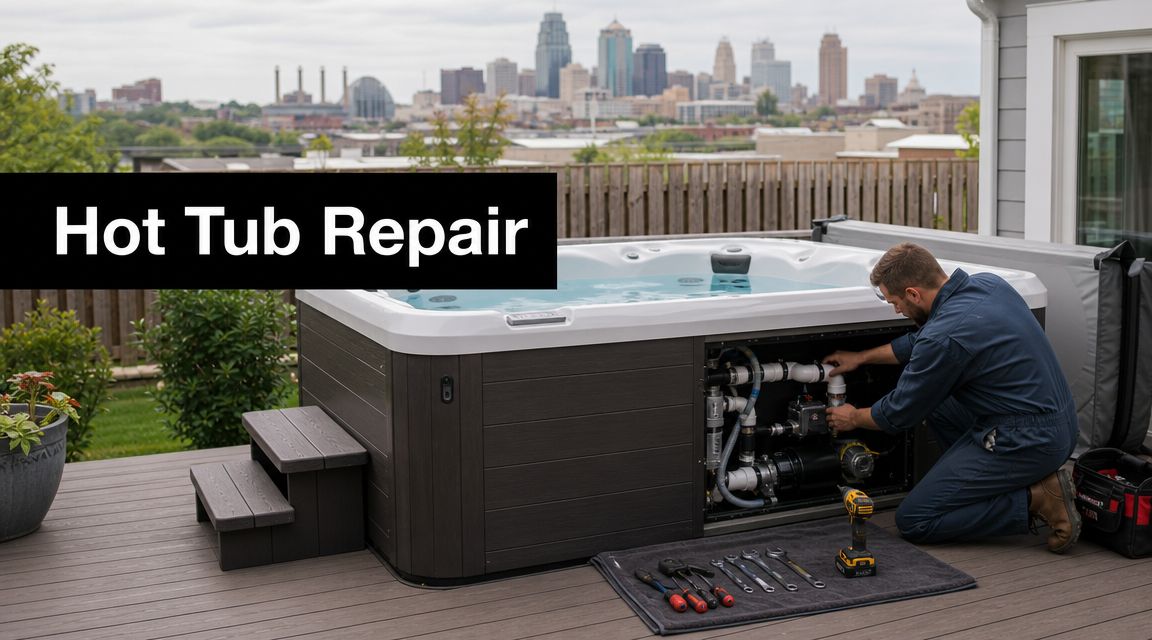
A cold spa, a tripped breaker, or a control panel that suddenly goes blank can turn a relaxing evening into a frustrating mess fast. If you're searching for hot tub repair Kansas City, the smartest first step is figuring out whether the problem is inside the spa or in the electrical system feeding it.
Is Your Hot Tub Trying to Tell You Something?
Most hot tubs don't fail all at once. They usually complain first.
One day the water takes too long to heat. A week later the jets feel weaker. Then the breaker trips once, resets, and seems fine. After that, the tub shuts down again during a cold night, and now you're standing outside staring at a dead panel wondering whether this is a pump problem, a heater problem, or something more serious.

The obvious signs
Some warning signs are hard to miss:
- No power at all means the spa may have lost supply power, tripped protection, or developed an internal control problem.
- Cold water often points to a heating issue, but it can also happen when the system shuts the heater off because of a flow, sensor, or safety fault.
- Leaking water can damage components that were fine until moisture reached them.
These symptoms matter because a hot tub isn't just a water feature. It's a tight combination of pumps, heaters, sensors, relays, circuit boards, and safety devices working in a wet environment.
The subtle signs homeowners often miss
The more useful clues are usually the ones people ignore at first.
Weak jets can mean a clogged filter, a circulation problem, or a pump that's struggling under load. Grinding or humming sounds can point to a motor that's binding, a failing wet end, or a pump that's getting power but can't move water properly. Water that swings from too hot to too cool may not be a simple thermostat issue. It can be a sensor feeding bad information to the control system.
Practical rule: A hot tub that acts inconsistent is often easier to diagnose than one that is fully dead, because those changing symptoms tell you which part is losing the fight first.
Cloudy water that won't clear up can be chemistry, but it can also show that circulation is poor. If water isn't moving right, the heater can run hotter than it should, sensors can misread conditions, and the whole system starts making bad decisions.
Watch your power use and timing
An oddly high electric bill can also be part of the story. A heater that runs too long, a failing pump that draws power inefficiently, or a control issue that cycles equipment at the wrong times can all push operating costs up. You might not notice the pattern until the tub stops working.
That's why guessing gets expensive. Replacing the wrong part in a spa is a lot like changing a car battery when the alternator is failing. The symptom looks familiar, but the root cause sits elsewhere.
If your hot tub is sending repeated little warnings, pay attention before a minor repair becomes a bigger service call.
Common Hot Tub Failures and What They Mean
Most service calls come back to a short list of troublemakers. The trick is knowing which failures are straightforward and which ones only look straightforward.

Pump and jet problems
A hot tub pump does the heavy lifting. It moves water through the heater, pushes water to the jets, and keeps circulation going.
When pumps start failing, homeowners usually notice one of three things:
- The motor hums but the jets don't move much. That can mean a seized impeller, debris, or a motor that can't start properly.
- The jets work, then weaken. Filters, air locks, or a circulation restriction can be part of the issue.
- The pump is loud. Bearings, motor wear, or cavitation may be involved.
A pump replacement can solve the problem if the motor is done. But if the pump is underperforming because voltage is dropping under load, replacing the pump alone won't fix the root cause.
Heating failures
No heat doesn't always mean a bad heater.
A heater element can fail outright. It can also leak current to ground, which may trip safety protection. In other cases, the heater is healthy but the spa won't energize it because the system thinks water flow is unsafe or a sensor is reading incorrectly.
That's why a real diagnosis matters. The heater is one piece of a chain, not an island.
Sensors and control boards
Temperature sensors are small parts with big influence. If a sensor misreads water temperature, the control system can shut heating down, throw error codes, or overrun equipment at the wrong time. Control boards add another layer. Burned relays, damaged traces, or failed logic can make a spa behave unpredictably.
A flashing display or random fault code doesn't always mean the board itself is dead. Sometimes the board is reacting correctly to bad incoming conditions.
A control board is like the traffic cop of the spa. If the information reaching it is wrong, it will still direct traffic badly.
The electrical failures that matter most
Many homeowners often get misled regarding hot tub repair. In Kansas City hot tub repair, the most common electrical failure modes are often diagnostic rather than purely mechanical. Service listings specifically call out GFCI breaker tripping, temperature-sensing faults, and control-board or pump issues, and a practical troubleshooting sequence is to verify the dedicated circuit, measure supply voltage under load, and isolate whether the trip happens at startup or during heating cycles, as described by Kansas City spa repair service categories and troubleshooting notes.
That startup-versus-heating distinction is useful:
| Failure pattern | What it may suggest |
|---|---|
| Trips at startup | Pump inrush issue, shorted heater, motor fault |
| Trips during heating | Heater element leakage, sensor issue, control fault |
| Random shutdowns | Loose connection, unstable voltage, board problem |
| Display powers on but equipment won't run | Relay, sensor, or safety lockout issue |
What works and what doesn't
What works:
- Testing the circuit before ordering parts
- Checking heater resistance and insulation to ground
- Looking at when the breaker trips, not just that it trips
- Confirming proper voltage under actual load
What doesn't:
- Replacing the heater because the water is cold
- Swapping the board because the display looks odd
- Assuming every trip is “just a bad breaker”
A hot tub combines water, heat, motors, and electricity in one cabinet. That means failures often overlap. The job is separating the symptom from the cause.
Decoding Hot Tub Repair Costs in Kansas City
The price question comes up fast, and for good reason. Most homeowners aren't budgeting for a spa repair the same way they'd budget for filter cleaner or cover treatment.
Kansas City pricing shows just how wide the spread can be. Documented hot tub repair pricing in the area averages $1,916 to $2,709, with a wider observed range from $722 to $5,317 as of April 2026, according to Kansas City hot tub repair cost data. That range matters because it shows the work is not fixed-price. The source also notes costs can vary by more than 7x, which tells you condition, age, and system complexity have a major effect.
Why the price range is so wide
A spa repair bill changes quickly based on what the technician finds after testing.
A smaller repair near the low end might involve a more limited component issue or a simpler fix. Costs rise when the problem touches multiple systems, when access is difficult, or when the diagnosis takes longer because the failure is intermittent. Older spas can also push the number up because parts are harder to match and previous repairs may have left behind wiring or control issues.
Here's a practical way to think about it. Replacing a clear failed part is one type of job. Chasing a fault that only appears under load, after heating begins, or after the pump has run for a while is a different type of job entirely.
Estimated Hot Tub Repair Costs in Kansas City 2026
| Repair Type | Low-End Estimate | High-End Estimate |
|---|---|---|
| Overall documented Kansas City hot tub repair range | $722 | $5,317 |
| Documented Kansas City average range | $1,916 | $2,709 |
What drives your final bill
Several factors usually push the final price up or down:
- System age. Older tubs often need more than one correction at the same visit.
- Electrical complexity. Digital controls, sensors, and safety devices add testing time.
- Accessibility. Tight equipment bays and awkward placement slow the work.
- Parts availability. Newer and high-tech models can require model-specific components.
- Condition of the spa. Deferred maintenance turns one failure into several.
Cheap diagnosis can be expensive repair. If someone skips testing and guesses wrong, you may pay for one visit to replace the wrong part and another to fix the actual fault.
The right mindset is to treat the repair as an investment in a correct diagnosis first. If the issue is electrical, a temporary workaround usually doesn't stay temporary for long.
Spa Technician vs Licensed Electrician Who to Call
Not every hot tub problem needs an electrician. Not every hot tub problem should start with a spa technician either.
That distinction matters more than most homeowners realize. Many local search results for hot tub repair focus on pumps, heaters, leaks, and routine service, but they often don't explain when the problem is electrical. That gap is serious because spas fall under National Electrical Code Article 680, and the U.S. Consumer Product Safety Commission notes fatal electrocution risks around spas and hot tubs. As noted in guidance discussing when electrical issues are the actual problem, recurring GFCI trips or power problems often point to wiring, panel, or breaker issues that a pump-focused visit won't solve.

Call a spa technician when
A spa technician is usually the right fit when the issue is clearly inside the spa's mechanical or model-specific systems.
Examples include:
- Jet and plumbing issues such as broken fittings, internal leaks, or jet body problems
- Filter and water-flow service when a clogged system or routine maintenance problem is obvious
- Part replacement inside the spa pack when diagnosis already points to a failed spa-specific component
- Model-specific error interpretation where the technician knows the manufacturer logic and service procedures
If the tub has good stable power and the problem stays confined to the spa hardware, that's normally their lane.
Call a licensed electrician when
An electrician should be the first call when the symptoms point upstream, toward the electrical supply and safety protection.
You know what? These are the red flags that should stop the guessing:
- The GFCI breaker keeps tripping
- The tub works intermittently
- The control panel flickers, reboots, or powers on and off
- The breaker feels hot, weak, or unreliable
- The tub was installed during a remodel or at an older home
- Lights dim or other circuits seem affected when the spa starts
Those are not “maybe later” symptoms. They can signal problems with the feeder, disconnect, breaker, grounding, bonding, or connections under load.
Why this line matters
A spa technician may be excellent with pumps and heaters and still not be the right person to evaluate a questionable breaker, a miswired disconnect, or bonding concerns around a wet-location appliance. In the field, repeated nuisance trips often lead homeowners into a loop of part swapping when the underlying issue sits in the circuit.
That's why an electrician starts at the power source. Supply voltage, load behavior, breaker performance, grounding path, and code compliance all matter. If the electrical side is wrong, the spa can't operate safely no matter how many internal parts get replaced.
For homeowners who need that type of work, Black Rhino Electric provides hot tub electrician services related to dedicated circuits, GFCI protection, troubleshooting, and code-aware repairs.
If a hot tub repeatedly loses power, the safest assumption is not “the spa is picky.” The safer assumption is that a protection device is reacting to something real.
A simple decision guide
| Symptom | Better first call |
|---|---|
| Small leak near equipment area | Spa technician |
| Broken jet, weak circulation with stable power | Spa technician |
| Repeated GFCI tripping | Licensed electrician |
| Intermittent power loss | Licensed electrician |
| New heater installed but breaker still trips | Licensed electrician |
| Display errors with known stable electrical supply | Spa technician |
When power and safety devices are involved, start with the person licensed to diagnose those hazards.
How to Vet a Kansas City Hot Tub Repair Company
Kansas City has a broad enough repair market that independent providers actively advertise specialized support, including service for newer high-tech models. That variety is useful for homeowners, but it also means you need to screen for the right skill set, especially when the problem may involve advanced electrical diagnostics, as reflected in Kansas City hot tub service providers advertising specialized support.
Ask questions that expose real competence
A good screening call is simple. You're not trying to impress anyone. You're trying to find out whether the company can diagnose your specific kind of problem.
Ask questions like these:
- What kinds of hot tub faults do you diagnose most often? Listen for specific language about breakers, sensors, control systems, pumps, and troubleshooting steps.
- Do you handle electrical diagnostics or only spa-side part replacement? This separates mechanics from full-system troubleshooters.
- Are you licensed and insured for the work you perform? If they're touching line-voltage issues, this matters.
- What happens if the first suspected part isn't the actual problem? Their answer tells you whether they test first or guess first.
- Do you work on newer digital or high-tech spa models? Some companies do. Some don't.
Look for process, not just confidence
The best companies don't just sound experienced. They describe a process.
That process might include checking the dedicated circuit, confirming voltage under load, isolating startup faults from heating-cycle faults, and testing before replacing expensive parts. If all you hear is “we'll come out and see,” keep asking.
A useful general guide on finding reputable home improvement contractors can also help you evaluate responsiveness, communication, and professionalism before you book anyone.
Practical signs you're talking to the right company
- They explain what they'll test before they mention parts
- They're comfortable saying a spa issue may be a house electrical issue
- They can discuss warranties on both labor and parts
- They don't dodge questions about permits, licensing, or insurance
- They give clear next steps if the problem falls outside their lane
If you want to understand the background of one electrical contractor's licensing and service approach, you can review Black Rhino Electric's company information before comparing options.
A trustworthy contractor is willing to narrow the problem before selling the repair.
Online reviews, BBB information, and local references still matter. But for a hot tub issue, the key question is narrower. Can this company diagnose a wet-location electrical load safely and correctly, or are they only comfortable changing obvious spa parts?
Proactive Maintenance to Prevent Future Headaches
Preventive care won't stop every breakdown, but it does reduce the stress you put on the spa's core systems. Pumps last longer when water moves freely. Heaters last longer when water chemistry stays in range. Electrical components have a better chance when leaks, moisture, and neglected shutdowns don't keep pushing them.

The maintenance habits that pay off
Start with the basics and stay consistent:
- Clean the filters regularly so the pump isn't fighting unnecessary restriction.
- Keep water balanced because scaling and corrosion both shorten heater life.
- Watch the cover condition since a waterlogged or damaged cover makes the system run harder to hold temperature.
- Drain and refill on a routine schedule so water quality doesn't create buildup that stresses components.
- Check for small leaks early before moisture reaches electrical connections or cabinet components.
A stable base matters too. If the tub sits unevenly or shifts over time, plumbing stress and shell strain can follow. For homeowners planning a new setup or replacing a failing pad, this guide to hot tub foundation services is a practical resource.
Seasonal and annual checks
Cold weather raises the stakes. If a tub is going to be shut down, proper winterization matters. Water left in the wrong place can freeze, crack plumbing, and create the kind of failure that turns into both a leak problem and an electrical problem later.
Once a year, it's smart to do a closer inspection:
| Maintenance check | Why it matters |
|---|---|
| Filters and circulation | Protects pump performance and heater flow |
| Cover and insulation | Reduces heat loss and equipment runtime |
| Visible wiring and equipment area | Helps catch moisture or deterioration early |
| Pump and heater operation | Flags weak performance before full failure |
The best maintenance plan is the one you'll follow. Simple, regular checks beat heroic catch-up work every time.
Your Next Step for a Safe and Reliable Repair
If your spa is cold, inconsistent, or tripping protection, the important move is getting the diagnosis right before anyone starts swapping parts. Electrical faults around a hot tub aren't just inconvenient. They can be dangerous, and they need code-aware troubleshooting from someone qualified to test the full system. If you need help, start with a professional who can evaluate both safety and function through a request a free quote option if scheduling online is easier.
If your hot tub is showing signs of an electrical fault, Black Rhino Electric can help you make a safe next decision. For code-compliant troubleshooting and repair guidance, call 385-396-7048 or request a free quote.