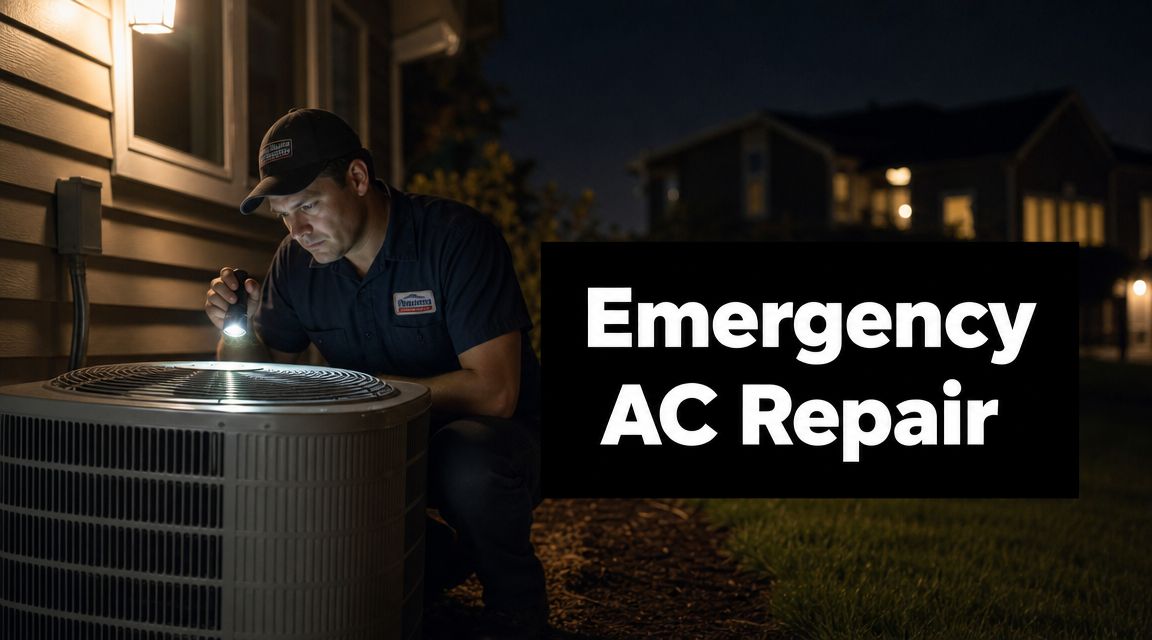
When your AC quits at night and the house keeps getting hotter, panic sets in fast. A real **24 hour ac company_ matters most in that moment, but not every company offering “after-hours service” is built the same. In Northern Utah, a lot of emergency AC calls turn out to have an electrical root cause, which changes who you should call and what you should expect.
What an Emergency AC Service Really Means
A real emergency AC service is built for immediate action. It isn't just someone answering the phone at 10 PM and promising to “get you on the schedule tomorrow.”
A true 24 hour ac company has technicians who can respond after hours with the tools, training, and common parts needed to triage the problem right away. That standard is spelled out clearly in this guidance on 24-hour HVAC service operations. If a company only has an answering service, you still have the same problem. You just have a friendlier voicemail.

What real dispatch-ready service looks like
Consider the difference between an ER doctor and a receptionist. One can start solving the emergency. The other can only record your name.
A legitimate after-hours AC response usually includes:
- A trained technician on call: Someone who can diagnose electrical faults, failed components, power issues, and safety hazards on site.
- Diagnostic tools in the truck: Meters, testers, and inspection tools matter because guessing wastes time when your home is heating up.
- Common replacement parts available: If the technician can't replace a failed contactor, capacitor, fuse, or damaged connection until the next day, the value of “24/7” drops fast.
- Actual triage, not just scheduling: The goal is to stabilize the system, identify the failure, and tell you whether the issue is repairable that night or needs a follow-up.
Practical rule: If the company can't tell you whether a technician is truly available after hours, assume you're speaking to a scheduler, not an emergency team.
Why the electrical side matters
A lot of homeowners assume an AC failure is always an HVAC-only problem. It often isn't. Breaker issues, disconnect failures, loose terminations, bad fuses, damaged outdoor whip connections, and panel problems can all shut cooling down or make it act erratically.
That's why it helps to understand what to know about electrical emergencies before an after-hours call. If the AC failure includes tripping breakers, a burning smell, flickering lights, or signs of heat at the panel, you may be dealing with an electrical emergency that happens to show up through the air conditioner.
In older Utah homes especially, the smartest emergency response starts with figuring out whether the AC unit failed on its own or lost safe, stable power from the house.
Signs You Definitely Need Emergency AC Help
Some AC problems can wait until morning. Others can't.
If the system is making your home unsafe, or if the failure points to electrical or combustion danger, stop trying to diagnose it yourself and get help. The most urgent guidance is straightforward: if there's a strong gas odor, a carbon monoxide alarm, smoke, or sparking, occupants should evacuate and shut off power or gas only if it's safe before calling an HVAC contractor, according to this emergency HVAC safety guidance.
The red flags that should stop you cold
These are the situations that move past inconvenience and into emergency territory:
- Smoke from vents or equipment: That can point to overheating wires, a failing motor, or another fire risk.
- Burning smell that doesn't clear quickly: A dusty startup smell is one thing. A sharp electrical or melting odor is another.
- Visible sparking or arcing: At the disconnect, breaker panel, condenser, or indoor equipment, this is a hard stop.
- Gas smell or carbon monoxide alarm: Leave the house and handle safety first.
- Loud grinding, banging, or metal-on-metal noise: Mechanical failure can quickly become wider system damage.
- No cooling during dangerous heat: This is especially urgent if you have infants, older adults, or anyone with medical vulnerabilities in the home.

Problems that are urgent, even if they aren't dramatic
Not every emergency announces itself with smoke. Some failures look minor at first and get worse fast.
Watch for these:
- AC blowing warm air only: If the outdoor unit isn't running correctly, the issue may be electrical, mechanical, or control-related.
- No air movement at all: If the thermostat is calling and nothing happens, power delivery or control failure may be involved.
- Thermostat unresponsive: Sometimes the thermostat is the issue. Sometimes it's the low-voltage circuit or a power problem feeding the system.
- Water leaking around the indoor unit: A blocked drain can damage ceilings, flooring, or nearby electrical components.
- Breaker trips when the AC starts: That often points to an electrical fault and should not be “tested” over and over.
If resetting the system makes the same dangerous symptom return, the problem isn't solved. It's repeating.
When waiting makes sense, and when it doesn't
If the house is still tolerable, there's no burning smell, no smoke, no sparking, and the system is underperforming, a daytime appointment may be fine. But if your home is heating up quickly, the equipment is making aggressive noise, or power-related symptoms show up with the AC problem, don't try to tough it out.
Many encounter problems by telling themselves they'll wait until morning, only to wake up to a hotter house, a dead system, and a bigger repair.
What to Check Before You Call And When to Stop
When the AC dies, start with the simple stuff. Don't start removing covers or opening electrical compartments.
A short homeowner check can save time and help the technician arrive with the right game plan. If the problem turns out to be deeper, that same check also tells you when to stop before you create a safety issue.
Safe checks you can make first
Run through these basics in order:
- Thermostat setting: Make sure it's set to cool, the setpoint is below room temperature, and the screen is responsive.
- Air filter condition: A badly clogged filter can restrict airflow enough to create system trouble.
- Breaker position: Check for a tripped breaker, but only reset it once. If it trips again, leave it off.
- Outdoor disconnect appearance: Look only from the outside. If you see scorching, buzzing, or damage, stop there.
- Indoor airflow: See whether vents are pushing any air at all, or if the system is silent.
If you're dealing with repeated breaker trips or suspicious power behavior, this page on electrical troubleshooting for homeowners is a useful next step before someone starts guessing at the cause.
DIY Troubleshooting vs. Professional Repair
| Action | Safe for Homeowner? | Why It Matters |
|---|---|---|
| Confirm thermostat is on cool | Yes | Wrong settings cause a surprising number of no-cooling calls |
| Replace or inspect air filter | Yes | Restricted airflow can mimic larger system problems |
| Check breaker and reset it once | Yes | A single trip may be minor, but repeated trips point to a fault |
| Inspect for water around unit | Yes | Leaks can signal drainage trouble or icing issues |
| Remove AC panel covers | No | Live components inside can injure you or worsen the failure |
| Touch wiring or terminals | No | This creates shock and fire risk |
| Replace fuses or capacitors yourself | No | Misdiagnosis is common, and stored electrical energy is dangerous |
| Keep resetting a tripping breaker | No | Repeated resets can feed a short or failing component |
The hard stop most homeowners need
You know what? The hard part isn't checking the easy things. It's knowing when to quit.
Stop immediately if you notice any of the following:
- Burn marks or melted insulation
- Buzzing at the panel or disconnect
- A breaker that won't hold
- Any sign of sparking
- Hot metal covers
- A smell like burning plastic or hot wiring
A homeowner can observe, reset once, and report symptoms. A licensed pro should handle everything past that line.
That matters even more in Northern Utah homes with older panels, remodel additions, garage subpanels, or outdoor disconnects that have seen years of weather. In those houses, what looks like an AC problem can be a power delivery problem hiding in plain sight.
What to Expect from an After-Hours Technician
Most emergency calls feel stressful because the homeowner doesn't know what happens next. The good companies make the process calm and predictable.
The call usually starts with symptom screening. The dispatcher or technician asks what the system is doing, whether there's smoke or odor, whether the breaker has tripped, and whether the house has completely lost cooling. That first conversation helps sort a comfort issue from a safety issue.

What happens on site
Once the technician arrives, the visit should move in a clear order.
Safety check first
The tech looks for immediate hazards such as overheated conductors, failed disconnects, smoke damage, or unsafe equipment condition.Power and control diagnosis
Before anyone talks about major parts, they should confirm the equipment is receiving proper power and responding to control signals.System-specific testing
The tech isolates whether the problem sits in the condenser, air handler, thermostat circuit, disconnect, breaker, or another component.Repair options and approval
You should get a plain-English explanation of what failed, whether a temporary fix makes sense, and what can be completed that night.Testing after the repair
The job isn't done when the part goes in. The system should be run and checked to confirm the failure is resolved.
What about cost
After-hours pricing varies by company. Some advertise no extra charge for weekend or after-hours calls, while others add a diagnostic fee or minimum labor charge, which is exactly why it's smart to ask about pricing upfront, as noted in this overview of emergency service pricing.
Ask these questions before the truck rolls:
- Is there an after-hours diagnostic fee
- Is there a minimum labor charge
- Does the quoted price include tonight's repair if a common part is needed
- If the issue is electrical, can your technician handle that diagnosis
Clear pricing doesn't mean cheap pricing. It means you know what you're agreeing to before the work starts.
What good communication sounds like
A solid after-hours technician won't bury you in jargon. They'll tell you what failed, why it matters, and whether the system is safe to run.
That's especially important when the AC problem touches house power. A failed breaker, damaged disconnect, loose lug, or overheated conductor changes the repair path. If the person on site can explain that clearly, you're in better hands than someone who just keeps swapping HVAC parts until something sticks.
Choosing a Reliable Provider in Northern Utah
When the house is hot and it's late, a common wish is for someone to answer the phone. That's understandable, but it's not enough.
Emergency cooling is common because air conditioning is part of everyday home infrastructure. About 75% of U.S. homes have air conditioners, which helps explain why emergency coverage has become a standard service model in many markets, according to these air conditioning market statistics. In practical terms, lots of companies say they offer emergency service. Fewer are built to solve the right problem fast.
What to verify on the spot
Use a short filter when you're calling around:
- Local presence: A company familiar with Weber, Davis, and Salt Lake county housing stock will diagnose faster than someone guessing at local infrastructure quirks.
- Licensed and insured status: This should be easy to confirm.
- Real after-hours dispatch: Ask whether a technician is on call.
- Clear scope: Can they evaluate both the AC equipment and the electrical supply feeding it.
- Review quality: Look for comments that mention communication, punctuality, and problem-solving, not just friendliness.
For a quick look at one local electrical contractor's background, learn about Black Rhino Electric. The relevant point here is simple: they provide residential and commercial electrical service in Northern Utah, including troubleshooting and after-hours emergency support.
Why electrical expertise matters more than people think
This is the part many homeowners miss. The AC can stop working because the unit failed, but it can also stop because the panel, breaker, disconnect, fuse, whip, thermostat circuit, or another electrical component failed first.
That's a big deal in Northern Utah. You might have:
- An older home with aging wiring
- A newer addition tied into an overloaded panel
- An outdoor disconnect that's taken weather damage
- A remodel where circuits were extended in less-than-ideal ways
If the provider only looks at the AC unit and never seriously checks the electrical path feeding it, you may get a partial answer instead of the true one.
A reliable emergency provider doesn't just restore cooling. They identify whether it's safe to keep the system running after the repair.
Emergency AC and Electrical FAQs for Utah Homeowners
A few questions come up over and over on hot nights in Utah homes.
Is an after-hours AC call always more expensive
Not always. Some companies charge extra after hours, and some promote the same pricing across time slots. The right move is to ask before dispatch. Ask about the service fee, diagnostic fee, and any minimum labor charge so you know the ground rules before the visit starts.
What if I think the house wiring is the real problem
That suspicion is worth taking seriously. If the AC keeps tripping a breaker, the thermostat cuts in and out, the outdoor unit buzzes without starting, or lights flicker when the system tries to kick on, the problem may involve the home's electrical side. If you need a plain-language example of how contractors address electrical safety concerns, that resource gives homeowners a useful outside perspective on rewiring and troubleshooting issues.
If the issue seems tied to service equipment, an old panel, or repeated breaker trouble, this page on breaker and panel troubleshooting is the place to start.
Is a buzzing outdoor unit an AC problem or an electrical problem
It can be either one. Buzzing can point to a failing contactor, capacitor-related startup trouble, a damaged disconnect, poor voltage delivery, or a motor problem. The sound alone doesn't answer it.
What matters is the pattern:
- Buzzing with no startup
- Buzzing followed by breaker trips
- Buzzing plus hot electrical smell
- Buzzing from the disconnect or panel area instead of the condenser itself
Those signs lean electrical and should be treated carefully.
Can maintenance reduce emergency calls
Yes, especially when maintenance includes the electrical side and not just coil cleaning or filter replacement. A good inspection should pay attention to connection condition, breaker behavior, disconnect wear, thermostat response, and signs of heat at electrical components. Let me explain it plainly. A lot of “sudden” AC failures weren't sudden at all. The warning signs were there in the power path first.
If your AC is down and you suspect the issue may be electrical, contact Black Rhino Electric for after-hours help in Northern Utah. You can call 385-396-7048 or request a free quote.