Planning your dream home is an exciting journey, but the most important decisions often happen behind the walls. Custom home electrical wiring is the essential foundation that ensures your new space is safe, functional, and ready for the technology of tomorrow. Honestly, getting this right during the design phase is the best way to avoid headaches and high costs later on.
Contents
Introduction to Custom Home Electrical Wiring
Building your dream home is a rare opportunity to get every detail just right—especially the hidden systems that power your daily life. Investing in Custom home electrical wiring ensures your living space is not only functional for today, but also ready for tomorrow’s technology. Honestly, planning your electrical system now is the best way to avoid expensive “zaps” to your budget later on.

When we talk about custom wiring, we aren’t just talking about where the lights go. We are talking about the “nervous system” of your home. A standard production home follows a template; a custom home follows you. This means early planning is vital. You know what? If you wait until the drywall is up to decide you want a floor outlet under the sofa or a dedicated circuit for a high-end espresso machine, you’re looking at significant extra costs and mess.
Designing a Comprehensive Custom Home Electrical Layout
The layout of your electrical system should be a “symphony” of convenience and aesthetics. At Black Rhino Electric, we often see homeowners underestimate how many outlets they truly need. While the average U.S. home has 75 electrical outlets, a custom build in areas like Ogden or Layton often exceeds this to accommodate modern life.
- Outlet Placement: Think about your daily routine. Do you want outlets inside bathroom cabinets to keep hair dryers plugged in but hidden? Do you need floor outlets in the Great Room so you don’t have cords stretching across the walkway to a lamp?
- Furniture Sightlines: Custom homes often feature specific views. If your living room is designed around a mountain view, your furniture placement is likely fixed. We coordinate wiring so that outlets and switches don’t interfere with your aesthetic or get buried behind a heavy cabinet.
- Dedicated Kitchen Circuits: Modern kitchens are power-hungry. We plan dedicated circuits for the refrigerator, microwave, oven, and dishwasher to ensure you never trip a breaker while making Thanksgiving dinner.
- Outdoor Living: Don’t forget the exterior! From holiday light outlets in the eaves to specialized hot tub wiring for your backyard oasis in North Ogden, planning these runs early is much cheaper than retrofitting.
If you are updating an existing space rather than building new, our remodeling electrician services can help bridge the gap between your old wiring and your new vision.
Smart Home Technologies and Future-Proofing
A truly custom home is a smart home. Integrating technology during the wiring phase is significantly more reliable than relying solely on Wi-Fi. We recommend Structured Wiring, which centralizes your data, security, and entertainment cables into a single hub.
- Cat6 Cabling: Even with great Wi-Fi, hardwiring your home office and entertainment centers with Cat6 ethernet ensures lightning-fast, stable internet.
- Home Automation: Imagine closing your garage door from your phone while at the airport or dimming the lights via voice command. Pre-wiring for these systems allows for seamless integration.
- EV Charging Readiness: With the rise of electric vehicles, we highly recommend installing a 240V circuit in the garage now. It’s one of our most requested EV charger installations in the Weber County area.
- PoE Security: Power over Ethernet (PoE) allows your security cameras to get power and data through one cable, making for a cleaner and more secure install.
For more insights on how to elevate your tech game, check out our guide on home automation in Utah.
Technical Execution and the Rough-In Process
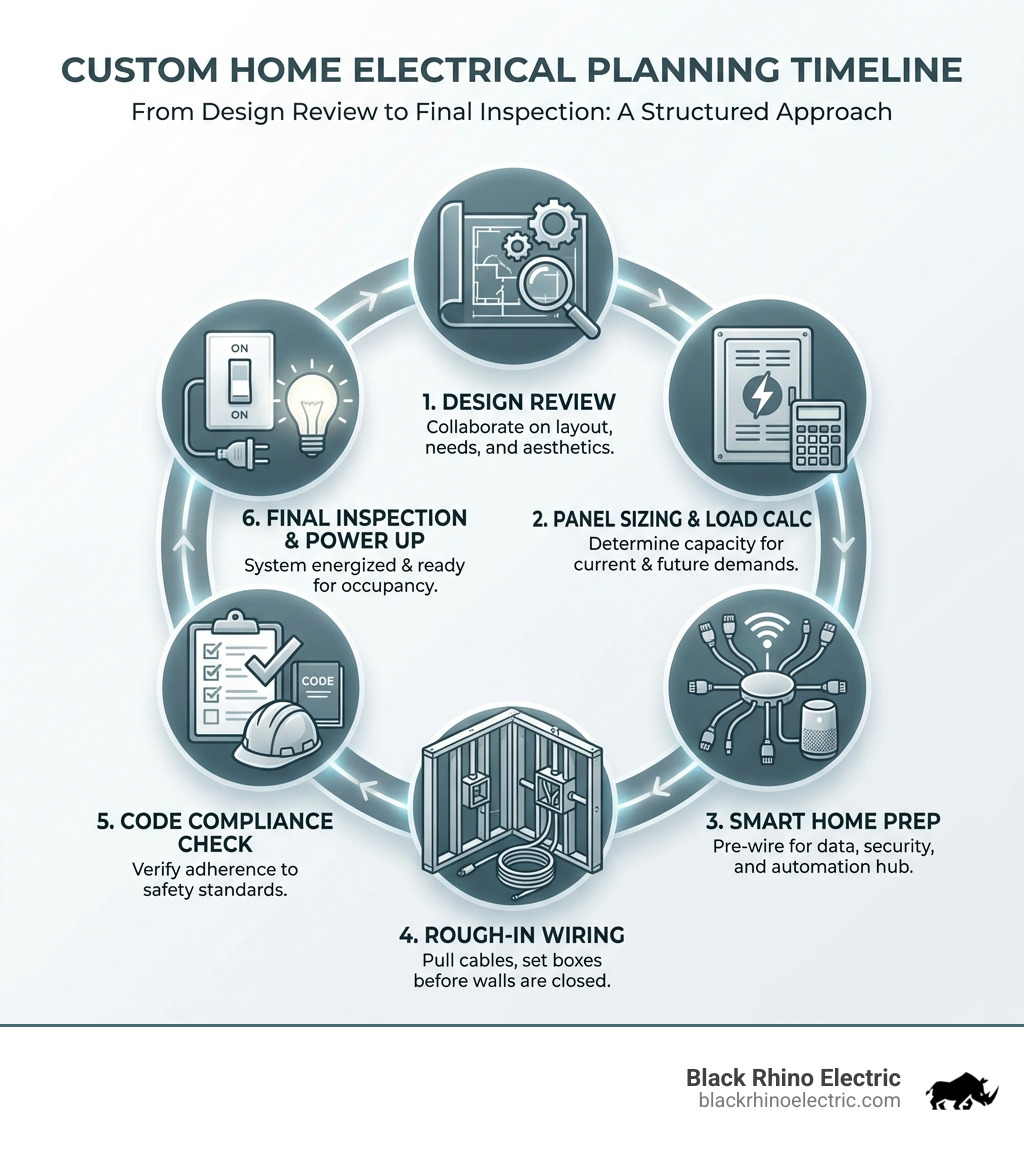
Once the planning is done, it’s time for the “rough-in.” This is the stage where we pull the wires and set the boxes before the insulation and drywall go up. Have you ever wondered why some homes just feel more “connected” than others? Let me explain: it all comes down to the technical accuracy of this phase.

We use precise load calculations to ensure your home can handle the strain. A general rule of thumb is to calculate lighting loads at 3 watts per square foot. This usually works out to one 15-amp circuit for every 500 square feet of floor space. However, for custom homes with high-end appliances or workshops, we often opt for 20-amp circuits to provide that extra “headroom” and prevent nuisance tripping.
| Feature | 200-Amp Service | 400-Amp Service |
|---|---|---|
| Standard Use | Typical for most modern homes | Ideal for large custom homes |
| High Loads | Supports standard appliances + AC | Supports shops, pools, & multiple EV chargers |
| Future Value | Standard resale appeal | High appeal for tech-heavy buyers |
| Circuit Space | Limited expansion | Massive capacity for future additions |
Managing Electrical Panels and Utility Connections
Your home’s electrical setup starts with the utility connection. In Utah, getting power to your property involves coordinating with local providers. Standard utility connections usually include up to 50 feet of conduit and trenching; however, if your custom home sits further back on the lot, additional footage can cost approximately $28 per foot.
Choosing the right panel size is vital. While 200-amp is the current residential standard, many of our custom clients in South Ogden and West Haven choose a 400-amp service panel. Why? It provides enhanced safety, more circuit breaker space, and ensures you won’t need an expensive upgrade if you add a workshop or a large solar array later. For more details on managing your power source, see our page on breakers and panels. You can also refer to this guide for new residential service for general utility expectations.
Understanding the Rough-In Electrical Process
The rough-in electrical process typically takes 5–10 days depending on the complexity of your home. During this time, we aren’t just “throwing wire.” We are:
- Mounting boxes at precise heights for switches and outlets.
- Drilling through studs and joists (following structural codes).
- Pulling and labeling every single wire so future electricians (or you!) know exactly what goes where.
- Installing specialized boxes for heavy fixtures like chandeliers or ceiling fans.
This stage culminates in a “rough-in inspection.” An inspector will verify that everything—from box fill to grounding and bonding—meets the strict standards of the National Electrical Code. You can learn more about what to expect during this phase in our new construction electrician guide.
Safety, Efficiency, and Why Professional Expertise Matters
Honestly, electrical work is not the place for a DIY project. While you might be handy with a drill, the risks of poor Custom home electrical wiring are severe, including electrical fires and code violations that can halt your construction or void your insurance.
Adhering to Essential Safety Standards and Electrical Codes
Every project we undertake at Black Rhino Electric is strictly NEC compliant. These codes aren’t just “suggestions”—they are life-saving regulations designed to prevent house fires.
- GFCI (Ground Fault Circuit Interrupter): Required in “wet” areas like kitchens, bathrooms, garages, and outdoors. These outlets shut off power in milliseconds if they detect a leak to ground, preventing deadly shocks.
- AFCI (Arc Fault Circuit Interrupter): These breakers are designed to detect dangerous “arcing” (sparks) behind walls, which is a leading cause of home fires. They are required in most living areas and bedrooms.
- Tamper-Resistant Outlets: A must-have for families with small children, preventing foreign objects from being inserted into the slots.
Hiring licensed electricians ensures that your home isn’t just “powered,” but protected.
Enhancing Energy Efficiency through Custom Home Electrical Wiring
Custom wiring is also a gateway to “green building.” By being smart about your design, you can significantly slash your monthly utility bills.
- LED Lighting Integration: We design lighting schemes that use 75% less energy than traditional bulbs. From accent lighting to task lighting, LEDs offer incredible longevity.
- Smart Meters & Monitors: Integrating energy-tracking technology allows you to see exactly where your power is going in real-time.
- Solar Readiness: Even if you aren’t installing solar panels today, we can pre-wire the “backbone” for them. This makes the eventual installation much cheaper and faster.
- Lighting Controls: Using dimmers, timers, and motion sensors instead of standard “flip” switches ensures lights are only on when you actually need them.
Explore our lighting electrician services to see how we can brighten your home efficiently.
You know what? Getting your electrical system right the first time is the ultimate gift to your future self. If you’re ready to start your project with the experts at Black Rhino Electric, call us at 801-810-4292 or Request a Free Quote today!