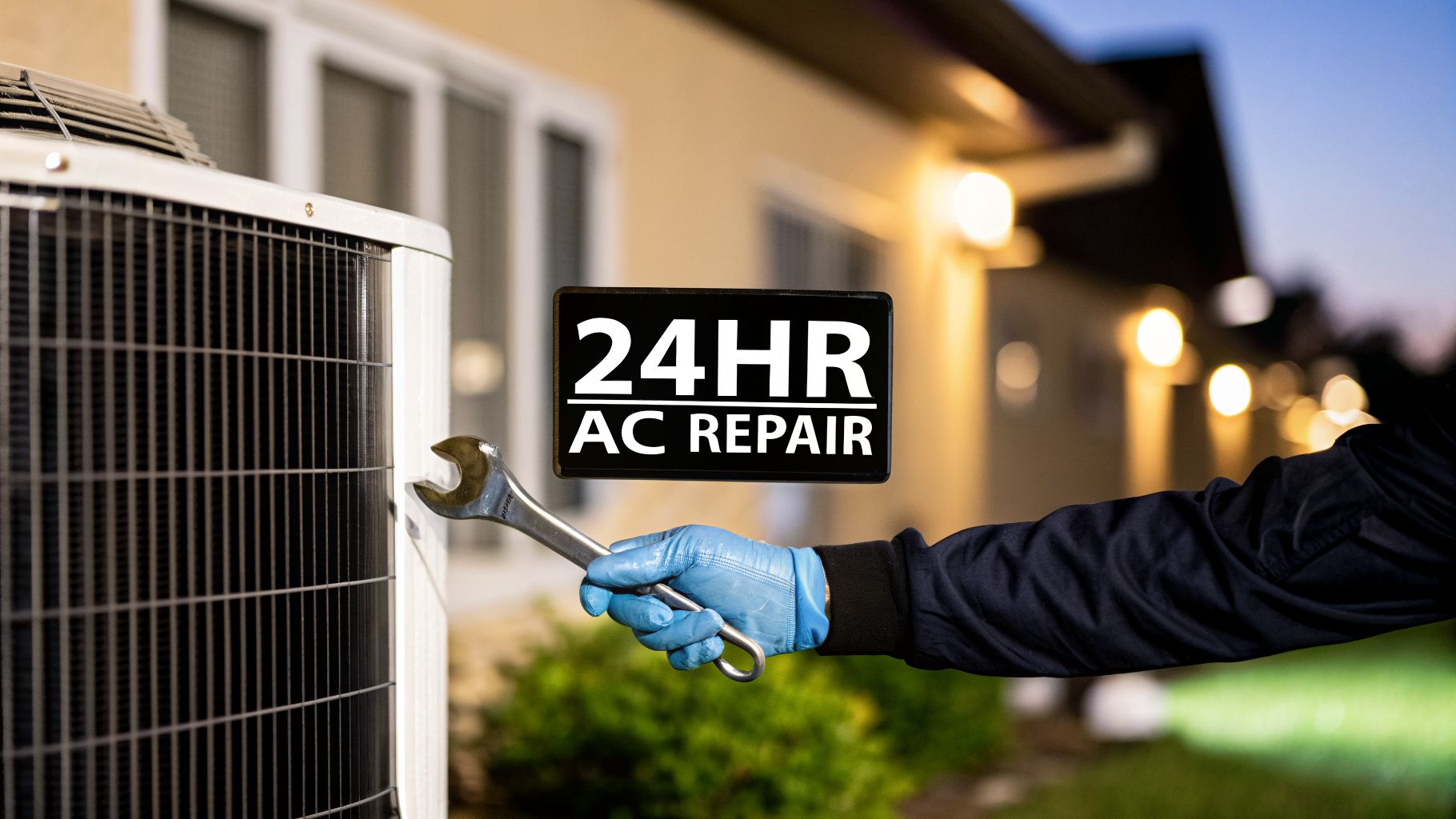
It’s a sweltering Northern Utah night, and suddenly, the reassuring hum of your air conditioner stops, plunging your home into an unsettling silence. You feel the temperature start to climb and a wave of panic sets in, which is completely understandable. Before you start frantically searching for 24hr ac repair, however, take a deep breath because we're here to help guide you.
Contents
- 1 Your AC Just Quit—What Should You Do First?
- 2 Quick DIY Checks Before You Make the Call
- 3 When to Stop Troubleshooting and Call a Professional
- 4 Choosing a Reliable After-Hours Technician in Northern Utah
- 5 What to Expect from Your Emergency AC Repair Visit
- 6 Your Questions About 24hr AC Repair Answered
Your AC Just Quit—What Should You Do First?
When your air conditioner fails, especially during a heat wave, those first thirty minutes are key. This isn't the time to start pulling panels off. It's about making sure your home is safe and ruling out the most common, easy-to-fix culprits that cause a system to shut down.
This initial playbook is designed to walk you through the immediate safety checks and simple troubleshooting steps you can perform right now. Let’s get started.
Immediate Safety and Simple Checks
Before you touch the thermostat or start poking around the unit, your first priority is always safety. Your air conditioner is a heavy-duty electrical appliance, and strange behavior can sometimes point to a serious hazard. Is it making a weird noise or giving off a strange smell?
Start with these fundamentals:
- Check for Burning Smells: A sharp, acrid smell of burning plastic or electronics is a major red flag. If you smell anything like this, turn the AC off at the thermostat and shut down its circuit breaker immediately. That smell is a clear sign of an electrical problem.
- Listen for Alarming Noises: Loud, unusual sounds like grinding, screeching, or banging from either the indoor or outdoor unit mean something is mechanically wrong. Don't let it keep running if you hear these noises.
- Look for Water Leaks: A little condensation is normal, but if you see significant water pooling around your indoor unit, it could signal a clogged drain line or a frozen coil, leading to water damage.
If you run into any of these serious signs, stop right there. Don't touch the unit. Electrical issues, in particular, need an expert’s touch, which speaks to the "Expertise" pillar of our E-E-A-T commitment. You can learn more about what a professional does in our guide on what a troubleshooting electrician does.
This simple flowchart lays out the first critical step: always perform a safety check before you do anything else.

The takeaway is simple but non-negotiable: every troubleshooting process has to begin with safety, a testament to our "Trustworthiness."
The Growing Need for Emergency Services
The demand for around-the-clock service isn’t just for convenience; it’s become a critical need. The HVAC repair service market is on track to grow from USD 25.49 billion to over USD 31.62 billion by 2035.
Residential services, which include emergency AC fixes like yours, make up about 40% of that market. With roughly 70% of repair requests happening within 24 hours of a system failure, it’s clear why immediate response is so important.
Once you've confirmed there’s no immediate danger, you can move on to a couple of simple diagnostic steps that might just get your cool air flowing again in minutes. If none of these safety checks reveal a hazard and your system just isn't cooling, your next move is to check the thermostat and circuit breaker—we'll cover those DIY checks next.
Quick DIY Checks Before You Make the Call
So, the air is still warm, and the frustration is building. I get it. But before you pick up the phone, there are a few more things you can safely check. A lot of the time, these simple diagnostics can pinpoint the problem and sometimes even solve it right then and there.

Check the Thermostat and Circuit Breaker
Let's start with the brain and the heart of your HVAC system. It sounds almost too basic, but you wouldn't believe how often a simple settings mistake or a tripped breaker is the real culprit.
- Thermostat Settings: First, walk over to your thermostat. Make sure it’s actually set to “Cool” and that the target temperature is at least 5 degrees below what the room feels like now. If it runs on batteries, pop in a fresh set. A dead battery can make the entire system go silent.
- Circuit Breaker: Next, head to your home's main electrical panel. Look for the breaker labeled "AC," "Air Conditioner," or "HVAC." If it's tripped to the middle or 'OFF' position, push it firmly all the way off, then switch it back on.
Expert Tip: If that breaker trips again right away, stop. Don’t try to reset it a second time. This is a clear sign of a serious electrical fault that needs a professional. Pushing your luck here is a genuine fire risk.
For anyone curious about what’s going on behind that metal door, we have a detailed guide on the role of circuit breakers and electrical panels in your home’s electrical system.
Inspect the Air Filter and Vents
Here’s the thing: your AC system has to breathe. One of the most common reasons for a system to fail—or just cool poorly—is restricted airflow.
A dirty, clogged air filter is like forcing your AC to breathe through a straw. It has to work way too hard, causing components to overheat or even freeze up completely. Pull your filter out. If you can't see light through it, it’s long past time for a change. A fresh filter can sometimes bring an AC back to life instantly.
While you're at it, take a quick walk around the house. Check that all your air vents are open and aren't blocked by furniture, drapes, or a stray rug. You'd be amazed how often a “hot room” is just a room with a blocked register.
Examine the Outdoor Condenser Unit
That big, noisy box outside is your condenser, and its job is to dump all the heat from inside your house. If it can’t do its job, your house stays hot. Take a quick look around the unit for these common troublemakers.
Use this quick reference table to systematically check for common AC issues before calling a professional for 24hr AC repair.
DIY Troubleshooting Checklist
| Check Area | What to Look For | Simple Fix Action | When to Stop and Call Us |
|---|---|---|---|
| Clearance | Debris, leaves, or overgrown plants within a 2-foot radius of the unit. | Gently clear away obstructions so the unit has room to breathe. | If you hear grinding or rattling noises from the unit. |
| Cleanliness | A blanket of dirt, dust, or cottonwood fuzz caked onto the unit's metal fins. | Turn off power at the breaker, then use a garden hose to gently rinse the fins. | If you spot any significant physical damage or bent parts. |
| Ice Buildup | Frost or a solid chunk of ice covering the copper lines or the coils themselves. | Turn the AC system off completely but leave the fan running to help it thaw. | If the ice comes right back after you’ve thawed it. |
A layer of ice is a classic sign of either an airflow problem (like that clogged filter) or low refrigerant. There's a bit more you can learn about what causes AC coils to freeze and how to fix it if you're curious.
If you’ve run through all these checks and your home still feels like a sauna, you’ve done your part. That’s the clear signal it's time to let a professional take over.
When to Stop Troubleshooting and Call a Professional
Look, there are times when a little DIY spirit is great. But when it comes to your AC, a well-intentioned fix can quickly turn into a “why did I even touch that?” moment. It’s smart to check the simple stuff, but knowing when to put the tools down is just as important—for your safety and for the health of your system.
Some symptoms are clear red flags. They aren't just hinting at a problem; they're screaming that something serious is wrong internally. These go way beyond a clogged filter or a tripped breaker.

Critical Signs to Call a Pro Immediately
If you see, hear, or smell any of the following, your next move is simple: turn the system off at the breaker and pick up the phone. These aren’t suggestions. These are warnings you need to take seriously.
- Loud, Unsettling Noises: A persistent grinding, a high-pitched screech, or a violent banging is your AC’s way of crying for help. This usually points to a failing motor, a broken fan belt, or other internal parts that are grinding themselves to bits. Letting it run is just causing more damage.
- Acrid Burning Smells: The smell of burning plastic, a sharp "gunpowder" odor, or an ozone-like scent from your vents is an undeniable sign of an electrical failure. This could be anything from a seized motor to melted wiring. All of them are serious fire hazards. Don't wait.
- Visible Electrical Issues: If you can see frayed wires or scorch marks on the unit, that’s an obvious one. Another big red flag is a circuit breaker that trips instantly every time you reset it. Don’t try it a third time. It’s signaling an overload or short that needs a licensed pro to diagnose safely.
These symptoms are so serious because the risks are immediate. A grinding motor can seize and trigger a cascade of expensive failures. A burning wire can start a fire. This is exactly why some repairs are strictly for licensed and insured technicians, like our team at Black Rhino Electric. Our "Experience" and "Authoritativeness" shine here, as we've seen and fixed it all.
Understanding the Risks of DIY Repairs
Trying to fix complex mechanical or electrical issues on your own can lead to life-threatening shocks, exposure to harmful refrigerant chemicals, or just plain catastrophic damage to your equipment. The financial stakes are high, too. Air conditioning systems in the United States gobble up nearly 7% of all electricity produced nationally, costing homeowners around $32 billion a year. You can find more of these HVAC industry insights on bdrco.com. That’s a huge investment in your home’s comfort, and a major failure demands a fast—and more importantly, a correct—professional response.
When to Make the Call: A Quick Gut Check
Use this table as a final reference. If your problem falls into the "Call a Pro" column, don’t second-guess it.
| Symptom | Safe DIY Check | When to Call a Pro |
|---|---|---|
| Noises | A gentle hum or whoosh | Grinding, screeching, or banging |
| Smells | A slightly dusty smell when first turned on | Burning plastic, gunpowder, or rotten eggs |
| System | Just not cooling well | System won't stay on; breaker trips instantly |
| Leaks | A small amount of condensation on the outdoor line | Water pooling inside or a hissing sound (refrigerant leak) |
Here’s the bottom line: your safety is what matters most. If you feel even a little unsure or out of your depth, making the call for help is always the right move.
Choosing a Reliable After-Hours Technician in Northern Utah
When your air conditioner quits on a sweltering Utah night, it’s tempting to call the very first number that pops up for 24hr ac repair. Honestly, you're desperate for cool air, and you want it now. But a hasty decision can lead to a much bigger headache—shoddy work, surprise fees, and a problem that isn't truly fixed.
Choosing the right emergency technician isn't just about speed; it's about finding a trustworthy partner to get your home back to normal, safely and efficiently. You need someone who is not only available but also qualified, transparent, and reputable.
Essential Vetting Criteria
Before you commit to a service call, take a few minutes to vet the company. A little due diligence now can save you from a major regret later. Here’s what to look for to ensure you're hiring a true professional.
- Verify Licenses and Insurance: This is non-negotiable. A licensed contractor, like Black Rhino Electric, operates under strict state and local rules designed to protect you. Insurance covers any accidental damage to your property, shielding you from liability. Ask for their license number—it should be easy to find.
- Check Recent Online Reviews: Look at Google, Yelp, or other local directories. Don't just focus on the star rating; read what customers are saying about their emergency service experiences. Are they described as punctual, professional, and honest?
- Ask for Transparent Pricing: A reliable company will be upfront about their charges. This is crucial for after-hours calls, which often involve a premium fee. You need to know what you're agreeing to before the technician even heads to your home.
It's also helpful to understand how organized service businesses implement strategies for managing after-hours leads to ensure consistent availability. A well-run company will have a system in place to handle your emergency professionally, not just a single, overwhelmed tech.
Flat Rate vs. Hourly Charges
Let me explain a key difference in pricing that can massively impact your final bill. Some companies charge an open-ended hourly rate for emergency calls, which can quickly spiral out of control.
A trustworthy company will typically charge a flat-rate diagnostic fee. This is a set price to come to your home, figure out the problem, and give you a firm, upfront quote for the total repair cost. This approach eliminates the anxiety of a running clock and surprise charges.
For a deeper dive into our company values and how we operate, you can get in touch with our team directly. At Black Rhino Electric, our commitment to safety-first workmanship and transparent pricing comes from our deep experience serving homeowners throughout Weber and Davis counties. We believe you deserve peace of mind, especially during a stressful AC emergency.
What to Expect from Your Emergency AC Repair Visit
From the moment a licensed Black Rhino Electric technician arrives, their focus is on three things: safety, an accurate diagnosis, and giving you a clear, straightforward solution. A huge part of our job isn't just fixing the machine—it's making sure you feel comfortable and informed every step of the way.
The Diagnostic Process
The first thing our tech will do is listen. They’ll ask what you saw, heard, or smelled right before the unit quit. That story is often the first and most valuable clue to what’s gone wrong.
After that, it's time for a systematic inspection. This isn't guesswork. It's a methodical process to pinpoint the exact failure. Here’s what that typically involves:
- Electrical Component Testing: We'll get our meters out to check for proper voltage, then test the capacitors, contactors, and relays. A failed capacitor is one of the most common culprits for a dead AC, and thankfully, it's often a quick fix.
- Refrigerant Level Analysis: Using specialized gauges, we measure the refrigerant pressure. If it's low, that’s a dead giveaway you have a leak somewhere in the system that needs to be found and sealed up.
- Airflow and Mechanical Checks: This means popping the panels to inspect the blower motor, fan blades, and coils, looking for anything that’s blocked, seized, or frozen over—all things that can cause the system to overheat and shut down.
Common Fixes and Transparent Pricing
Once we know exactly what’s wrong, our technician will explain it to you in plain English. They'll show you the faulty part if they can and give you a firm, upfront quote for the entire repair. You will know the total cost before any work begins.
The need for skilled, urgent repairs is a massive part of the home services economy. The HVAC repair sector pulls in about $14 billion a year in the U.S. With tons of systems from the mid-2000s now hitting their end-of-life, 2026 is seeing a huge spike in demand—around 3.5 million HVAC units will be replaced this year alone. You can dig into more of these HVAC marketing statistics on WebFX if you're curious.
To give you a clearer picture, here are a few common emergency repairs and what they actually involve.
| Common Emergency Repair | Why It's an Emergency | What the Fix Involves |
|---|---|---|
| Capacitor Replacement | The capacitor is like a small battery that jolts the compressor and fans to life. When it fails, the system is dead in the water. | A straightforward parts swap. It’s a quick fix that can have your cool air back on in minutes. |
| Fan Motor Repair/Replacement | A burnt-out or seized motor stops air from moving, causing the whole system to quickly overheat and shut itself down to prevent damage. | Replacing the motor to get air flowing properly again, either inside at the furnace or outside at the condenser. |
| Refrigerant Leak Repair | A refrigerant leak doesn’t just stop the cooling; it can starve and destroy the compressor, which is the most expensive part of your AC. | Hunting down the leak, repairing the refrigerant line, and then recharging the system back to the manufacturer’s specs. |
The most important thing to know is our commitment to being upfront. We charge a flat-rate diagnostic fee for the visit, and you always get a full, itemized quote before we pick up a single tool for the repair. No hidden fees. No hourly rates that sneak up on you.
This approach means you can make a decision without feeling pressured. Our goal is to get your home cool and comfortable again while earning your trust for the long run.
Your Questions About 24hr AC Repair Answered
When your AC gives up on a sweltering summer night, a lot of questions pop into your head while the house gets hotter by the minute. You need help now, but what’s it going to cost? Is the quality going to be there? We hear these concerns all the time from homeowners who are in a tough spot.

How Much More Does A 24hr AC Repair Call Cost?
Let's be upfront about it: yes, after-hours service comes with a premium. This is usually a higher diagnostic or 'call-out' fee compared to a standard business-hours appointment. You know what? That fee covers our technician’s immediate availability, ensuring someone is ready to head your way when you need it most.
A trustworthy company like Black Rhino Electric is always transparent about this from the start. We’ll tell you the emergency fee on the phone. The good news is that the actual repair costs for parts and labor are right in line with our standard rates.
Once we’ve figured out what’s wrong, we’ll give you a clear, upfront quote for the whole job. That slightly higher initial fee is what guarantees you get fast relief and, frankly, helps prevent the small problem from turning into a much bigger, more expensive one if you let it go.
Will An Emergency Repair Void My AC Unit's Warranty?
This is an excellent—and very important—question. The short answer is no. Using a licensed and certified professional for your emergency repair will not void your manufacturer’s warranty.
In fact, the opposite is true. Most warranties explicitly state that all service and repair work must be done by qualified, licensed technicians to stay valid.
The real risk to your warranty? Attempting a major DIY repair you aren't qualified for or hiring an unlicensed handyman to save a few bucks. When our technicians show up, we use manufacturer-approved parts and follow strict industry practices. Your system’s warranty stays fully intact, period.
This commitment to doing things the right way is a cornerstone of how we operate. It's about experience, expertise, and earning your trust.
How Can I Prevent Future AC Emergencies?
The single best way to avoid surprise breakdowns is regular, professional maintenance. An ounce of prevention is truly worth a pound of cure—especially with HVAC systems.
We strongly recommend having your entire system serviced annually, ideally in the spring before the summer heat really kicks in. During a maintenance visit, a technician can tackle crucial preventative tasks:
- Clean Critical Components: Getting dirt and grime off coils and fans is like giving your AC a breath of fresh air. It boosts efficiency and reduces strain.
- Tighten Electrical Connections: Loose connections can cause shorts or complete system failure. Securing them is a key safety check we never skip.
- Identify Small Issues: A trained eye can spot wearing parts or minor refrigerant leaks long before they cause a middle-of-the-night emergency.
A few simple habits also go a long way. Changing your air filter every 1-3 months and keeping your outdoor unit clear of leaves and debris can seriously extend your AC's life and help you avoid that emergency call.
When an unexpected AC failure throws your life off track, you need a reliable expert you can count on, day or night. For fast, professional, and transparent emergency service in Northern Utah, trust the licensed team at Black Rhino Electric. Don't let the problem get worse—call us now at 385-396-7048 or request a free quote online to get your comfort back.