

More outlets will not save an outdoor kitchen that was wired after the slab cured. Outdoor kitchen electrical planning starts with nameplate ratings, separated circuits, and inspection access, not with a guess about where a receptacle looks convenient. Settle those choices on paper before concrete, stone, or framing is ordered.
Outdoor Kitchen Electrical Load Worksheet
Copy voltage and amps or watts from each nameplate or the manufacturer installation manual. A brochure, a sales range, or a similar unit next door is not a load figure.
What each row records
Heavy cooking and heating equipment, plus the refrigerator, usually need their own circuits. Ice makers, coolers, warming drawers, and pumps still get a row so motor-start current is visible. Lighting stays separate so a tripped appliance breaker does not black out the work surface. Leave the future-addition row blank until that unit is chosen, then copy its nameplate the same way. Also note cord-and-plug versus hard-wired, because that choice sets where the circuit ends and who may connect the appliance.
| Load | Voltage from nameplate | Amps or watts from nameplate | Continuous or motor load | Circuit to discuss |
|---|---|---|---|---|
| Refrigerator | Nameplate blank | Nameplate blank | Check label | Dedicated circuit, confirm with electrician |
| Ice maker | Nameplate blank | Nameplate blank | Check label | Confirm with electrician |
| Electric grill or induction cooktop | Nameplate blank | Nameplate blank | Check label | Dedicated circuit, confirm with electrician |
| Warming drawer | Nameplate blank | Nameplate blank | Check label | Confirm with electrician |
| Beverage cooler | Nameplate blank | Nameplate blank | Check label | Confirm with electrician |
| Outdoor lighting | Nameplate or transformer blank | Nameplate blank | Check label | Separate lighting circuit |
| Outdoor heater | Nameplate blank | Nameplate blank | Resistance or motor, check label | Dedicated circuit, confirm with electrician |
| Pump serving the kitchen | Nameplate blank | Nameplate blank | Motor load, check label | Confirm with electrician |
| Future addition | Nameplate when the unit is chosen | Amps or watts when the unit is chosen | Continuous or motor, check the future label | Spare capacity to discuss |
How the totals get used
Add continuous loads in one pass and the peak load in another. Two appliances that can run together both belong in the peak, even if you rarely use them at once. Empty cells stay empty.
Practical rule: A tripped cooking circuit should not shut off task lighting or the refrigerator.
Long feeder distance plus several large loads is the usual reason to discuss an electrical panel upgrade or an outdoor subpanel instead of many long branch circuits. Estimators who price from the nameplate list, including teams using Exayard electrical estimating software, can tie breaker count and conduit length to real ratings before the patio is poured. The sheet is a planning aid. The electrician checks every value against the labels and the panel schedule.
Outlet, Lighting and Disconnect Locations Before Construction
Put every device and access point on a scaled plan before stone, concrete, or framing is ordered. A receptacle belongs where the appliance sits, not where a cabinet run happens to end.
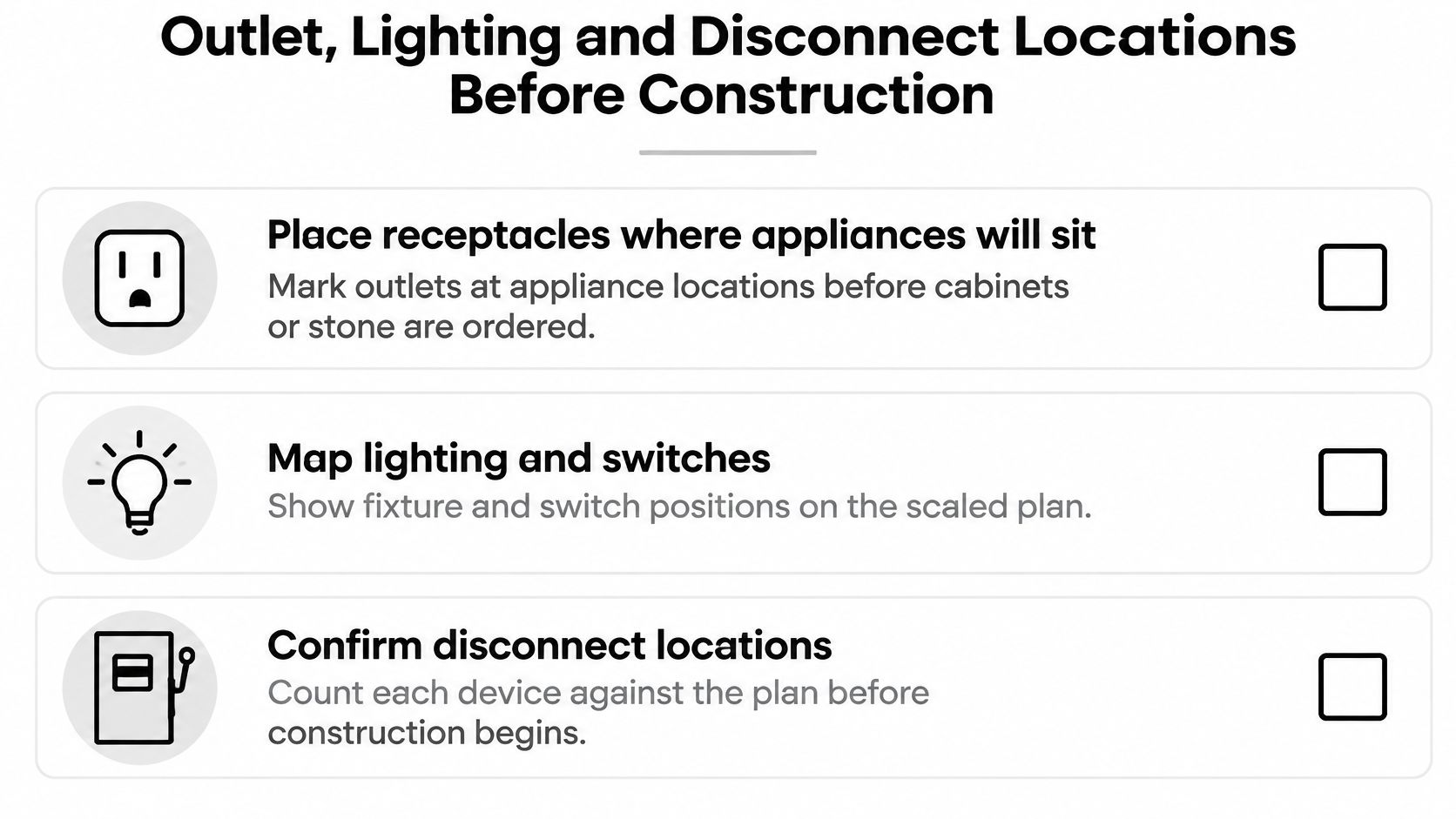
Count each symbol against the load sheet. Show hard-wired landings too, such as a built-in refrigerator, a lighting transformer, or a heater whip, and keep those boxes reachable after the island is closed. An outdoor lighting electrician should see fixture and switch positions as their own circuit, with heights marked from the finished surface.
What to hand the electrician
- Appliance footprints: Outline each unit on the scaled plan so outlets are not guessed from cabinet ends.
- Disconnect: Pick a spot a person can reach without pulling stone or cladding, and write that spot on the drawing.
- Conduit length: Mark the route from the panel or subpanel, with approximate feet, because longer runs raise voltage drop and trenching cost.
- Spare path: Leave a sleeve for a later refrigerator, television, or similar load so the next circuit does not mean cutting cured concrete.
- Sleeve notes: Call out conduits that pass under slab or through stone before those materials are purchased.
Do not pour, seal, or clad over a box until that plan and the electrician agree the opening stays serviceable.
GFCI and Outdoor-Rated Equipment Decision Points
A GFCI receptacle is not automatically a safe outdoor kitchen. Water still reaches devices through hose spray, cleaning, condensation, and wet concrete, even under a roof.
The National Fire Protection Association reports that home electrical fires most often begin in a kitchen or cooking area, which accounts for 15% of reported home electrical fires, more than bedrooms at 12% and attics or ceilings at 9%. That same page states that all outdoor receptacles should be GFCI protected. Treat that statement as safety guidance. The binding rule is the electrical code your city or county has adopted, applied by the electrician.
Exposure changes the hardware
An open counter, a roofed counter, a semi-enclosed bay, and a spot near a pool or spa are not the same location. A roof blocks rain. It does not block splash or wash-down. Weather-resistant devices and in-use covers still have to match the enclosure rating in the manufacturer manual. GFCI protection also has to sit where someone can test and reset it. Hiding the device behind masonry fails that test. Older houses in the area often need GFCI upgrades for older Northern Utah homes on existing outdoor circuits, not only on brand-new patio boxes. The electrician, not the cabinet drawing, decides which kitchen, outdoor, and replacement rules apply.
| Decision point | What to confirm | Where the answer comes from |
|---|---|---|
| Outdoor outlet at the patio or counter | GFCI protection and a readily accessible device location | NEC outdoor outlet rule as adopted locally |
| Existing outdoor outlet serving an appliance that is replaced | GFCI protection added at replacement | 2023 NEC requirement for replaced equipment |
| Kitchen receptacles for sink, cooking or prep | Whether the broader kitchen GFCI provisions apply | 2023 NEC kitchen provisions, checked by the electrician |
| Hard-wired heater or lighting transformer | Protection, disconnect and enclosure rating | Manufacturer installation manual and local code |
| Roofed, semi-enclosed or pool-adjacent location | Device and cover rated for the wet or damp exposure | Manufacturer enclosure rating and the installation manual |
Use the table as a discussion list. It does not replace the electrician's review of the adopted code and each manual.
Permits, Code Edition and Inspection Stops
The code edition is set by the jurisdiction responsible for the patio, not by a neighboring city's permit. Weber, Davis, and Salt Lake County offices can treat the same outdoor kitchen differently, so call the office for your address.
Under NEC 210.8(F), as described by Eaton's summary of the 2020 outdoor-outlet change, outdoor outlets on single-phase branch circuits rated 150 volts to ground or less and 50 amperes or less generally require GFCI protection, subject to listed exceptions. That rule reaches some permanently connected equipment, not only plug-in patio receptacles. Your building department may be on a different edition or a local amendment, so the plan has to name the edition that office enforces.
Three questions before design locks
Ask which edition and amendments apply, whether new circuits or a subpanel need a permit, and when the inspector wants to see the rough-in. A rough-in visit happens before stone, concrete, or cladding covers conduit and wire. A final visit follows once devices, lights, and the disconnect are in place. A meter or service change can also wait on the utility, which moves the pour date. In most places a licensed electrician pulls this permit. Confirm that with the permit office rather than opening a panel to keep a schedule moving. Black Rhino Electric on inspection failures is a useful read before you book those stops.
| Question | Who answers it | Where to check |
|---|---|---|
| Which NEC edition and local amendments apply | Local building department | Permit office or municipal code adoption notice |
| Does a new circuit or subpanel need a permit | Local building department | Permit office |
| Is a service, meter or panel change needed | Electrician and utility | Load calculation and utility service request |
| When the rough-in and final inspections happen | Building inspector | Permit record and inspection schedule |
| Who may pull the permit and do the work | Licensed electrician | Permit office requirements for licensed contractors |
Document voltage, amperage, routing, disconnects, weather exposure, and cord versus hard-wired gear on the same set of drawings the inspector will see.
Coordinating Electrical Rough-In With the Patio Build
Treat the patio as a sequence of handoffs. If one trade closes a cavity early, the next trade cannot service the connection.
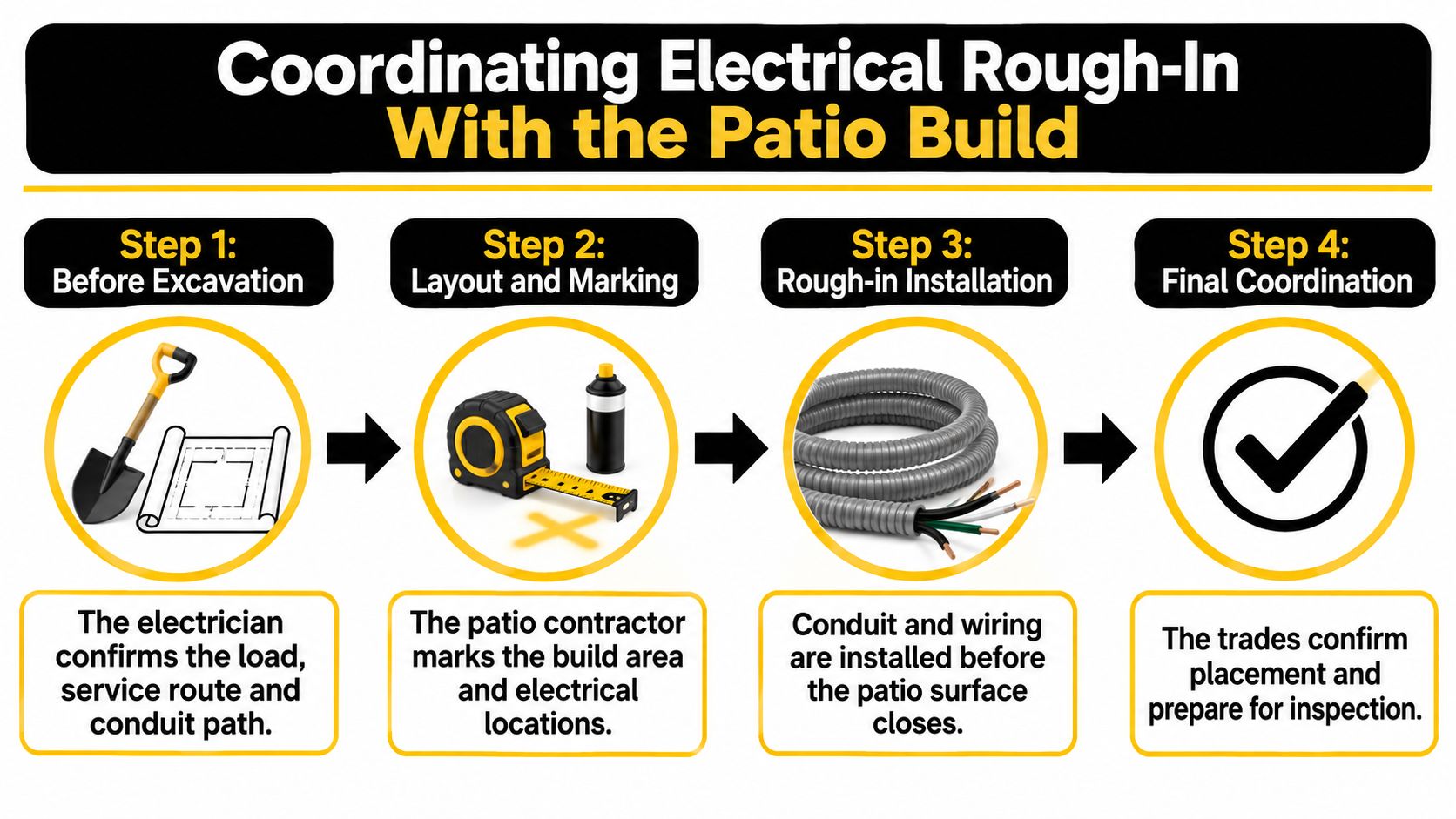
Before excavation, the electrician confirms load, service route, and conduit path. The patio contractor marks sleeves and slab penetrations so footings do not land on that path.
At layout, both trades check appliance centerlines, outlet heights, and the disconnect against the scaled plan. This is the cheap moment to move a box.
At rough-in, conduit, boxes, and grounding go in, and the rough-in inspection is scheduled where the permit requires it. The North Carolina Office of State Fire Marshal's 2023 NEC bulletin states that dwelling outdoor outlets on single-phase branch circuits rated 150 volts or less to ground and 50 amperes or less need GFCI protection, and that the device must be readily accessible. A reset hidden in a finished island does not meet that rule. Do not pour or enclose until the electrician and, where required, the inspector have signed off on access.
At final coordination, waterproofing and flashing are done, then devices, covers, lights, and the disconnect go on. Final inspection follows. Black Rhino Electric's wiring compliance guide lines up with that order.
Route and exposure notes to bring
- Path: Conduit misses planned footings and slab penetrations.
- Shelter: The kitchen is open, roofed, or semi-enclosed, written on the plan.
- Water: Any pool or spa proximity is marked.
- Reach: The disconnect stays usable after stone and cladding.
Warning Signs, Service Visits and Next Steps
Stop using a circuit that misbehaves. You can observe the symptoms. You should not open panels, handle conductors, or keep resetting a breaker.
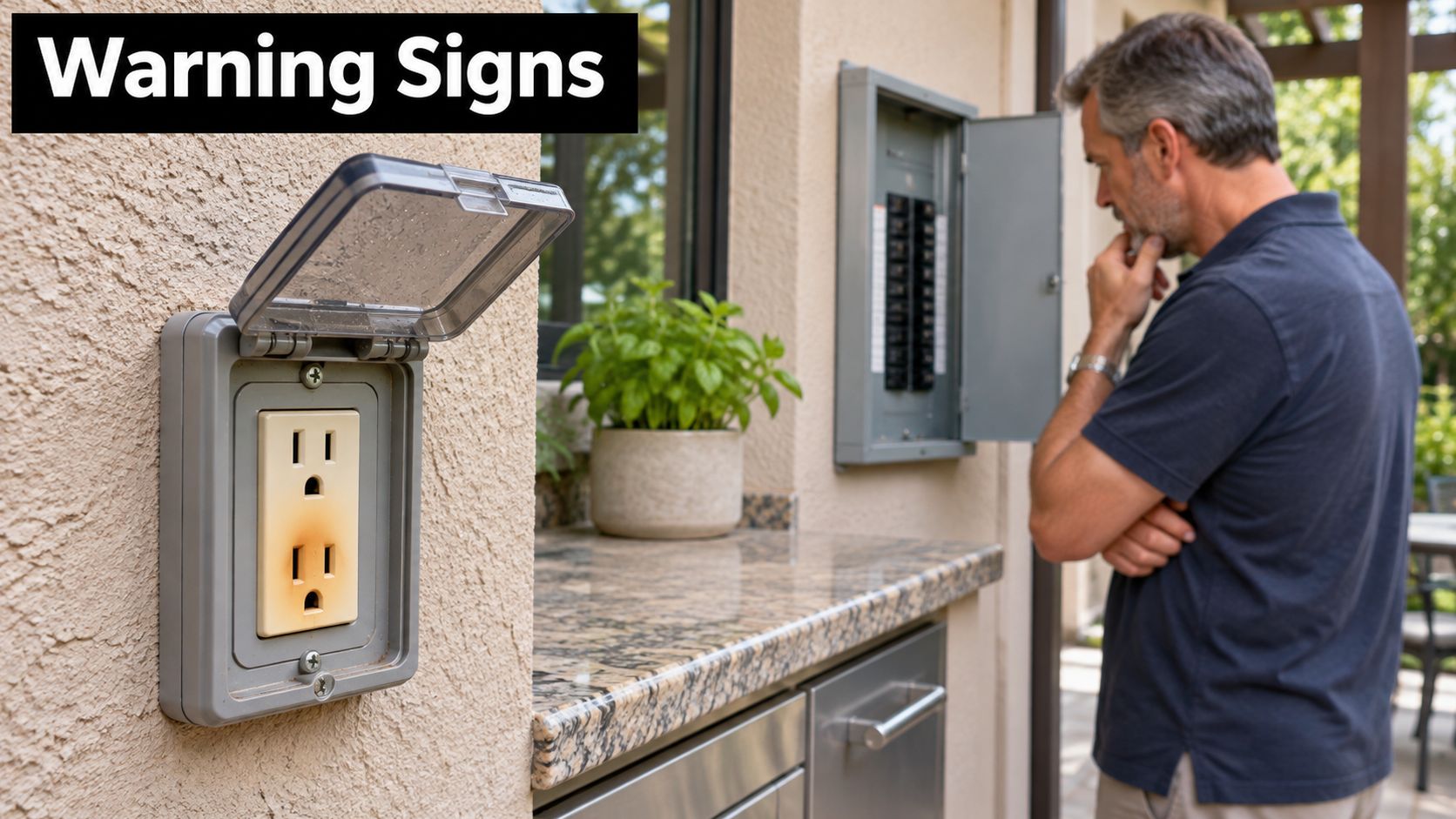
- Repeat trips: A breaker that opens again after one reset means leave that circuit off and call a licensed electrician.
- Heat or scorch: A warm cover, discoloration, or a burned faceplate is a stop-use sign. Do not plug anything back in.
- Noise or flicker: Buzzing or flickering on an outdoor circuit is a reason to clear the area, not to tighten anything yourself.
- Unexplained GFCI trips: A device that trips with nothing plugged in needs a professional test, not a bypass.
- Standing water: Water around a box or device means keep people away until the circuit is checked.
The 2023 NEC kitchen GFCI summary from Mike Holt notes that the revised rule requires GFCI protection for receptacles in a dwelling-unit kitchen and removed the old limit that tied protection only to countertop surfaces. On a service visit, the electrician should identify sink, cooking, beverage-prep, appliance, and general-use receptacles and apply the code your jurisdiction adopted. That review is part of the visit, not a substitute for the official inspection.
What drives the scope
Cost follows distance from the panel, trench and conduit length, whether the service or a subpanel must grow, how many new circuits the nameplates require, and whether appliances are cord-connected or hard-wired. A normal visit reviews your sheet and plan, compares the load with the panel, confirms whether a permit is required, and produces a written scope. Ask who pulls the permit, which GFCI and enclosure ratings will be used, where the disconnect will sit, and how the work will be labeled for the inspector.
Black Rhino Electric is fully licensed and insured in Utah for residential and commercial electrical work and serves Weber, Davis, and Salt Lake Counties. The company handles the electrical scope only. Your general contractor keeps the kitchen and patio build. For the wider residential picture, see the home improvement electrician page. Bring the finished worksheet, scaled plan, exposure notes, and patio schedule before the slab is finalized. You can request a no-obligation quote on the quote form or call 385-396-7048.
Black Rhino Electric plans and installs the circuits, protection, and disconnects for outdoor kitchens in Weber, Davis, and Salt Lake Counties, and leaves the patio build with your contractor. A clear nameplate sheet and a marked route make that electrical scope easier to permit and inspect. Visit Black Rhino Electric to start the conversation before the concrete is ordered.