
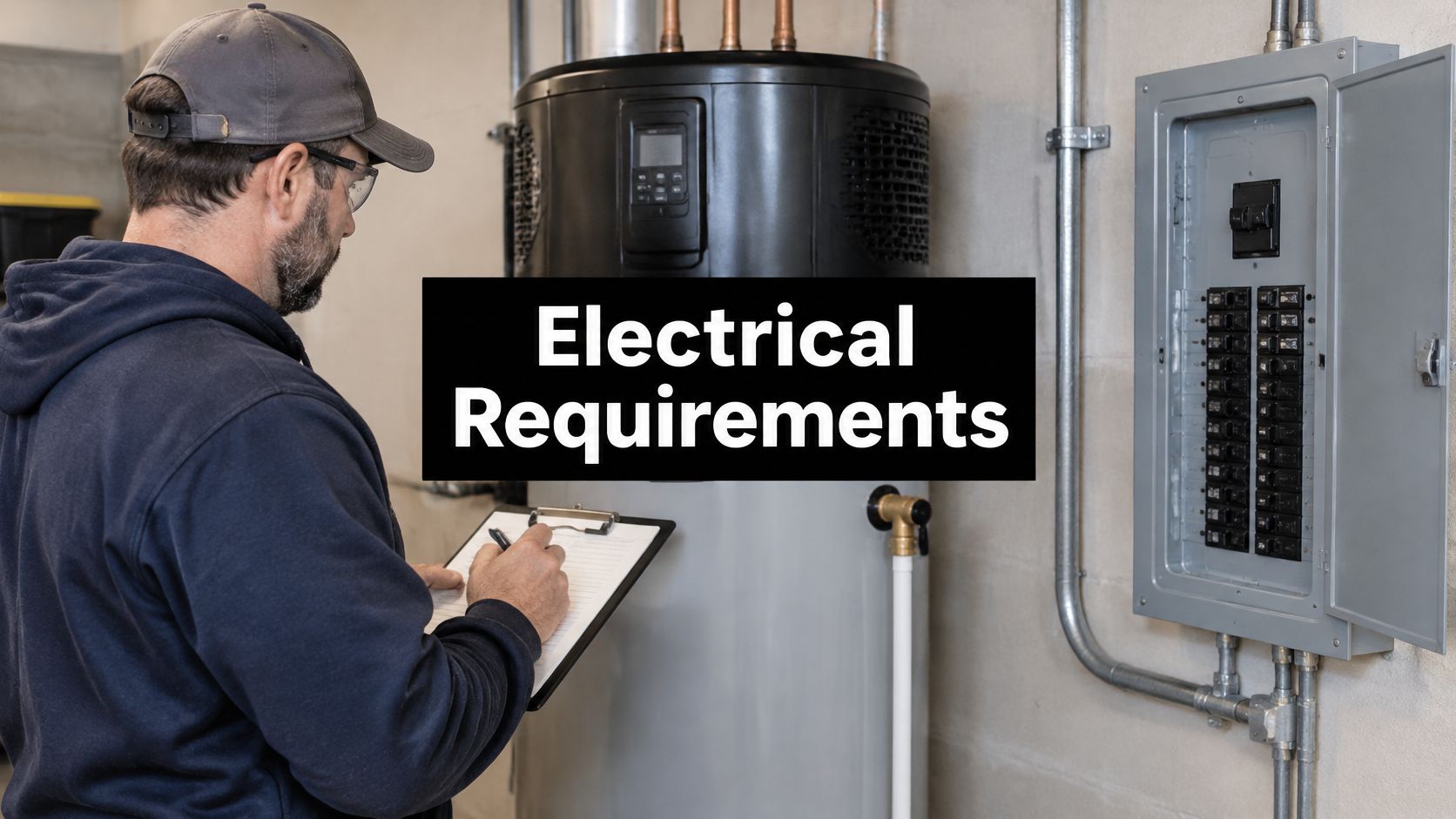
A water heater that already sits on a 240-volt circuit is not proof the next tank can use that circuit. Heat pump water heater electrical requirements come from the specific model, its installation manual, and the electrical code adopted for that house. Two tanks with the same storage volume can still need different voltage, breaker, and conductor sizes.
Why the Model Sets Electrical Requirements
The model nameplate determines how much electrical work a replacement needs. Many residential heat pump water heaters use a dedicated 240-volt circuit. The ENERGY STAR heat pump water heater installation guide gives 30 amps and 10-gauge wire as typical for a 240-volt unit. Treat those as a reference, then confirm the actual requirements in the model's listing and installation manual. The design match does not confirm the old breaker is correct for the new listing.
Some models use 120 volts and connect through a receptacle, which changes the circuit review. The manual specifies whether that receptacle must be dedicated or may share a circuit. Resistance backup can add load when the listing permits it to operate with the compressor, so tanks of the same size may require different circuit arrangements. An existing electric-tank circuit provides a starting point for the review.
Practical rule: Record the model number, serial number, and electrical specifications from the manual before scheduling installation.
For regional installation context, see Richmond installations by Encano Plumbing & Drainage. The electrician determines the circuit design for the specific home. Have a licensed electrician read the model information against the panel.
Nameplate Worksheet for Your Specific Model
Every blank comes from this nameplate and this manual. There is no universal amp rating to copy onto the form. In 2024, the U.S. Department of Energy classified heat-pump water-heater units under a maximum current rating of 24 amperes at a voltage no greater than 250 volts. That describes the product category. It does not size the circuit for any one model.
Rated voltage is the first line, because it chooses the 120-volt or 240-volt path. Mark any item the manual doesn't state with a blank and a note to ask the manufacturer or the installer. Don't estimate a missing ampacity or breaker limit.
| Nameplate or manual item | Where to find it | Why it matters | Who verifies |
|---|---|---|---|
| Rated voltage | Nameplate and installation manual | Decides the 120-volt or 240-volt circuit path | Licensed electrician against the panel |
| Maximum current rating | Nameplate electrical data | Sets the load the circuit must carry | Licensed electrician against breaker and wire size |
| Minimum circuit ampacity | Installation manual electrical section | Minimum conductor capacity the listing requires | Licensed electrician when selecting conductors |
| Maximum overcurrent protection | Installation manual electrical section | Largest breaker the listing allows | Licensed electrician confirms breaker type |
| Resistance backup element | Manual operating modes | Adds to peak load when it runs with the compressor | Licensed electrician in the load review |
| Listed GFCI or other protection | Manual and nameplate markings | Determines which protection device is required | Licensed electrician against code and listing |
| Plug-in or hardwired approval | Manual electrical and installation sections | Confirms whether a standard receptacle is approved | Licensed electrician for receptacle and circuit |
| Clearance and service access | Manual dimensions and service section | Affects disconnect and wiring location | Electrician and installer together |
The finished sheet shows which replacement scenario applies and which questions go to the electrician. Breaker and conductor rows stay blank until that person matches them to the listing.
Replacement Scenarios and the Electrical Work Each Needs
Read the table left to right. The left column is the house as it stands. The middle column is the likely electrical work. The right column is what must be confirmed before the heater is ordered. No prices belong in this lookup.
| Starting point | Typical electrical work | What to verify |
|---|---|---|
| 240-volt electric tank, same configuration | May reuse the existing dedicated circuit if breaker, wire, and disconnect match the new nameplate | Breaker rating, wire size, and disconnect against the new listing |
| Gas, oil, or propane tank converting to electric | Often needs a new 240-volt outlet or branch circuit, and sometimes a panel upgrade | Panel spaces, available capacity, and wiring route |
| 120-volt plug-in retrofit model | May use an existing 120-volt receptacle only if the model is approved for it | Plug-in approval, whether the receptacle must be dedicated, and nuisance-tripping risk |
| No suitable outlet or unknown circuit | New dedicated branch circuit after panel and service review | Panel spaces, existing load, grounding, and bonding |
The ENERGY STAR heat pump water heater toolkit states that the most common units need a dedicated 240-volt outlet or branch circuit, so a home that already has a conventional electric water heater is often the simpler swap. The same guidance says an electric panel upgrade may be necessary when converting from gas, oil, or propane, or when no suitable 240-volt outlet is available.
A 120-volt retrofit is model-specific. The outlet may need to be dedicated, or the listing may allow a shared circuit, and the manufacturer may set different air-space requirements. A nearby receptacle is never proof of compatibility. Equipment selection still sits with the installer. The Covenant Aire Solutions water heater guide is one place homeowners compare replacement paths, while the electrician still inspects service size, open spaces, breaker layout, grounding and bonding, and the branch wiring on site.
Dedicated Circuit, Breaker and Disconnect Checks
A dedicated circuit serves the water heater alone, as the listing and the adopted code require. It doesn't share the run with lights, a receptacle string, or another appliance. The electrician confirms that before any conductor is moved. ENERGY STAR installation best practices direct installers to follow the National Electrical Code, local amendments, and the manufacturer's instructions.
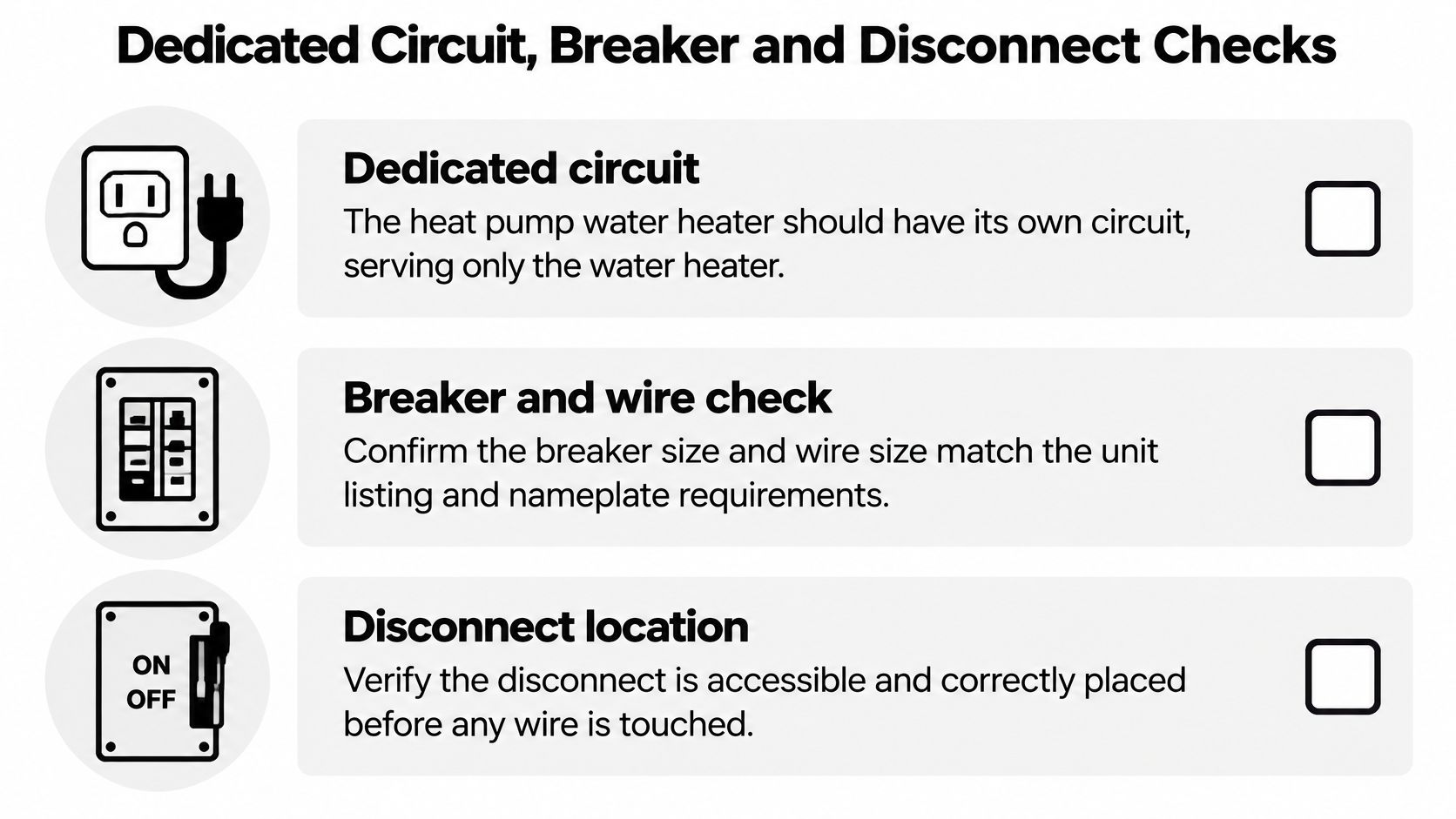
The check follows a fixed order.
- Breaker versus listing. The breaker matches the manufacturer's maximum overcurrent protection, not the size of the old breaker.
- Conductors versus ampacity. Conductor size matches minimum circuit ampacity, run length, and the code as adopted locally.
- Disconnect. The disconnecting means sits where the code and the listing require it, and it stays readily accessible.
- Service room. Wiring leaves clear access for the filter, controls, and compressor.
A larger breaker is not automatically safer. If the wire can't carry what that breaker allows, the conductor is left unprotected. Homeowners can read the existing breaker label, note the room the tank occupies, and see whether the panel is reachable. They shouldn't open the panel, touch conductors, or change breaker sizes.
For a plain explanation of what "dedicated" means on other equipment, understanding dedicated circuit breakers is a useful primer. The same panel review often shows up when a household is adding a circuit for EV charging, because both loads compete for spaces and capacity.
Grounding and GFCI Protection Your Electrician Confirms
Protection is confirmed in order, and none of it is assumed from the tank type.
Equipment grounding comes first. The equipment grounding conductor has to be continuous back to the panel, and bonding is checked at the panel and the service. A painted box, a loose lug, or an old cable without an equipment ground is a stop, not a workaround.
GFCI is next, and only if the listing or the adopted code requires it. A device that trips once can be a nuisance. A device that trips again points to a fault. Resetting it in a loop doesn't clear the circuit, and bypassing a GFCI is never acceptable. Black Rhino Electric explains inspection failures that show up when protection, grounding, or listing details don't match the permit set.
Water near the connection
The electrical connection has to stay dry. The plumber routes temperature-and-pressure relief discharge so it can't reach electrical parts. The electrician confirms that path before the unit is energized. This is a coordination check, not plumbing installation advice.
Commissioning, still on the electrical side
Before the heater is left in service, the electrician checks voltage under load, breaker and conductor compatibility, secure terminations, correct polarity, grounding continuity, and whether the new load clashes with other household circuits. Homeowners don't open the panel or test live wiring. Warning signs they can see or hear are listed with the panel review.
Panel Capacity Review and Questions to Ask
Whether the panel can take the new circuit is a calculation, not a glance at empty slots. The electrician looks at service size, a load calculation that includes large loads already in the house, open breaker spaces, and the physical condition of the panel and branch wiring. An electric range, dryer, EV charger, or hot tub all belong in that total. A panel that looks full can still have capacity once existing loads are calculated. A panel with open spaces can still be over its service rating.
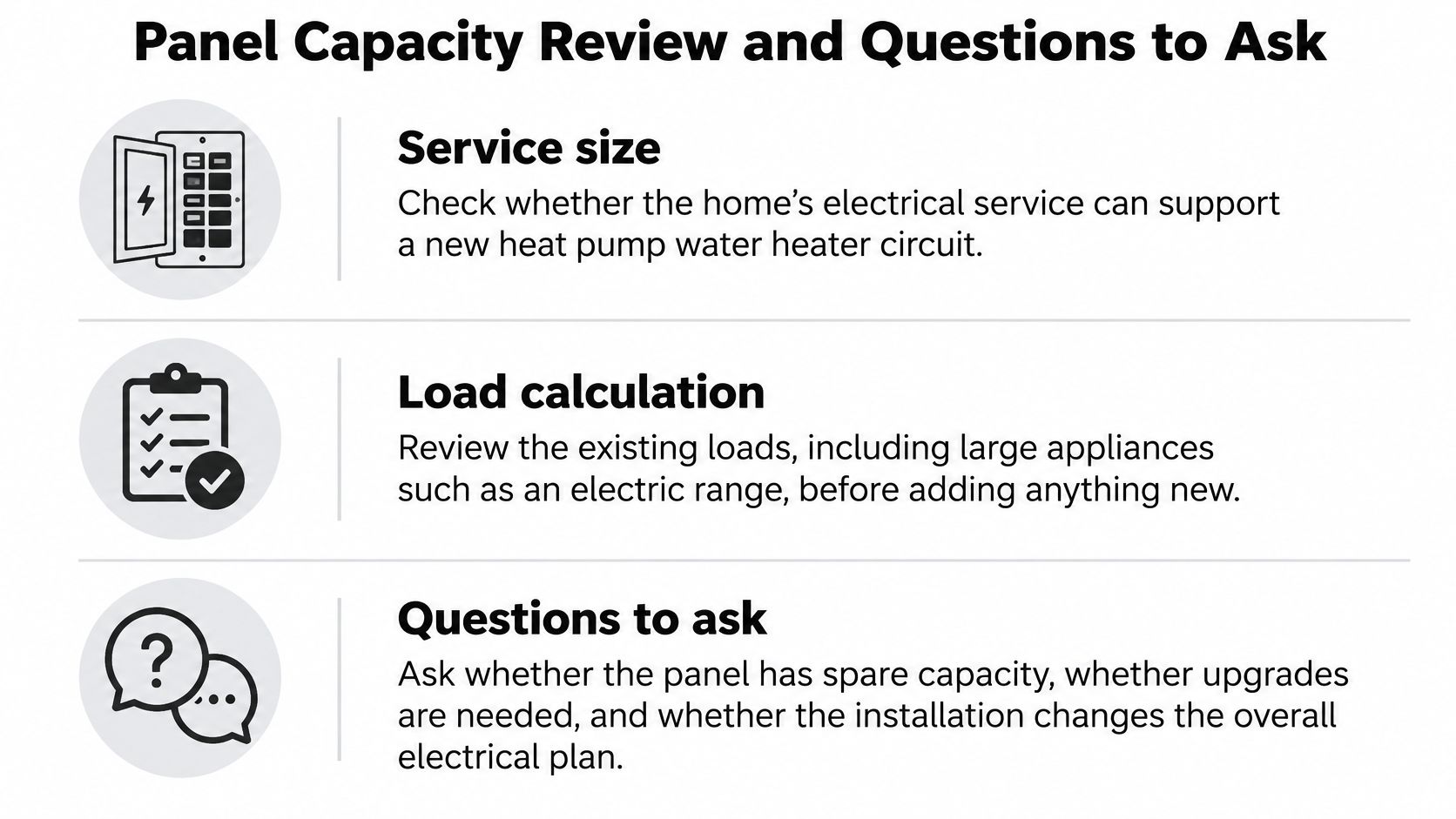
Ask these in the order the electrician answers them:
- Has a load calculation been done for existing loads plus this heater?
- Are there open spaces for a two-pole breaker?
- Do a planned EV charger or hot tub share capacity with this heater?
- Will the service need an upgrade, and what triggers that?
- Is the panel in sound condition for the added load?
Black Rhino Electric's charging capacity guide walks through the same capacity question for a charger. The method carries over when a heat pump water heater is the new load instead.
What a homeowner can notice safely
Stop using the affected circuit and call a licensed electrician if any of these show up. Don't open the panel.
- Dimming lights when a large appliance starts.
- Repeated trips on the same breaker.
- A warm or discolored outlet or panel cover.
- Buzzing, or a burning smell, at the panel or near the tank.
Black Rhino Electric's breaker and panel work, and its EV charger installation, are the next electrical step when that review says the service or the spaces can't take the heater as planned.
Electrician and Plumber Handoff Before You Buy
Settle the electrical scope before ordering the heater. The model number and nameplate determine the electrical details the electrician must use to assess the installation. The electrician handles the circuit, breaker, conductors, disconnect, grounding, and any required permit. The plumber handles the water connections. Schedule water work after the electrical scope is settled and, where required, after the electrical inspection.
| Task | Lead | Coordination point |
|---|---|---|
| Confirm model number and electrical nameplate | Installer or homeowner supplies the model | Electrician confirms voltage and current before making circuit decisions |
| Panel space and capacity review | Licensed electrician | Electrician shares the circuit decision with the installer before scheduling |
| Dedicated circuit, breaker, and conductors | Licensed electrician | Complete or schedule electrical work before the water connection |
| Disconnect and service access | Licensed electrician with installer | Confirm access clearance against the unit's service area |
| Water connection and relief discharge routing | Plumber | Coordinate routing with the electrician, as covered in the grounding and GFCI section |
| Permit and inspection | Licensed electrician where a permit applies | Where required, complete the electrical inspection before the water connection |
Each row controls a decision that must be settled before the unit is ordered or work is scheduled. The lead column identifies who handles the task; the coordination point states what the trades need to agree on. This handoff covers coordination, not plumbing installation steps. Give both trades the completed nameplate worksheet and selected replacement scenario so they can write one shared scope.
Permits, Inspection Steps and Cost Factors
Permit rules aren't the same for every address, and this guide doesn't list county-specific rules for Weber, Davis, or Salt Lake County. The building department for the city or county where the house sits confirms whether an electrical permit applies.
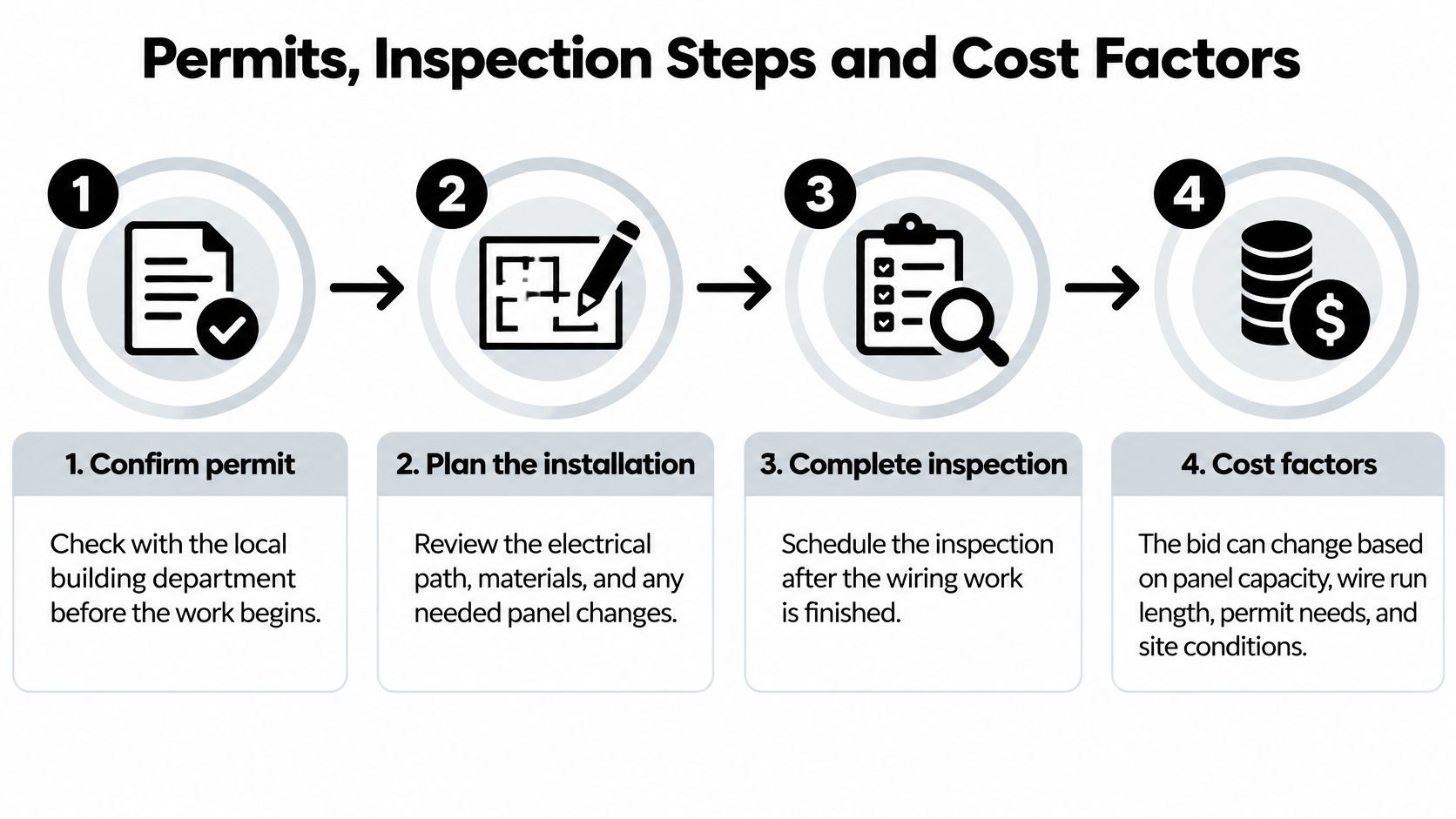
- Confirm the permit. Ask that building department whether this job needs an electrical permit.
- Write the scope. The licensed electrician reviews the nameplate and panel and states the work.
- Pull and build. The electrician pulls any required permit and completes the electrical work.
- Inspection. The inspector checks wiring, breaker, disconnect, grounding, and listed protection.
- Closeout. Corrections are finished and the permit is closed.
What changes a written bid
Dollar figures don't belong here, because the site changes the number. Ask for a written estimate with each driver on its own line so a panel finding shows up as a visible change.
- Panel work when spaces or service capacity fall short.
- Breaker and wire size set by the listing, not by the old tank.
- Length of run from the panel to the heater location.
- Disconnect and access when the listing or the room layout moves the hardware.
- A new outlet or branch circuit on a fuel-to-electric conversion.
- Transfer-switch or control devices if backup power or managed operation is part of the scope.
- Permit and inspection fees set by the jurisdiction.
Outage Behavior, Controls and Backup Power
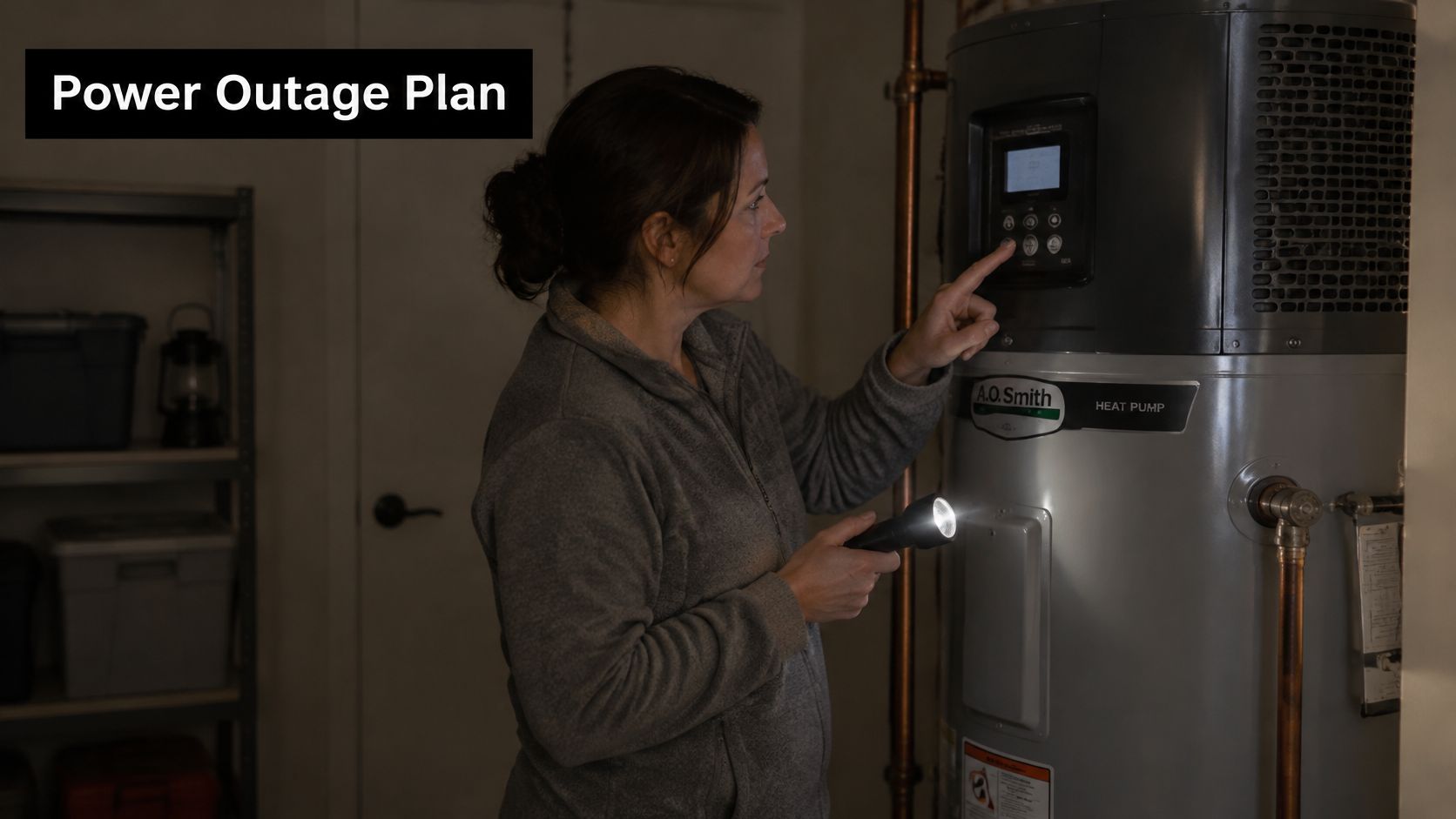
A heat pump water heater can't reheat during an outage. ENERGY STAR's heat pump water heater FAQ is direct on this point. Both the compressor and the electric resistance backup need electricity. Water already in the tank can stay hot for a while. It doesn't reheat until power returns.
Backup power
A generator or other backup supply has to be checked against the heater's voltage, circuit requirements, and starting or operating demand, along with the rest of the house and the transfer equipment's rating. An electrician verifies that the transfer switch is installed and configured under the electrical rules that apply. Without that backup, the tank only holds what it already heated.
Controls are a separate decision
Manufacturer app scheduling is not the same thing as a utility demand-response program. A 2025 Northwest Energy Efficiency Alliance project found that heat pump water heaters can take part in programs meant to reduce peak demand or provide energy-storage services to the grid. Enrollment and any incentive are set by each utility, so the homeowner checks with that utility rather than assuming a program exists.
Document normal, vacation, resistance-only, and grid-event modes at commissioning, and ask whether any control device needs its own circuit.
Write the outage plan and those control choices on the worksheet before the electrician visit.
Confirm the Electrical Plan Before You Order
The model nameplate and the home's electrical panel determine the replacement plan. Before ordering, confirm that the selected heater's electrical requirements match the existing circuit and available panel capacity. If the review calls for service or breaker changes, an electrical panel upgrade may be one step within the same electrical plan.
Black Rhino Electric is fully licensed and insured for residential and commercial electrical work in Utah, serving Northern Utah, including Weber, Davis, and Salt Lake counties. Its home improvement electrical services include work relevant to a home project. Customers can request a free quote through the online quote form.
Use the handoff checklist in section 7 to prepare for the electrician's review. Black Rhino Electric can assess the panel and related electrical work a heat pump water heater replacement may require. Request a quote before ordering so the electrical plan can be coordinated with the replacement. Start through Black Rhino Electric.