
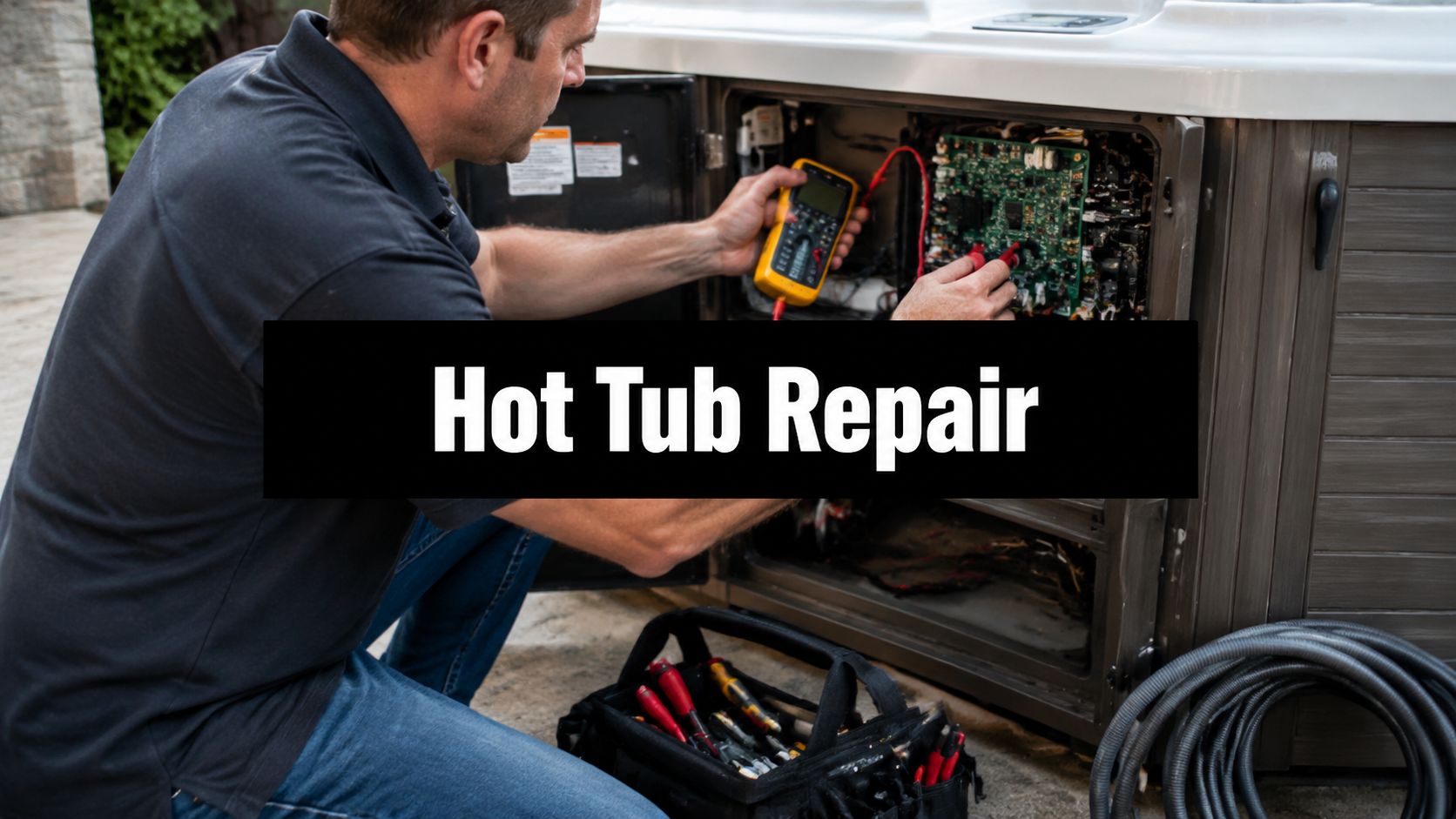
A cold tub on a Utah evening is frustrating enough. What worries most homeowners more is not knowing whether the issue is a bad part, a wiring fault, or an actual shock risk. If you're searching for hot tub repair Salt Lake City, it helps to start with the electrical side first, because that's often where the core problem begins.
Signs Your Hot Tub Has an Electrical Problem
A common Salt Lake City call goes like this: the tub was fine last night, the cover comes off after work, and now the water is cold, the topside panel is blank, or the breaker trips the moment the system starts. Homeowners often assume the heater or pump failed. In practice, the electrical side is often the first place to look.
That distinction matters because a bad connection, a weak breaker, a nuisance-tripping GFCI, or low voltage under load can make good spa components act bad. I see tubs with replaced parts that never needed replacing because nobody tested the circuit feeding the tub first. If you want a clearer sense of why protection devices behave the way they do, this guide on how GFCI power outlets work in real installations helps explain the shutdown patterns many homeowners notice around spas.

What homeowners usually notice first
These symptoms usually point to an electrical fault, not just routine wear on spa parts:
- The tub is completely dead. No lights, no control panel, no pump activity. That often means lost power at the disconnect, breaker, GFCI, terminal block, or control pack.
- The breaker or GFCI keeps tripping. Repeated trips are a warning sign. Common causes include a failing heater element, moisture intrusion, damaged wiring, or a motor drawing more current than it should.
- The pump runs but the water never heats. The circulation side may still work while the heater circuit, relay board, pressure switch, or incoming power to the heater does not.
- You hear buzzing or humming in the equipment bay. That can point to a motor trying to start on poor voltage, a stuck relay, or a contactor with failing contacts.
- The control panel flickers, resets, or throws intermittent errors. Loose connections, corrosion, and voltage drops often show up here before the system fails completely.
- There is a hot or burning smell. Shut it off and leave it off. Overheated terminals, scorched insulation, and failing boards can get worse fast.
- Problems show up during cold weather. Winter tends to expose weak electrical connections and marginal breakers because the tub has to work harder to maintain temperature.
Practical rule: If the tub is tripping protection, losing power at random, or giving off heat or odor from the equipment area, stop using it until the electrical system is tested under load.
Why this shows up so often in Utah
Utah weather is hard on outdoor spa equipment. Snow, freeze-thaw cycles, condensation inside equipment compartments, and long heating runs in winter all add stress to electrical parts. A connection that survives summer may start failing once temperatures drop and current demand stays high for hours at a time.
The trade-off is simple. A hot tub can keep running with a minor plumbing issue for a while, but electrical faults tend to get less predictable, not more stable. Loose lugs create heat. Moisture creates leakage paths. An undersized or aging breaker may hold for weeks, then start tripping every cold evening. Those are the kinds of problems that look random until someone checks voltage, amp draw, and terminations across the full circuit.
A simple way to describe the problem when you call
A few details make troubleshooting much faster:
- What still works. Lights, jets, circulation pump, heater, or none of the above.
- When it fails. At startup, when heat kicks on, after running for a while, or only on cold nights.
- What trips. Main breaker, spa disconnect, GFCI, or nothing visible.
- What you notice. Clicking, humming, a burnt smell, moisture in the cabinet, or error codes on the display.
“The hot tub stopped working” is a start. “It runs jets, then trips when heat starts” is far better, and it usually points the diagnosis in the right direction before anyone opens the panel.
Hot Tub Electrical Safety You Cannot Ignore
Water and electricity can coexist safely, but only when the system is installed and maintained the right way. A hot tub isn't just another backyard appliance. It's a high-load piece of equipment operating in a wet environment, which means the protective devices matter just as much as the heater and pumps.

Why the GFCI matters so much
Think of a GFCI as a hyper-vigilant bodyguard. It watches electrical flow and cuts power fast if current starts going somewhere it shouldn't, including through water or a person. If it trips, that's not the device being annoying. It's doing its job.
A lot of homeowners make the mistake of focusing only on the part that stopped working. Safety starts earlier than that. The tub needs proper grounding, correct wiring methods, an accessible disconnect, and a dedicated circuit that matches the load.
For homeowners dealing with nuisance trips at outdoor outlets or spa equipment, it also helps to understand how GFCI power outlets work in real-world installations, because many “mystery” shutdowns come back to protection reacting to an actual fault.
The safety items that get overlooked most often
The dangerous issues usually aren't dramatic until they are. Watch for these:
- Shared circuits. A hot tub should not compete with other heavy loads.
- Improper wire sizing. If conductors aren't matched to the actual draw and run conditions, heat buildup and voltage problems can follow.
- Loose terminations. A slightly loose connection can create heat, intermittent faults, and equipment damage over time.
- Missing or poorly located disconnects. Service work becomes less safe when power can't be shut off clearly and reliably.
- DIY modifications. Added lights, accessories, or patched wiring can create hidden hazards.
A hot tub that “mostly works” can still be unsafe.
Why the contractor choice matters
Salt Lake City has a large service market. The Better Business Bureau directory shows 64 results for hot tub service and repair near Salt Lake City, which signals plenty of demand and plenty of options. It also means homeowners need to be selective and choose a licensed electrical contractor when the issue involves power, protection, wiring, or code compliance, as shown in the BBB hot tub service and repair listings for the area.
That distinction matters. A spa technician may be very capable with covers, plumbing, pumps, and controls. But when the problem involves feeder wiring, panel capacity, disconnects, grounding, or recurring GFCI trips, electrical training is what keeps the repair both functional and safe.
Our Professional Hot Tub Repair Process
A proper hot tub repair visit should answer three questions fast. Is the problem inside the spa, in the electrical supply feeding it, or in the protection devices meant to shut it down when something is unsafe? That electrical sequence matters, because a heater that will not heat or a pump that only hums can start with a supply problem, not a bad spa component.

What the service call should include
A solid hot tub electrical visit usually follows a clear sequence:
Initial triage
The visit starts with symptom gathering. A dead topside panel, a breaker that trips on reset, a heater that never comes on, or equipment that fails after rain all point in different directions. Good notes at this stage save time later.On-site electrical diagnosis
Diagnosis begins with testing, not part replacement. That usually means checking breaker response, GFCI operation, disconnect condition, incoming voltage, terminal connections, and whether the spa pack is receiving and sending power where it should. If voltage is wrong or unstable, replacing a pump or heater first can waste time and money.Clear quote before repair
Once the fault is isolated, the homeowner should get a plain-language explanation of what failed, what needs to be repaired now, and what should be watched next. If a return trip is needed for parts, that should be clear upfront.Licensed electrical repair
Problems involving feeders, breakers, disconnects, heater circuits, control wiring, or damaged terminations need code-correct electrical work. In practice, that often includes cleaning up overheated connections, replacing failed GFCI protection, correcting wiring faults, or confirming the panel can handle the load safely.Load testing and verification
A proper closeout includes running the spa under normal conditions. The system should be checked while pumps start, the heater calls, and controls cycle, because some faults only show up when the tub is under load.
Why this process saves time
Misdiagnosis is what stretches a one-visit repair into two or three. I have seen tubs get a new heater when the issue was no output from the control side, and I have seen pumps blamed when low voltage from a failing connection was the cause.
The pattern is familiar in other systems too. If you have had to troubleshoot common water heater issues, you have seen how a symptom at the fixture can start with a problem farther back in the electrical or control path.
The fastest repair usually starts with meter readings, load checks, and isolation testing.
For homeowners dealing with spa wiring, disconnect problems, breaker trips, or full electrical fault tracing, hot tub electrician services are the right fit, rather than general pool or spa maintenance.
Ballpark Costs for Hot Tub Repair in Salt Lake City
Cost is usually the first practical question, and it's a fair one. Most homeowners aren't worried about the name of the failed component. They want to know whether they're dealing with a relatively contained repair or a larger electrical problem that needs parts, labor, and a second trip.
A useful local benchmark puts the typical hot tub repair cost in Salt Lake City at $661.29 to $1,322.58, which indicates that many calls involve component-level troubleshooting and replacement rather than a minor adjustment, according to ContractorPlus repair cost data for Salt Lake City.
What drives the final bill
The total usually depends on a few real-world factors:
- Whether the fault is identified quickly or requires deeper tracing through supply, controls, and connected components
- If parts are immediately available or need to be ordered
- Whether one failed part damaged another such as a heater issue tied to relays, wiring, or protection devices
- How accessible the equipment area is for testing and replacement
- Whether the repair stays within the spa pack or extends back to disconnects, breakers, or feeder wiring
Example hot tub electrical repair costs
| Repair Type | Common Cause | Estimated Cost Range |
|---|---|---|
| Electrical fault diagnosis and repair | Breaker behavior, wiring issue, GFCI trip, control-side troubleshooting | Within the typical local repair range of $661.29 to $1,322.58 |
| Heater circuit repair | Water stays cold, relay or heater-side electrical failure | Within the typical local repair range of $661.29 to $1,322.58 |
| Pump electrical issue | Pump hums, won't start, or loses power under load | Within the typical local repair range of $661.29 to $1,322.58 |
| Control or power-feed issue | Dead panel, intermittent startup, no response from spa pack | Within the typical local repair range of $661.29 to $1,322.58 |
Service fee versus full repair cost
A separate point that confuses homeowners is the difference between the diagnostic visit and the full repair total. They're not the same thing.
A local specialist's pricing structure lists an $109/hour service fee and a reduced $60 to $80 diagnostic fee when a second trip is needed for parts. That's useful because it shows how many repairs unfold in practice. The first visit isolates the fault, and the follow-up visit handles the actual replacement once the correct component is available.
You know what? That's usually a good sign, not a bad one. It means the technician is confirming the exact failure instead of swapping parts blindly.
Hot Tub Electrical Service FAQs
Some questions come up right before a homeowner decides to schedule service. These are usually less about theory and more about logistics, timing, and who should handle the work.

Do you serve only Salt Lake City
No. Service needs often extend beyond one city because homeowners, landlords, and property managers across Northern Utah run into the same spa wiring and protection issues. Black Rhino Electric serves Weber, Davis, and Salt Lake counties, which is especially useful when a property owner manages homes in more than one area.
Can you handle emergency or after-hours electrical issues
Yes. Some hot tub issues can wait for scheduled service. Others shouldn't. If there's a burning odor, repeated tripping, visible heat damage, or a disconnect that won't operate properly, it makes sense to treat the problem as urgent and shut the system down until it's inspected.
Can you wire a new hot tub, not just repair one
Yes. Many repair calls uncover installation problems rather than true equipment failure. New tub setups often need panel review, dedicated circuit planning, disconnect placement, GFCI protection, and final connection by a licensed electrician. That's especially important when the home already has a busy electrical panel or an older service layout.
Why hire a licensed electrician instead of a general spa tech
Because some failures start in the spa and others start upstream. If the issue involves branch circuit wiring, panel capacity, grounding, nuisance tripping, disconnects, code corrections, or damaged electrical connections, a licensed electrician is trained to diagnose and repair those hazards directly.
If the symptom is electrical, the solution should start with someone qualified to test electrical systems safely.
That doesn't diminish the role of spa technicians. It just keeps the scope clear. Plumbing leaks, shell issues, and cover problems belong in one lane. Shock protection, feeder wiring, breaker faults, and code compliance belong in another.
Schedule Your Hot Tub Repair with Black Rhino Electric
A hot tub that trips the breaker on Friday night and sits cold by Saturday usually has an electrical fault that will not correct itself. In my experience, the longer a bad connection, weak breaker, or failing GFCI is left in place, the more likely it is to turn into heat damage, repeated shutdowns, or a repair that spreads beyond one part.
The goal is to find the actual cause, not just get the spa running for a day or two. Hot tubs put a steady load on the electrical system, and that means the repair has to hold under normal heating and pump cycles. For Black Rhino Electric, that starts with testing the circuit, protection devices, connections, and panel side components that many general repair calls overlook.
To start the process online, request a free quote for hot tub electrical repair.
If your spa is tripping breakers, staying cold, losing power, or showing signs of wiring trouble, contact Black Rhino Electric for help from a licensed local electrician. Call 385-396-7048 to get your hot tub running safely again.