It’s a frustratingly common story. You’re getting ready for the day, you plug in the hairdryer, and the room suddenly goes dark. If you're constantly asking, "why does my breaker keep tripping?", you're not just dealing with an annoyance; you're getting a critical safety alert from your electrical system. This guide will help you decode your home's electrical warnings and understand what's really going on behind your walls.
Decoding Your Tripping Breaker
Think of your breaker as your home’s first line of defense against electrical fires. We'll walk through the three main culprits—overloaded circuits, short circuits, and ground faults—so you can understand the difference between a simple fix and a serious hazard. Let me explain the key reasons, so you can stop guessing and start understanding what your electrical system is trying to tell you.
A constantly tripping breaker isn't just an inconvenience; it's a critical safety alert from your electrical system that you should never, ever ignore.
First, let's get a quick overview of the most common reasons your breaker keeps giving up. We’ll dig into each of these in more detail, but this will give you a solid starting point.
Why Your Breaker Trips at a Glance
This table gives a quick look at the big three causes, what you might notice, and how seriously you should take it.
| Primary Cause | Common Signs | Risk Level |
|---|---|---|
| Circuit Overload | Breaker trips when you use a specific high-power appliance, like a microwave or space heater. The trip isn't immediate. | Low to Moderate: Usually an inconvenience, but chronic overloads can wear out wiring over time. |
| Short Circuit | A loud snap or pop from an outlet or switch, followed by an instant breaker trip. You might see a spark or smell burning. | High: This is a direct fire hazard. The circuit should not be used until it's inspected by a professional. |
| Ground Fault | Breaker trips instantly when an appliance is plugged in or turned on, especially in wet areas like kitchens or bathrooms. | High: Poses a serious risk of electric shock. Requires immediate attention. |
As you can see, while an overload is the most frequent reason, short circuits and ground faults are far more dangerous. Now, let’s explore what each of these really means for your home.
The Most Common Culprit: Overloaded Circuits
Honestly, the most frequent reason your breaker trips is surprisingly simple: an overloaded circuit. If you’ve ever wondered, "why does my breaker keep tripping?", this is almost always the place to start.
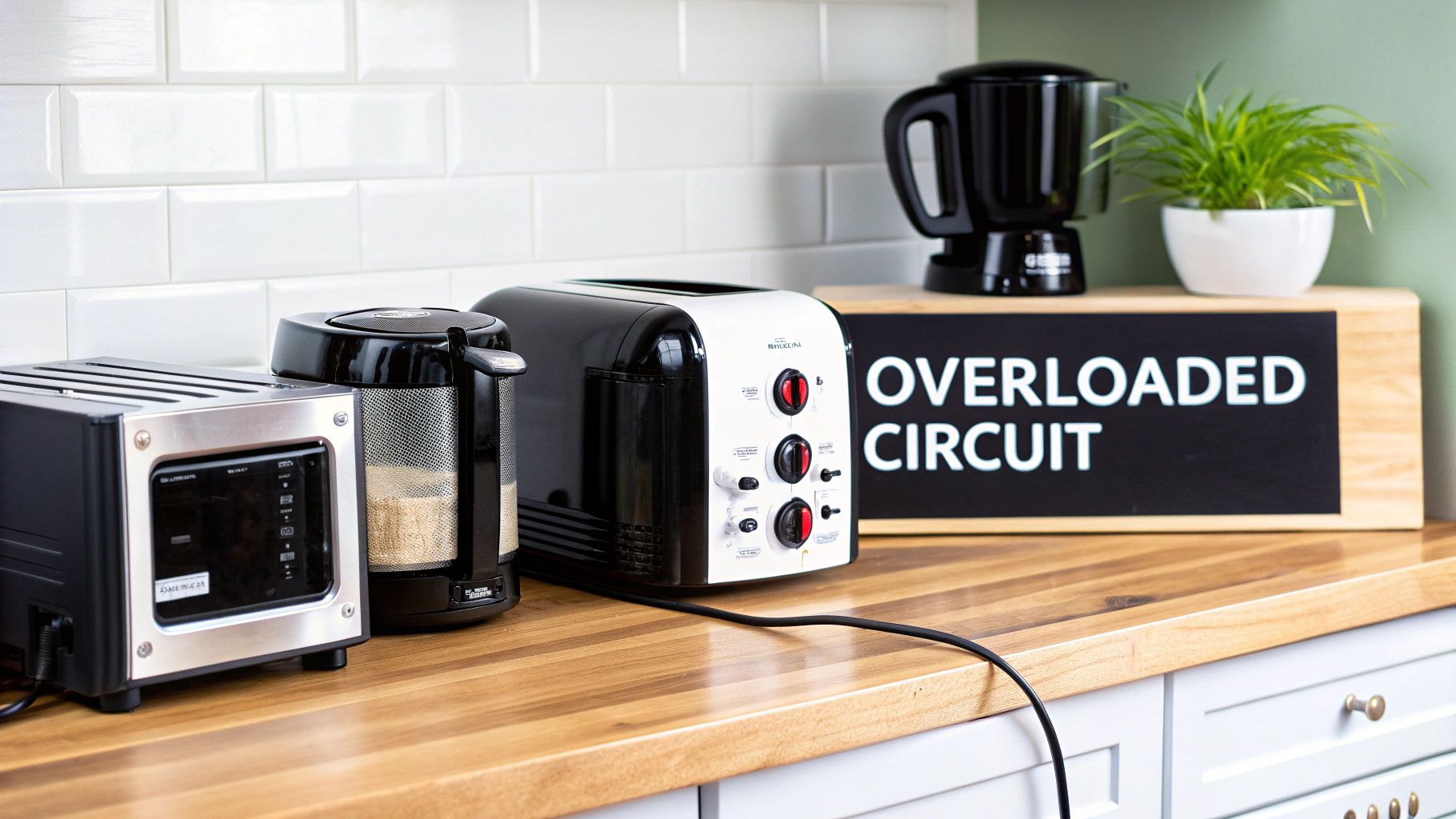
Think of a circuit like a single lane on a highway, designed for a specific amount of traffic (electrical current). When you run too many high-power devices at once—like a microwave, space heater, and coffee maker on the same kitchen circuit—you create an electrical traffic jam. The breaker acts like a vigilant traffic cop, shutting the lane down to prevent a dangerous pile-up, such as overheating wires and a potential fire.
Understanding Amperage and Appliance Demands
Let me put it another way. Your circuit's capacity, measured in amperes (or amps), is like a bucket. The electricity your appliances use is the water being poured into it. A standard household circuit is typically a 15-amp or 20-amp bucket.
If you pour too much water in at once by running too many appliances, the bucket overflows. In your home, this "overflow" is the breaker tripping to stop the flow of electricity before it can cause real damage.
The problem is that many modern appliances are incredibly thirsty for power. A single high-draw device can nearly fill that bucket all by itself, leaving little room for anything else. This is especially true in older homes whose electrical systems weren't designed for today's power-hungry gadgets.
Ignoring these warnings can be severe. According to global electrical safety data, faulty wiring and overloaded sockets are significant hazards. In the US, the Electrical Safety Foundation reports that overloads cause roughly 51% of home electrical fires. Circuits rated at 15-20 amps are routinely overwhelmed by modern appliances that pull more power than a typical branch circuit can handle. You can discover more insights about high-voltage circuit protection on weishoelec.com.
Identifying High-Power Appliances
So, which appliances are the usual suspects in these electrical traffic jams? You know what? It’s almost always the devices that generate heat. These are the biggest power hogs in your home.
Here’s a quick look at some common culprits and the typical power they draw. Keep in mind that a standard 15-amp circuit can handle about 1,800 watts, while a 20-amp circuit can handle 2,400 watts.
| Appliance | Typical Wattage | Impact on a 15-Amp Circuit |
|---|---|---|
| Space Heater | 1,500 Watts | Consumes 83% of the circuit's capacity on its own. |
| Hair Dryer | 1,800 Watts | Can use 100% of the circuit's capacity, leaving no room for anything else. |
| Microwave Oven | 1,200 Watts | Takes up 67% of the available power. |
| Toaster Oven | 1,200 Watts | Also uses about 67% of the circuit's capacity. |
| Coffee Maker | 1,000 Watts | Consumes over half (55%) of the circuit's power. |
As you can see, running just two of these appliances at the same time on the same 15-amp circuit is a guaranteed recipe for an overload and a tripped breaker.
How to Perform a Simple Electrical Audit
You can figure out if an overload is your problem with a simple "electrical audit." This process of elimination helps you pinpoint which combination of devices is pushing your circuit past its limit.
Here’s how to do it, step-by-step:
- Go to the Tripped Circuit: First, identify the room or area where the power went out.
- Unplug Everything: Now, systematically unplug every single device and appliance from the outlets on that circuit. Don't forget lamps, chargers, and power strips.
- Reset the Breaker: Go to your electrical panel and flip the tripped breaker back to the "ON" position. If it stays on, the problem is likely one of the devices you unplugged, not a more serious wiring issue. Good news.
- Plug In One by One: Head back to the room and start plugging your devices back in, one at a time. Turn each one on to its highest setting after plugging it in.
- Identify the Culprit: Keep doing this until the breaker trips again. The last device you plugged in—or the combination of devices now running—is the source of your overload.
Once you find the overload, the solution is simple: redistribute your high-power appliances across different circuits. For example, avoid running the microwave and the coffee maker at the same time if they are on the same circuit. Easy.
The Hidden Danger of a Short Circuit
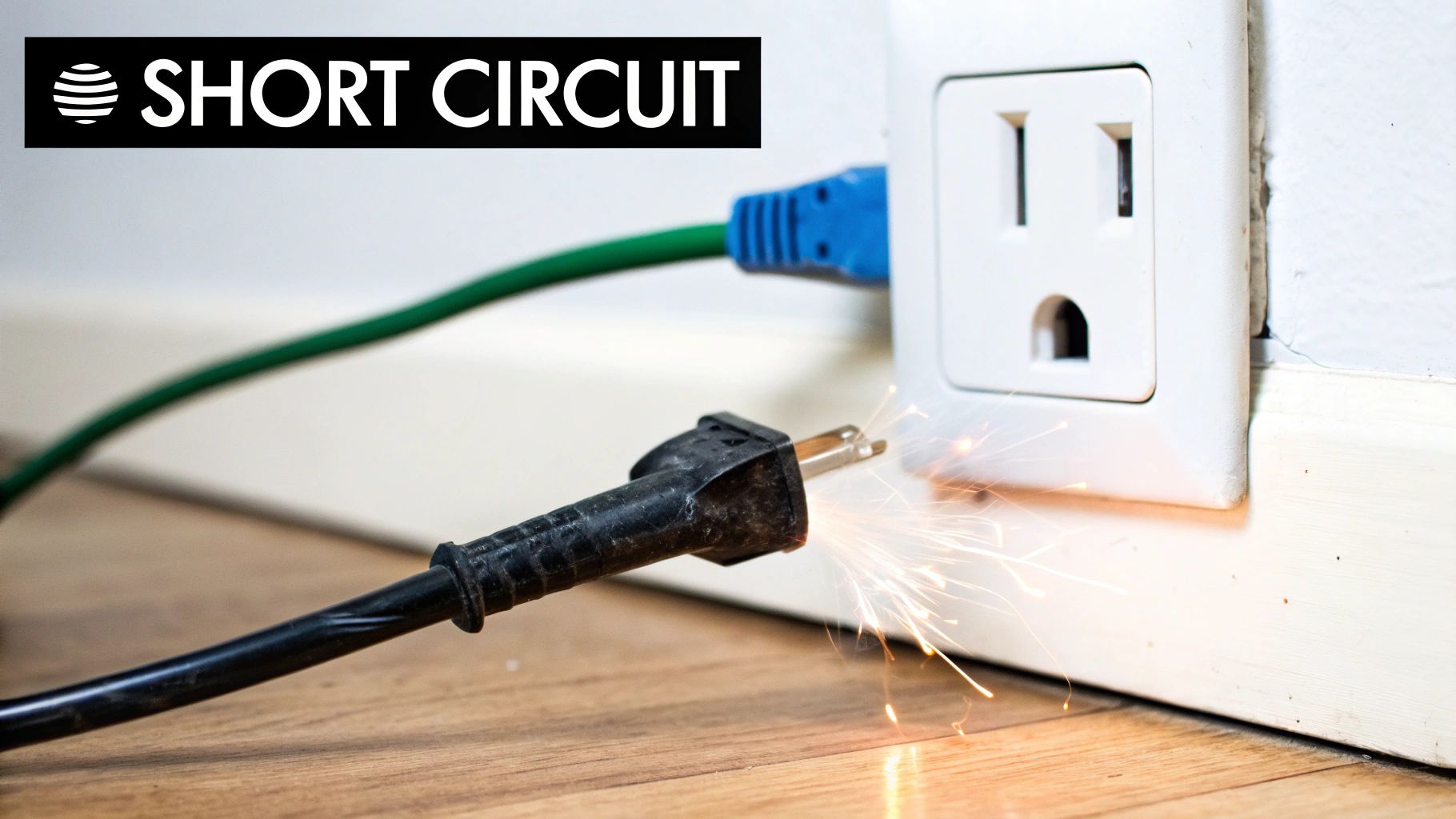
While an overloaded circuit is a problem of "too much," a short circuit is a different beast entirely. It’s far more dangerous, happening when electricity jumps off its intended path and goes somewhere it absolutely shouldn't.
Think of it this way: an overload is like a traffic jam on the electrical highway. A short circuit? That's a high-speed, head-on collision. It's the kind of immediate threat your breaker is designed to shut down instantly.
A short circuit occurs when a hot wire makes direct contact with a neutral wire, creating an unauthorized shortcut for the current. This bypasses your appliance and unleashes a massive, uncontrolled surge of electricity, generating intense heat almost instantly.
The breaker’s job is to see this violent surge and react in a fraction of a second, cutting the power before wires can melt and start a fire.
What Causes a Short Circuit
Here’s the thing: the causes of a short circuit are often hiding in plain sight, which makes them particularly treacherous. You might not see the danger until it’s already happened.
Common culprits lurking in your home include:
- Damaged Appliance Cords: A frayed, pinched, or cracked cord on a lamp or appliance can let the hot and neutral wires inside touch.
- Faulty Internal Wiring: Sometimes, the problem is deep inside an appliance where internal parts have degraded or rattled loose.
- Pests and Rodents: Mice are notorious for chewing through the insulation on wires hidden inside walls, exposing the bare conductors.
- Loose Connections: Over time, the connections inside outlets, switches, or light fixtures can loosen, allowing wires to make contact.
These situations are serious fire hazards. According to NFPA data, short circuits and ground faults are responsible for 13% of home fires in the US. That translated to an estimated 52,000 incidents in 2022 alone, costing a staggering $1.5 billion in property damage. The danger is even greater in older homes, as outdated wiring materials like aluminum are known to cause 55% more fires than copper. You can read the full research on these electrical safety statistics at meteorelectrical.com.
Unmistakable Signs of a Short Circuit
Unlike a simple overload, a short circuit often announces itself with some drama. If your breaker trips and you noticed any of the following, you're almost certainly dealing with a short.
These are clear warnings that demand your immediate attention:
- A loud popping or snapping sound from an outlet or switch.
- A bright spark or flash of light when you plug something in or flip a switch.
- A distinct burning smell or the scent of ozone coming from an outlet or your panel.
- Black scorch marks or visible melting around an outlet.
If your breaker trips instantly after you reset it—even with nothing plugged into that circuit—that’s a tell-tale sign of a persistent short circuit in your home’s wiring. Do not keep trying to reset it.
You might be asking, "why does my breaker keep tripping instantly?" An immediate trip means the dangerous fault is still there. Forcing power through that shorted path is like pouring gasoline on a smoldering fire; you’re increasing the risk of severe damage with every attempt. This is a clear signal that the problem is beyond a simple DIY fix and needs a professional diagnosis from a licensed electrician.
Ground Faults and Aging Breakers Explained
Sometimes, the constant tripping isn't about what you've plugged in, but the electrical system itself failing behind the scenes. If you've ruled out overloads and short circuits but are still asking, “why does my breaker keep tripping?”, it’s time to look at two often-overlooked culprits: ground faults and the simple, inevitable aging of your circuit breakers.
A ground fault is a specific, and particularly hazardous, type of short circuit. It happens when a hot wire makes contact with a grounded part of your system—like the metal outlet box or the frame of an appliance. This creates a dangerous, low-resistance path for electricity to find its way home, turning anything connected to that ground into a potential shock hazard.
This is precisely why you find those special outlets with the little "test" and "reset" buttons in your kitchen, bathroom, and outdoor areas. They're called Ground Fault Circuit Interrupters, or GFCIs.
The Critical Role of GFCI Outlets
A GFCI outlet is a life-saving device that constantly acts as a watchdog on the flow of electricity. It measures the current going out on the hot wire and compares it to what’s coming back on the neutral wire.
If it detects even a tiny imbalance—as small as 4-5 milliamps—it assumes the electricity is leaking out through a ground fault (potentially through a person) and shuts off the power in a fraction of a second.
This rapid response is fast enough to prevent a serious electrical shock, making GFCIs essential in any area where electricity and water might mix. If a breaker connected to one of these areas is tripping, it could be the GFCI protection doing its job, signaling a dangerous fault in an appliance or the wiring itself. You can learn more about how these crucial devices work in our detailed guide on GFCI power outlets.
A ground fault isn't just a technical glitch; it's an active shock hazard. A tripping GFCI outlet or breaker is a clear warning sign that should be investigated immediately to protect your family.
The danger is not trivial. Research shows that ground faults are a major contributor to nuisance trips and serious accidents, sparking an estimated 20,000 fires annually. Alarmingly, about 40% of homes in the Davis and Salt Lake counties were built before modern GFCI mandates were fully implemented, increasing the risk for many local families. You can explore more data on breaker failure rates and fault causes on brainfiller.com.
When the Breaker Itself Is the Problem
Let me explain another possibility. Circuit breakers are mechanical devices with internal springs, latches, and contacts. Just like any other mechanical part, they wear out over time. An aging breaker can become weak or overly sensitive, leading to what electricians call "ghost tripping"—where it trips for no apparent reason, even under a light electrical load.
An old breaker may fail in a few ways:
- Weakened Springs: The internal springs that hold the contacts together can lose tension over decades, making the breaker trip too easily.
- Corroded Contacts: Moisture or humidity can cause the internal metal contacts to corrode, creating resistance and heat that can cause a trip.
- Physical Damage: Overheating from past overloads can warp the breaker's components, making it unreliable.
You might notice a breaker feels loose or won't click firmly back into place. In more serious cases, you could see scorch marks on the breaker itself or smell a faint burning odor coming from your electrical panel. These are all signs that the breaker is faulty and needs immediate replacement by a qualified electrician. An aging electrical panel full of old breakers could very well be the root cause of your frustrations.
Safe Troubleshooting Steps You Can Take Now
Before you pick up the phone, there are a few safe things you can do to figure out why your breaker is so grumpy. This isn't about diving into complex electrical work; it's about playing detective. A little logical elimination can tell you if you're dealing with a faulty toaster or a more serious wiring problem.
First things first, let's give the circuit a clean slate. Head to the room where the power is out and unplug everything. Every lamp, every charger, every single device. Then, walk back to your panel and firmly reset the breaker.
If it stays on, you can breathe a sigh of relief. This is great news. It almost always means the problem isn't with your house wiring but with one of the gadgets you just unplugged.
The Process of Elimination
Now for the detective work. Your mission is to find the one appliance that's causing all the trouble, whether it's an overload or a short circuit. The best part? This method is completely safe, requires zero tools, and can often solve the mystery in just a few minutes.
Here’s the step-by-step:
- Start with an Empty Circuit: The breaker is on, and everything is still unplugged. Perfect.
- Plug In and Test, One by One: Grab one appliance and plug it back in. Turn it on. If the breaker holds, that device is probably in the clear.
- Continue the Process: Unplug that item and move on to the next. Repeat the process—plug it in, turn it on, and see what happens.
- Find the Problem Device: Sooner or later, you'll plug something in, and click—the breaker will trip instantly. You’ve found your culprit. That device needs to be repaired or replaced.
This methodical approach takes all the guesswork out of it and helps you find the root cause without putting yourself at risk.
This decision tree gives you a visual path to follow when a breaker trips, helping you sort through potential causes like ground faults, an old breaker, or a simple overload.
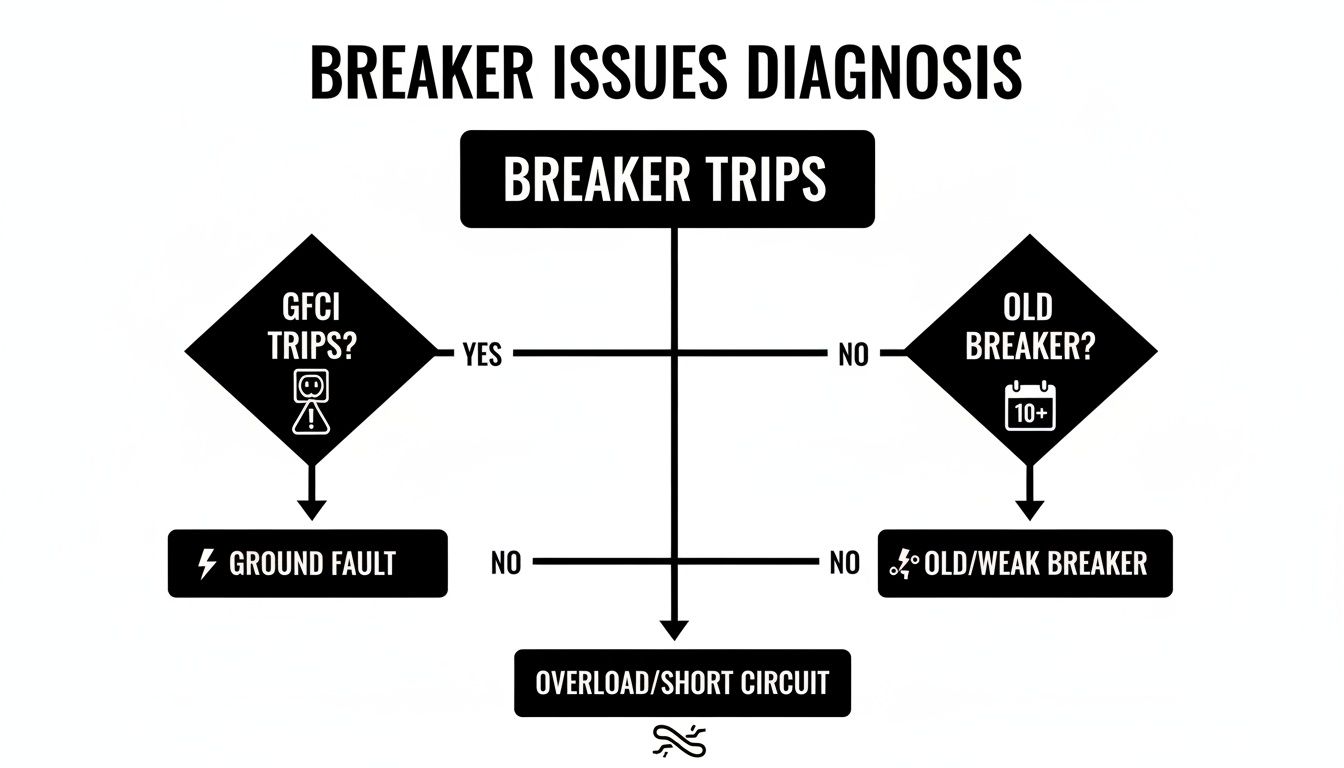
As the chart shows, these steps help you figure out if you're dealing with a simple fix—like a faulty coffee maker—or a more stubborn problem in your electrical system that needs a professional’s touch.
How to Properly Reset a Circuit Breaker
It seems simple, but there’s a right way and a wrong way to reset a breaker. A lot of people just flick the switch back to "ON," but that often doesn't work.
A breaker that has tripped will be in the middle position, not fully in the "OFF" position. You must first push it completely to "OFF" before you can successfully switch it back to "ON."
Follow these two simple steps to get it right:
- Step 1 Firmly to OFF: Find the tripped breaker (it’ll be the one that’s out of line with the others). Push the switch all the way to the "OFF" position. You should feel a solid click.
- Step 2 Back to ON: Now, push the switch firmly back to the "ON" position. It should snap into place. If it feels mushy, loose, or trips again right away, you’ve got a bigger issue on your hands.
Knowing what’s safe for you to tackle versus what needs a pro is the most important part of this whole process. For anything more complicated, getting help from a professional troubleshooting electrician is always the smartest and safest move.
Homeowner Troubleshooting Do's and Don'ts
Your safety is priority number one. Here’s a clear guide on what you should—and absolutely should not—do when a breaker keeps tripping. It’s critical to understand the line between a simple reset and a dangerous DIY project.
| Action | Safe for a Homeowner? | Critical Explanation |
|---|---|---|
| Reset a Breaker Once | Yes: Resetting a tripped breaker one time is standard procedure. It’s the first step in troubleshooting. | If it trips again immediately, that’s a persistent fault. Do not keep resetting it. This can overheat wiring and create a fire hazard. |
| Unplug Appliances | Yes: This is a perfectly safe and effective way to find out if the problem is a faulty appliance or a circuit overload. | This simple test tells you if the problem is with your stuff or your home's wiring. |
| Inspect for Scorch Marks | Yes (Visually): Looking at outlets and your panel for burn marks or discoloration from a safe distance is a smart safety check. | The presence of scorch marks means a dangerous electrical arc has occurred. Don't touch anything and call an electrician immediately. |
| Open the Electrical Panel | No: Never, ever remove the cover of your electrical panel. The components inside carry live, dangerous voltage. | This is extremely hazardous work that should only be performed by a licensed electrician with proper safety gear. |
| Replace a Circuit Breaker | No: Swapping out a breaker involves working directly with the panel's live bus bars. One wrong move can be fatal. | Leave all breaker and panel repairs to a certified professional. This is not a DIY job under any circumstances. |
At the end of the day, electrical systems demand respect. Following these guidelines will help you stay safe while diagnosing the problem.
When You Need to Call a Professional Electrician
While a little DIY troubleshooting is a great first step, some red flags are your electrical system’s way of screaming for help. These are the moments you stop, step away from the panel, and call a licensed electrician. Immediately.
Knowing the difference between a simple overloaded circuit and a serious hazard is absolutely critical for your safety. Sometimes, the answer to why does my breaker keep tripping? is a problem that’s flat-out dangerous to handle on your own.
Certain symptoms are non-negotiable signs of deeper, more dangerous issues lurking behind your walls. Think of these not as suggestions, but as urgent warnings that require an expert's eye and specialized tools to diagnose safely.
Absolute Stop Signs That Demand a Pro
If you run into any of these scenarios, it’s time to call in the professionals. Trying to fix these yourself can lead to severe electrical shock or a house fire. Your safety just isn't worth the risk.
- A Breaker That Won't Reset: You flip it back on, and it immediately snaps off again. Or maybe it won't even click into the "ON" position at all. This points to a persistent and dangerous fault, like a direct short circuit that isn't going away.
- Any Burning Smell or Smoke: A burning odor from your electrical panel or any outlet is a five-alarm fire warning. It often signals melting wire insulation or an overheating component that's right on the edge of igniting.
- Visible Scorch Marks: See any black or brown marks around your outlets, switches, or on a breaker itself? That's physical evidence of an electrical arc—a dangerous, high-heat event that has already happened.
- Frequent Tripping with a Light Load: The circuit trips when only a few low-power items are running, like an LED lamp and a phone charger. This could point to a failing breaker or a more subtle—and tricky—wiring problem.
These symptoms often point to serious dangers like a major short circuit, a ground fault, or a failing electrical panel that has compromised your home's entire electrical safety net.
The Professional Diagnostic Advantage
When our licensed electricians at Black Rhino Electric show up, we don't just guess. We use advanced diagnostic tools like circuit tracers and multimeters to safely and efficiently pinpoint the exact cause of the fault, all without tearing your walls apart unnecessarily.
A professional electrician doesn’t just fix the symptom; they diagnose and repair the underlying disease in your electrical system. This ensures a safe, permanent solution, not just a temporary patch.
We can also identify when the problem isn’t just one component but the system as a whole. Sometimes, frequent trips are a sign that your home has simply outgrown its original electrical panel. When basic troubleshooting steps are exhausted, it's crucial to know when to call a professional for complex electrical problems, as understanding how these specialized professional electrician services operate can guide your choice.
Long-Term Solutions for a Safer Home
Often, the best fix is a proactive one. If your home's electrical needs have grown—maybe with a new home office, an EV charger, or a hot tub—your existing system might not be able to keep up safely.
In these cases, we can provide lasting solutions that grow with you. To learn more about how we handle these critical upgrades, check out our guide on breakers and electrical panels. These upgrades aren't just for convenience; they are fundamental to your home's long-term safety and functionality.
Questions We Hear All the Time About Tripping Breakers
Even after you’ve tried a few things, it’s totally normal to have questions about your home’s electrical system. Honestly, who wouldn’t? Here are some straightforward answers to the questions we get asked most by homeowners trying to solve the frustrating puzzle of a misbehaving breaker.
Is an Occasionally Tripping Breaker a Serious Problem?
Not always. Let's be real—a breaker that trips once in a blue moon, especially when you know you just fired up the air fryer while the microwave was going, is just the system doing its job. Think of it as a built-in safety guard.
The real red flag is when it starts happening more often. If you’re resetting the same breaker weekly or even daily without a clear reason, that’s your home telling you there’s an underlying problem that needs a professional eye. A breaker that trips consistently is a symptom, not the problem itself.
Can a Single Bad Appliance Cause a Breaker to Trip?
Absolutely. In fact, it’s one of the most common culprits we find. A faulty appliance with a hidden short circuit or a beat-up power cord can be the sole reason for your headaches. That trusty old toaster or the coffee maker that’s seen better days could be the troublemaker.
Here’s a quick rundown of how an otherwise good appliance can turn bad:
- Internal Short: Wires inside get frayed and touch, creating a massive, instant surge of electricity that trips the breaker.
- Damaged Cord: A cord that's been pinched, chewed, or frayed can expose wires, causing a short.
- Overheating Component: A struggling motor or a failing heating element starts pulling way more power than it should, triggering an overload.
The simple unplugging test we talked about earlier is your best bet for diagnosing this. Unplug everything on that circuit, then plug things back in one at a time. If a specific device trips the breaker the second it's plugged in or turned on, you’ve found your problem. It needs to be repaired or, more likely, replaced right away.
Your breaker tripping is your home's warning system. When a single appliance is the clear cause, listen to that warning. Continuing to use a faulty device is a significant fire risk.
How Much Does It Cost to Fix a Tripping Breaker?
This really depends on what’s causing it. If the problem is a simple circuit overload, the fix is free—you just need to move a high-power appliance to a different circuit.
But if the cause is more complex, the cost will vary. Replacing a single faulty breaker is a relatively quick and inexpensive job. However, if the root issue is an outdated electrical panel that just can’t keep up with your home’s modern demands, a panel upgrade becomes a bigger but necessary investment. At Black Rhino Electric, we’re all about transparency—we provide clear, upfront pricing before we touch a single wire, so you know exactly what to expect.
Why Does My Breaker Trip When I Use My New EV Charger?
This is a big one we’re seeing more and more. High-draw equipment like an EV charger, a hot tub, or serious workshop tools can’t just be plugged into any old outlet. They need their own dedicated circuit with a breaker sized specifically for that massive, sustained power draw.
If your new EV charger keeps tripping a breaker, it was almost certainly installed on an existing circuit that’s already busy running other things. That circuit simply can't handle the load. This isn't just an annoyance; it’s a serious safety hazard that can overheat wires inside your walls and create a fire risk. This is a situation that absolutely requires a licensed electrician to install a new, correctly sized circuit directly from your panel to the charger.
Ready to Stop the Tripping for Good?
Look, a breaker that trips is doing its job—it’s your home’s built-in safety alarm. But when that alarm keeps going off, it's more than just a hassle; it’s a clear signal that something isn't right. Knowing the difference between a simple overload and a more serious short circuit gives you the power to make the right call for your family's safety.
If you’ve tried the simple fixes and the problem persists, or if you're just not comfortable poking around in your electrical panel, that’s your cue. Don’t hesitate. Your safety is the only thing that matters, and some jobs are simply meant for a pro.
For homeowners in our community, the team at Black Rhino Electric is ready to find a safe, permanent solution. Whether it's a straightforward repair, a full panel upgrade to handle modern demands, or a dedicated circuit for that new EV or hot tub, we have the tools and experience to get it done right. You shouldn't have to live with persistent electrical issues putting your home at risk.
Protect your home and family with professional electrical services from Black Rhino Electric. Call us today at 385-396-7048 or request a free quote online to get your electrical system safe, stable, and ready for whatever you plug in next.