

So, you're wondering what a whole house surge protector installation is all about and why it’s worth considering? You've come to the right place. Think of it less as an add-on and more as a dedicated security system for your home's entire electrical network, standing guard 24/7.
Contents
- 1 Your Home's Ultimate Defense Against Power Surges
- 2 Why Every Modern Home Needs Surge Protection
- 3 The Professional Installation Process Explained
- 4 DIY Installation Vs Hiring a Licensed Electrician
- 5 Let's Talk About the Cost of Whole-House Surge Protection
- 6 Your Questions About Whole House Surge Protectors, Answered
- 7 Ready to Protect Your Home? Let’s Get it Done Right.
Your Home's Ultimate Defense Against Power Surges
Honestly, most people think of power surges as these rare, dramatic events caused by lightning. While a nearby lightning strike is a huge threat, the reality is that smaller, more frequent surges are constantly hitting your home. These can come from the power grid itself when a transformer blows down the street, or even from large appliances inside your house cycling on and off.
Here’s the thing: a whole-house surge protector acts like a pressure-relief valve for your home's electricity. It’s installed directly at your main electrical panel—the single entry point for all power coming into your home.
When a sudden, dangerous voltage spike occurs, the surge protector detects it in a split second. Instead of letting that damaging electricity flood your home's wiring and fry your sensitive electronics, it safely diverts the excess voltage right into your home's grounding system. Gone.
The Key Difference from Power Strips
You know those little power strips you plug your computer or TV into? They’re helpful, but they are only the last line of defense. A point-of-use surge protector (the power strip) can only protect whatever is directly plugged into it. A whole-house surge protector provides a powerful, first layer of defense for your entire electrical system.
This includes protecting the big-ticket items that can't use a power strip:
- Your HVAC system
- Washers and dryers
- Refrigerators and dishwashers
- Smart home devices and hardwired lighting
Think of it this way: a power strip is like a bodyguard for one celebrity, while a whole house surge protector is the security team for the entire building. One protects a single asset; the other protects everything inside.
By stopping surges at the source, you're not just protecting your TV; you're safeguarding the complex network of circuit boards and electronics that makes a modern home run. This is exactly why a professional whole-house surge protector installation is one of the smartest upgrades a homeowner can make for both protection and genuine peace of mind.
Why Every Modern Home Needs Surge Protection
Let’s be honest, the number of sensitive electronics in the average home today is staggering. Smart TVs, powerful computers, connected kitchen appliances, and even EV chargers—our lives run on delicate circuitry. That’s why a whole house surge protector installation isn't just an option anymore; it’s a fundamental part of protecting your investments.
You know what? Most people immediately think of lightning when they hear "power surge." While lightning is a massive threat, it's far from the only one. The more common danger comes from smaller, frequent surges that slowly degrade your electronics over time, shortening their lifespan without you even realizing it.
Think of them as tiny, invisible shocks that gradually wear down the internal components of your expensive gear. A huge number of these damaging surges actually start right inside your home. Every time your air conditioner kicks on, your refrigerator compressor starts up, or you run a power tool in the garage, a small electrical surge gets created. On top of that, routine grid adjustments by the local power company send countless minor surges through your wiring every single year.
Beyond Lightning: The Real Surge Threats
Think of these small, internal surges as "electrical noise." They are constant, low-level disturbances that your electronics are forced to endure day in and day out. While one of these minor events won't fry your new laptop, the cumulative effect of hundreds or thousands of them absolutely will.
This slow, silent degradation is what causes electronics to fail "for no reason" a few years down the line. It's the hidden enemy that a whole-house surge protector is designed to fight. By filtering out this constant electrical static, it not only protects against major events but also helps extend the life of everything plugged into your walls.
It's not just about stopping a single catastrophic event. It's about creating a clean and stable electrical environment that allows your valuable electronics to operate safely and last longer.
The need for this kind of protection is growing, and fast. Market analysis shows the whole-house surge protector sector is projected to hit roughly USD 2,382 million by 2033. North America is leading the charge, partly because the U.S. alone sees over 20 million cloud-to-ground lightning strikes every year. Those strikes trigger devastating power surges that can destroy appliances worth thousands. You can dig into the full market analysis on power surge risks for more details.
A Layered Strategy for Complete Surge Protection
Let me explain a key concept: a layered approach provides the best possible defense. A whole-house surge protector is your first and most powerful line of defense, but it works best when paired with point-of-use protectors (think surge protector power strips).
Think of it like this: the whole-house unit at your main panel is the heavy-duty gatekeeper. It stops the big, powerful surges from the utility grid or a nearby lightning strike before they can even get inside your home's wiring. The smaller point-of-use strips then act as personal bodyguards for your most sensitive devices, like computers and home theater systems, cleaning up any smaller "noise" generated inside the house.
This combination creates a comprehensive shield. To make this clearer, let’s break down how these two types of protectors work together.
| Protection Type | Installation Location | Protects Against | Best For |
|---|---|---|---|
| Whole-House (Type 1 or 2) | Main Electrical Panel | Large, external surges from lightning, downed power lines, and utility grid switching. | Protecting the entire home, including major appliances, HVAC, and all hardwired systems. |
| Point-of-Use (Type 3) | Wall Outlets (Power Strips) | Small, internal surges from appliances cycling on/off and filtering electrical noise. | Shielding highly sensitive electronics like computers, TVs, and gaming consoles. |
Ultimately, the financial benefit is undeniable. Preventing just one major surge—or the cumulative damage from thousands of smaller ones—can save you thousands of dollars in replacement costs for everything from your refrigerator to your home office setup. When you weigh that against the one-time investment in a professional installation, the choice becomes clear. It’s about securing peace of mind and protecting the expensive technology that runs your modern life.
The Professional Installation Process Explained
So, what really goes on when a pro installs a whole-house surge protector? Let me walk you through it. This isn't just about plugging something in; it's a precise operation that integrates a vital safety device right into the heart of your home's electrical system.
You know what? Most homeowners feel a little intimidated by their main electrical panel, and for good reason. It’s the command center for every circuit in your house. At Black Rhino Electric, our licensed electricians treat it with the respect and expertise it deserves, ensuring the job is done safely and correctly from start to finish.
The process isn't a one-size-fits-all deal. Every home’s electrical setup has its own quirks. That’s why we always start with a solid assessment to make sure we pick the perfect device for your specific needs.
Step 1: Initial Assessment and Device Selection
Before a single tool comes out, we conduct a professional evaluation of your main service panel. An experienced electrician will pop the cover and examine its capacity, the condition of the wiring, how much space is available, and its overall health. We need to match the surge protector's amperage rating to your home's main breaker—usually 100, 150, or 200 amps.
This is more than just grabbing a box off the shelf. We have to consider your home's total electrical load, factoring in the big stuff like your HVAC system and any special equipment you might have, like an EV charger. This guarantees the surge protector we install provides beefy protection without getting in the way of your system's performance.
Step 2: Critical Safety Shutdown
Honestly, this is the most critical step and the number one reason this is not a DIY project. Before we even think about opening the main electrical panel, the main circuit breaker gets shut off, cutting all power to the home. This de-energizes the panel, making it safe to work on.
Working inside a live electrical panel is incredibly dangerous, carrying a huge risk of severe electrical shock or arc flash. Our team follows strict safety protocols, using proper personal protective equipment (PPE) and double-checking with a voltage tester to confirm the panel is completely dead. Safety isn't just a priority; it's a non-negotiable.
Step 3: Mounting and Wiring the Protector
Once we've confirmed the panel is safe, we physically mount the surge protector. This is typically done on the side of the panel through a knockout, which allows for a short, direct connection to the circuit breakers. The length of the wires is actually a big deal here—shorter wires mean less resistance and better, faster protection.
Next, we connect the device's wires to a dedicated two-pole circuit breaker, usually a 15- or 20-amp breaker, based on what the manufacturer specs out. These connections have to be rock-solid. A loose wire can make the protector useless and even create a fire hazard. This step demands the skill of a professional who understands breaker panel wiring and the National Electrical Code (NEC). If you're curious about the health of your main panel itself, you can learn more about our expert services for breakers and panels.
A whole-house surge protector is only as good as its connection to the ground. That grounding wire is the escape route for excess voltage. Without a solid, direct path to your home's grounding system, a power surge has nowhere to go and will just blow right past the protector.
This diagram shows how the protector acts like a gatekeeper, intercepting both external and internal surges.
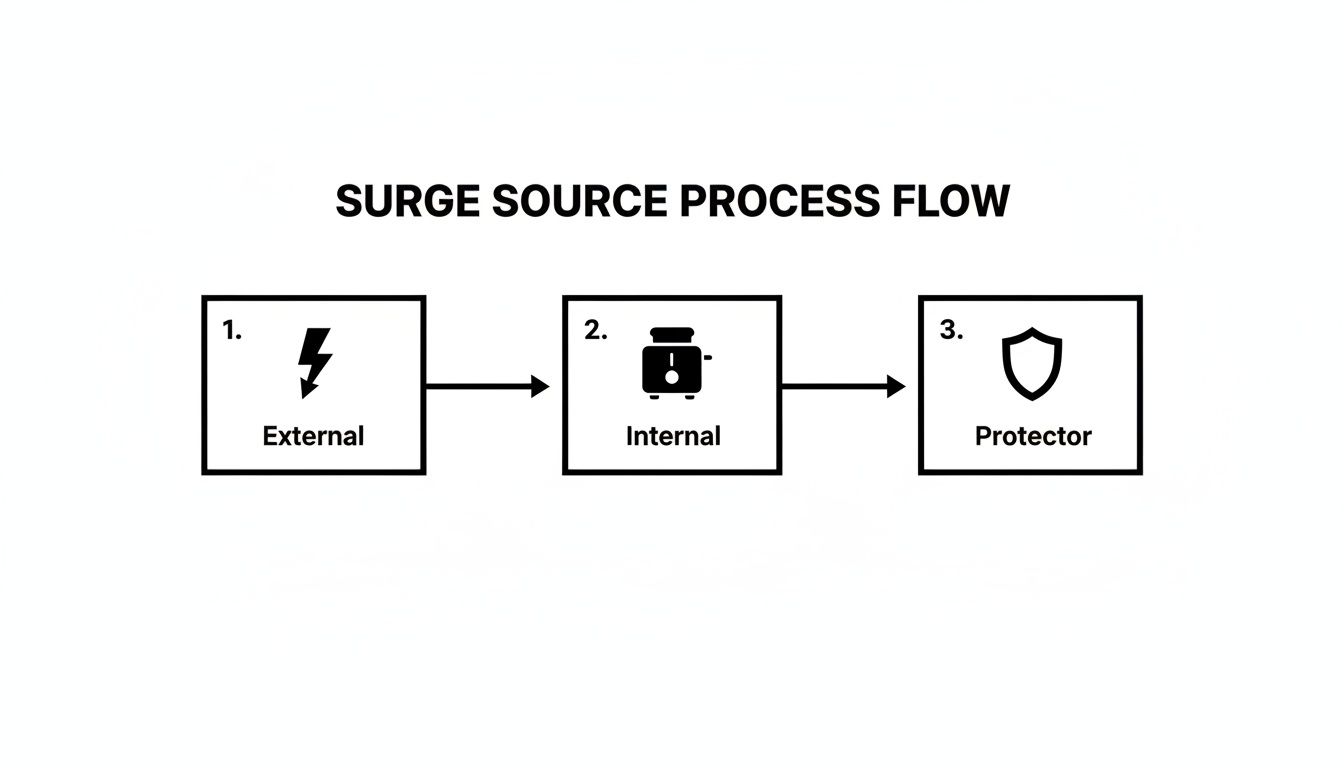
As you can see, the device sits between the threat and your home, safely steering harmful voltage away from your sensitive electronics.
Step 4: System Restoration and Final Checks
After the surge protector is securely mounted and wired, we carefully put the panel cover back on. Only then is it safe to bring the power back to your home by flipping the main breaker.
But we're not done just yet. The final step is to verify everything is working as it should. We check the indicator lights on the surge protector—a solid green light usually means it's on and ready to guard your home. We also do a quick system check to make sure power has been restored properly everywhere. This final once-over gives you total confidence that your new defense system is fully operational and on duty.
DIY Installation Vs Hiring a Licensed Electrician
When it comes to a whole house surge protector installation, it's natural to wonder, "Could I just do this myself?" It’s a tempting thought, especially if you’re handy and looking to save a few bucks. But honestly, this is one of those projects where the risks of a DIY approach far outweigh any potential savings.
Here’s the thing: your main electrical panel is the heart of your home’s power system. Working inside it without extensive training and experience is incredibly dangerous. We’re talking about a direct line to the high-voltage power coming in from the utility grid, where one slip can lead to severe injury, electrocution, or even a house fire.
Beyond the immediate physical danger, there’s the very real risk of doing the job incorrectly. A surge protector that’s improperly wired might as well not be there at all. If the connections are loose or attached to the wrong breakers, it simply can’t do its job, leaving your expensive electronics completely vulnerable when the next power spike hits.
The Hidden Risks of a DIY Installation
Let’s get real about what can go wrong. A botched installation isn't just a minor "oops." It can have serious, long-term consequences that go way beyond a malfunctioning device.
Think about your homeowner's insurance. Many policies have clauses that can void your coverage for any damage caused by unpermitted or non-professional electrical work. On top of that, the surge protector's manufacturer warranty will almost certainly be voided if it wasn't installed by a licensed electrician.
So, that money you thought you were saving could evaporate in an instant if a fire starts or a major surge wipes out your appliances and your claim gets denied. It’s a huge gamble, and you’re putting your home and financial security on the line.
The National Electrical Code (NEC) has very specific requirements for these installations. A licensed electrician ensures every connection is up to code, guaranteeing the device works as intended and your home remains safe.
The Value of Professional Expertise
Hiring a licensed professional from Black Rhino Electric transforms the installation from a risky gamble into a sound investment. We bring experience, safety, and accountability to the table. Our electricians have spent years working inside panels just like yours and know exactly how to perform a flawless installation.
We guarantee the right device is chosen for your home’s specific electrical load, that it’s wired for optimal performance, and that the crucial grounding connection is solid. This professional touch ensures your system is not only safe but also fully compliant with local and national codes.
Plus, you get the peace of mind that comes with knowing the job is backed by a licensed and insured company. When our troubleshooting electricians perform a job, we stand behind our work. If something goes wrong, you’re covered.
Risk-Benefit Analysis: DIY Vs Professional Installation
Here’s a clear breakdown of the factors to consider when you’re deciding between installing a surge protector yourself or calling in a pro.
| Consideration | DIY Approach | Professional Installation (Black Rhino Electric) |
|---|---|---|
| Safety | High risk of electrocution, arc flash, and fire due to inexperience with live panels. | Guaranteed safety with licensed electricians following strict protocols and using proper PPE. |
| Code Compliance | Likely to miss crucial NEC requirements, potentially leading to failed inspections or hazards. | Ensured compliance with all local and national electrical codes for a safe, legal installation. |
| Warranty & Insurance | Voids the device warranty and may jeopardize your homeowner’s insurance coverage. | Preserves all warranties and ensures the work is covered by our professional liability insurance. |
| Effectiveness | Incorrect wiring can render the device useless, offering a false sense of security. | Expert installation guarantees the protector functions optimally for maximum protection. |
The rise of smart homes has made this protection more critical than ever, with a web of connected devices demanding robust defense against power surges. Studies show that a professional whole house surge protector installation can reduce surge-related damages by up to 98%. For a deeper dive into market trends, discover more insights about the U.S. surge suppressor market.
Ultimately, while the appeal of DIY is understandable, the expertise, safety, and guaranteed protection offered by a professional are invaluable.
Let's Talk About the Cost of Whole-House Surge Protection
Alright, let's get right to it. The first question I usually hear is, "So, what's this actually going to cost me?" It’s a fair question. The answer isn't just a single number; it’s about weighing a smart, one-time investment against the massive cost of doing nothing.
The total price breaks down into two main parts: the surge protector device itself and the labor from a licensed electrician to install it correctly. You’re not just buying a box off the shelf; you’re paying for the expertise to wire it safely into the heart of your home’s electrical system.
Factors That Shape the Final Price
Honestly, the price tag can move around a bit based on a few key things. The brand and guts of the surge protector play a huge role, and so do its specs. A beefier device with a higher surge capacity and better warranty is naturally going to cost more than a basic model.
Here’s a quick look at what nudges the price up or down:
- Device Amperage Rating: This is its kA rating. It tells you how big of a hit the protector can take. A higher rating means more protection, which comes with a higher price.
- Brand and Warranty: Reputable brands often have better warranties and a track record of reliability. You’re paying for that peace of mind.
- Your Panel's Condition: The state of your main electrical panel can affect how long the job takes. An older, crowded, or messy panel might need a little extra time and care to work with.
- Labor Rates: The cost for a licensed and insured electrician varies, but this is the non-negotiable part that ensures the job is done right and to code.
A Smart Investment, Not Just an Expense
You know what? It’s easy to look at the upfront cost and see it as just another bill. But let me reframe that for you. Think about what’s plugged in around your house right now: computers, smart TVs, the fridge, your furnace and AC, maybe a gaming console or two.
The value of all that gear is easily over $10,000 for most families. A single, powerful surge can fry every last one of them in less than a second. That leaves you with a replacement bill that makes the cost of a surge protector look tiny in comparison.
Think of it this way: a professional surge protector installation is like a one-time insurance premium for every single electronic device in your home. You pay a small amount once to prevent a catastrophic financial loss down the road.
There's a reason the demand for this is growing so fast. Surges from the power grid, equipment failures, and lightning are a huge risk. The market for these devices is projected to jump from USD 1,974.7 million in 2025 to a whopping USD 3,500 million by 2035 as our grid faces more instability. You can learn more about surge protection device trends to see the data for yourself. For most homeowners, the ROI is clear within just one to two years through prevented damage.
When you stack that against the thousands of dollars in electronics at risk, the decision becomes pretty straightforward. It's a proactive, financially savvy move to protect the tech that runs your modern life.
Your Questions About Whole House Surge Protectors, Answered
A whole house surge protector installation is a serious upgrade to your home’s electrical safety, so it’s only natural to have questions. We get a lot of them. Here are straightforward answers to what our customers ask most often.
How Do I Know if My Surge Protector Is Working?
Honestly, this is the first thing most people wonder. The good news is, manufacturers make it simple. Most whole-house units have a status indicator light, usually a bright green LED. As long as that light is on, your system is armed and ready to protect your home.
If that light goes out, it usually means one of two things. Most often, the device did exactly what it was supposed to do—it absorbed a massive power surge and sacrificed itself to save your electronics. When that happens, its internal protective parts are used up, and the unit needs to be replaced. It's a small price to pay compared to replacing every TV, computer, and smart appliance you own.
Will It Protect Against a Direct Lightning Strike?
This is a critical question, and the honest answer is no, not completely. A direct lightning strike is a catastrophic force of nature. It releases an incredible amount of energy, and no single device can absorb that kind of raw power.
Think of it this way: your whole-house surge protector is your first and best line of defense against the most common threats, like distant lightning strikes or grid fluctuations. It’s a crucial part of a complete lightning protection strategy, but for a direct hit, you'd need a dedicated lightning rod system.
Do I Still Need My Old Power Strips?
Yes, you do. And it’s not redundant—it’s just smart. This is what we call a layered defense. The big unit at your electrical panel is the gatekeeper, stopping massive external surges from ever entering your home's wiring. It handles the heavy lifting.
But smaller surges can actually be created inside your own home when large appliances like an air conditioner or a refrigerator cycle on and off. Those smaller, point-of-use surge protector strips act as a final filter, cleaning up that internal "electrical noise" and protecting your most sensitive electronics right at the outlet.
A layered approach provides the best defense. The whole-house unit at your panel is the powerful gatekeeper, while your point-of-use strips are the personal bodyguards for your most valuable electronics.
How Long Does a Whole House Surge Protector Last?
This is a great question. A surge protector’s lifespan isn't really measured in years, but in how much energy it can absorb before it's "full." Under normal conditions, most high-quality units last five to ten years. However, if your area gets frequent storms or a major power event hits, its life can be much shorter.
Its longevity all comes down to its joule rating—that’s the total amount of energy it can take before it fails. While manufacturer warranties are a good sign of quality, they don’t cover the normal wear and tear from everyday surges. That’s why we recommend having your electrician give it a quick check during any routine service call, just to make sure those indicator lights are still shining bright.
Ready to Protect Your Home? Let’s Get it Done Right.
You’ve seen what’s at stake—from a sudden lightning strike to the slow, quiet damage caused by power shifts inside your own walls. Honestly, leaving your home’s electronics unprotected is a gamble you just don't need to take.
A whole-house surge protector isn't a luxury; it’s essential. Think about it. Your home is packed with thousands of dollars in sensitive electronics: the HVAC system, smart appliances, your home office setup, and the family entertainment center. Every single one is an investment that deserves to be shielded.
Your Local Experts in Electrical Safety
Here’s the thing: electrical work isn’t the place to cut corners. The licensed team at Black Rhino Electric has the experience to look at your home’s unique setup and install the right surge protection system for you. We handle the job safely, correctly, and make sure it’s fully up to code. That’s how you get real, lasting peace of mind.
Our job is to protect your investments and your family. We don’t just hang a device on your panel; we integrate a powerful shield right at the heart of your home’s electrical system. You can count on our crew for straight talk, professional work, and a commitment to safety you can see.
Don’t wait for a damaging power surge to make you wish you had acted sooner. Being proactive is always smarter—and a whole lot cheaper—than dealing with repairs and replacements after the fact.
Installing a whole-house surge protector is one of the wisest moves a homeowner can make. It’s a straightforward, one-time investment that stands guard 24/7, defending everything you rely on day in and day out.
Ready to secure your home? It's time to make the smart choice and protect what matters most. The team at Black Rhino Electric is ready to help. Call us today at 385-396-7048 or request a free quote online.