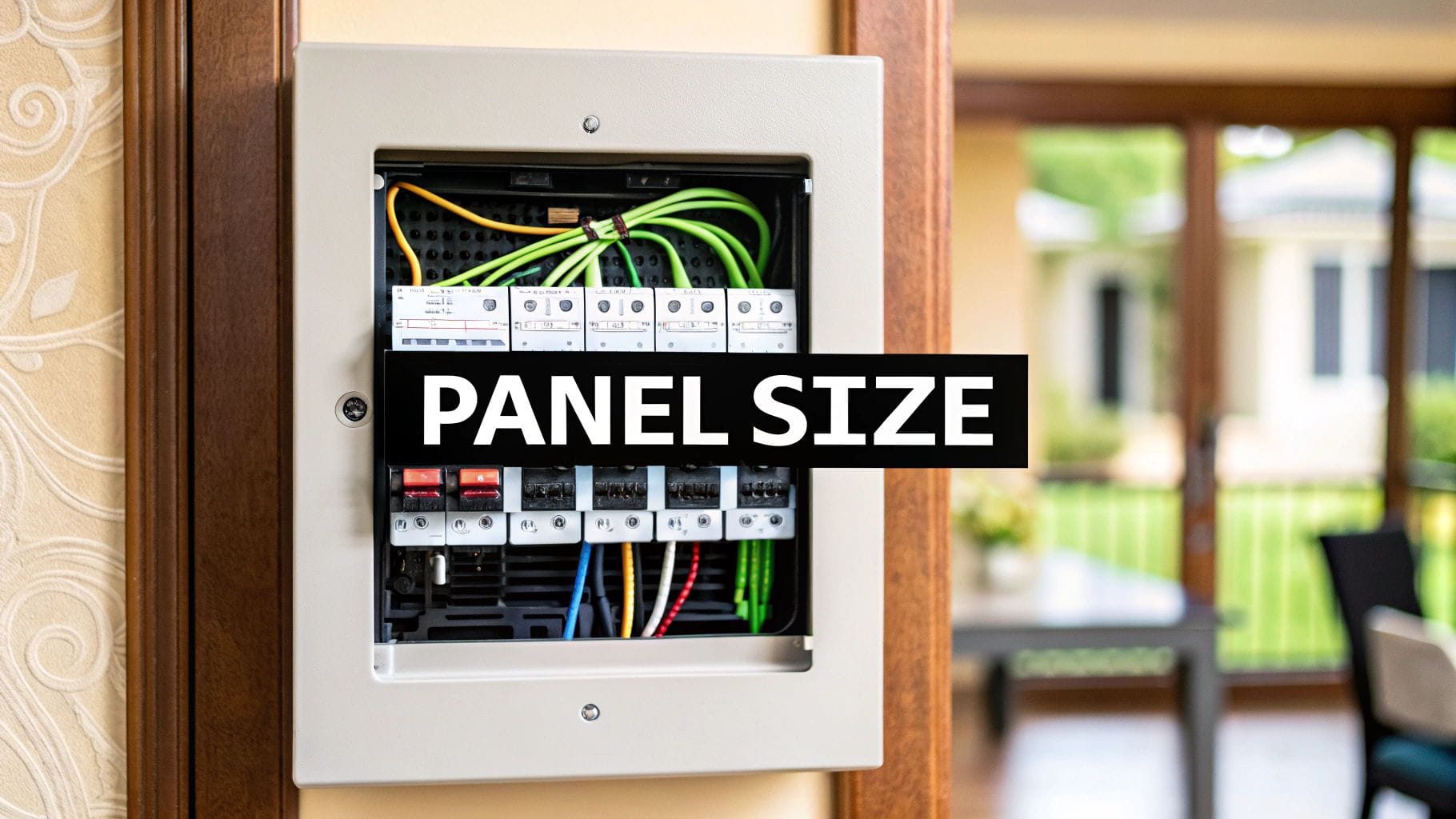
Choosing the right electrical panel is one of the most important decisions for your home's safety and functionality. So, what size electrical panel do i need to keep up with modern demands? Honestly, for most homes today, the answer is a 200-amp panel, which provides plenty of power for current appliances and future upgrades.
Contents
- 1 Choosing the Right Electrical Panel Size
- 2 Why Your Old Panel May Be Undersized
- 3 How To Estimate Your Home's Electrical Load
- 4 Understanding Common Panel Sizes
- 5 Key Signs You Need an Electrical Panel Upgrade
- 6 The Panel Upgrade Process From Start to Finish
- 7 It’s Time to Future-Proof Your Home—Professionally
Choosing the Right Electrical Panel Size
Think of your electrical panel as the heart of your home's electrical system. If it’s too small for the job, it simply can’t pump enough power to where it needs to go. This leads to frustrating issues and, honestly, some real safety risks. Choosing the right size is one of the most important decisions you can make for your home’s long-term health and usability.
Why Panel Size Matters More Than Ever
You know what? The days when a home's biggest electrical draw was the refrigerator are long gone. Today, our homes are packed with power-hungry devices that older panels were never designed to handle.
Here’s the thing, a properly sized panel is crucial for a few key reasons:
- Safety: It’s your first line of defense against dangerous overloads that can lead to electrical fires. A panel that's too small is a panel under constant stress.
- Functionality: It ensures you can run the dishwasher, the EV charger, and the air conditioner at the same time without the whole house going dark.
- Future-Readiness: It prepares your home for what’s next, whether that’s a hot tub, a kitchen remodel, or a workshop in the garage.
The reality is, a lot of older homes are running on borrowed time with outdated equipment. Did you know that a staggering 23% of U.S. single-family homes are still operating with electrical panels rated at 100 amps or less? That number jumps to over 39% for houses built before 1960. It’s a widespread issue, and as experienced electricians at Black Rhino Electric, we see it all the time right here in Northern Utah. You can learn more about these residential electrification findings to see just how common this problem really is.
Quick Reference Guide to Electrical Panel Sizes
To give you a better feel for how these sizes translate to the real world, here’s a quick-glance table breaking down the common options.
| Panel Size (Amps) | Best Suited For | Typical Capacity | Upgrade Needed For |
|---|---|---|---|
| 100A | Smaller homes (<1,500 sq ft) with gas appliances | Basic lighting, outlets, and a few major appliances | EV chargers, hot tubs, central A/C, electric ranges |
| 150A | Mid-sized homes, or those with a mix of gas and electric | A solid middle-ground for moderate electrical loads | Multiple high-demand appliances running simultaneously |
| 200A | Most modern family homes (>2,000 sq ft), new construction | Powers all-electric homes, EV chargers, and multiple systems | Very large luxury homes with extensive electrical needs |
| 400A | Large luxury homes with extensive systems or workshops | Supports multiple HVAC units, pools, and smart home systems | Standard residential homes |
This chart is a great starting point, but remember, every home is different. The best way to know for sure is to have a professional take a look.
Why Your Old Panel May Be Undersized
Honestly, you probably never gave your electrical panel a second thought until a light started flickering or a breaker kept tripping. It's easy to overlook that gray metal box in the garage. Here’s the thing, though: the electrical demands of a modern home have exploded, and that old panel might be struggling to keep up.
Relying on an outdated panel today is like trying to browse the internet with a dial-up modem—it just can't handle the speed and volume of modern life. It was built for a time when the biggest power draws were a refrigerator and a television set, not a household full of smart devices, powerful appliances, and maybe even an electric vehicle.
The Growing Demand on Your Home's Power
You know what? It’s not just one big thing; it's the accumulation of many small things that strains an older panel. The slow creep of new technology has completely changed the electrical landscape inside our homes.
What’s driving this massive increase in power consumption?
- High-Efficiency HVAC Systems: Modern air conditioners and heat pumps are far more powerful than their predecessors, often requiring dedicated high-amperage circuits.
- The Modern Kitchen: Think about it—air fryers, instant pots, high-powered blenders, and electric ranges all add up.
- Home Offices and Entertainment: Multiple computers, large-screen TVs, and sophisticated sound systems all contribute to a constant, significant electrical load.
- Major Lifestyle Additions: This is where the real strain comes in. Things like a new hot tub, a sauna, or a workshop with power tools can easily overwhelm an older system.
And the biggest game-changer of all? The electric vehicle. A Level 2 EV charger alone can draw as much power as an entire small home from the 1960s, making it a non-starter for most undersized panels.
A Tale of Two Eras in Home Electrics
Let me explain. The shift in what's considered a "standard" panel size tells a powerful story about our evolving energy needs. Homes built in the mid-20th century were perfectly fine with 60 or 100 amps. Back then, that was more than enough.
But times have changed dramatically. Imagine stepping into a home built post-1980: you're far more likely to find a robust 200-amp electrical panel, the gold standard for new constructions since the late 20th century. Historical shifts reveal this evolution—pre-1960 homes clung to 60-100 amp services for modest needs, but by the 1990s, NEC updates and rising appliance efficiencies pushed the norm to 200 amps to accommodate modern loads. You can discover more insights about these historical electrical panel standards and see how building codes adapted over time.
This is especially relevant for homeowners right here in Weber, Davis, and Salt Lake counties, where many beautiful, classic homes are being updated with the latest amenities. That charming bungalow wasn't built to handle an EV charger and an all-electric kitchen.
An undersized electrical panel isn't just an inconvenience; it's a bottleneck. It limits your ability to modernize your home and can even become a serious safety hazard if pushed beyond its designed capacity.
That's why a professional panel inspection is such a critical first step before undertaking any significant home improvement project. Before you install that hot tub or remodel the kitchen, you need to know if the heart of your electrical system can handle the new demand. Ignoring the panel is like building a beautiful new wing on a house with a crumbling foundation—it’s just asking for trouble down the road. It ensures your investment is safe, functional, and ready for the future.
How To Estimate Your Home's Electrical Load
Feeling a bit lost trying to figure out what size electrical panel you need? It’s completely normal. While a precise, official load calculation has to be done by a licensed electrician, you can absolutely get a solid estimate on your own. Let me explain how to approach this so you can have a much more informed conversation with a pro.
This process, known as a load calculation, is basically an inventory of your home's electrical demands. It's not just about what you use now, but also what you might want to add in the future.
The Basic Building Blocks of a Load Calculation
Think of this like creating a budget for your electricity. You start with the non-negotiable fixed costs (general lighting and circuits) and then add the big-ticket items (major appliances). The goal is to make sure your "income" (your panel's amperage) is comfortably higher than your "expenses" (your total electrical load).
We'll break this down into three main categories:
- General Lighting and Receptacle Load: This is a baseline calculation for all the lights and standard outlets in your home, based on its size.
- Dedicated Circuits: These are required for power-hungry areas like the kitchen and laundry room that need their own circuits to function safely.
- Major Fixed Appliances: This category includes the heavy hitters—your HVAC system, water heater, electric range, and clothes dryer.
Sizing your electrical panel isn't guesswork—it's math, rooted right in NEC Section 220. For example, a 2,000 sq ft home needs roughly 200 amps at 240V, which comes from a 3VA/sq ft general load (6kVA base) plus all those fixed appliances.
This calculation is becoming more critical as homes electrify. A recent analysis of 76 million homes showed that a stunning 23% are undersized for modern needs, especially those with panels of 100 amps or less. You can read the full technical brief on electric service sizing to see the data for yourself.
The infographic below shows exactly how an older home with a small panel can quickly get overwhelmed by today's electrical demands.
This visual shows the natural progression: a home built for a simpler time is now facing electrical demands that can easily overwhelm its original system. It's a story we see play out all the time.
Your DIY Electrical Load Calculation Worksheet
Ready to crunch some numbers? Honestly, it’s easier than it sounds. Use the table below as a worksheet. Just find the nameplate on your appliances to get their wattage (W) or volt-amp (VA) rating. If you can only find amps and volts, just multiply them together to get the VA (Amps x Volts = VA).
| Load Category | Calculation/Your Appliance Rating | Calculated Load (Watts/VA) |
|---|---|---|
| General Lighting | Home Square Feet x 3 watts/sq ft | Example: 2,000 sq ft x 3 = 6,000 W |
| Small Appliance Circuits | 2 circuits x 1,500 watts each | 3,000 W |
| Laundry Circuit | 1 circuit x 1,500 watts | 1,500 W |
| Electric Range | Enter the rating from your appliance | Example: 12,000 W |
| Electric Dryer | Enter the rating from your appliance | Example: 5,000 W |
| Water Heater | Enter the rating from your appliance | Example: 4,500 W |
| HVAC System (Largest Load) | Use either A/C or Heat Pump rating | Example: 6,000 W |
| Other Large Appliances | Dishwasher, garbage disposal, etc. | Example: 2,400 W |
| Future Additions (Crucial!) | Hot tub, EV charger, etc. | Example: 7,200 W (EV) |
| SUBTOTAL | Example: 47,100 W |
After you sum up all your loads, electricians apply demand factors from the National Electrical Code (NEC). Here's the thing: you'll never have everything running at full power all at once. The NEC allows for this, reducing the total calculated load to a more realistic number.
A simplified final step: take your total watts, apply a demand factor (for a rough estimate, you can multiply the subtotal after the first 10,000W by 40%), and then divide by 240 volts to get your required amperage. This gives you a ballpark figure to work with.
For instance, adding a new hot tub can be a major draw on your system. If you're considering one, it's wise to consult with a professional about the specific wiring requirements; our guide on what a hot tub electrician handles can provide more details on this process.
This exercise isn't meant to replace a professional assessment, but it empowers you. You'll have a much clearer picture of your home's needs and can ask smarter questions when you bring in an electrician.
Understanding Common Panel Sizes
Okay, so you have a rough idea of your home's electrical appetite. Now comes the part where we match that need to the right gear. It can feel a little confusing when you start looking at the different options, but honestly, it’s simpler than it looks. Let me walk you through the common residential panel sizes you'll see and what they’re actually built to handle in the real world.
Getting this right is a big deal. Picking an electrical panel is a long-term decision that directly impacts your home’s safety, how well it functions, and whether it’s ready for the future. The goal is to land on a size that not only covers you today but gives you a comfortable cushion for whatever you decide to plug in tomorrow.
The 100-Amp Panel: A Relic of a Simpler Time
For decades, the 100-amp electrical panel was the king of the castle. It was standard for most homes built before the 1980s, and back then, it was perfectly fine.
But in today’s world, a 100-amp panel is a real bottleneck. Think of it this way: you can typically run about three major 240-volt appliances at once—say, an electric range, a clothes dryer, and a water heater. If you try to add a central air conditioner or an EV charger into that mix, you’re just asking for tripped breakers.
A 100-amp panel might still be enough if:
- You have a smaller home, usually under 1,500 square feet.
- Your big appliances are gas-powered. If your furnace, water heater, and stove all run on natural gas, your electrical load drops way down.
- You have no plans for major electrical additions like a hot tub, a powered workshop, or an electric vehicle.
You know what? For most people looking to modernize, a 100-amp panel just holds you back. It severely limits your ability to add the kind of amenities that are quickly becoming the new normal.
The 150-Amp Panel: The Middle Ground
The 150-amp panel is a solid, practical choice that sits right in the middle. It gives you a noticeable capacity boost over a 100-amp service without the full cost and commitment of jumping all the way to 200 amps.
This size often works well for mid-sized homes, particularly those with a mix of gas and electric appliances. For instance, if your home has gas heating but you use an electric range and have central AC, a 150-amp panel can usually handle the load just fine. It offers more breathing room than a 100-amp panel, which means fewer tripped breakers when everything is running.
However, if you're thinking about big future projects—like a Level 2 EV charger or a good-sized solar panel array—you might find that even a 150-amp panel starts to feel crowded pretty fast.
The 200-Amp Panel: The New Standard for Modern Homes
Here’s the thing: the 200-amp panel has become the gold standard for new home construction, and for good reason. It provides plenty of power to comfortably run a modern, all-electric household without breaking a sweat.
With a 200-amp service, you can run your high-efficiency HVAC system, charge your EV, and operate all your kitchen appliances at the same time without worrying about overloading the system. This is the panel that truly gets your home ready for the future.
A 200-amp panel isn't just an upgrade; it's an investment in your home's capability and value. It ensures you have the electrical foundation to support modern technology and lifestyle choices for years to come.
If you’re planning any of the following, a 200-amp panel is almost always the right move:
- Building a new home.
- Doing a major kitchen or whole-home remodel.
- Installing a Level 2 EV charger.
- Adding a hot tub, sauna, or a powered workshop.
- Switching from gas to all-electric appliances.
Beyond 200 Amps: When Is a 400-Amp Panel Necessary?
For the vast majority of homeowners, a 200-amp panel is more than enough power. But for very large, high-end homes with massive electrical demands, a 400-amp service might be on the table. We’re talking about homes with multiple HVAC units, heated pools, extensive outdoor lighting, and several other high-draw features that all need to run at once. This is a specialized setup that absolutely requires a detailed professional assessment.
Don't Forget About Circuit Capacity
Finally, it’s not just about the total amps. The physical number of slots in your panel for circuit breakers is just as important. Each breaker protects a different circuit in your home. If you run out of slots, you can't add new circuits for that remodeled bathroom or new appliance without installing a subpanel or replacing the main panel itself.
When you're looking at a new panel, always make sure it has plenty of extra spaces for future projects. For a deeper dive, our team at Black Rhino Electric has a great guide on the essential roles of breakers and panels for your home’s electrical system. It’s a good resource that helps explain why both amperage and circuit space are so vital.
Key Signs You Need an Electrical Panel Upgrade
So, how do you know it’s time for a new panel? Your house usually gives you some pretty clear hints that its electrical heart is working overtime. Honestly, ignoring these signs isn't just an inconvenience—it can be a serious safety risk.
Think of these as your home's way of asking for help before a small issue turns into a big, expensive problem. They’re direct clues that your panel is overloaded, outdated, or just not up to the job anymore.
Obvious Red Flags You Shouldn't Ignore
Some signs are more urgent than others. If you’re dealing with any of these, your electrical system is under serious strain. It’s a loud-and-clear signal to have a professional figure out what size electrical panel you need now.
These are the big ones we see all the time:
- Frequently Tripping Breakers: A breaker is supposed to trip to prevent a fire. If it happens over and over, it means your circuits are constantly begging for more power than your panel can safely deliver. It’s not a faulty breaker; it’s a system pushed to its absolute limit.
- Flickering or Dimming Lights: Notice the lights dip every time the AC kicks on or you fire up the microwave? That’s a classic symptom of an overloaded circuit. The sudden power demand from a big appliance is basically stealing juice from everything else on that line for a split second.
- A Panel That Is Warm or Hot to the Touch: Go put your hand on your breaker box. It should feel cool or room temperature. If it's warm, that’s a bad sign. It means connections inside are overheating and creating a major fire hazard.
- A Persistent Burning Smell: If you get a whiff of a sharp, plasticky smell from your panel or any outlet, treat it like an emergency. That’s the smell of wire insulation melting—a step away from an electrical fire. Shut off the main breaker immediately if you can do it safely, and call an electrician. Right now.
Proactive Reasons for an Upgrade
Sometimes, the need for a new panel isn't about fixing an existing problem. It's about getting ready for the future. You might not have any flickering lights yet, but big life changes often demand a bigger electrical capacity to keep things safe and running smoothly.
Planning for a panel upgrade before you start a major project isn't just smart—it's essential. It ensures your new investment will function correctly from day one without putting your entire electrical system at risk.
You should definitely be thinking about an upgrade if you’re planning any of these:
- A Major Home Remodel or Addition: Adding a new kitchen, a second bathroom, or more square footage will dramatically increase your home's electrical appetite.
- Installing a Level 2 EV Charger: An EV charger is a huge power draw, often needing 40-60 amps all to itself on a dedicated circuit. Most older panels just don't have that kind of room.
- Switching to All-Electric Appliances: That beautiful new induction cooktop or an efficient heat pump water heater needs a lot more electrical muscle than their gas-powered cousins.
- Adding High-Demand Luxuries: Things like a hot tub, a sauna, or a workshop filled with heavy-duty power tools will almost always require you to upgrade your panel.
The Panel Upgrade Process From Start to Finish
Thinking about a major electrical project like a panel upgrade can feel a little overwhelming. I get it. You're probably wondering, "How long will the power be out?" or "What's this actually going to involve?" Honestly, that’s completely normal. But when you know what to expect, the whole thing feels a lot more manageable.
Let me explain. At Black Rhino Electric, we’ve dialed in this process to be as smooth and clear as possible. Our goal is simple: minimize the disruption to your life while making sure the job is done safely and correctly, from the first call to the final inspection.
Your Upgrade Journey Step-by-Step
A professional panel upgrade is a well-coordinated dance. There are no shortcuts when it comes to the safety of your home's electrical system. From our initial chat to the moment we flip the switch on your powerful new system, every step is handled with precision.
Here’s a breakdown of what that journey typically looks like with our team:
- Initial Consultation & Load Calculation: It all starts with a conversation. We’ll visit your home, talk about your current and future electrical needs, and run a detailed load calculation to figure out exactly what size electrical panel you need. This isn't a guess; it's a data-driven assessment.
- Transparent Quoting: Once we have the full picture, we give you a clear, detailed quote. You’ll see all the costs right upfront—no surprises, no hidden fees. We believe in total transparency.
- Permitting & Coordination: We handle all the necessary paperwork, securing permits from your local municipality. We also coordinate directly with the utility company (like Rocky Mountain Power) to schedule the brief power shutoff needed for the swap.
- The Installation Day: On the scheduled day, our licensed electricians show up to do the physical installation. This is where our expertise really shines as we safely disconnect the old panel and install your new, higher-capacity one.
- Final Inspection: After our work is done, a city or county inspector will visit to verify the installation meets all National Electrical Code (NEC) and local standards. That final sign-off is your guarantee of a safe, compliant job.
Answering Your Biggest Question
You know what? The number one question we get is, "How long will my power be out?" It's a great question, and the answer is usually much shorter than people expect.
For a standard residential panel upgrade, the power is typically off for only 4 to 8 hours. We schedule the utility disconnect for the morning, and our team works efficiently to get your home powered back up by the afternoon.
We understand that being without power is a major hassle. That's why we meticulously plan every detail to make the downtime as brief and predictable as possible. We communicate with you every step of the way, so you're never left in the dark—figuratively, anyway. The whole process is designed for your peace of mind.
It’s Time to Future-Proof Your Home—Professionally
You’ve got the basics down: why the right panel size matters, a rough idea of your home’s needs, and what goes into an upgrade. But when it comes to the heart of your home’s electrical system, this isn't a weekend DIY project. Honestly, the risks are just too high.
Figuring out what size electrical panel do i need is the first step, but the installation is where safety and code compliance become non-negotiable. This is especially true as more homeowners in Utah look ahead. For example, getting your garage ready for an electric vehicle requires careful planning, which we talk about in our guide to EV charger installation by an electrician. A professional install makes sure it's done right the first time.
Trust Your Local Experts
At Black Rhino Electric, we help homeowners across Northern Utah—from Marriott-Slaterville to the surrounding Weber, Davis, and Salt Lake counties—make smart, safe electrical decisions every day. Our licensed electricians provide precise load calculations and install high-quality panels that meet all local codes, giving you a robust system built to last.
We’ve built our reputation on trust, straight talk, and clean, solid workmanship. We treat your home’s electrical system with the seriousness it deserves, ensuring every connection is secure and every installation is flawless.
Don't guess when it comes to your home's future and your family's safety. A professional installation is the only way to guarantee your panel can handle today's demands and tomorrow's innovations without missing a beat.
Let us provide the reliable, code-compliant solution your family deserves. We'll make sure your home is not just powered, but protected for years to come.
Ready to secure your home's electrical future? The team at Black Rhino Electric is here to provide a professional assessment and a seamless upgrade. For a reliable solution you can trust, call us today at 385-396-7048 or request a free quote online.