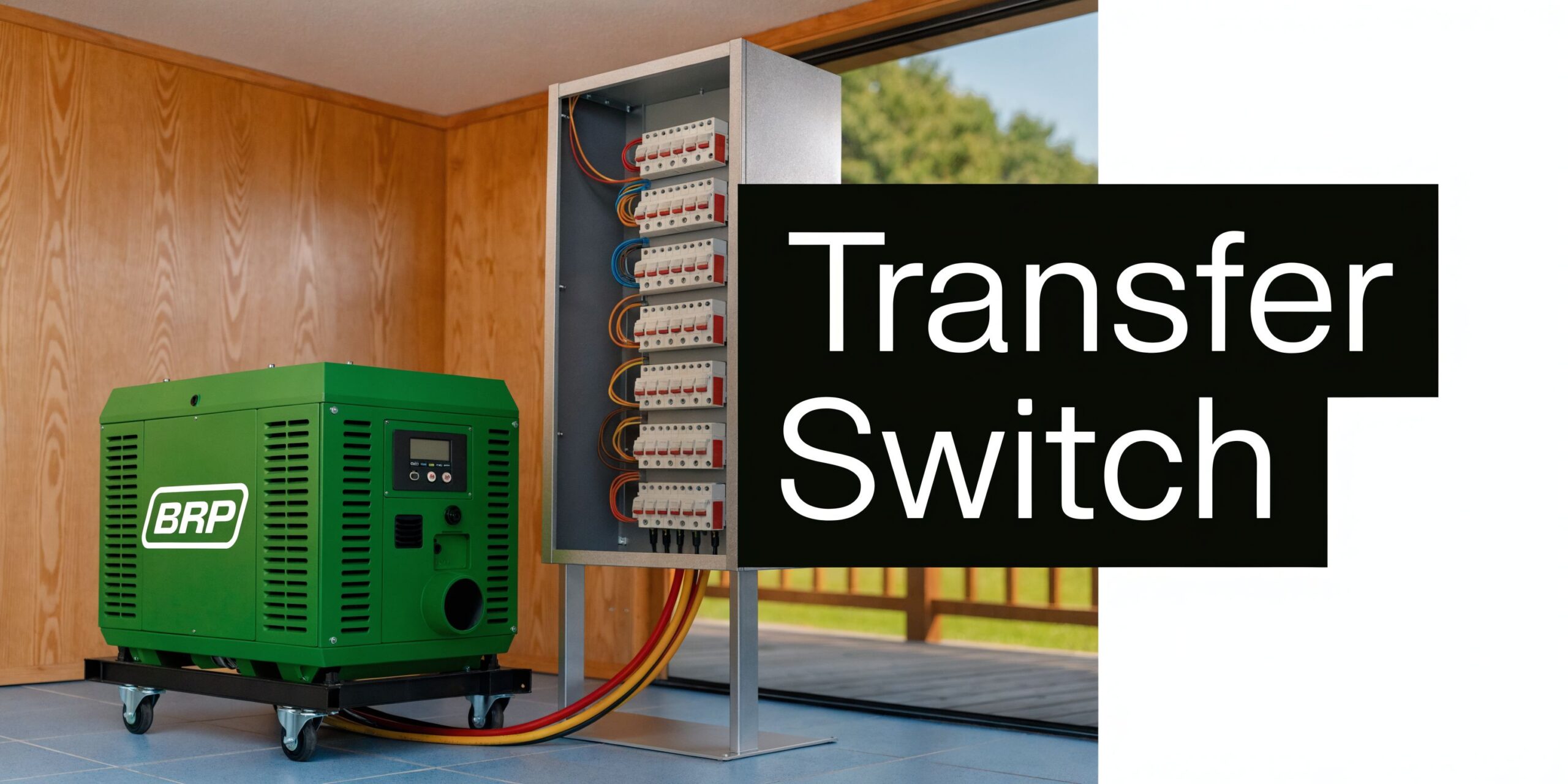
When the power drops on a cold Northern Utah night, most homeowners want one thing. Heat, lights, and a fridge that stays running. What is a transfer switch for generators? It is the device that makes backup power safe, practical, and code-compliant instead of risky and improvised.
Contents
- 1 The Unseen Hero of Your Backup Power System
- 2 Manual Automatic or Interlock Your Three Main Choices
- 3 How to Size a Transfer Switch for Your Home and Generator
- 4 Navigating Safety Codes and Northern Utah Requirements
- 5 Understanding Installation Costs and Process
- 6 Clear Signs Your Home Needs a Transfer Switch
- 7 Get Safe Backup Power Before the Next Outage
The Unseen Hero of Your Backup Power System
A transfer switch is the control point between utility power and generator power. It lets your home use one source at a time, and that is a critical distinction.
Imagine a traffic cop at a busy intersection. Utility power comes from one direction. Generator power comes from another. The transfer switch decides which one gets through and blocks the other, so electricity does not collide inside your electrical system.

Why this device matters so much
Without a transfer switch, homeowners often fall back on extension cords. That may seem simple, but it creates problems fast.
- You limit what you can power: Hard-wired loads like many furnaces, well pumps, and some lighting circuits are not practical to run that way.
- You create trip and fire hazards: Cords through doors, garages, and living spaces turn into a mess during an already stressful outage.
- You lose control of the load: It becomes much easier to overload the generator when appliances get plugged in without a plan.
The bigger danger is backfeeding. That happens when generator power flows the wrong direction into the utility side of the system. A properly installed transfer switch isolates your home from the grid, which helps protect utility workers and also protects your generator and home wiring when utility power comes back.
Practical takeaway: A generator is only half the backup power system. The transfer switch is the safety device that makes the generator usable with your home's wiring.
What it does during an outage
In normal conditions, your panel receives utility power. During an outage, the transfer switch changes the source so selected circuits, or in some cases the whole service, can be powered by the generator instead.
That is why electricians often call it the “brains” of the setup. The generator makes power. The transfer switch decides where that power can safely go.
For readers comparing system types in more detail, this overview of Automatic Transfer Switch (ATS) Systems gives useful background on how automatic models monitor and transfer power.
Manual Automatic or Interlock Your Three Main Choices
Once homeowners understand they need safe source switching, the next question is which approach fits their house, budget, and outage habits.
The three common paths are manual transfer switches, automatic transfer switches, and interlock kits. All can be code-compliant when properly selected and installed. They do not deliver the same experience.

Manual transfer switches
A manual transfer switch, often called an MTS, is the workhorse option for many homes. You start the generator, then physically move the selected circuits from utility power to generator power.
That sounds less glamorous than an automatic setup, but it works well for a lot of Northern Utah homes with occasional outages.
Manual switches also carry a cost advantage. The verified data for this topic notes that MTS setups can save 60 to 70% upfront compared with ATS options, and that a FEMA resilience study found manual transfer switches were twice as reliable in dusty environments, with 95% uptime versus a 12% sensor failure rate for some ATS models in those conditions (Honda Power Equipment).
Good fit for:
- Budget-conscious homeowners: You get safe power transfer without paying for automation.
- Portable generator owners: Especially if you want to run essentials only.
- People who are usually home during outages: You do need to operate it.
Less ideal for:
- Homes that sit empty during winter storms
- Anyone who wants backup power to kick in without going outside
Automatic transfer switches
An automatic transfer switch, or ATS, monitors incoming utility power and transfers the load without a person standing there flipping anything.
That convenience is the big selling point. If the power goes out while you are asleep or away, the system responds on its own. For homes with critical loads, that can be worth it.
The verified data also gives useful detail on how ATS controls work. Automatic switches can include programmable time delays such as 0 to 6 seconds for transfer delay with a factory setting of 3 seconds, plus voltage and frequency lockouts that help prevent premature connection to unstable generator output (University of Maryland transfer switch specification).
For a homeowner, that means the switch is not just “automatic.” It is making decisions about when power is stable enough to transfer.
Interlock kits
An interlock kit is different from a dedicated transfer switch cabinet. It is a mechanical device installed at the panel that prevents the main breaker and the generator breaker from being on at the same time.
Used correctly, it can be a practical option for portable generators. It is usually the most affordable hardware path, but it demands disciplined operation and a panel that is compatible with the kit.
Interlocks can make sense when:
- You already have a suitable main panel
- You want a simpler setup for a portable generator
- You are comfortable managing loads manually at the panel
They are not a shortcut around proper installation. The panel, breaker arrangement, inlet, labeling, and load planning still have to be done correctly.
Manual vs automatic transfer switch at a glance
| Feature | Manual Transfer Switch MTS | Automatic Transfer Switch ATS |
|---|---|---|
| Operation | You start generator and switch circuits manually | System detects outage and transfers automatically |
| Upfront cost | Lower | Higher |
| Best use case | Occasional outages, essential circuits, portable generators | Frequent outages, unattended operation, critical loads |
| User involvement | Hands-on | Minimal |
| Dust-prone environments | Verified source cited earlier reports stronger reliability performance | More convenience, but sensors and controls add complexity |
Field perspective: In Northern Utah, the “best” option usually depends less on marketing language and more on whether you want hands-free convenience or straightforward reliability with fewer parts involved.
How to Size a Transfer Switch for Your Home and Generator
A good transfer switch setup starts on paper, not at the supply house. In Northern Utah, I size these systems around what the generator can carry during a January outage, not around a wish list of every circuit in the house.
Sizing comes down to three checks. Generator output. The loads you plan to run. The limits of the panel the switch will tie into.

Start with the loads that matter in a Utah outage
For homes in Weber, Davis, and Salt Lake counties, the first question is usually heat. If the furnace blower will not run, the house gets cold fast. After that, I usually look at refrigeration, a few lighting circuits, garage door access, internet equipment, and well or sump equipment if the property has it.
That list is different from full-house comfort. It is the list that keeps the home safe and usable.
Here is the practical way to size it:
| Backup goal | Common switch approach | Typical loads |
|---|---|---|
| Selected outage circuits | Smaller manual transfer setup | Furnace, refrigerator, freezer, lights, garage circuit, kitchen receptacles |
| Larger portable generator plan | Higher-capacity manual setup or properly matched interlock arrangement | More branch circuits, sometimes a 240-volt load if generator output supports it |
| Whole-house standby | Service-rated transfer equipment sized to the home service and generator | Broader home coverage, still limited by generator capacity and load management settings |
Match the switch to real generator capacity
A transfer switch cannot create power. It only transfers available power safely to the circuits you selected.
That is why oversizing the switch does not solve an undersized generator. A homeowner may have a portable unit with a 30-amp receptacle, but if they expect it to run electric resistance heat, a water heater, kitchen appliances, and the dryer at the same time, the plan falls apart the first time those loads stack up. Motor starting current matters too. Furnaces, well pumps, and refrigerators can hit harder at startup than their running wattage suggests.
For portable generators, the cleaner approach is usually to pick a short list of priority circuits and leave the heavy electric loads off the backup plan. If you want to use a generator safely during outages, load discipline matters just as much as the hardware.
Common sizing mistakes I see in the field
Homeowners usually run into trouble in one of four places:
- Counting running watts but ignoring startup loads
- Trying to back up large 240-volt appliances without enough generator capacity
- Choosing circuits before checking panel space and breaker layout
- Buying a generator first, then finding out the panel is a poor fit for the intended setup
Older homes along the Wasatch Front can complicate this. Some have crowded panels, tandem breakers, limited working space, or service equipment that really should be replaced before adding generator equipment. If you are already evaluating panel capacity or service condition, review your options for breaker and panel upgrades before you lock in the transfer switch size.
A practical sizing rule
Size the transfer equipment to the generator connection and the way the house will be used during an outage. Then choose the circuits in order of safety, heat, food storage, water, and basic livability.
That approach usually gives homeowners in Northern Utah a backup system they can afford, operate, and trust when the weather turns bad.
Code compliance is where a lot of generic online advice falls apart. The switch may look simple on paper, but inspections in Weber, Davis, and Salt Lake counties often turn on details that homeowners never see.
Older homes are a common example. An outdated panel, limited breaker space, or questionable grounding can turn a “quick generator hookup” into a more involved correction.
Local code issues that commonly trip up installations
For Northern Utah, one of the biggest missed details is recent code changes. Verified guidance for this topic states that NEC updates effective in 2024 require specific grounding and AFCI integration for generators over 5,000 watts, and that these issues are a leading cause of permit denials in Weber and Davis counties (W Power Products).
That matters because many portable generators used by homeowners cross that threshold. If someone buys a generator first and thinks about code later, the installation can stall at inspection.
A few local trouble spots show up repeatedly:
- Older service equipment: Retrofit work gets harder when the panel was not designed with modern generator integration in mind.
- Grounding details: Grounding is not a paperwork issue. Inspectors look closely at how the system is bonded and connected.
- AFCI coordination: For qualifying generator systems, this can no longer be treated as an afterthought.
- Weather exposure: Exterior inlet boxes and outdoor equipment must be installed for local conditions, not just convenience.
Why local knowledge matters
A lot of internet advice treats code like it is the same everywhere. It is not. Northern Utah installations have to satisfy the NEC as adopted and amended locally, plus the expectations of the inspector reviewing that specific job.
For homeowners, that means the right electrician does more than mount a switch and pull wire. They check the panel, service rating, grounding path, breaker compatibility, load plan, labeling, and permit requirements before installation day gets expensive.
For broader household safety during outages, this guide on how to use a generator safely during outages is a useful companion to the electrical side of the project.
The safest mindset
The safest approach is simple. Treat generator integration as service equipment work, not as an accessory add-on.
Expert advice: If a proposal skips permitting, grounding review, or panel evaluation, that is not a shortcut. It is a warning sign.
Understanding Installation Costs and Process
In Northern Utah, transfer switch pricing usually swings less on the switch itself and more on what your electrical system lets us do cleanly on day one. A newer panel with open breaker space is straightforward. An older crowded panel in Weber, Davis, or Salt Lake County can turn a simple install into panel rework, breaker changes, permit coordination, and more labor.
Manual transfer switches usually cost less than automatic systems because the equipment is simpler and the wiring scope is smaller. Interlock-based setups can also save money in the right panel, but only if the panel model supports a listed kit and the load plan makes sense. I tell homeowners to budget for the whole job, not just the box on the wall.
What changes the final price
A few job conditions drive the number up or down:
- Panel condition and space: Tight wiring, obsolete breakers, corrosion, or no room for added circuits slows the work.
- Type of transfer equipment: Manual switches, automatic switches, and interlocks all install differently and carry different equipment costs.
- How many circuits you want backed up: A short list for furnace, fridge, sump, and a few lights is faster than a highly customized circuit layout.
- Generator setup: A portable generator with an exterior inlet is one process. A standby unit with utility coordination and automatic controls is a bigger project.
- Permit and inspection requirements: Local approval is part of the true cost, and skipping it is a bad gamble.
If a contractor gives a price without asking for panel photos, generator specs, and a list of loads you want to run, that quote is probably missing something.
What installation day usually involves
Most properly planned jobs are completed in a day, but the prep work matters. Before any wire gets pulled, the electrician should confirm the panel layout, verify breaker compatibility, and match the transfer equipment to the generator inlet and cord configuration.
Then the physical work starts. That usually means mounting the transfer equipment near the service panel, installing the inlet box in a location that makes sense for snow, ice, and generator exhaust, pulling conductors, and terminating each selected circuit correctly. In Northern Utah, exterior placement matters more than many online guides admit. A convenient inlet location that ends up buried by drifting snow is not a good design.
The last part is testing and labeling. Utility power has to be isolated correctly. The selected circuits need to transfer the way they were designed to. The panel and transfer equipment also need clear markings so nobody is guessing during a winter outage at 6 a.m.
Where projects get more expensive than expected
The surprise costs usually come from problems already sitting in the panel. Double-tapped breakers, messy circuit identification, failed breakers, or a service that was modified over the years without a clear load plan all add time. In those cases, it often makes sense to have a residential troubleshooting electrician inspect the existing system first so the generator install does not stall halfway through.
The best way to keep cost under control is simple. Decide what must stay on, confirm your generator can carry those loads, and have the panel evaluated before installation day. That avoids paying for a bigger setup than your house or generator really needs.
Clear Signs Your Home Needs a Transfer Switch
Some upgrades are optional extras. A transfer switch usually stops feeling optional the first time an outage exposes how awkward your current setup really is.
If you own a generator but still run cords through a cracked-open garage door or window, that is a sign. If your backup plan depends on moving lamps, unplugging appliances, and hoping nobody trips a breaker, that is another one.

Common real-world indicators
- Your generator has no clean way to feed home circuits: Owning the machine is not the same as having a usable backup system.
- You worry about heat or water during outages: Furnace circuits, well pumps, and similar loads are exactly why many homeowners install transfer equipment.
- You are tired of extension cord chaos: That temporary setup gets old fast, especially in bad weather.
- You want a more dependable outage routine: Less scrambling, fewer decisions, safer operation.
For some homes, frequent nuisance trips, panel quirks, or outage-related power issues also point to a need for a broader electrical review. If that sounds familiar, a troubleshooting electrician can often identify the bigger picture before a generator project starts. This page on electrical troubleshooting is a useful starting point.
The comfort factor matters too
A transfer switch is not just about convenience. It lets your home function more normally when conditions outside are not normal.
That means less stress, less improvising, and a much safer way to keep the essentials running.
Get Safe Backup Power Before the Next Outage
A generator becomes far more useful when it is connected to your home the right way. The transfer switch is the piece that turns backup power from a workaround into a safe system.
For homeowners in Weber, Davis, and Salt Lake counties, local code requirements, panel condition, and generator sizing all matter. A proper installation should be planned around your house, your loads, and the way outages affect your family.
If you are weighing options, it helps to talk with a licensed electrician before you buy hardware you may not need. A good site review can tell you whether a manual switch, ATS, or interlock makes the most sense, and whether your existing panel is ready for it. You can also start the process through this request quote page.
When you are ready for a safe, code-compliant backup power setup, Black Rhino Electric can help you choose the right solution for your home. Call 385-396-7048 or request a free quote to get started.