A winter outage in Ogden or Layton can turn a portable generator from a useful appliance into a serious electrical hazard if it isn't connected correctly. The central decision, generator interlock vs transfer switch, comes down to more than purchase price. Panel compatibility, load management, neutral bonding, local permitting, and how much responsibility the homeowner wants during an outage all matter.
Why Backup Power Choices Matter in Northern Utah
A storm moves through Weber County, the power drops, and a homeowner starts thinking about the furnace, refrigerator, lights, internet equipment, or a sump pump. A portable generator may be available, but plugging it into a household receptacle or improvising a connection can send power in the wrong direction. A proper interlock or transfer switch is the equipment that keeps utility and generator sources from operating together when installed correctly.
Both options can provide a code-compliant path for connecting a portable generator to a home. They don't manage the system in the same way, though. An interlock works with the existing main panel and gives access to selected branch circuits, while a transfer switch creates dedicated control over the circuits chosen during installation. The difference affects convenience, overload risk, neutral handling, and the amount of judgment required in the dark.
A homeowner in Ogden, South Ogden, Roy, Layton, or Clearfield can use a Northern Utah electrician to review the panel before buying equipment. That review matters especially in older homes, where panel design, available breaker space, previous alterations, and grounding arrangements may not match modern assumptions.
How Generator Interlocks and Transfer Switches Work
The interlock approach
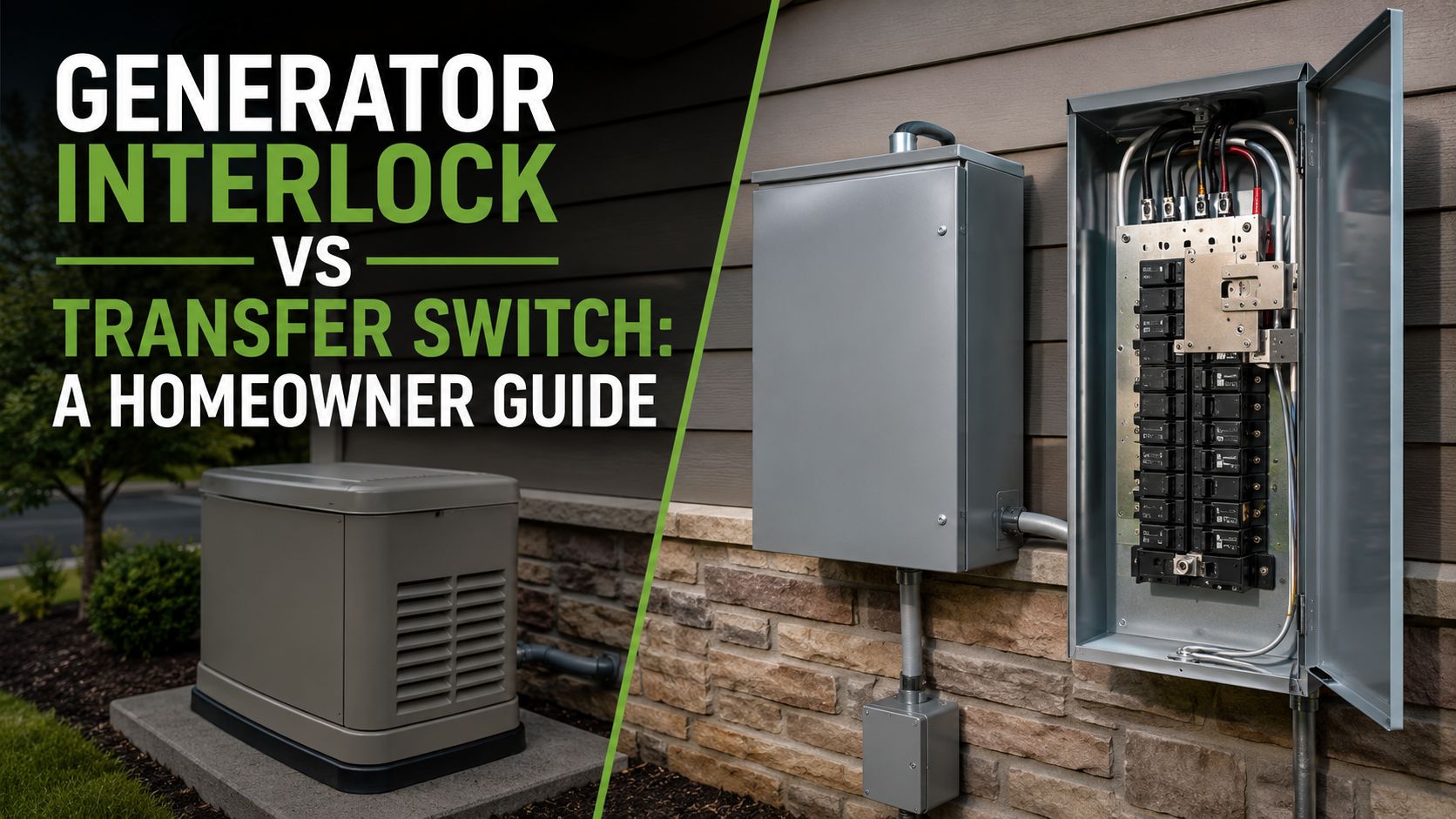
A generator interlock kit is a mechanical device mounted to a compatible breaker panel. Its sliding plate blocks the utility main breaker and the generator backfeed breaker so they can't both be on at the same time. The operating sequence requires the main breaker to be off before the plate allows the generator breaker to be turned on. That physical barrier is the anti-paralleling mechanism described in this explanation of generator interlock operation.
A simple water-system analogy helps. The interlock is like a valve guard that lets the operator close the city-water valve before opening the generator valve. It doesn't decide which faucets the household uses after the generator is connected. The homeowner still has to turn off unnecessary branch circuits and avoid combining loads that exceed the generator's capability.
The transfer-switch approach
A manual transfer switch acts more like a small, dedicated breaker panel. It receives utility or generator power and supplies only the preselected circuits connected to it. Many transfer switches use break-before-make switching, meaning one source is disconnected before the other source is connected.
An automatic transfer switch adds detection and switching equipment for standby systems. It can transfer the selected or managed load without requiring the homeowner to operate the panel manually. That convenience can matter when the property is vacant or when a household member shouldn't be expected to manage breaker changes during an outage.
The practical difference is simple. An interlock protects source isolation mechanically at the main panel, then leaves load decisions to the homeowner. A transfer switch enforces isolation through dedicated switching and limits the connected circuits. Homeowners researching safe backup power with a transfer switch can also use a general electrical help centre when organizing unfamiliar technical information, but equipment selection and installation still require a panel-specific electrical assessment.
Comparing Cost, Flexibility, and Code Standards
Interlocks became a lower-cost alternative to transfer switches in the early 2000s. Generator InterLock Technologies launched its interlock product line in 2005, and its product history reports approval for panels listed to UL 67 standards by 2009, after about a year of changes and modifications. The same history records more than 40 standard kits designed for nearly every panel sold in the United States over the prior 30 years. The documented product history shows how panel-specific interlocks developed beyond a niche workaround.
Interlock hardware typically costs about $50 to $150, with labor commonly adding $400 to $800. A transfer switch functions as a miniature breaker panel for preselected circuits, while an interlock uses a metal bracket to prevent the main and generator breakers from operating together. That cost and equipment comparison helps explain why homeowners often choose an interlock when they want backup access without reorganizing the entire panel.
| Factor | Generator Interlock Kit | Transfer Switch |
|---|---|---|
| Hardware cost | About $50 to $150 for the kit | About $300 to $1,000+, depending on amperage and whether the switch is manual or automatic |
| Labor | About $400 to $800 | About $800 to $1,500+ for a typical installation, depending on wiring, circuit selection, and equipment |
| Circuit flexibility | Existing branch circuits can be energized selectively | Dedicated circuits are selected and wired in advance |
| Equipment evaluation | Commonly treated as a panelboard accessory evaluated with the panel under UL 67 | Manual and automatic transfer switches are typically evaluated under UL 1008, as explained by this equipment-standard guide |
| Installation complexity | Depends heavily on exact panel compatibility | Requires transfer equipment, circuit planning, wiring, and source-specific checks |
| Automation | Manual operation | Manual or automatic, depending on the switch type |
The lower purchase price does not make an interlock universal. The kit must match the exact panelboard, breaker arrangement, cover, and listing. Older Northern Utah homes often have obsolete panels, crowded interiors, or breaker configurations that limit compatibility. A transfer switch is a separate device with its own evaluation, but it still must match the generator, service, selected circuits, and installation method.
Ask the electrician to verify panel compatibility, neutral configuration, permit requirements, and the generator's connection method before buying hardware. For homeowners reviewing how to install a transfer switch, the installation method matters as much as the equipment price. A cheaper interlock can become the wrong choice if the panel cannot accept it or if the generator and neutral arrangement require switched-source equipment.
Load Management and Neutral Bonding Pitfalls
The most overlooked interlock problem isn't the sliding plate. It's what happens after the generator breaker is on. An interlock can make many existing branch circuits available, which is flexible, but that flexibility means the homeowner must control the load. A furnace, well pump, heat pump, hot tub, electric water heater, or EV charger can create a demanding combination, especially when motors start and temporarily draw more power than their running load.
A transfer switch moves much of that decision into the installation. The electrician selects circuits, routes them through the switch, and can plan the connected load around the generator and its outlet rating. An interlock can work well when the household understands which circuits to use, which to leave off, and how to stagger demanding equipment. It works poorly when every breaker remains on because power is available.
Practical rule: Whole-panel access doesn't mean whole-panel capacity. The generator still limits what can run at the same time.
The second issue is the neutral-to-ground relationship. An interlock is generally suited to an arrangement with a non-switched neutral, where the main panel remains the bonding point. A transfer switch may be the safer or required arrangement for a separately derived system, a bonded-neutral generator, or a GFCI-equipped portable unit when the switching configuration needs to isolate the neutral. This neutral and grounding discussion explains why the generator's bonding arrangement must be identified before selecting equipment.
What the electrician needs to verify
A professional checks the generator's neutral configuration, the transfer equipment's pole arrangement, grounding connections, and the panel's existing neutral and grounding conductors. Incorrect bonding can create objectionable current paths, nuisance tripping, or shock hazards. Homeowners shouldn't remove a generator bond, add a grounding connection, or alter panel conductors based on a generic diagram.
New electrical loads can change the decision as well. A future EV installation, hot tub, or heating upgrade deserves review through an EV charger load calculation Utah service conversation before backup equipment is chosen. The right solution must account for the loads that exist now and the loads the panel may need to support later.
Real-World Use Cases for Northern Utah Homes
An older home in Weber County may have a 100-amp service, limited panel space, and a portable generator intended for essentials rather than full-house operation. If the panel is compatible and the neutral arrangement is appropriate, an interlock can provide a cost-conscious way to reach selected existing circuits. The homeowner still needs a written outage plan, clearly identified priority circuits, and discipline around high-demand equipment.
A newer Davis County home with a 200-amp service may have more electrical capacity but also more competing loads. Heat pumps, electric cooking equipment, EV charging, hot tubs, and finished-basement circuits can make an interlock's broad access difficult to manage. A manual transfer switch can limit the outage supply to circuits selected for heating, refrigeration, lighting, communications, or other essential functions.
Manual transfer switch sizing follows the generator outlet rating and intended load. A published sizing guide states that a generator with a 30-amp outlet needs a 30-amp manual transfer switch, while a generator with a 50-amp outlet needs a 50-amp switch. Whole-house automatic transfer switches are commonly 100 to 200 amps and must match the home's main service capacity, according to this manual transfer switch sizing guide.
Winter and summer priorities aren't identical. Winter outages may make furnace controls, circulation equipment, and freeze protection important, while summer outages can shift attention toward cooling equipment and refrigeration. Households comparing generators, batteries, and other equipment can also find affordable home backup solutions, but the electrical connection still needs to match the home's service and the selected backup source.
For a property owner who wants automatic operation during an extended outage, an automatic transfer switch is the more appropriate direction. It adds system complexity, but it reduces dependence on someone being present to start equipment, operate breakers, and monitor loads.
What Happens During a Professional Installation
A service visit starts with the panel, not the kit box. The electrician identifies the panel manufacturer and model, checks the breaker arrangement, confirms available space, reviews service capacity, and looks for signs of overheating, loose terminations, corrosion, obsolete equipment, or previous alterations. In an older Marriott-Slaterville, Ogden, or Layton home, those conditions can determine whether an interlock is appropriate or whether panel work should happen first.
The electrician also confirms generator output, outlet configuration, conductor requirements, breaker sizing, inlet location, grounding, neutral bonding, and the circuits the homeowner wants to support. An interlock must be listed or approved for the exact panelboard combination, because it functions as a panel accessory evaluated with the panel under UL 67. A manual or automatic transfer switch is typically evaluated under UL 1008, but it still must be installed as part of a compatible system.
The work homeowners can observe
Homeowners can safely identify the generator model, outlet rating, panel location, desired essential circuits, and any loads added since the panel was installed. They can also note whether the generator has a manufacturer-provided neutral-bonding configuration and share installation documents with the electrician.
The electrical work itself isn't a homeowner observation task if it requires opening an energized panel, changing breakers, routing conductors, or modifying neutral and grounding connections. The professional handles the installation, testing, labeling, and any required inspection process. Local permit and code requirements vary by jurisdiction, so the electrician confirms the applicable requirements for the property rather than assuming a kit is acceptable because it fits physically.
A panel upgrade may be necessary when the existing equipment lacks compatible breakers, has no suitable space, shows unsafe damage, or cannot support the planned backup connection. Permit documentation and inspection also create a record that can matter during future property transactions and insurance questions. Homeowners can schedule an electrician to review those conditions before purchasing equipment.
Making the Right Choice for Your Home
An interlock is often the practical choice when the panel is compatible, the homeowner wants lower equipment cost, existing branch-circuit flexibility, and manual control during an outage. It requires a clear load plan and a household that will follow it. That makes it less suitable when several people may operate the system without understanding generator limits.
A manual transfer switch is a stronger fit when the household prefers dedicated essential circuits and less opportunity for accidental overload. An automatic transfer switch makes more sense when backup power must operate without someone standing at the panel, or when the generator and neutral configuration calls for more explicit source isolation.
The decision should be based on:
- Panel condition: Older or altered panels may need corrective work before either option.
- Generator connection: Outlet rating, breaker sizing, and conductor requirements must match.
- Outage loads: Heating, cooling, pumps, refrigeration, EV charging, and hot tubs can change the plan.
- Neutral arrangement: Bonded-neutral and separately derived systems need specific evaluation.
- Operating preference: Manual flexibility and automatic convenience are different system designs.
Northern Utah homeowners can contact Black Rhino Electric at 385-396-7048 or submit the quote form for a panel and backup-power assessment.
Black Rhino Electric evaluates generator interlocks, manual transfer switches, automatic transfer systems, breaker panels, grounding, and load requirements for homes and businesses across Weber, Davis, and Salt Lake counties. Visit Black Rhino Electric to arrange professional electrical work for backup power, panel upgrades, troubleshooting, and related safety corrections.