Forgetting about that filter tucked away in your furnace or return air vent is easy, but this one simple task is incredibly impactful for your home's health, comfort, and wallet. When it comes to changing hvac filters, a little bit of know-how goes a long way in preventing bigger, more expensive problems down the road. In this guide, we'll walk you through the entire process, from start to finish.
Contents
Why Changing Your HVAC Filter Is So Important

Let me explain the real-world consequences of putting this off. Honestly, a dirty filter is a quiet problem that can lead to surprisingly high energy bills during Utah's hot summers and cold winters. It also directly tanks your indoor air quality, which can affect your family's health.
The connection between a clean filter and a healthy HVAC system is direct. When a filter gets clogged with dust, pet dander, and other gunk, it forces your furnace or air conditioner to work much harder just to pull air through. Think of it like trying to breathe through a thick, dusty blanket—it takes a whole lot more effort.
The Impact on Your System and Wallet
This constant strain isn't just inefficient; it causes serious wear and tear on some of your system's most expensive parts, like the fan motor and compressor. Over time, that added stress can lead to costly breakdowns and even shorten the lifespan of your entire HVAC unit.
The impact of a dirty filter shows up loud and clear on your utility bills. The U.S. Department of Energy estimates that a clogged filter can spike your energy use by 5-15%. For homeowners here in Weber, Davis, and Salt Lake counties, that's real money wasted every single month.
A clean filter is your HVAC system's first line of defense. Neglecting it is like skipping an oil change on your car—a small, easy task that prevents major, expensive problems down the road.
This is exactly why regular filter changes are the cornerstone of preventative care. While changing the filter is a vital step, maintaining the whole system is key to its efficiency and long life. For a broader look, you can check out a complete guide to HVAC maintenance. For now, this guide will focus on making you a pro at this one essential task.
How to Find and Size Your HVAC Filter Correctly
Before you can swap out a dirty filter, you have to find the thing. Sounds simple, but depending on your home’s layout, it can feel like a scavenger hunt. Let’s create a quick map to find your filter and get the right size on the first try.
Your filter is almost always located where air gets pulled back into your HVAC system. It’s the gatekeeper, cleaning the air before it’s heated or cooled. There are two main places you’ll find it.
In a Return Air Vent: Many homes, especially newer ones, have filters right behind the big return air grilles on a wall or ceiling. They’re easy to spot—a grated cover, usually with clips or tabs that let you swing it open.
Inside the Furnace or Air Handler: In other setups, the filter slides into a slot on the HVAC unit itself. This is common if your furnace is in a utility closet, basement, or garage. Look for a thin metal cover on the side of the unit where the large return duct connects.

Reading the Numbers and Measuring Right
Once you’ve pulled the old filter, the next job is sizing it up. The easy way? Just look at the cardboard frame. The dimensions are almost always printed along the edge in a Length x Width x Depth format, like 16x25x1.
Take a picture of the numbers with your phone. Seriously. It saves you from that frustrating second trip to the hardware store when you grab the wrong size.
But what if the numbers are faded, torn off, or were never there? No problem. Grab a tape measure and get the three measurements yourself. It's important to measure the actual dimensions of the filter, not the "nominal" size you see on the box. A filter labeled 20x20x1 might actually measure 19.5" x 19.5" x 0.75". Measure your old one carefully to get that snug, correct fit.
A properly sized filter is non-negotiable. A dirty or poorly fitting one can restrict airflow, forcing your system to work overtime and hiking your energy bill by up to 15% a year. This focus on good maintenance is catching on; the global HVAC filters market is expected to grow from USD 3.5 billion in 2021 to USD 4.5 billion by 2026. For us here in Northern Utah, keeping up with filter changes is just as important as making sure your home’s electrical system can handle the seasonal load. You can find out more about this growing market and its impact in recent industry reports.
Choosing the Right Filter Type and MERV Rating
Walking down the filter aisle at the hardware store can feel a little like a pop quiz you didn't study for. Fiberglass, pleated, electrostatic—they all claim to be the best. But here’s the thing: for your home here in Northern Utah, the right filter isn't about marketing claims. It’s about striking a smart balance between clean air and healthy airflow for your furnace and AC.
Let's cut through the noise and break down the common types you’ll see on the shelf. They each have a different job to do.
- Fiberglass Filters: These are the cheap, flimsy blue ones. Honestly, their main job is to stop big stuff like pet hair and carpet fibers from getting sucked into your HVAC unit. They do almost nothing for air quality.
- Pleated Filters: This is the sweet spot for most homeowners. The folded, accordion-like material gives them more surface area to trap smaller particles—think dust, pollen, and pet dander—without choking your system.
- Electrostatic Filters: These often have a plastic frame and can be washed and reused. They use static electricity to grab particles out of the air. They’re a good eco-friendly option, but only if you’re disciplined about cleaning them. A clogged reusable filter is worse than no filter at all.
Decoding MERV Ratings
Besides the material, you’ll see a MERV number on the package. This stands for Minimum Efficiency Reporting Value, and it’s a simple scale from 1 to 16 that scores how well a filter traps tiny airborne particles. The higher the number, the smaller the particles it can catch.
But hold on—higher isn't always better. A super-high MERV filter can be so dense that it's like trying to breathe through a thick blanket. It restricts airflow, making your HVAC system work overtime. That extra strain drives up energy bills and can cause expensive damage down the road.
For most residential systems, especially with our local air quality concerns in Northern Utah, a MERV rating between 8 and 13 is the perfect balance. It’s a range that’s great at grabbing common allergens without putting a stranglehold on your equipment. In fact, just keeping a clean filter can cut your HVAC electricity use by 5-15%. The push for cleaner indoor air is a big deal, and you can read more research on the HVAC filter market to see just how much focus is going into efficiency.
Utah-Specific Considerations
So, which number is right for your house? It really depends on your family's needs and what's happening outside.
HVAC Filter MERV Rating Guide
This responsive table breaks down the most common MERV ratings to help you pick the right one.
| MERV Rating | Captures Particles Like… | Best For |
|---|---|---|
| MERV 8 | Pollen, dust mites, and mold spores. | Standard residential use; a great baseline for good air quality. |
| MERV 11 | Pet dander, smoke, and smog. | Homes with pets or moderate allergy sufferers. |
| MERV 13 | Bacteria, virus carriers, and wildfire smoke particles. | Homes with significant allergy/asthma concerns or during Utah's wildfire season. |
It's a straightforward system once you know what to look for. A MERV 8 is a solid starting point for any home, while a MERV 11 offers a noticeable upgrade for families with pets or allergies.
For those tough summer days when wildfire smoke drifts into the Salt Lake Valley, temporarily swapping in a MERV 13 filter can make a huge difference in your indoor air quality. Just be prepared to check it more often—it will clog up much faster with all that extra gunk it's trapping.
The Safe and Correct Way to Change Your Filter
Alright, let's get to the main event—changing your HVAC filter. I promise, it’s a lot more straightforward than it sounds, and once you’ve done it a couple of times, it becomes second nature. Getting this right isn't just about finishing a chore; it’s about protecting you and your expensive HVAC system from some pretty preventable headaches.
The first, most important rule is to always kill the power. You wouldn’t mess with an outlet without flipping the breaker, right? Same logic applies here. Start by setting your thermostat to the "Off" position.
This simple move keeps the system from kicking on unexpectedly while your hands are in there. It's a critical safety habit that, frankly, a lot of people skip. Don't be one of them.
Powering Down and Prepping the Area
Next, for your own safety, walk over to your home’s main electrical panel and switch off the breaker labeled for your "Furnace," "Air Handler," or "HVAC." This is non-negotiable. It guarantees zero power is running to the unit, protecting you from a nasty shock and saving the fan motor from damage.
If you’re ever unsure about what’s what inside that metal box, it's a good idea to understand how your breakers and panels work.
With the power safely off, grab your supplies. It's a short list:
- Your new, correctly sized filter
- A stepladder (if your return is in the ceiling)
- A permanent marker
- A trash bag for the old filter
Now you can open up the filter housing. If your filter is in a return air vent, this usually just means sliding a couple of latches. If it's at the furnace or air handler itself, you’ll likely slide off a metal door that covers the filter slot.
The Swap: Disposable and Reusable Filters
Before you yank the old filter out, do yourself a favor. Use your marker to draw an arrow directly on the furnace housing or ductwork to show which way the air is flowing. Most new filters have an arrow printed on them, but they can be surprisingly hard to spot. This little mark is your foolproof guide.
Now, slide the old filter out. Take a good look at it—is it just dusty, or is it caked with a solid layer of gunk? This visual check tells you if your replacement schedule is on track or needs adjusting.
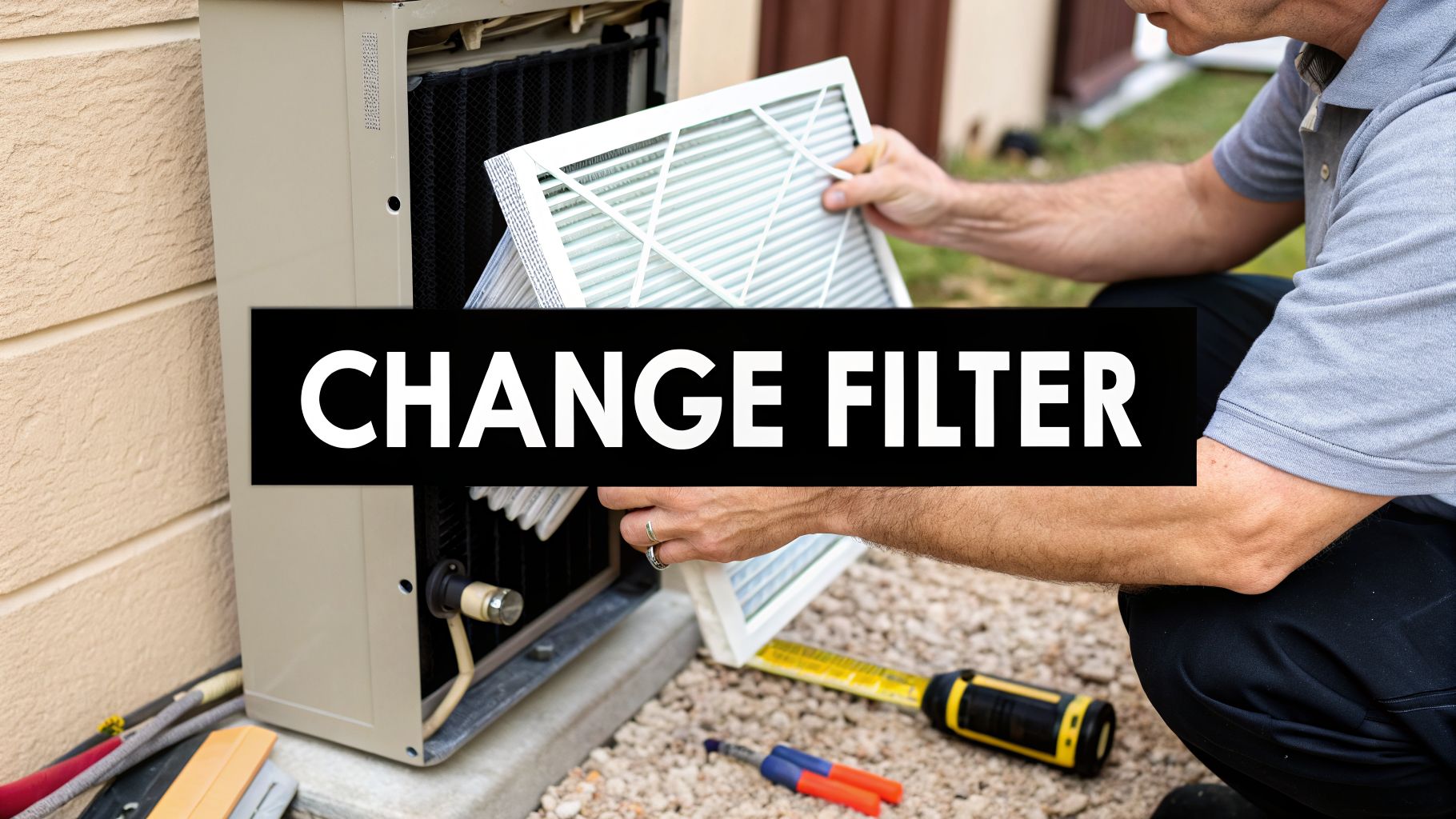
Slide the new filter into the slot. Make sure the airflow arrow on the new filter’s frame points toward the furnace or air handler and away from the return duct. A backward filter chokes the system and can even get sucked into the fan. Not good.
If you have a washable electrostatic filter, the process is a bit different:
- Gently rinse the filter with a garden hose on a low-pressure setting.
- If it’s really grimy, you can use a mild household detergent.
- Rinse it completely until the water runs clear.
- Let it dry completely before putting it back in. A damp filter is a perfect breeding ground for mold and mildew.
This quick guide can help you figure out which filter type makes the most sense for your home.

As you can see, it's a trade-off. Basic fiberglass protects your equipment, pleated filters do a better job with air quality, and electrostatic models are your reusable option.
Expert Tip: After you slide the new filter in and close everything up, grab that marker and write the date of the change right on the filter's cardboard frame. It completely eliminates any guesswork about when you last did it.
Last step: go back to the breaker panel and flip the power back on. Then you can turn your thermostat back to its normal setting. Your HVAC system is now breathing clean again.
Ignoring this simple task has real consequences. Dirty filters are a contributing cause in an estimated 30% of all HVAC failures. The growing awareness around this has turned filter changes into a $36.5 billion global market, and you can find out more about this routine maintenance market if you're curious about the industry trends.
Now that your filter is fresh, what happens if airflow problems or strange noises continue? Let’s tackle some of those common troubleshooting questions next.
When to Call a Professional for HVAC and Electrical Help
Changing your own HVAC filter is a great DIY skill, one every homeowner should have in their back pocket. You know what? It’s empowering to handle these small tasks yourself. But what happens when a clean filter doesn't actually solve the problem?
Knowing when to put the tools down and pick up the phone is just as important as the maintenance itself.
Let me explain. If you just slid in a brand-new filter and the air is still barely trickling out of your vents, something else is going on. Weak airflow can point to blocked ductwork, a failing blower motor, or even frozen evaporator coils. These aren't simple filter issues, and they need a professional eye to diagnose correctly.
Beyond the Filter Red Flags
Sometimes, the clues are things you hear, not see. Have you noticed strange noises coming from your system lately? Don’t just turn up the TV and ignore them.
- Grinding or Squealing: These sounds often mean the motor bearings are shot. If you let it go, the motor could seize up completely, turning a small repair into a very expensive replacement.
- Banging or Clanking: This is a bad one. It could be a loose or broken part, like a fan blade rattling around. It’s critical to shut the system down immediately to prevent it from tearing itself apart.
- Constant Clicking: A little clicking when the system starts or stops is normal. But if it’s persistent, you could be looking at a faulty control board or an electrical relay that’s about to give up.
These are the kinds of mechanical and electrical problems that go way beyond a simple filter swap. Ignoring them is just a recipe for a total system breakdown, usually on the hottest or coldest day of the year.
A struggling HVAC system can also put a serious strain on your home’s electrical panel. What feels like a furnace problem could really be a symptom of an underlying electrical issue that only a licensed electrician can safely track down and fix.
Electrical Issues in Disguise
One of the biggest red flags is electrical trouble. Does the breaker for your furnace or AC unit trip all the time? This is a clear warning that the system is pulling too much power. It might be a strained motor, bad wiring, or a problem with the circuit itself.
Here’s the thing: continuously resetting a breaker without fixing the root cause is a serious fire hazard.
As specialists in electrical solutions, we’ve seen it all. If you’ve gone through this guide and are still hitting a wall, or if you just have a gut feeling something more is wrong, it’s time to call in a professional. Getting to the bottom of these issues can be complex, and our guide on troubleshooting common electrical problems offers more insight into why some jobs are best left to the experts.
Common Questions About Changing HVAC Filters
Even a straightforward job like changing a filter can leave you with a few nagging questions. I get it. Our team hears the same ones all the time from homeowners right here in Northern Utah, so let's clear them up with some straight answers from the field.
How Often Should I Really Change My Filter?
There’s no single magic number, but here’s a solid rule of thumb. That cheap, 1-inch fiberglass filter? Change it every month. No exceptions. The higher-quality pleated filters can go up to 90 days, but that’s in a perfect world.
Let's be real—most homes aren't a perfect world. Got a dog or cat? Does anyone in the house battle allergies? If you said yes, check that filter monthly. When it looks dirty, it is dirty. Change it. For a deeper dive on timing, you can read more about how often to change furnace filter to keep your system from choking.
What if I Cannot Find the Right Filter Size?
This is a really common headache, especially in older homes or with custom systems. Don't just give up and try to cram the wrong size in there. First, do a deep dive online—specialty suppliers have a much wider inventory than the big-box stores.
You’ll even find some online sellers that will build a custom-sized filter to your exact specs. If you've searched everywhere and still come up empty, it's time to call an HVAC pro. We have access to commercial supply houses that stock those oddball sizes and can get you the right fit.
Why Is My New Filter Making a Whistling Noise?
That whistling sound is your HVAC system screaming for help. It’s a classic sign of an airflow problem, and it almost always comes down to two culprits.
- The Wrong Size: The filter is probably a hair too small for the slot, creating tiny gaps. Air getting sucked through those gaps at high speed is what makes the whistle. Make sure the filter fits snugly in its frame.
- Too High MERV Rating: You might have gone a little overboard on filtration. A filter with a super-high MERV rating is dense, and if your system's fan isn't powerful enough to pull air through it easily, you'll get that whistling noise as it struggles.
Here's the thing: if you hear whistling, your system is working way too hard. The easiest fix is to swap in a filter with a slightly lower MERV rating. That usually solves the noise and gets the air moving properly again.
For more answers to common home maintenance questions, feel free to check out our extensive FAQ page.
Does the Arrow on the Filter Really Matter?
Yes. 100% yes. That little arrow is not a suggestion. It shows the proper direction of airflow, and it must always point toward the furnace or air handler—the big metal box with all the machinery. It should point away from the return duct pulling air from your house.
Putting it in backward doesn’t just make the filter work poorly; it can cause the filter media to get sucked into the fan motor. That’s a fast track to a serious and expensive repair bill. It's a tiny detail with huge consequences, so always double-check the arrow before you slide the new one in.
If you've followed this guide on changing hvac filters and you're still stuck with weird noises, weak airflow, or breakers that keep tripping, the issue is probably bigger than just the filter. For expert electrical troubleshooting and a full HVAC system inspection in Northern Utah, trust the licensed professionals at Black Rhino Electric. Give our team a call at 385-396-7048 or request a free quote online to make sure your system is safe, reliable, and ready for the season.