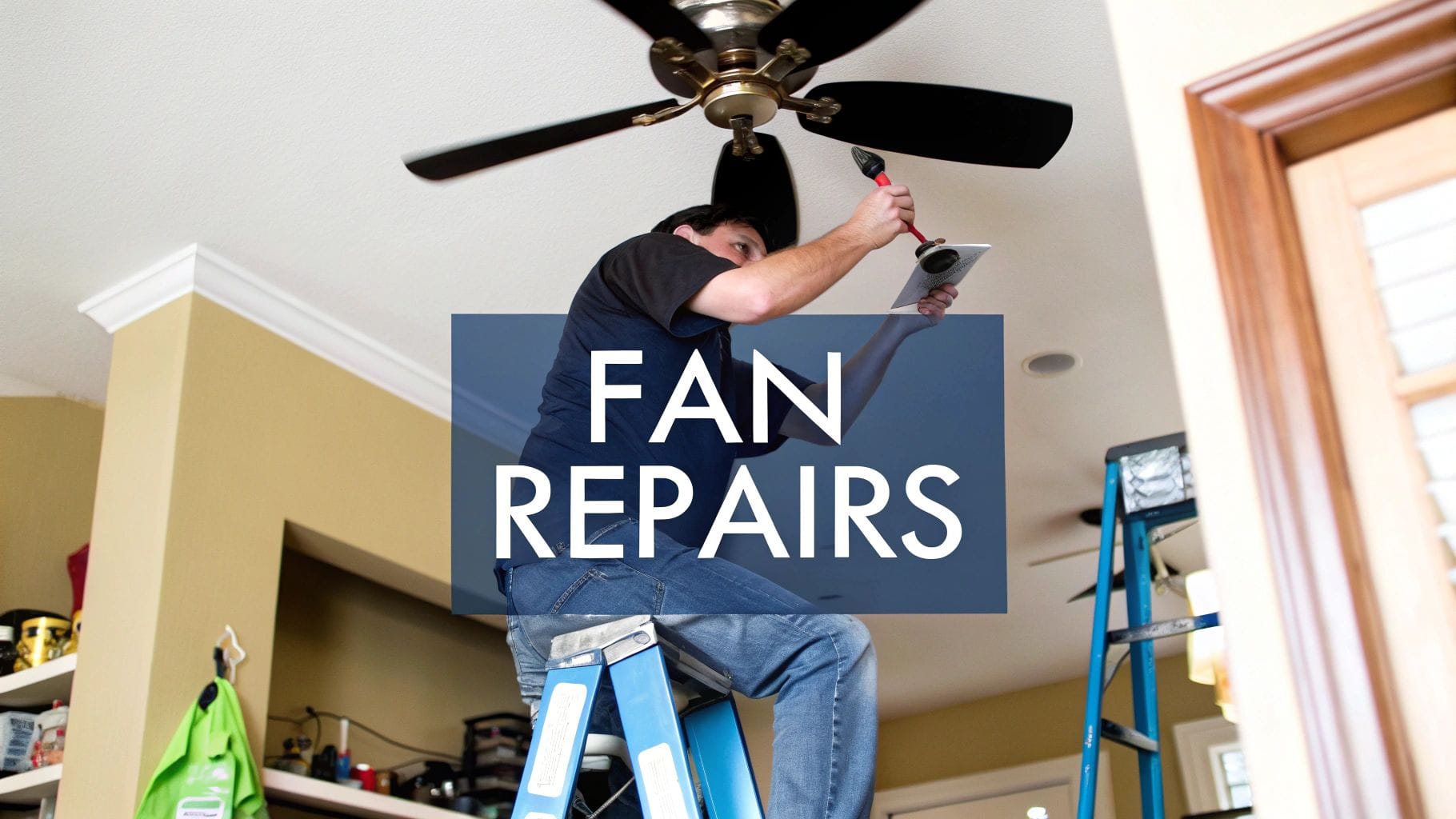
Is your ceiling fan making noises or wobbling precariously? Dealing with ceiling fan repairs can be frustrating, but many common issues are surprisingly straightforward to diagnose and fix. With the right guidance, you can determine whether it's a simple DIY task or a job for a professional.
Contents
Diagnosing Common Ceiling Fan Problems
Is your ceiling fan suddenly making strange noises or wobbling like it's about to take off? Before you can fix it, you have to figure out the root cause. A gentle hum turning into a rhythmic click, or a slight wobble becoming a violent shake—these are clear signs your fan needs attention.
You know what? A lot of homeowners in Northern Utah run into these exact issues. The good news is that finding the culprit is often just a process of elimination. The most frequent problems come from simple mechanical imbalances or loose parts that have worked their way free over hundreds of hours of spinning.
From Wobbles to Clicks: Uncovering the Cause
Let me explain what these symptoms usually mean. A wobbly fan is almost always an imbalance issue. This could be caused by a few things:
- Loose Blade Screws: The screws holding the fan blades to their brackets can loosen over time, causing an uneven spin. It's the most common culprit.
- Warped Blades: This is less common, but blades can warp from humidity or just plain age, throwing the fan's balance completely off.
- Improper Mounting: The mounting bracket connected to the ceiling's electrical box has to be rock-solid. Any give or play in that connection will translate directly into a wobble.
A clicking or grinding noise, on the other hand, often points to something happening inside the motor housing or with the fan's assembly. This could be a loose wire tapping the housing as it spins, a problem with an internal part, or even just some debris that found its way inside. For trickier electrical symptoms, you might find our guide on troubleshooting common electrical issues helpful.
This decision tree infographic really simplifies the diagnostic process, guiding you from the main symptom to its most likely cause.
As this visual guide shows, whether your fan is wobbling, clicking, or has no power at all, there's a logical path to figuring out the fix.
Listening for Clues: Motor and Electrical Issues
Sometimes the problem isn't mechanical—it's electrical. A distinct burning smell is a major red flag that you should never, ever ignore.
A burning odor is a clear sign to immediately turn off the fan at both the switch and the circuit breaker. This indicates overheating wires or a failing motor, which is a significant fire hazard.
Other electrical symptoms might include a fan that only works on certain speeds, which could point to a faulty capacitor or speed controller. If the fan is completely dead and you've already confirmed the circuit breaker is on, the issue might be with the wall switch, the remote receiver, or the internal wiring itself. Pinpointing these specific signs is the key to a safe and effective repair.
Safe DIY Fixes for Your Ceiling Fan
Alright, you think you’ve figured out what’s wrong and you’re ready to get your hands dirty. That's fantastic. The good news is that many common issues don't require calling in a professional for ceiling fan repairs. We'll walk through some real, practical fixes for the usual fan headaches, giving you the confidence to handle those small adjustments that often solve the entire problem.
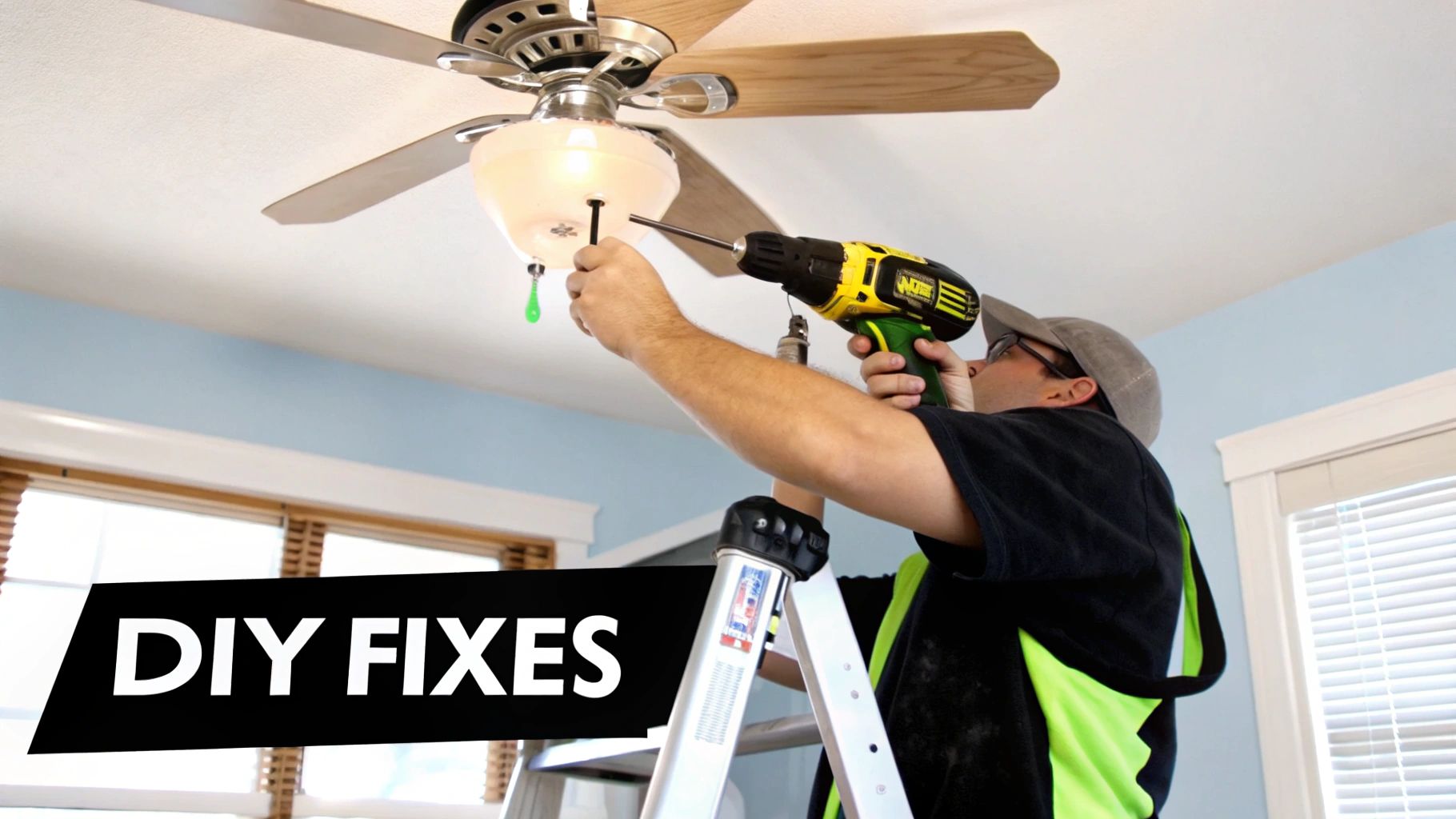
Before you do anything else, let’s talk about the single most important step: safety. Head over to your home's electrical panel and flip the breaker for that fan to the OFF position. This isn't a friendly suggestion—it’s the absolute rule. You have to kill the power to prevent any risk of electrical shock.
Tightening Screws to Stop Wobbling
Nine times out of ten, a wobbly fan is just a fan that’s a little loose. After thousands of spins, the constant vibration can work screws loose. It's a quick fix, and honestly, it solves the problem more often than not.
Here’s a simple checklist to run through:
- Blade Brackets: Start where the blades meet the metal. Tighten the screws connecting each blade to its bracket (sometimes called a blade iron).
- Bracket to Motor: Now, move inward. Tighten the screws that hold those blade brackets onto the fan’s motor housing.
- Downrod and Canopy: Finally, look up. Check the screws on the downrod and at the canopy cover where the fan meets the ceiling. Make sure it's all snug.
You want them firm, but don’t go crazy and overtighten, or you could strip a screw. This five-minute checkup handles the vast majority of wobbling fans I see.
Using a Balancing Kit for Smooth Operation
If tightening everything up didn't fix the wobble, you're likely dealing with unbalanced blades. This can happen if one blade is slightly heavier than the others or has warped a tiny bit over time. The perfect tool for this job is a simple ceiling fan balancing kit, which you can grab at any hardware store for a few bucks.
The kit is nothing fancy—just a plastic clip and a few small weights with sticky backs. The process is a bit of trial and error, but it's straightforward and incredibly effective for getting that fan spinning smoothly and silently again.
First, attach the plastic clip to the back edge of one blade, about halfway between the motor and the tip. Turn the fan on low and watch. Did the wobble get better or worse? Turn the fan off, move the clip to the next blade, and repeat. Keep going until you find the blade where the clip makes the biggest difference.
Once you’ve found the problem blade, you can slide the clip along its edge to find the "sweet spot" where the wobble almost disappears. When you've found it, peel the backing off one of the adhesive weights and stick it to the top of the blade, right in line with where the clip was. Pull the clip off, and your fan should be back in business.
Quick Fixes for Common Annoyances
Sometimes, the fix is even simpler than that. If the light on your fan suddenly stops working, it might not be a major wiring problem at all. You can explore some common lighting fixture problems that apply here, too. Another frequent flyer is a malfunctioning pull chain, which is often just a simple mechanical fix.
If the chain feels stuck or just isn't doing anything, the little switch inside has probably failed. After you've confirmed the power is off, you can usually take off the fan's light kit or switch housing to get to this small, inexpensive part and swap it out.
Common Ceiling Fan Issues and Potential DIY Fixes
This little guide can help you connect the dots between what your fan is doing and what you can safely do about it yourself.
| Symptom | Possible Cause | Safe DIY Solution |
|---|---|---|
| Clicking Noises | A loose screw in the motor housing or a wire nut tapping the canopy. | With power off, inspect and tighten all visible housing screws and check wire connections. |
| Lights Not Working | The light bulbs have burned out, or the pull-chain switch is faulty. | Replace the bulbs. If that fails, replace the pull-chain switch assembly. |
| Fan Won't Change Speeds | The pull-chain speed switch has failed. | This is just like the light switch; it’s a small, replaceable part inside the housing. |
These straightforward fixes can save you a service call. But let’s be clear: if you run into anything that feels more complicated than these basic adjustments, it’s always smarter and safer to stop what you're doing and call a professional.
When to Call a Professional Electrician
Knowing your limits is the single most important skill in any home repair, and that’s especially true when electricity is involved. Tightening a loose screw or balancing a wobbly blade is one thing. But some ceiling fan repairs cross a clear line into professional territory, and knowing those red flags is what keeps you—and your home’s wiring—safe.

Here’s the thing: a motor that hums but won’t turn, a fan that’s completely dead, or one stuck on a single speed—these often signal serious internal electrical faults. These aren't simple mechanical tweaks. They point to deeper issues that need a trained eye and the right tools.
Critical Warning Signs to Watch For
Some symptoms are non-negotiable. They are clear, stop-what-you're-doing signs to step back and call a licensed electrician immediately. Trying to fix these without proper training isn't just difficult; it's downright dangerous.
- A Distinct Burning Smell: This is the big one. If you smell something like burning plastic or ozone, it means wires are overheating or the motor is failing. That’s a significant fire hazard. Turn the fan off at the switch and the circuit breaker right away.
- Sparks or Arcing: Seeing sparks from the motor housing, switch, or ceiling canopy is a sign of a dangerous short circuit or a loose connection that could arc and start a fire.
- Persistent Circuit Breaker Trips: A fan that constantly trips its breaker is drawing way too much current. The cause could be a faulty motor, a short in the wiring, or an overloaded circuit that a pro needs to diagnose.
- Exposed or Damaged Wires: Frayed, cracked, or chewed-up wiring is a serious shock and fire risk. Don't touch it. It has to be addressed by a professional.
These warning signs go far beyond the scope of a simple DIY fix. Messing with them can lead to more damage or, worse, serious personal injury.
Electrical Issues Beyond Basic Fixes
Even without the obvious danger signs, some problems are just too complex for a weekend project. These usually involve the core electrical guts of the fan or the wiring hidden in your walls and ceiling.
Understanding the complexity of modern fans is key. The North America ceiling fan market was valued at USD 3.90 billion in 2024 and is projected to reach USD 5.55 billion by 2033, with advanced models becoming more common. Learn more about these ceiling fan market trends and their implications for repairs.
This growth means fans are only getting more intricate, making professional diagnostics more critical. That humming motor that won’t start? It could be a failed capacitor or a seized motor bearing. Both require an electrician to replace safely. If your fan is completely dead and it’s not the breaker, the problem could be the wall switch, the remote receiver, or the house wiring itself—all jobs for a pro.
When Safety and Certainty Matter Most
Ultimately, it all boils down to safety and expertise. If a repair requires you to work with your home's main wiring, diagnose a tricky electrical fault, or replace a major internal part like a motor, it's time for a professional. Electricians have the diagnostic tools, knowledge of electrical codes, and experience to perform these ceiling fan repairs safely and correctly the first time.
Don't risk it. If you’re in Northern Utah and facing a ceiling fan problem that feels over your head, Black Rhino Electric is here to help. For safe, reliable service, our licensed electricians are ready to provide expert assistance.
What Do Ceiling Fan Repairs Cost in Northern Utah?
So, you’ve decided to call in a pro. Smart move. The next thought is always, "Okay, but what's this going to run me?" Getting a handle on potential costs for ceiling fan repairs helps you budget and keeps surprises off the table. Let me walk you through what shapes the final price, so you can make a good call for your home here in Northern Utah.
There’s no single flat rate for this kind of work. The final cost is a mix of labor, the parts needed, and how tricky the job is. A simple fix, like swapping out a broken pull-chain switch, is going to be worlds apart from a full motor replacement or sorting out some complex internal wiring.
The fan's location is a huge factor, too. Is it hanging from a standard eight-foot ceiling? Or is it perched way up on a twenty-foot vaulted ceiling that demands special ladders, extra safety gear, and more time? That accessibility piece can really change the numbers.
Common Repair Cost Estimates
To give you a clearer picture, here are some ballpark figures for common repairs. Just remember, these are estimates from Black Rhino Electric, and your specific situation will determine the final invoice.
| Repair Type | Estimated Cost Range (Labor & Parts) | What's Actually Involved |
|---|---|---|
| Replace Wall Switch | $100 – $200 | A pretty straightforward job. We remove the old switch and wire in a new one. |
| Replace Remote Receiver | $150 – $250 | This involves getting into the fan's canopy at the ceiling to swap out the bad electronic receiver. |
| Motor Replacement | $200 – $400+ | A much more involved repair that means taking the fan apart to replace its core component. |
| Complex Rewiring | $250 – $500+ | This is for bigger issues inside the fan's wiring or with its connection to your home's electrical system. |
More and more, homeowners are choosing to fix what they have instead of buying new. The global market for ceiling fan repair services was valued at around $2.1 billion in 2023 and is expected to hit nearly $3.8 billion by 2032. That tells you something: people are seeing the value in professional repair as a smart, cost-effective choice. You can learn more about the growth of the fan repair market and why it makes sense.
What Shapes the Final Price
Beyond the specific part that failed, a few other things can move the needle on the total cost.
- Labor Rates: A licensed electrician’s hourly rate is a primary driver. That rate isn't just for their time; it covers their expertise, insurance, and the specialized tools they bring to the job.
- Trip or Service Call Fee: Many companies have a base fee for coming out to your home, which usually covers the time and fuel to get there, plus the initial diagnosis.
- Fan Accessibility: Like I mentioned, high or angled ceilings are a different ballgame. They take more time, more equipment, and sometimes a second technician for safety, all of which adds to the labor cost.
When you hire a licensed and insured electrician from a reputable company like Black Rhino Electric, you're not just paying for a repair. You're investing in safety, code-compliant work, and the peace of mind that comes from knowing the job was done right the first time.
If you’re staring up at a stubborn fan and need a clear, upfront estimate for professional ceiling fan repairs, Black Rhino Electric is here to help. We are committed to providing reliable service across Northern Utah.
Proactive Maintenance to Prevent Future Repairs
The best way to deal with ceiling fan repairs is to avoid them altogether. A little proactive care goes a long way. Just a few simple maintenance habits can dramatically extend the life of your fans, keeping them running smoothly and quietly for years.
Think of it as a quick check-up for one of the hardest-working appliances in your Northern Utah home. These small, seasonal tasks help you catch minor issues before they have a chance to turn into bigger, more expensive problems.
Your Seasonal Upkeep Checklist
Running through this simple routine twice a year—once before summer and once before winter—can make all the difference. It’s quick, easy, and you won’t need any special tools.
- Clean the Blades Thoroughly: Dust might seem harmless, but it adds weight to the fan blades. Over time, that buildup creates an imbalance that leads to wobbling and puts unnecessary strain on the motor.
- Tighten All Visible Screws: Vibration is a fan's worst enemy. Gently tighten the screws holding the blades to their brackets, and don't forget to check the canopy and downrod connections at the ceiling to make sure everything is snug.
- Lubricate the Motor (If Applicable): Older fans sometimes have a small oil reservoir that needs a few drops of specialized fan motor oil once a year. Most modern fans have sealed bearings and don’t require this, so check your owner's manual first.
This kind of upkeep is becoming more important every year. The global ceiling fans market is projected to hit USD 19,924.4 million by 2030, which means millions of new, often more complex, fans are being installed. Regular maintenance is key to managing this growing base of units and avoiding premature failure. You can learn more about the growing global ceiling fan market and its trends.
Reversing Your Fan for Seasonal Efficiency
Did you know your fan has a directional switch? It's a small feature, but it’s designed to improve your home's energy efficiency year-round. Using it correctly helps reduce strain on your HVAC system.
In the summer, your fan should spin counter-clockwise. This pushes air straight down, creating a cool downdraft that lets you raise your thermostat a few degrees. In the winter, switch the fan to spin clockwise. This pulls cool air up, displacing the warm air trapped at the ceiling and pushing it down along the walls where you can feel it.
This simple switch helps your fan work with your heating and cooling systems, not against them. A fan that runs efficiently is a fan that lasts longer.
If you follow these proactive steps and still run into trouble, don't hesitate to get professional help with your ceiling fan repairs. We provide expert service in Northern Utah for any issues that arise.
Need a Pro for Your Ceiling Fan Repair?
Look, sometimes a DIY fix just doesn't cut it. When you've checked all the boxes and your ceiling fan still wobbles, hums, or just plain refuses to work, you need a local expert you can trust to get the job done right.
At Black Rhino Electric, we've built our reputation on safe, reliable, and straightforward ceiling fan repairs for homeowners all over Weber, Davis, and Salt Lake counties. You should never have to second-guess the electrical work in your home.
Our licensed electricians have seen it all—from tricky wiring problems in older homes to total motor replacements in newer models. We operate on a safety-first basis and believe in clear communication, so you’ll always understand the issue and the solution before we even pick up a tool.
Our Promise to Northern Utah Homeowners
What does it really mean to be a trusted local electrician? It means we show up on time, treat your home with respect, and provide fixes that actually last. It's about more than just repairing a fan; it's about giving you peace of mind.
Here’s what you can expect when you call Black Rhino Electric:
- Licensed and Insured Professionals: Our entire team is fully licensed and insured. Your property is in safe hands, period.
- Transparent, Upfront Pricing: We give you a clear, detailed estimate before starting any work. No surprises on the final bill.
- Guaranteed Workmanship: We stand behind our work, making sure every repair meets the highest safety and performance standards.
- Local Expertise: We know the homes in Northern Utah—from historic bungalows to modern builds—and understand their specific electrical needs.
Why Some Repairs Are Not Worth the Risk
Some jobs just aren't meant for a Saturday afternoon DIY session. A professional electrician brings more than just the right tools; they bring a deep understanding of electrical codes and safety protocols that keep your home safe.
Trying to tackle complex wiring or a motor replacement without that knowledge can easily lead to bigger, more dangerous problems, including fire hazards or damage to your home’s entire electrical system.
Choosing a professional isn't just about fixing the fan. It's an investment in your home's long-term safety and your family's well-being. It ensures every connection is secure and every component works exactly as it should.
We handle the tough stuff so you don't have to. Whether it's diagnosing that maddening hum or tracing a complicated wiring fault, our team has the experience to sort it out safely and efficiently. If you want to see how we approach these jobs, you can find more details when you request a quote from our team.
If you're dealing with a ceiling fan problem that’s beyond a simple fix, don't risk it. For professional service and peace of mind, contact Black Rhino Electric by calling 385-396-7048 or you can request a free quote online today.